










• TRUSTED RESEARCH

    TRUSTED RESEARCH | STRATEGIC INSIGHT

    SMB. CORE MIDMARKET. UPPER MIDMARKET. ECOSYSTEM
    LEARN MORE
  • INTERWORK 2.0: THE AGENTIC FUTURE OF CONNECTED BUSINESS

    INTERWORK 2.0: THE AGENTIC FUTURE OF CONNECTED BUSINESS

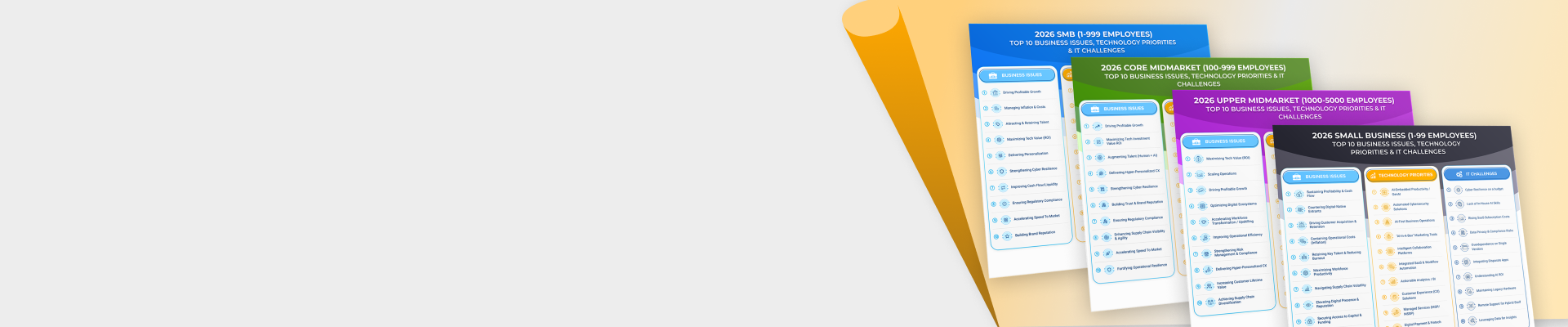
  • 2026 TOP 10 SMB BUSINESS ISSUES, IT PRIORITIES, IT CHALLENGES

    2026 TOP 10 SMB BUSINESS ISSUES, IT PRIORITIES, IT CHALLENGES

  • 2026 TOP 10 SMB PREDICTIONS

    2026 TOP 10 SMB PREDICTIONS

    SMB & Midmarket: Autonomous Business
    READ
  • 2026 TOP 10 PARTNER PREDICTIONS

    2026 TOP 10 PARTNER PREDICTIONS

    Partner & Ecosystem: Next Horizon
    READ
  • ARTIFICIAL INTELLIGENCE

    ARTIFICIAL INTELLIGENCE

    SMB & Midmarket Analytics & Artificial Intelligence Adoption
    LEARN MORE
  • IT SECURITY TRENDS

    IT SECURITY TRENDS

    SMB & Midmarket Security Adoption Trends
    LATEST RESEARCH
  • BUYERS JOURNEY

    BUYERS JOURNEY

    Technology Buyer Persona Research
    LEARN MORE
  • PARTNER ECOSYSTEM

    PARTNER ECOSYSTEM

    Global Channel Partner Trends
    LATEST RESEARCH
  • CLOUD ADOPTION TRENDS

    CLOUD ADOPTION TRENDS

    SMB & Midmarket Cloud Adoption
    LATEST RESEARCH
  • FUTURE OF PARTNER ECOSYSTEM

    FUTURE OF PARTNER ECOSYSTEM

    Networked, Engaged, Extended, Hybrid
    DOWNLOAD NOW
  • MANAGED SERVICES RESEARCH

    MANAGED SERVICES RESEARCH

    SMB & Midmarket Managed Services Adoption
    LEARN MORE

Techaisle Analyst Insights

Trusted research and strategic insight decoding SMBs, the Midmarket, and the Partner Ecosystem.
Anurag Agrawal

Are Tablets Really Replacing PCs within SMBs?

In 2012, a total of 47.2 million households and 1.9 million SMBs purchased a PC for the first time (Techaisle estimates), increasing global PC penetration by 2% in both the consumer and small business segments as an average of 5,200 small businesses and 130,000 households per day purchased a PC for the first time.

According to IDC, a total of 350 million PCs (desktops + notebooks) were shipped worldwide in 2012. Assuming that each first-time buyer in both the consumer and small business segments bought one PC, a total of 49.2 million PCs were first-time purchases. Therefore, the remaining 300 million PCs purchased in 2012 were either for increasing density or for replacements.

There are three elements that contribute to PC shipments. These are:

    1. Increasing Penetration: businesses or households that purchase and use PCs for the first time


    1. Increasing Density: purchase and use of PCs for either additional members of a household or employees within a business


    1. Replacements: replacing older PCs with new PCs


Increasing Penetration

PC market penetration will continue to be driven by emerging market countries. There are 1.26 billion addressable households in emerging markets but only one in four have a PC. Similarly, there are 44.7 million SMBs in emerging markets, but only two in five have a PC. Both of these figures indicate a huge opportunity for new PC sales as there are still 26.4 million SMBs and 994 million households that
have yet to buy a PC – a huge gap indeed!.

techaisle-established-markets techaisle-emerging-markets


It is true that many of these households and small businesses may choose to purchase a tablet first rather than a PC if the planned usage is focused on consuming content through activities such as emailing, browsing, playing games, following news and watching videos. However, it is also true that PCs will
remain an important part of the device market. A tablet’s weight, portability and convenience cannot be ignored, but Techaisle believes that the tablet market may reach the same set of conundrums – lengthening replacement cycles and fully saturated addressable density – that are affecting the PC market today, causing tablet sales to skid. Since 1982 when the first PC was introduced, a combined one billion households and small businesses have yet to purchase a PC. It is hard to say that tablets will fill that void, especially when the market gets flooded with too many configuration choices and a profusion of different brands with unique value propositions; for a majority of buyers, the tablet purchase decision process will become as difficult as for PCs.

Increasing Density

Increasing density is certainly a problem area within mature markets as the household PC density is more than 1 in most countries. However, in emerging markets the household PC density varies from 0.5 to 0.9 devices per person depending upon the country. Similarly, in the case of small businesses the density is also almost 1.0 in mature market countries and varies from 0.4 to 0.7 in emerging market countries. There is therefore potential for PC vendors to increase density in emerging market countries both within households and small businesses. But here again, we may find that tablets become a device of choice thus impeding density increase. However, these conditions will also hold true for tablets in the next 3-4 years when the number of tablets within a household and a small business will reach a density saturation point beyond which no new tablets will be purchased for additional employees or household members.

Replacements

This is where the most brouhaha is currently. PC replacement cycles are getting extended and users – both corporate and consumers – are buying tablets. Notwithstanding the tepid acceptance of Windows 8, the PC buying process has become a daunting task even for the most technological savvy individual. PCs are variously categorized as Ultrabooks, ultra-thins, light and thin, long battery life, anti-glare screen, Premium HD screen, SSD, HDD, All-in-ones – it makes one’s brain dizzy. So the consumer ends up either pushing back the decision or continues to shop for a suitable configuration at an affordable price. “A PC in hand is worth two in a bush” begins to hold true. The consumer may then default to a tablet, which is still a novelty device. But the question remains, at least, within the context of small businesses – are the tablets they are purchasing really replacing PCs? Let us look at Techaisle survey data below based on total sample size of 9,500 SMBs.

smb-replace-pcs-with-tablets smb-replace-pcs-with-tablets-2


Above data (will not add to 100 percent due to multiple responses) clearly suggests that while there are some incidences of replacements, consistently over 60 percent of SMBs either currently use tablets or plan to use tablets as additions to PCs. However, it is interesting to note that the density of tablets in many small businesses is not always 1.0. For example, a small retail store may have 4 employees but uses 6 tablets and 2 PCs. These tablets are used for point-of-sale, display advertising or self-serve terminals. So in effect tablets are doing the work of PCs with more convenience and a smaller foot-print. It is debatable whether retailers would have used PCs for these tasks in the absence of tablets.

This brings us back to the point that we started with. If 300 million PCs were purchased for either replacements or density increase, are tablets then really replacing PCs, or is the PC market itself getting saturated, with fewer compelling reasons to purchase additions or replacements? Are the PC vendors sufficiently targeting the first time buyers, as this group would have the highest potential for increasing penetration and driving increasing density? IDC also said that a total of 128 million Tablets were shipped in 2012. Approximately 32 million Tablets were purchased by SMBs assuming that SMB share was 25 percent. The two charts above when combined with IDC data gives a rough number of 5 million tablets displacing PC sales. The data for SMBs demonstrates that tablets are not replacing PCs, but are being used in addition to PCs.

Techaisle’s bottom line: PC vendors should therefore market PCs to new users and current users with two very distinct messaging to open up the market.


Anurag Agrawal

Converged Mobility: 2-in-1 PCs in the SMB segment

Techaisle’s SMB research on Tablets, PCs and Smartphones usage has found that 28 percent of SMBs are aware of 2-in-1 PCs, and 15 percent are considering purchase in the next one year.  Marketers have done a generally good job of building awareness which is highest at 73 percent within the 500-999 employee size businesses in the US. However, marketers have not succeeded in creating consideration to purchase from awareness within mid-market segments.

Globally there are 265 million mobile SMB employees who are telecommuting, traveling and/or using cloud-based services.  The potential market is therefore massive. However, most SMB employees are already two-device users and are on their way to becoming a three-device user as they gain power of device choice, bringing personal experiences to work and vice-versa. The odds of a tablet and notebook both needing to be refreshed at the same time is low, and therefore it may be difficult to position a 2-in-1 PC as a replacement for either device. Nevertheless there are seven different potential market opportunity segments and each of these seven opportunity areas has scenarios in which 2-in-1 PCs might gain share – but each has its challenges.

The SMB survey data also indicates that general-purpose devices are losing ground to task-specific devices, a trend that would negatively impact middle-ground opportunity. Further, 2-in-1 PCs will likely be at a price disadvantage to Android PCs, which will begin targeting this same niche. PC OEMs will need to position the benefits of both the 2-in-1 PCs and their unique approach to these devices, while attempting to avoid the confusion that has hampered progress in the SMB market to date.

When we sift through the data on different perspectives on 2-in-1 PCs’ positives and negatives, we see that there are some core strengths to build upon, but that some design changes will be needed before these products can make a serious run at the endpoint device (PCs, Tablets, Smartphones) market’s middle ground. The moving parts needed to enable a 2-in-1 are also viewed as a drawback/potential point of failure for these products. And the overall diversity of approaches to enabling 2-in-1 functionality – ranging from detachable displays to Ferris wheel, flip/fold, swivel/twist and slider-based approaches – has confused the market. Too many options in the marketplace provide choice but also cause purchase inertia. This is a high-stakes issue for 2-in-1 PC OEMs and those with successful designs stand a much better chance of growing with the market than those whose designs are marginalized.

The aggregate opportunity for 2-in-1 PCs is compelling but there is no aggregate marketing strategy that will capture this opportunity. PC OEM marketers will need to align with the market opportunity segment that they can best develop, and ensure that their message and activity content is consistent with the conditions that govern the target area.

techaisle-tablet-pc-smartphone-continuum-blog

The 2-in-1 market is an attempt to fill a ‘middle ground’ that has been created by the trend towards multi-screen endpoint device strategies. Techaisle’s research shows a usage continuum of endpoints. On one side, there are desktop devices capable of creating content. At the other end of the spectrum, there are smartphones that lack the tools needed for content creation, but provide a lightweight, mobile option for content consumption. On this continuum, tablets are also primarily consumption devices, but can be used for light content creation, while laptops are capable of creating content, and can be used as a mobile consumption port. 2-in-1 devices are targeting the space between tablets and laptops. They are attempting to provide better creation options than are found with tablets, while offering a form factor better suited to consumption than is found with traditional laptop.

Techaisle believes that the key to 2-in-1 PC success within the SMB market will be the ability to articulate the benefits of the “middle ground” – the combination of consumption and creation that 2-in-1 PCs can address better than either tablets or traditional laptops.

More detailed data is available in Techaisle’s report titled “SMB End-Point Device Adoption Trends: Tablets, PCs, Smartphones” which covers:

  • Current and Planned purchase Intentions of client devices: Tablets, PCs, Smartphones
  • Current and Planned Tablet OS & Application adoption trends
  • BYOD trends within SMBs
  • XP, Windows 8 refresh intentions
  • New OS PCs: Chromebook, Android adoption trends
  • Converged Mobility PCs trends: 2-in-1 PCs
  • Purchase Channel and Sources of Information
Davis Blair

Meet the New Boss: Big Data (WSJ) – Techaisle Take

Wall Street Journal Article

This is an interesting article from the WSJ concerning how we are slowly allowing decision-making processes to move away from people and be handled by algorithms instead. It caught our attention at a time when we are completing survey work for Business Intelligence report. As discussed in an earlier post, one of the key trends in BI is how deeply it is being embedded into all kinds of applications , and this article is a good example. Please let us know what you think: comment, like, tweet or forward.

Laying the Foundation


mobility - Techaisle - Global SMB, Midmarket and Channel Partner Analyst Firm - Techaisle Analyst Insights Man_And_An_Old_Mainframe-e1348376410194 Analytic software has evolved through several generations over the last 70 years from around WWII, when a series of unprecedented number-crunching challenges gave rise to Decision Support Systems (DSS) designed to solve problems such as best equipment production mix given material constraints, how to logistically support the Allied invasion of Europe, split the atom, or break the Japanese code. These kinds of problems tended to be monolithic, using stochastic models to find the best answer – and were a major catalyst to development of the mainframe computer.

Business Intelligence (BI) followed this linear and iterative approach with one that supported solving business problems, mostly operational, within divisions and departments of large commercial organizations, using more distributed equipment within a wider audience, i.e., Finance, Operations and Distribution. In the late 1990s there was an explosion of data resulting from widespread adoption of CRM, the killer app of the Client/Server era, adding mountains of Sales and Marketing Data to the volumes of operational information. There was a growing need to get a top down view of how performance in one area of the organization was impacting the others, to begin taking a more structured approach at understanding cause and effect, setting objectives and consistently measuring performance to improve results. BI was evolving into Enterprise Performance Management (EPM) - which is where market leaders are today.

EPM is characterized by using Business Intelligence software to understand the best performance scenarios, measure actual performance indicators (KPIs) and determine how to close the gaps, using exception reporting for most front office functions (CRM/SFA) and rules-based processing for the back office (Process Manufacturing/Real Time Bidding, SCM/Advanced Web Analytics).

Optimization Nation


Equally important as the individual BI technology advances are some of the underlying rules that have accompanied the evolution: Moore’s Law, Metcalfe’s Law, the Law of Accelerating Returns all drove exponential growth in production, adoption and utility. Over a 20 year period, these have resulted in a slow-motion Black Swan event based on the cumulative effect of technology investments, and having huge impacts on our society, including but not limited to the following optimization activities:

Law of DisruptionEconomy – development of consumer mortgage products designed to optimize sales volume regardless of risk, bundling them into bonds to optimize profit on the debt, creation of derivatives to optimize transactions and create demand for increasingly suspect debt, development of new financial instruments that have no underlying value such as  synthetic derivatives that truly have nothing but conceptual paper profits behind them, etc. By 2008 these financial instruments had optimized leverage to create risk greater than the combined GDP of industrialized world.

Employment – The WSJ article goes into depth about how algorithms have already replaced a hiring manager's decisions based on probabilities of how the employee might behave under certain circumstances. Employer choices have also been optimized by a flattening of the market caused by oceans of virtually unlimited supply from sites like Monster.com, 100K Jobs, Dice, etc. Middle management has been optimized out of the organizational chart and replaced with productivity tools, more efficient communications and a lower ratio of managers to workers. And the actual number of staff required to hit the bottom line has been optimized while CEO salaries have been optimized. If we look a little further down the line, Andrew McAfee's POV is deep on this subject, and more technical than mine.

Industry – We all know that manufacturing was moved offshore en masse over the past three decades to optimize production costs, but several other industry segments have been optimized as well, including Retail which has optimized through consolidation and healthcare which has optimized revenue per patient. Retail has been optimized at a structural level, to provide one-stop shopping for almost everything you need in a single location while volume has been optimized to produce the absolute lowest price and any cost, including optimizing the number of worker hours to keep an optimal ratio of full time to part time employees and save the resulting benefit costs. And it has also optimized the number and variety of retail outlets and small businesses required to service an optimized population in square miles. Healthcare prices have been optimized to take advantage of tax structure, potential law suits, healthcare insurance gaps, maximizing federal matching funds, Board and C-Suite compensation, pharma industry profits, and many more.

Government – Automation has also enabled a profitable business model that optimizes the use of Federal Government funds and ensures that every available dollar is spent, whether it is to make sure everybody gets a state-of-the-art mobile wheelchair, their 120 monthly catheters, a speaking glucose meter, maximum disability benefits, etc.  “Don’t worry - we’ll handle all the paperwork.”

Set it and Forget it


Complex SystemsThe imminent next generation of analytics involves truly “optimized” complex systems with human intervention largely removed from the process. Not to single out Wall Street, but they offer one of the best examples of unbridled application of technology in the singular pursuit of optimization, in their case, profit for themselves and their shareholders. The Financial Services industry has invested billions into technology and employed thousands of physicists and Ph.D.-level mathematicians to achieve a couple-millisecond transaction advantage, and programmed algorithms to use the advantage and change the rules (i.e., share price represents perfect information is no longer true). This has not proved to always produce predictable results, and the ghost in the machine has put us back on the precipice more than once, as seen in this TED video by Kevin Slavin. As we move into a brave new world that combines optimization software with networks that operate too fast for human intervention, more of our lives will be controlled by how rules are programmed into the system than what we do as individuals to impact the results. One of the best examples of where this is heading is the IBM’s Smarter Cities Initiative, which combines intelligent networks that manage Traffic, Water and Electric Utilities, Transportation, Healthcare, Public Safety, Education and others into an overall “Intelligent City”. Everyone hates traffic, so the video example from the IBM innovation site does more to explain this than I can by writing more on the subject.

Whether you agree with it or not, we are on a direct course to this future that is almost impossible to divert. This is a philosophical question and everyone will have their own opinion about the cost/benefit of chasing optimization. Comments and Opinions are welcome, please let us know what you think.

Anurag Agrawal

Techaisle survey data shows BYOD is a major force in the US SMB Market

techaisle-smb-byod-trend-end-point-device-adoption

To set the context for a BYOD discussion Techaisle’s survey on end-point technology status of SMBs provide an intriguing set of statistics through which we can assess recent endpoint trends. BYOD is clearly a major force in the US SMB market. BYOD purchases accounted for 13% of all new laptops, 17% of all new tablets, and 22% of all new smartphones purchased by US SMBs in 2013. This creates challenges for both IT management, which needs to establish methods of managing these devices, and for suppliers, who need to work with SMBIT to secure their position in the main endpoint categories, and also appeal to business managers and individual buyers to ensure that they are not left out of a major portion of the market. Techaisle’s SMB End-point survey data shows that approaches to BYOD –brand selection, reimbursement, application download and support – vary with employee size, with small SMBs leaving most of the decision, cost and support to individual users, and larger SMBs tending to involve business and/or IT management in these activities.

The survey data also shows that overall frequency of device purchases, which speaks to the erosion of the notebook market as emphasis shifts to alternative screens; in 2013, a higher percentage of US SMB employees were using tablets and smartphones than notebooks purchased within the year.

Suppliers need to recognize the distinctions that are apparent across employee size categories, and structure their offerings accordingly. IT vendors courting the very small business (1-19 employee) segment should recognize that employees are most likely paying for and supporting these devise themselves; as a result, IT vendors will need to offer financing and vendor/carrier-supplied, business-grade support options. In larger SMBs, specifically, mid-market businesses, funding and support is more likely to come from business and IT management; in these segments, OEMs are advised to establish programs that make it easy to onboard, secure and support new devices and users. In both cases, there are gaps in policies; suppliers who help businesses to establish and implement effective BYOD practices may be able to position their products favorably as a result.

SMB employees driving much of the activity is also creating sales and marketing challenge for suppliers: opportunities to sell brands and configurations that are outside corporate specifications, and challenges in aligning channel strategies to a market that includes both IT and individual employees (business management) as important buying groups.

Within the SMB context, BYOD itself comes in several ‘flavors.’ Techaisle survey data shows that on hand an SMB employee both selects and pays for a new device, delighting the CFO, but causing problems for IT. On the other, the SMB employee pays for the device, but selects it based on guidelines or an approved list – an approach (referred to in some cases as CYOD) that appeals to both the CFO and IT, but might not be completely satisfactory for the employee. BYOD can take any one of these paths and add some level of reimbursement for the purchase from the company and/or technical support for the devices, which has both upside (because the employee selects technology that he/she is comfortable with) and downside (the cost burden rests, at least to some extent, with the company rather than the employee) for the SMB business owner. And regardless of the approach chosen, some SMBs are instituting formal contracts that provide them with authorization to secure and (if necessary) ‘wipe’ employee-owned devices.

Who selects the BYOD brand?


The most critical BYOD question for IT manufacturers revolves around brand selection: is it done by the employee or the employer? Survey data shows that the answer depends largely on the size of the SMB business.

Who pays the BYOD bill?


One of the contentious issues in BYOD is the matter of responsibility for funding the device purchase. Many employees view BYOD as an attempt by their SMB employers to shift costs from the business to its staff. Many SMBs, on the other hand, see BYOD as a means of ensuring that employees have access to the technology that they like best. Some employers view paying for the devices as a means of building goodwill with staff (and/or as a means of building a basis for exerting management control over the devices), while others believe that simply allowing the devices to be connected to corporate assets represents contribution enough.

Who is responsible for BYOD support?


In our survey, we asked respondents to identify the ways in which their organizations support BYOD devices. The findings provide a fascinating insight into the ways in which BYOD devices are integrated into the corporate endpoint portfolio from no support at all to commitment to full integration of BYOD devices.

What is the policy with respect to app downloads on BYOD devices?


One of the key employee benefits associated with BYOD devices is that employees have a platform on which to run personal applications. What, though, is the implication for business applications? Are employees free to select any app that they choose, or should the business play a role in directing or determining the selection of business apps? Results from the survey suggest that the degree of formalization associated with app selection and installation varies from no formal policy to a very structured approach.

Is there a contract in place to govern BYOD use?


The final BYOD issue investigated by our survey related to the creation of contracts between employers and employees. Techaisle considers these contracts to be important to the success of BYOD strategies, as they provide explicit employee agreement to IT activities necessary to safeguarding corporate apps and data and we expect that this will become standard HR practice in BYOD-friendly SMBs over time.

About the Report

Coverage:

  • Current and Planned purchase Intentions of client devices

  • Tablet OS & Application software adoption – Behind the Screen

  • BYOD: Employers vs. Employees, or Micros vs. Larger SMBs?

  • Across the OS generations: XP, Windows 8 refresh intentions

  • The Android Opportunity: Google in the PC Market

  • Converged Mobility PCs: 2-in-1 PCs

  • PC Purchase Channel and Sources of Information


More details about the report can be found here.

Related Research Articles

Seven Key Trends and their Meaning: SMB Endpoint Device Market in 2014

SMB Purchase Intentions for Android PCs

Key Attributes of Successful SMB Mobility Solutions

Trusted Research | Strategic Insight

Techaisle - TA