• TRUSTED RESEARCH

    TRUSTED RESEARCH | STRATEGIC INSIGHT

    SMB. CORE MIDMARKET. UPPER MIDMARKET. ECOSYSTEM
    LEARN MORE
  • INTERWORK 2.0: THE AGENTIC FUTURE OF CONNECTED BUSINESS

    INTERWORK 2.0: THE AGENTIC FUTURE OF CONNECTED BUSINESS

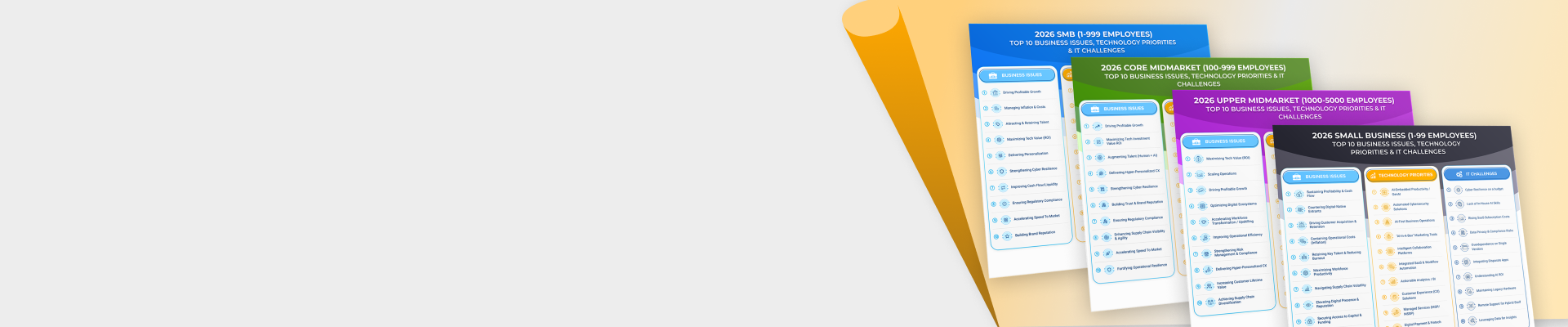
  • 2026 TOP 10 SMB BUSINESS ISSUES, IT PRIORITIES, IT CHALLENGES

    2026 TOP 10 SMB BUSINESS ISSUES, IT PRIORITIES, IT CHALLENGES

  • 2026 TOP 10 SMB PREDICTIONS

    2026 TOP 10 SMB PREDICTIONS

    SMB & Midmarket: Autonomous Business
    READ
  • 2026 TOP 10 PARTNER PREDICTIONS

    2026 TOP 10 PARTNER PREDICTIONS

    Partner & Ecosystem: Next Horizon
    READ
  • ARTIFICIAL INTELLIGENCE

    ARTIFICIAL INTELLIGENCE

    SMB & Midmarket Analytics & Artificial Intelligence Adoption
    LEARN MORE
  • IT SECURITY TRENDS

    IT SECURITY TRENDS

    SMB & Midmarket Security Adoption Trends
    LATEST RESEARCH
  • BUYERS JOURNEY

    BUYERS JOURNEY

    Technology Buyer Persona Research
    LEARN MORE
  • PARTNER ECOSYSTEM

    PARTNER ECOSYSTEM

    Global Channel Partner Trends
    LATEST RESEARCH
  • CLOUD ADOPTION TRENDS

    CLOUD ADOPTION TRENDS

    SMB & Midmarket Cloud Adoption
    LATEST RESEARCH
  • FUTURE OF PARTNER ECOSYSTEM

    FUTURE OF PARTNER ECOSYSTEM

    Networked, Engaged, Extended, Hybrid
    DOWNLOAD NOW
  • MANAGED SERVICES RESEARCH

    MANAGED SERVICES RESEARCH

    SMB & Midmarket Managed Services Adoption
    LEARN MORE

Techaisle Analyst Insights

Trusted research and strategic insight decoding SMBs, the Midmarket, and the Partner Ecosystem.
Tavishi Agrawal

SMBs would like to have Android Apps on Ultrabooks

A Techaisle survey of 810 SMBs in the US shows that SMBs would ideally like to see Android applications running on Ultrabooks. Nearly 60% of SMBs that use smartphones have Android based smartphones. On an average, a small business has three Android based smartphones and a mid-market business has 26 Android based smartphones. These SMBs have become used to Android apps and would desire to have the same type of capability within Ultrabook.

PC - Techaisle - Global SMB, Midmarket and Channel Partner Analyst Firm - Techaisle Analyst Insights SB-Android-Apps1  PC - Techaisle - Global SMB, Midmarket and Channel Partner Analyst Firm - Techaisle Analyst Insights MB-Android-Apps


Similar desire does not exist for iPhone apps because they do feel strongly that iPhone is a closed environment, whereas Android is open-sourced, hence, a higher likelihood of Android apps becoming available on a PC platform.

Anurag Agrawal
Techaisle


Anurag Agrawal

Updating PCs and software vital for SMB bottom line - says new report

A recent report into the technology purchasing habits of SMBs in the Asia Pacific has revealed that a significant number of businesses are operating with dated PCs and operating systems – which has the potential to damage both productivity and profits.

The Asia SMB Tech Insights Report, conducted in September 2019 by Microsoft and Techaisle, was produced following a survey of 2,000 IT and business decision makers across the Asia Pacific region. The study specifically covered small and mid-size businesses only (up to 499 PCs).

Get the key insights by downloading the summary report for your region:

 Key findings from the report include:

  • Over 1/3 of SMBs are using old PCs (4+ years old) and old Windows operating systems
  • Over half of SMBs have no PC refresh policy (or aren’t following it)
  • Using old PCs can cost a business up to US$2,657 per year
  • 82% of SMBs agree that new PCs can make employees more productive, and 87% agree that new PCs reduce maintenance costs
  • More than 50% of all SMBs in the region experienced security breaches in the past 12 months, and operating with older versions of Windows increases vulnerability
Anurag Agrawal

SMB Purchase Intentions for Android PCs

29 percent of SMBs say that PC OEMs should offer Android OS PCs; 5 percent intent to purchase

Techaisle’s recent survey of SMBs in North America (UK, Australia data coming in March; China, India in April) suggests that the PC may be returning to its roots as a window to broader resources, less important as a content creation machine than as a portal to cloud-based systems. In the survey on SMB end-point device adoption trends, respondents were asked to use a scale to indicate the kinds of PCs that they would like to see from their PC suppliers: a “1” response indicated that they required only Windows-based PCs, a “10” indicated that they required only Android-based PCs, and responses towards the middle of the scale indicated a preference for choice between the two platforms.

techaisle-smb-android-pc-adoption-blog

The data shown in the graphic indicates that Windows is clearly still the #1 choice for PC buyers – but it also shows that many small and mid-market businesses are interested in having an Android alternative. 29 percent of SMB respondents said that PC vendors should offer Android OS based PCs.  In fact, in a follow-up question, 5 percent of small businesses and 18 percent of mid-market businesses stated that they would “most definitely” be interested in acquiring Android-based PCs. Almost twice as many BDMs (Business Decision Makers) as ITDMs (IT Decision Makers) are in the “most definitely” group.

What’s behind this? It’s very likely that Android-based PCs may not have the same level of capability as Windows-based PCs – but we can assume that buyers at SMBs understand this, particularly the traveling business decision makers. It appears that they are indicating that the needs associated with ‘personal productivity’ in a cloud-based world are changing, that in many cases, the PC is primarily a window into resources located elsewhere, and secondarily, a content-creation device.

The PC in 2014: more like the windshield than the engine

The PC has been a ‘content creation’ device in world dominated by consumption-oriented smartphones and tablets. Is its position eroding?

In the very early days (the 1980s), PCs in business led a dual existence. Especially in technology-poor small businesses, PCs provided access to tools like spreadsheets that allowed for automation of previously-manual, hard-to-manage tasks, while in larger enterprises, they were often used as terminal emulators – essentially, windows to larger systems offering the added bonus of local processing power.

Through time, the PC became the key personal productivity tool for staff in all industries, working for organizations of all sizes. In recent years, though, the PC’s pre-eminence has been assailed by the growing use of smartphones and tablets that offer limited local processing power, but access to the vast resources of the Internet. In many environments – and in the usage patterns of many ‘multi-screen’ workers who can choose between a PC, a smartphone and a tablet for a specific task – the PC has become niched as a ‘content creation’ device, useful for building presentations or spreadsheets or complex documents, but awkward for on-demand display of these kinds of content.

Good news for the monkeys. Whither the gorilla?

An increasing market for Android-based PCs would be hugely advantageous for companies that produce tools for Android users, and especially, for providers of open-source Office suites such as FreeOffice, OpenOffice and Kingsoft. However, it is Techaisle’s belief that the availability of a fully-functional version of Microsoft Office on Android will be essential for broad Android PC success, as many businesses require these applications for local PC activities.

How should Microsoft react to these market trends? On the one hand, delivering a complete version of Office for the Android platform would open up an enormous market opportunity, giving Microsoft the potential to continue positioning Office as the lynch-pin connecting PCs and content creation. On the other hand, Android’s gains in the PC market will come directly at the expense of Windows 8, diminishing Microsoft’s control of the platform, and accelerating Windows sales declines in an already-soft PC market.

There are likely widely-divergent views on this issue in Redmond. It is worth noting, though, that even a firm as omnipresent as Microsoft takes on risk if it attempts to thwart buyer demand for new technology. The “third hand” in the dichotomy above – that Microsoft continues not to offer full Office functionality for Android, that FreeOffice, OpenOffice, Kingsoft or something similar become embraced as ‘good enough,’ and that large swaths of the market decide they can live without Windows and Office – is clearly a nightmare scenario. We expect that as user demand mounts, Microsoft will feel increasingly-compelled to participate aggressively within the Android PC market segment, even as it touts the advantages of Windows within its native PC constituency, and as an alternative to Android (and iOS) in the smartphone and tablet environments.

More detailed data on end-point device preferences is available in Techaisle’s upcoming report titled “SMB End-Point Device Adoption Trends: Tablets, PCs, Smartphone” which covers:

    • Current and Planned purchase Intentions of client devices


    • Tablet OS & Application adoption – Behind the Screen


    • BYOD: Employers vs. Employees


    • Across the OS generations: XP, Windows 8 refresh intentions


    • New OS PCs: Chromebook, Android


    • Converged Mobility PCs: 2-in-1 PCs


    • Purchase Channel and Sources of Information


More details about the report can be found here

Related Research Articles

Techaisle survey data shows BYOD is a major force in the US SMB Market

Seven Key Trends and their Meaning: SMB Endpoint Device Market in 2014

Key Attributes of Successful SMB Mobility Solutions

Anurag Agrawal

Are Tablets Really Replacing PCs within SMBs?

In 2012, a total of 47.2 million households and 1.9 million SMBs purchased a PC for the first time (Techaisle estimates), increasing global PC penetration by 2% in both the consumer and small business segments as an average of 5,200 small businesses and 130,000 households per day purchased a PC for the first time.

According to IDC, a total of 350 million PCs (desktops + notebooks) were shipped worldwide in 2012. Assuming that each first-time buyer in both the consumer and small business segments bought one PC, a total of 49.2 million PCs were first-time purchases. Therefore, the remaining 300 million PCs purchased in 2012 were either for increasing density or for replacements.

There are three elements that contribute to PC shipments. These are:

    1. Increasing Penetration: businesses or households that purchase and use PCs for the first time


    1. Increasing Density: purchase and use of PCs for either additional members of a household or employees within a business


    1. Replacements: replacing older PCs with new PCs


Increasing Penetration

PC market penetration will continue to be driven by emerging market countries. There are 1.26 billion addressable households in emerging markets but only one in four have a PC. Similarly, there are 44.7 million SMBs in emerging markets, but only two in five have a PC. Both of these figures indicate a huge opportunity for new PC sales as there are still 26.4 million SMBs and 994 million households that
have yet to buy a PC – a huge gap indeed!.

techaisle-established-markets techaisle-emerging-markets


It is true that many of these households and small businesses may choose to purchase a tablet first rather than a PC if the planned usage is focused on consuming content through activities such as emailing, browsing, playing games, following news and watching videos. However, it is also true that PCs will
remain an important part of the device market. A tablet’s weight, portability and convenience cannot be ignored, but Techaisle believes that the tablet market may reach the same set of conundrums – lengthening replacement cycles and fully saturated addressable density – that are affecting the PC market today, causing tablet sales to skid. Since 1982 when the first PC was introduced, a combined one billion households and small businesses have yet to purchase a PC. It is hard to say that tablets will fill that void, especially when the market gets flooded with too many configuration choices and a profusion of different brands with unique value propositions; for a majority of buyers, the tablet purchase decision process will become as difficult as for PCs.

Increasing Density

Increasing density is certainly a problem area within mature markets as the household PC density is more than 1 in most countries. However, in emerging markets the household PC density varies from 0.5 to 0.9 devices per person depending upon the country. Similarly, in the case of small businesses the density is also almost 1.0 in mature market countries and varies from 0.4 to 0.7 in emerging market countries. There is therefore potential for PC vendors to increase density in emerging market countries both within households and small businesses. But here again, we may find that tablets become a device of choice thus impeding density increase. However, these conditions will also hold true for tablets in the next 3-4 years when the number of tablets within a household and a small business will reach a density saturation point beyond which no new tablets will be purchased for additional employees or household members.

Replacements

This is where the most brouhaha is currently. PC replacement cycles are getting extended and users – both corporate and consumers – are buying tablets. Notwithstanding the tepid acceptance of Windows 8, the PC buying process has become a daunting task even for the most technological savvy individual. PCs are variously categorized as Ultrabooks, ultra-thins, light and thin, long battery life, anti-glare screen, Premium HD screen, SSD, HDD, All-in-ones – it makes one’s brain dizzy. So the consumer ends up either pushing back the decision or continues to shop for a suitable configuration at an affordable price. “A PC in hand is worth two in a bush” begins to hold true. The consumer may then default to a tablet, which is still a novelty device. But the question remains, at least, within the context of small businesses – are the tablets they are purchasing really replacing PCs? Let us look at Techaisle survey data below based on total sample size of 9,500 SMBs.

smb-replace-pcs-with-tablets smb-replace-pcs-with-tablets-2


Above data (will not add to 100 percent due to multiple responses) clearly suggests that while there are some incidences of replacements, consistently over 60 percent of SMBs either currently use tablets or plan to use tablets as additions to PCs. However, it is interesting to note that the density of tablets in many small businesses is not always 1.0. For example, a small retail store may have 4 employees but uses 6 tablets and 2 PCs. These tablets are used for point-of-sale, display advertising or self-serve terminals. So in effect tablets are doing the work of PCs with more convenience and a smaller foot-print. It is debatable whether retailers would have used PCs for these tasks in the absence of tablets.

This brings us back to the point that we started with. If 300 million PCs were purchased for either replacements or density increase, are tablets then really replacing PCs, or is the PC market itself getting saturated, with fewer compelling reasons to purchase additions or replacements? Are the PC vendors sufficiently targeting the first time buyers, as this group would have the highest potential for increasing penetration and driving increasing density? IDC also said that a total of 128 million Tablets were shipped in 2012. Approximately 32 million Tablets were purchased by SMBs assuming that SMB share was 25 percent. The two charts above when combined with IDC data gives a rough number of 5 million tablets displacing PC sales. The data for SMBs demonstrates that tablets are not replacing PCs, but are being used in addition to PCs.

Techaisle’s bottom line: PC vendors should therefore market PCs to new users and current users with two very distinct messaging to open up the market.


Trusted Research | Strategic Insight

Techaisle - TA