










• TRUSTED RESEARCH

    TRUSTED RESEARCH | STRATEGIC INSIGHT

    SMB. CORE MIDMARKET. UPPER MIDMARKET. ECOSYSTEM
    LEARN MORE
  • INTERWORK 2.0: THE AGENTIC FUTURE OF CONNECTED BUSINESS

    INTERWORK 2.0: THE AGENTIC FUTURE OF CONNECTED BUSINESS

  • 2026 TOP 10 SMB BUSINESS ISSUES, IT PRIORITIES, IT CHALLENGES

    2026 TOP 10 SMB BUSINESS ISSUES, IT PRIORITIES, IT CHALLENGES

  • 2026 TOP 10 SMB PREDICTIONS

    2026 TOP 10 SMB PREDICTIONS

    SMB & Midmarket: Autonomous Business
    READ
  • 2026 TOP 10 PARTNER PREDICTIONS

    2026 TOP 10 PARTNER PREDICTIONS

    Partner & Ecosystem: Next Horizon
    READ
  • ARTIFICIAL INTELLIGENCE

    ARTIFICIAL INTELLIGENCE

    SMB & Midmarket Analytics & Artificial Intelligence Adoption
    LEARN MORE
  • IT SECURITY TRENDS

    IT SECURITY TRENDS

    SMB & Midmarket Security Adoption Trends
    LATEST RESEARCH
  • BUYERS JOURNEY

    BUYERS JOURNEY

    Technology Buyer Persona Research
    LEARN MORE
  • PARTNER ECOSYSTEM

    PARTNER ECOSYSTEM

    Global Channel Partner Trends
    LATEST RESEARCH
  • CLOUD ADOPTION TRENDS

    CLOUD ADOPTION TRENDS

    SMB & Midmarket Cloud Adoption
    LATEST RESEARCH
  • FUTURE OF PARTNER ECOSYSTEM

    FUTURE OF PARTNER ECOSYSTEM

    Networked, Engaged, Extended, Hybrid
    DOWNLOAD NOW
  • MANAGED SERVICES RESEARCH

    MANAGED SERVICES RESEARCH

    SMB & Midmarket Managed Services Adoption
    LEARN MORE

Techaisle Analyst Insights

Trusted research and strategic insight decoding SMBs, the Midmarket, and the Partner Ecosystem.
Anurag Agrawal

Forget apps, SMBs increasing adoption of mobility management solutions

Techaisle’s 2015 SMB and Midmarket Mobility Solutions Adoption study shows that the trend towards increased diversity and sophistication of mobile app portfolios within SMBs is driving a concurrent requirement for enterprise mobility management solutions capable of automating management, security and infrastructure associated with complex mobile portfolios.

Although much of the public debate around mobility involves hardware brands and feature sets and overall penetration rates and even BYOD (which is now passé), the real business benefit of mobility is delivered via applications that address specific task requirements within the business, and mobility management solutions that overlay the management and security structures needed to integrate these apps with corporate IT systems.

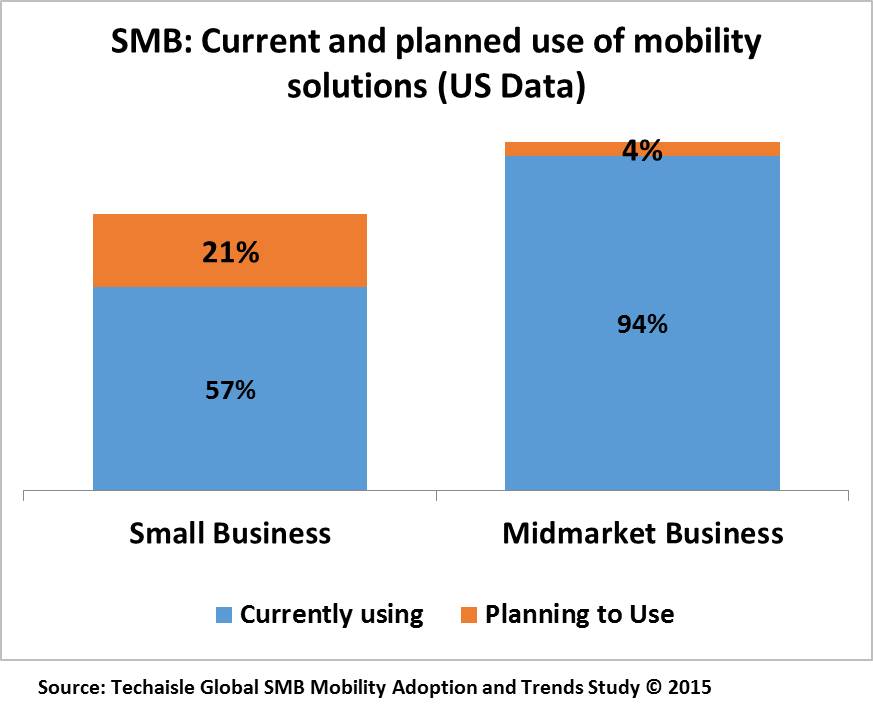
Figure below provides a snapshot of current and planned usage of mobility solutions. It shows that today, use of mobility solutions has crossed 50% in the small business segment, and that aggressive 2015 purchase plans – especially amongst 1-9 employee and 10-19 employee microbusinesses – will boost this figure closer to 80% in the near term. Initial penetration is nearly complete within midmarket enterprises, where well over 90% report current use of mobility solutions.
techaisle-smb-current-planned-use-mobility-solutions

Focusing on Enterprise Mobility Management Solutions

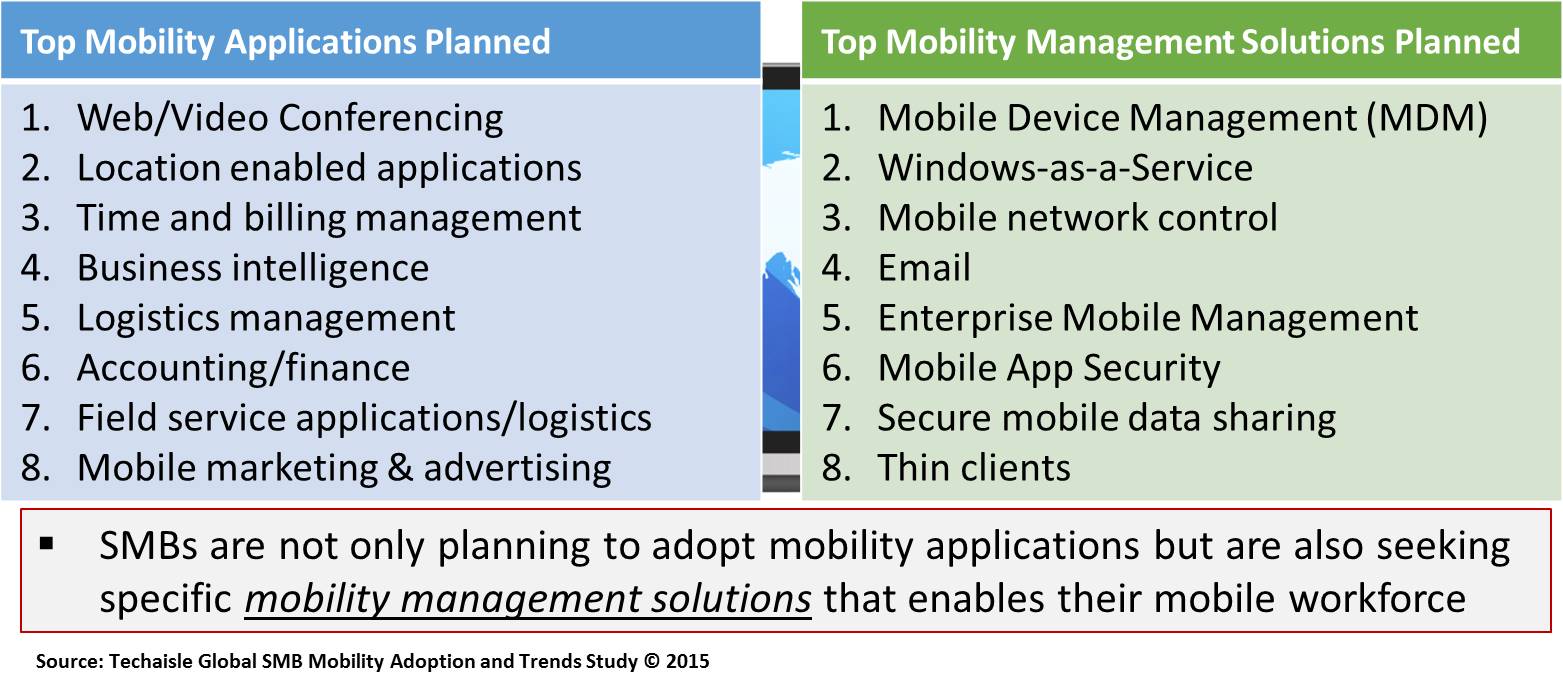
Consider the perspective included in the figure below. The left-hand text box includes eight mobility application categories predicted (by the Techaisle SMB 2015 Mobility survey) to have the greatest increase in adoption in the next one year. Half of the list is comprised of advanced applications: web/video conferencing (foundational), location-enabled applications and mobile marketing and advertising (emerging technologies) and business intelligence (second-order application). The SMB mobile application portfolio is both growing explosively and becoming more complex.
techaisle-smb-seeking-mobility-management-solutions

The right hand side of figure highlights the top mobility management solutions that SMBs are investing in to automate control of these sprawling assets. This list includes security solutions (MDM, mobile app security, secure mobile data sharing) that address widespread concern over the exposure that accompanies mobility, as well as methods of automating management (mobile network control, enterprise mobile management) and of deploying infrastructure tuned to the needs of mobile workers (Windows-as-a-Service, thin clients). Also included on this list is email, which is in the process of making the leap from an application that is accessed remotely to an integrated solution that connects seamlessly across environments and devices – a progression that will likely occur with other applications (especially foundational applications) over time.

This link between more sophisticated mobile deployments and the need to invest in mobility solutions to provide for management, security and infrastructure is apparent in survey data outlining SMB use of and investments in mobile solutions.

However, mobility management solutions are not a “set it and forget it” type of technology. These solutions require continuous tuning and ongoing investment as their scope expands to match the burgeoning requirements of an increasingly-complex mobile environment. Techaisle 2015 SMB Mobility study data also captured expenditure levels for mobility solutions by employee size. Comparing this data and connecting the dots with Techaisle’s other data on cloud, virtualization, managed services and analytics we find that mobility drives increased IT investment, especially amongst small businesses and as a market force, mobility “grows the pie” of IT spending in the overall SMB market.

Upcoming blogs on SMB Mobility:

  • Mobility solution providers: not limited to traditional IT suppliers – VMware AirWatch, Citrix and IBM MaaS360 become important
  • What drives mobility solution supplier evaluation, especially in the midmarket?
  • What are the SMB IT challenges associated with mobile workforce support?
Anurag Agrawal

SMB and Midmarket workforce enablement through unified workspace and collaboration

Techaisle global research shows that 409 million SMB employees will still be in hybrid work mode at the end of 2021. As a result, SMBs are investing in processes, products, and policies to support hybrid workforces. Better hardware equipment and mobile devices are an essential component of remote work, but remote work enablement extends beyond hardware to applications, solutions, and work habits. Techaisle data also found that improving workforce productivity is among the top five business objectives for SMB and midmarket segments. Many factors drive productivity, including management approaches, processes and practices, and collaboration/synergy across activities and functions. But technology is a pivotal contributor to productivity directly and through its ability to affect operations and internal coordination positively. Moreover, as the chart below demonstrates, these benefits don't accrue to all SMBs equally. SMBs that are advanced in their approach to IT ("Enterprise IT") are about twice as likely to achieve the productivity-enabled benefits than lowest-performing firms and 30% more likely to realize productivity benefits than the average SMB. IT provides the tools to support greater employee efficiency and productivity. So what are the best ways to help the workforce to capture these benefits and be more productive?

Anurag Agrawal

Top 5 technology areas where midmarket firms are increasing investment

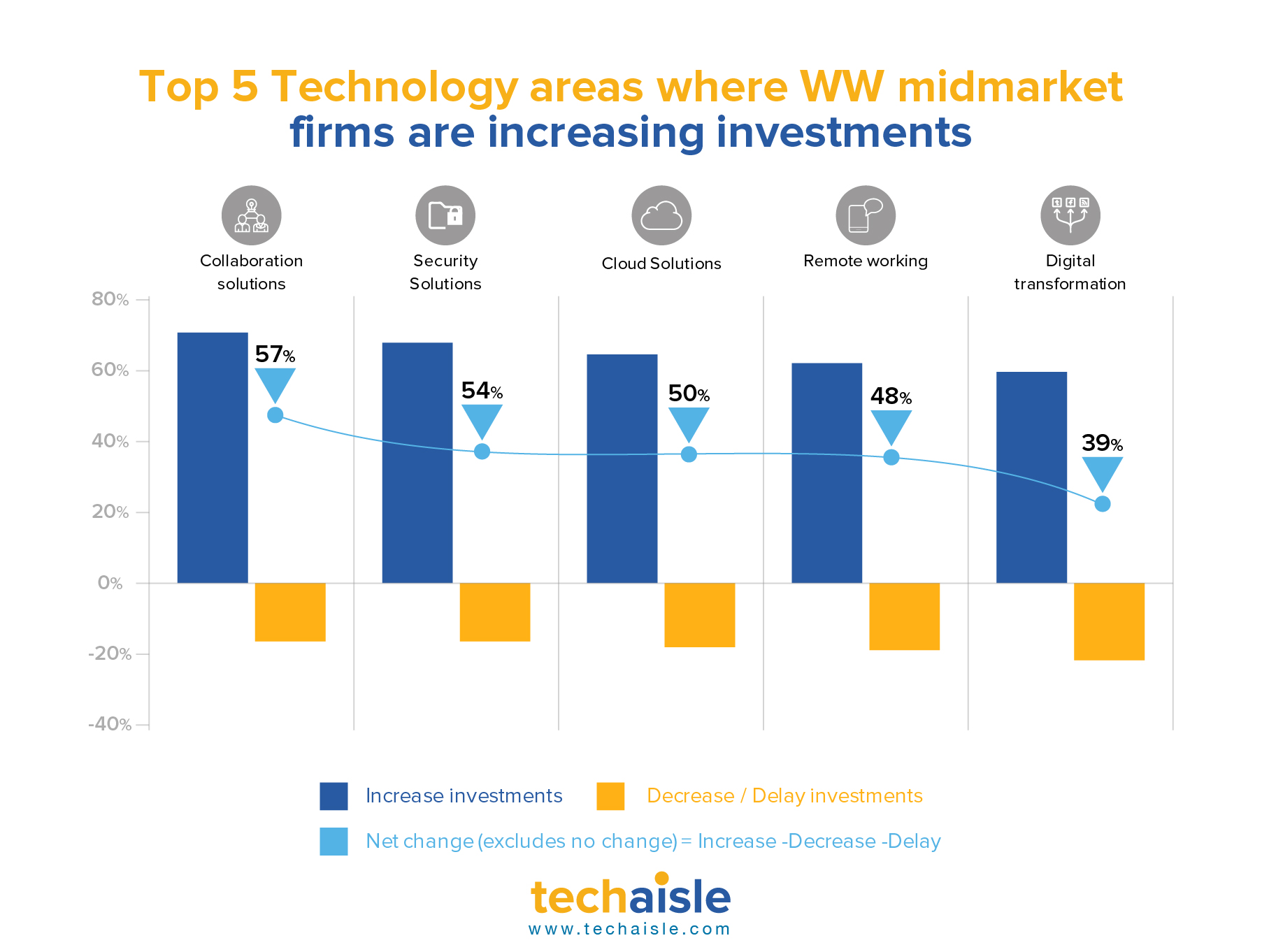
Techaisle worldwide survey of midmarket firms shows that collaboration, security, cloud, remote work and digital transformation are the top five areas where midmarket firms are increasing technology investments.

techaisle top 5 technology areas midmarket

Collaboration: 72% of midmarket firms are increasing investments in collaboration solution as compared to 15% who are either decreasing or delaying investments. Collaboration is a central component to virtually all business activities and is evolving in response to new market conditions and those collaborative technology solutions are being acquired which are positioned as a framework that integrate and extend the value of discrete capabilities, rather than as a “first step” platform.

Security: 69% of midmarket firms are increasing investments in security solutions. IT security is no longer being viewed as a necessary and unwelcome cost, rather as an enabler of business solutions, a viewpoint that is reinforced by a clear need for IT security in the face of increasing threats to information security and business continuity. Effective security practices are going beyond merely “raising the shields” around users, data and networks – they are being seen as enabling innovation throughout the IT/business infrastructure.

Cloud: 66% of midmarket firms are increasing investments in cloud. Cloud addresses real-world IT issues and business challenges. Cloud represents a powerful way of addressing budget constraints: cloud infrastructure can be deployed quickly and at low cost. Cloud is linked with mobility solutions, particularly security solutions, as data that is accessed via a mobile device can be available anywhere/anytime via cloud, but remain separate from the devices themselves, protecting corporate information from loss or theft or malware. And cloud’s pay-as-you-go approach meshes very well with the need to align IT investment with business benefits.

Remote work: 65% of midmarket firms are increasing investments in remote working. Mobile devices, technologies and services are perhaps the most exciting space today, remaining resilient even in a downturn. Midmarket firms are investing to automate control of sprawling mobile assets. The list includes security solutions (MDM, mobile app security, secure mobile data sharing) that address widespread concern over the exposure that accompanies mobility, as well as methods of automating management (mobile network control, enterprise mobile management) and of deploying infrastructure tuned to the needs of mobile workers (Windows-as-a-Service, VDI, DaaS).

Digital transformation: 61% of midmarket firms are increasing investments in digital transformation. Mature cloud adoption does not equate to high digitization of the business. Data shows that only half of the 47% of mature midmarket cloud adopters are holistic adopters of digitalization. It is true that these firms believe in cloud and its effect on digitization but they also believe that true digital transformation requires advanced adoption of multiple technology solutions. The roadmap to successful digital transformation begins with the creation of a sound physical infrastructure - the ‘building blocks’ or ‘foundations’ of business infrastructure.

Anurag Agrawal

Workforce enablement - driving IT benefit throughout the organization

IT provides the tools to support greater efficiency and market engagement. What are the best ways to help the workforce to capture these benefits, and be more productive? The workspace isn’t defined by windows and walls and common area couches. For millions of SMB and midmarket employees, the “workspace” isn’t a physical location – it’s a virtual space defined by access from multiple screens which are used from multiple locations. This is especially true of mobile workers, a category which is increasingly indistinguishable from “workers.” Techaisle data shows that 72% of SMB employees are mobile, 87% of SMB employees use mobile devices to access corporate information.

Workforce enablement

Techaisle global survey found that improving workforce productivity is the second most important midmarket business objective for 2019 and among the top five objectives of small businesses. Data shows that for 42% of SMBs’ improving employee productivity is a priority and 43% of SMBs are using digitalization initiatives for employee empowerment.

There are many factors involved in driving productivity, including management approaches, processes and practices, and collaboration/synergy across activities and functions. But technology is a key contributor to productivity – directly, and through its ability to positively affect processes and internal coordination.

Techaisle research shows that these benefits don’t accrue to all SMBs equally: SMBs that are advanced in their approach to IT (“Enterprise IT”) are about twice as likely to achieve the productivity-enabled benefits than lowest-performing firms, and 30% more likely to realize productivity benefits than the average SMB.

The statistics quoted above show that IT is seen as a source of productivity-enhancing capabilities – meaning, in some way, that IT has ‘permission’ from the business to help drive higher levels of workforce performance. However, improved performance requires a strategy, and in technology matters, this strategy should be driven by IT management. It is important that the IT function be responsive to business requirements, deploying requested technology and delivering user training. There is another role, though, that IT management can and should play: focusing on technologies that are proven to contribute to workforce enablement, deploying these technologies within the organization and working with business staff to ensure that the benefits inherent in the technologies are recognized and captured. This advances the IT function from simply responding to requests to providing leadership in enabling the SMB and midmarket workforce.

Techaisle’s research has identified a number of solutions that are seen as driving productivity within SMBs and midmarket firms – approaches that IT managers can and should explore as they seek ways to connect the potential of IT to demonstrable increases in productivity. Three of these solutions - unified workspace, collaboration, and mobility, are especially important in a technology-dependent economy, and each contributes meaningfully to enabling the workforce.

Unified workspace

‘Distributed,’ ‘remote,’ ‘mobile’ – these are the realities of today’s workforce. In many economies, roughly half of workers are remote for at least some part of the work week.

Increasingly, SMBs and midmarket firms are using technology to provide cohesion within the workforce. Unified workspace solutions, which (in Techaisle’s definition) “provides secure anytime, anywhere, any device access from any web browser with single sign-on and password management for all public and private applications, services and file sources used to run the business” help SMBs to organize workers into connected groups. Techaisle research has found that over 75% of firms deploy unified workspace to support the needs of multilocation and full-time remote or travelling workers. These systems also help IT to deliver on key goals of data protection and mobility enablement. Businesses that have adopted unified workspace technology believe strongly that it contributes to productivity by providing a single workspace from which employees can accomplish majority of their daily work, delivering better access to applications and resources.

Trusted Research | Strategic Insight

Techaisle - TA