










• TRUSTED RESEARCH

    TRUSTED RESEARCH | STRATEGIC INSIGHT

    SMB. CORE MIDMARKET. UPPER MIDMARKET. ECOSYSTEM
    LEARN MORE
  • INTERWORK 2.0: THE AGENTIC FUTURE OF CONNECTED BUSINESS

    INTERWORK 2.0: THE AGENTIC FUTURE OF CONNECTED BUSINESS

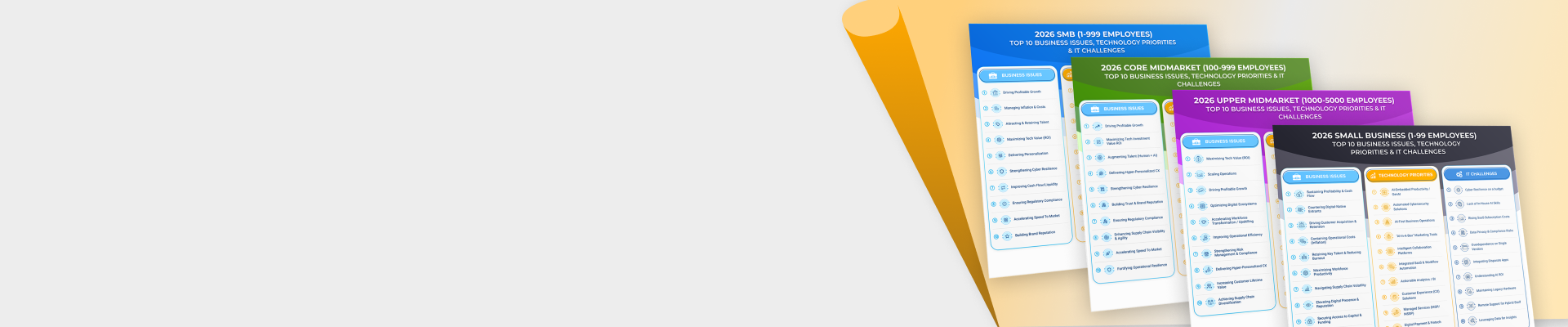
  • 2026 TOP 10 SMB BUSINESS ISSUES, IT PRIORITIES, IT CHALLENGES

    2026 TOP 10 SMB BUSINESS ISSUES, IT PRIORITIES, IT CHALLENGES

  • 2026 TOP 10 SMB PREDICTIONS

    2026 TOP 10 SMB PREDICTIONS

    SMB & Midmarket: Autonomous Business
    READ
  • 2026 TOP 10 PARTNER PREDICTIONS

    2026 TOP 10 PARTNER PREDICTIONS

    Partner & Ecosystem: Next Horizon
    READ
  • ARTIFICIAL INTELLIGENCE

    ARTIFICIAL INTELLIGENCE

    SMB & Midmarket Analytics & Artificial Intelligence Adoption
    LEARN MORE
  • IT SECURITY TRENDS

    IT SECURITY TRENDS

    SMB & Midmarket Security Adoption Trends
    LATEST RESEARCH
  • BUYERS JOURNEY

    BUYERS JOURNEY

    Technology Buyer Persona Research
    LEARN MORE
  • PARTNER ECOSYSTEM

    PARTNER ECOSYSTEM

    Global Channel Partner Trends
    LATEST RESEARCH
  • CLOUD ADOPTION TRENDS

    CLOUD ADOPTION TRENDS

    SMB & Midmarket Cloud Adoption
    LATEST RESEARCH
  • FUTURE OF PARTNER ECOSYSTEM

    FUTURE OF PARTNER ECOSYSTEM

    Networked, Engaged, Extended, Hybrid
    DOWNLOAD NOW
  • MANAGED SERVICES RESEARCH

    MANAGED SERVICES RESEARCH

    SMB & Midmarket Managed Services Adoption
    LEARN MORE

Techaisle Analyst Insights

Trusted research and strategic insight decoding SMBs, the Midmarket, and the Partner Ecosystem.
Tavishi Agrawal

Mobile and Touch: A new interaction formula takes hold

Every decade or so, the tech industry experiences a tectonic shift. Over the last 40 years, we have seen changes in hardware, software, communications, networking, development tools, languages and platforms. Each has been significant in its own right. Some are incremental and though touted as game changers, they impact a narrow slice of technology users. It is arguable whether the shift to mobile is the most important of all but it has been as impactful as the arrival of the PC, if not more because of the pace at which the change has occurred.

Most readers of this blog are well aware that the most impactful changes in technology are those that ultimately change user behavior and disrupt how people interact with information that affects their daily personal and professional lives. A technology such as that changes the entire eco-system around it. When Apple introduced the world to GUIs and the mouse followed subsequently by Microsoft, it broadened the market for PCs and changed how people interacted with information. The combination of mobile and touch
technologies is having the same impact.

Take Instagram for instance. I must admit that I never gave Instagram a fighting chance of success. When I first heard of it I thought what possessed these guys to build a photo sharing app given the presence of huge success of Flickr and Picasa – both properties of
large companies. Similarly, Pinterest is but a feature of Facebook, right? Wrong! And I am glad to have been proven wrong. These and other apps prove a simple reality – Mobile IS different. What these and other success stories prove that it is possible to reinvent existing applications and indeed markets in an increasingly mobile centric world.

Emerging Mobile Interaction Formula
When one analyzes the characteristics of these apps a few things become evident.

    1. Goal completion – Successful mobile apps must be responsive and allow users to complete the task quickly and with the least amount of friction. This seems elementary but is critical in mobile scenarios.


    1. Context – Apps must be contextually aware and on the flip side make easily make evident to the user what the context is. Again, elementary but of heightened importance when thinking mobile apps.


    1. Relevance – Limitation of screen size means that developers must be clever and super sensitive to how an app communicates relevance. There is no room to explain what an app does or is supposed to do, no room to guide the user in a systematic manner.


    1. Entertainment – Even productivity apps must provide some form of entertainment even if it takes the form of simply taking engagement to a new level. Immersive games do this as a matter of necessity but so do apps like Path and Evernote.


    1. Communication – Communication is central to all successful mobile apps. People don’t use mobile devices in a vacuum. While apps like Path present a simple elegant UI, its central value lies in being able to share one’s life with others. Regardless of the genre an app might fall into, communication has to be a central tenet of the app whether it is one-to-one or via social networks.


Touch technology is an important component of this and also presents some challenges. It has its advantages but also has limitations. It allows for a more natural interaction with information but for that to happen applications must be redesigned and rethought impacting even the most basic applications used every day.

    • What does a spreadsheet optimized for mobile platforms look like?


    • Does it (should it) even look like a spreadsheet?


    • What about graphics applications?


    • What is the best way to create a presentation on a touch optimized mobile platform?


Historically these apps have been designed and optimized for specific operating systems and devices. Compared to successful mobile apps they take on the status of silos, operated by individuals and content created within these apps is shared in the most rudimentary ways (think email). Touch interfaces aren’t just a way to replace mouse clicks and apps that do just that are foregoing the opportunity to drive new value for their users. For example, take a look at the following concept emerging out of MIT’s Fluid Interfaces lab.

This is Swÿp and this is how MIT describes it.

mobility - Techaisle - Global SMB, Midmarket and Channel Partner Analyst Firm - Techaisle Analyst Insights swyp-300x150

With Swÿp you can transfer any file from any app to any app on any device: simply with a swipe of a finger. Swÿp is a framework facilitating cross-app, cross-device data exchange using physical "swipe" gestures. The framework allows any number of touch-sensing and collocated devices to establish file-exchange and communications with no pairing other than a physical gesture. With this inherent physical paradigm, users can immediately grasp the concepts behind device-to-device communications. The prototype application “Postcards” explore touch-enabled mobile devices connected to the LuminAR augmented surface interface. Postcards allows users to collaborate and create a digital postcards using Swÿp interactions. Swÿp enabled interfaces can support new generation of interactive workspaces possible by allowing pair-free gesture-based communications to and from
collocated devices. (Source: http://fluid.media.mit.edu/people/natan/current/swyp.html)

Another interesting concept is “Sparsh” (means “to touch” in Sanskrit).

mobility - Techaisle - Global SMB, Midmarket and Channel Partner Analyst Firm - Techaisle Analyst Insights sparsh-300x150

'SPARSH' lets one conceptually transfer media from a digital device to one’s body and pass it to another digital device by simple touch gestures. The digital world -- laptop, TV, smart phone, e-book reader and all are now relying upon the cloud, the cloud of information. SPARSH explores a novel interaction method to seamlessly transfer something between these devices in a real fun way using the underlying cloud. Here it goes. Touch whatever you want to copy. Now it is saved conceptually in you. Next, touch the device you want to paste/pass the saved content. SPARSH uses touch based interactions as just indication for what to copy, from where and where to pass it. Technically, the actual magic (transfer of media) happens on the cloud.
(Source: http://fluid.media.mit.edu/people/pranav/current/sparsh.html)

What this means for businesses – Embrace “Mobile First” Approach

Businesses Should Embrace "Mobile First" Approach
IT departments are already dealing with an onslaught of devices that their constituency is asking them to support. The so called BYOD (Bring Your Own devices) trend has stressed IT managers and many resist the trend citing security concerns. But any platform shift causes some pain for some amount of time. Progressive IT managers should look at this as an opportunity to add new and more value to employees. The shift to mobile and touch platforms will eventually force IT departments to embrace a “Mobile First” approach to IT strategy and the sooner IT managers do it the better because ultimately, the growth in mobile isn’t about devices or software or networks. Those will continue to evolve. It is about how we interact with information in a way that enriches our individual experiences and productivity.


 

Michael O

Increasing role of BDMs in SMB Cloud and Mobility Security Management

Techaisle’s recently completed study on SMB IT Decision Making Authority: ITDM vs. BDM, examining the balance in SMB IT decision making authority between IT decision makers (ITDMs) and business decision makers (BDMs)  shows that BDMs are becoming increasingly involved in SMB cloud and security management processes. In 76 percent of SMBs BDMs have active roles in cloud security and in a whopping 87 percent of SMBs they are active in mobility security management.

Techaisle’s SMB IT Decision Making Authority: ITDM vs. BDM report provides data to substantiate a common theme: business management is taking a more active role in IT acquisition, deployment and management. This is especially true in cloud and mobility as BDMs are able to directly procure systems that support their business needs (such as CRM systems used by sales management) – avoiding IT’s processes and timeframe for deployment, and in some cases, avoiding input from IT altogether.

When we speak to ITDMs or IT suppliers who work with IT managers we are often exposed to the counter-argument against this newfound BDM freedom: that without effective IT oversight, cloud systems can become disconnected from the corporate IT infrastructure, creating silos of data, and potentially, security, audit, compliance and privacy risks.

To obtain insight into this issue, Techaisle asked survey respondents to identify who (by area of responsibility) has primary responsibility in each of 10 cloud security areas and 12 mobility security areas. Looking across both groups, we see at a glance that in both the small and mid-sized businesses business management is viewed as a source of access policy but the management of the security process is largely the preserve of IT.

Comparing Cloud and Mobility Security Management

The study shows that there are three key players in managing cloud and mobility security within SMB organizations – Business Management, IT Management and Service Providers. Business management involvement is higher than IT management in mobility security, 87 percent vs. 68 percent. Drilling down into the data we find that SMB BDMs take an active role in five out of twelve mobility security areas and have primary responsibility in seven security areas.

On the other hand, SMB BDM involvement in cloud security management is 76 percent which is almost same as ITDM at 78 percent. But unlike mobility security management, BDMs are actively involved in three cloud security areas and have primary responsibility in only one security area.

Within the mid-market businesses, IT management has a higher percent of involvement than business management for both mobility and cloud security administration. ITDMs actively participate in five of twelve mobility security areas and five of ten cloud security areas.

The above data does not imply that BDMs and ITDMs are not involved in all security management areas; in fact, they are but the roles and responsibilities shuttle between the two principle SMB custodians.

Comparing Small and Mid-market Businesses for Cloud security management

Drilling down into the cloud security management process only, the data reveals that BDMs are responsible for setting access policy in over 60 percent of cases – but all other steps in the process are primarily the responsibility of IT but with involvement from BDMs, from user authentication to ensuring consistency with audit, regulatory and compliance requirements and to ensuring that backup is regular, effective and testing.

When we turn our attention to the mid-market businesses, the first finding that leaps out at us is the more prominent role played by business management. In nine of the ten cloud security activities covered in the survey, medium business respondents report more non-IT management involvement than their small business peers – and in one step in the cloud security process (ensuring consistency with audit, regulatory and compliance requirements) medium business BDMs have similar level of responsibility as ITDMs.

Role of Service Provider in Securing SMB Cloud and Mobility solution deployments

Survey data presents a very interesting dichotomy about the role of service providers in securing SMB cloud and mobility solution deployments. Service providers are involved in 47 percent of SMBs for cloud security which is 35 percent higher than their involvement in mobility security. But for mid-market businesses they are 50 percent more involved in mobility security than cloud security. Out of the twelve areas, key roles played by service providers for mobility security are “Authenticating user identities” and “Deploying and updating malware and other security technologies on corporate-owned endpoint devices”. Within the ten different cloud security areas, service providers are most involved in “Safeguarding against unauthorized access” and “Authenticating user identities”.

It is interesting to note that both small and mid-sized businesses rely on cloud suppliers through the security process – interesting primarily because (as the saying goes) “you can’t outsource responsibility”. SMBs are free to rely on cloud suppliers for assistance through the cloud security process, but if/where there are breaches or other issues, the responsibility still rests with the business, not with the supplier. Techaisle believes that the proportion of SMBs –both small and medium businesses – who report that their cloud suppliers have responsibility for one or more cloud security activities should take a closer look at whether and how they might separate responsibility (which is a management requirement) from delivery (which may well be best outsourced to a cloud vendor). Here again, SMBs require guidance from security specialists to align practices with requirements.

Details about the report can be found here

Related research:

2014 SMB & Mid-Market Cloud Computing Adoption Trends

2014 SMB & Mid-Market Mobility Solutions Adoption & Trends

Anurag Agrawal

Mobility is Strategic for 13 percent of SMBs - Meet "Aggressive Adopters" Segment

techaisle-smb-infographic-mobility-segmentationTechaisle’s SMB Mobility adoption research and corresponding segmentation shows that there are three distinct SMB segments of mobility solution users.

Aggressive Adopters: Mobility is Strategic to their business; these form 13 percent of SMBs

Steady Movers: Mobility is enabled in their business; by far the largest segment at 49 percent of SMBs

Fence Sitters: Mobility is a convenience for their business; these form 19 percent of SMBs

It is imperative for IT Vendors and channels to understand the segments' different attitudes towards mobility, current and planned usage of mobility and firmographics to create an actionable marketing strategey. For example, Techaisle’s SMB Mobility Segmentation shows that for 13 percent of SMBs that fall into the Aggressive Adopters segment mobility is strategic to their business growth and survival. A deep understanding of the three segments will help IT vendors and channel partners identify their target markets and how to sell into them.

Sales Strategies for SMB Mobility Segments

techaisle-smb-mobility-segments-1

Even in terms of spending, aggressive adopters are spending a higher percentage of their IT budget on mobility solutions. Interestingly, Fence Sitters are spending comparatively higher percentage on mobility consulting assessments looking for advice on the most appropriate solutions before adopting mobility enterprise-wide.

BYOD Policy and Use of Tablets & Smartphones

Not only Aggressive Adopters were the first to use tablets and smartphones but they also have the highest density (mobile devices per employees) and highest average number of tablets and smartphones being used at all employee size levels among all three segments.

techaisle-smb-mobility-segments-2

There are twice as many SMBs in the Aggressive Adopters segment as Fence Sitters that use Tablets and Smartphones.

Aggressive Adopters have also moved quickly to implement a BYOD policy whereas a large percentage of Steady Movers do not have a BYOD policy but they also do not stop their employees from using their own devices.


techaisle-smb-mobility-segments-3

Aggressive Adopters also have a very healthy attitude towards employees using consumer applications at work as they feel it is a good way to learn about technology that their employees find useful and can be officially integrated into their business.


techaisle-smb-mobility-segments-4


Adoption of mobility solutions has also led to a positive effect on work-life balance of their employees. Aggressive Adopters have also seen improved productivity, higher employee satisfaction and improved quality of work.


With improved productivity and quality of work there will be a continued proliferation of mobile devices and corresponding solutions that will drive new forms of collaboration of content and communication. As devices become increasingly small, smart, connected and powerful, the server and network become less visible progressively moving offsite both physically and from a management perspective, simultaneously serving more computing power, storage and bandwidth; mobility will revolve around collaboration delivered through an enhanced browser. Therefore, todays Aggressive Adopters will look for integration of communication channels, content and workflow as the foundation on which to build their strategic mobile solutions.


The responsibility lies with the IT Vendors and their channel partners to effectively mine the Aggressive Adopters’ segment at the same time using realized proof points to move each of the other two segments (Steady Movers and Fence Sitters) to the Aggressive Adopter segment.

In terms of market opportunity, Aggressive Adopters show the highest growth rate for mobility spending requiring sophisticated solutions whereas Steady Movers have the biggest size due to sheer volume of SMBs falling into the category.

Anurag Agrawal

Codeproof: Cloud-based MDM for SMBs

A common SMB usage scenario

An IT administrator of a small business gets a call from an employee saying that he lost his iPad with customer billing info, specs of recent architecture drawing; corporate emails and he did not even have a lock in the iPad. What can the IT Administrator do? This is where Codeproof comes into picture. With Codeproof, the IT Administrator could have remotely located the iPad, locked it and even remotely erased the iPad thereby preventing any data-theft.

A common barrier to Mobility Adoption within SMBs

The need for device and data security for mobile devices is an important deterrent in mobility adoption, especially as consumer and business apps converge onto the same devices. Nevertheless mobility is here to stay but going down the route of mobility is also fraught with unexpected surprises – most important being accidental loss of device with company data, employee walking off with device or malware creating havoc with the device.  Many surveys conducted by Techaisle reveal that SMBs worry about these issues a lot but fail to protect themselves adequately. For example, 69 percent of SMB IT Decision makers in the US are concerned about accidental loss of devices containing sensitive data. And nearly 1/3rd of these decision makers are also concerned about inability to manage device configurations so that they comply with company policies. To top it all, there is the issue of managing employee devices that businesses did not buy.

Techaisle survey of 9,500 SMBs across different geographies show that accidental loss of device followed by imminent danger of mobile viruses are the top concerns of SMBs while using mobile applications. This also clearly demonstrates the need for remote mobile device management, authentication, and remote erasure of data.

 SMB Apprehensions in using Tablets and Smartphones


The above data clearly demonstrates the need for remote management, authentication, and remote erasure of data on mobile devices. Data no longer resides on tethered devices such as desktops but is spread across multiple devices that “move”. SMBs need to plan for it to make mobility an enjoyable and productive experience.

Codeproof is a simple to use, Cloud-based, SaaS, Freemium model MDM

In four easy steps Codeproof MDM is up and running on iOS and Android devices. A Seattle-based company, Codeproof offers an integrated BYOD security and mobile device management platform specially targeted at small and medium businesses. Some of its main mobile security features are App-white listing, Malware protection and Mobile policy management. It is built on Amazon EC2 elastic cloud for scalability, anytime, anywhere access.

 Codeproof mobile policy screenshots


An admin can enroll all mobile devices to Codeproof by installing and enrolling Codeproof App on the device. As the devices get enrolled via the mobile Copdeproof app, the devices automatically appear in Codeproof Cloud console tree. The admin can now remotely manage all devices from Cloud console. When an employee leaves the company, the admin just deletes the corresponding employee MDM profiles (WiFi profiles, Email Profiles, etc.) thus disabling the devices from accessing any type of corporate data.

Codeproof is free for 2 devices and is priced at only 29.99$ per device per year. It is worth a try.

Trusted Research | Strategic Insight

Techaisle - TA