









• TRUSTED RESEARCH

    TRUSTED RESEARCH | STRATEGIC INSIGHT

    SMB. CORE MIDMARKET. UPPER MIDMARKET. ECOSYSTEM
    LEARN MORE
  • INTERWORK 2.0: THE AGENTIC FUTURE OF CONNECTED BUSINESS

    INTERWORK 2.0: THE AGENTIC FUTURE OF CONNECTED BUSINESS

  • 2026 TOP 10 SMB BUSINESS ISSUES, IT PRIORITIES, IT CHALLENGES

    2026 TOP 10 SMB BUSINESS ISSUES, IT PRIORITIES, IT CHALLENGES

  • 2026 TOP 10 SMB PREDICTIONS

    2026 TOP 10 SMB PREDICTIONS

    SMB & Midmarket: Autonomous Business
    READ
  • 2026 TOP 10 PARTNER PREDICTIONS

    2026 TOP 10 PARTNER PREDICTIONS

    Partner & Ecosystem: Next Horizon
    READ
  • ARTIFICIAL INTELLIGENCE

    ARTIFICIAL INTELLIGENCE

    SMB & Midmarket Analytics & Artificial Intelligence Adoption
    LEARN MORE
  • IT SECURITY TRENDS

    IT SECURITY TRENDS

    SMB & Midmarket Security Adoption Trends
    LATEST RESEARCH
  • BUYERS JOURNEY

    BUYERS JOURNEY

    Technology Buyer Persona Research
    LEARN MORE
  • PARTNER ECOSYSTEM

    PARTNER ECOSYSTEM

    Global Channel Partner Trends
    LATEST RESEARCH
  • CLOUD ADOPTION TRENDS

    CLOUD ADOPTION TRENDS

    SMB & Midmarket Cloud Adoption
    LATEST RESEARCH
  • FUTURE OF PARTNER ECOSYSTEM

    FUTURE OF PARTNER ECOSYSTEM

    Networked, Engaged, Extended, Hybrid
    DOWNLOAD NOW
  • MANAGED SERVICES RESEARCH

    MANAGED SERVICES RESEARCH

    SMB & Midmarket Managed Services Adoption
    LEARN MORE

Techaisle Analyst Insights

Trusted research and strategic insight decoding SMBs, the Midmarket, and the Partner Ecosystem.
Anurag Agrawal

Mobility becoming a niche within SMB Channel Partners

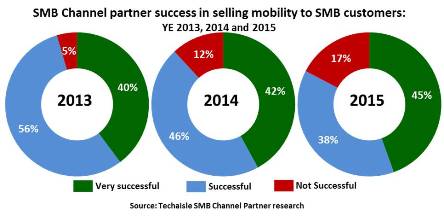
Where is the SMB mobility channel today, as we enter 2016? Results from three Techaisle SMB channel surveys and compiled in report The Channel and Mobility: SMB Supply Options show that there has been substantial retreat from mobility as a core offering in the SMB and midmarket channel. In two years, the proportion of partners stating that they are unsuccessful at selling mobility has increased from 5% to 17%. There are likely two main reasons for this, a “push” and a “pull,” both related to the increased need for specialization in 1-2 of four main market areas (mobility, cloud, managed services, converged infrastructure/virtualization).

On the “push” side, Techaisle believes that many channel partners are struggling to find a profitable entry point to mobility. Supply of the devices themselves is not sufficient: buyers are deploying a wide range of client technology (PCs, smartphones, tablets) which has the effect of diffusing investments in PCs, diverting investment from the channel (since some technologies, especially smartphones, are generally acquired from telcos or other non-traditional-channel sources), and slowing PC refresh cycles (since client technology investment is now spread across 2-3 different devices). Additionally, the rise of BYOD is a double-edged sword: on the one hand, it increases the need for mobility management solutions (since these devices have greater need for security and related capabilities, such as audit/compliance monitoring), but on the other, authority for these devices doesn’t reside entirely within IT. And SMB channel partners are continuing to struggle on how best to offer mobility management solutions, mobility security solutions and bet on which vendor suppliers.
smb channel mobility success trend techaisle

On the “pull” side, channel members who are being forced to abandon the ‘one stop solution shop’ positioning in favor of specialization in 1-2 of the core four areas need to decide if the uncertain journey into mobility has a greater overall benefit than focus on cloud, managed services and/or converged infrastructure/virtualization.
Anurag Agrawal

Look back on US SMB PC purchase intentions

Look back

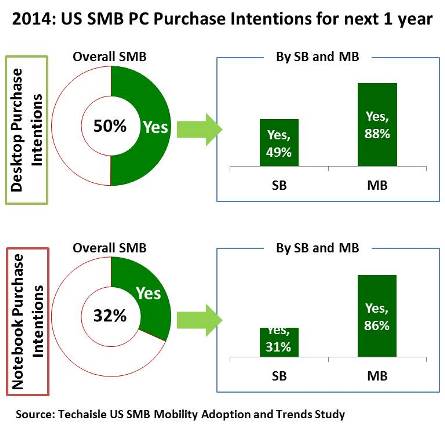
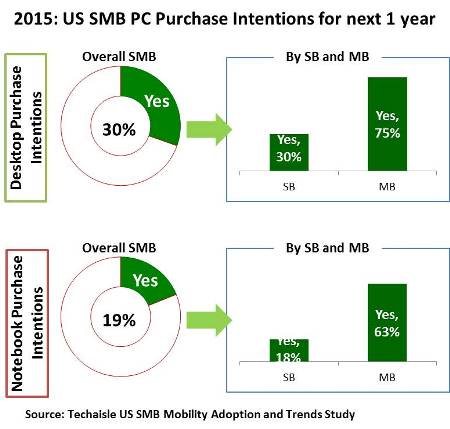
As is the case in each year’s SMB research, Techaisle SMB survey respondents are asked to detail their plans for acquisition of different types of client devices. Two of the major categories investigated by the surveys are desktop PCs and notebook PCs. To establish a baseline understanding of PC use and demand, Techaisle asks SMB respondents to specify the number of endpoint devices that are currently in use within their companies, and then asks them to specify the quantity that they are planning to buy over the next twelve months. To provide actionable insight to our clients, the question asks separately about desktop PCs, notebook PCs and tablets. While 2016 survey is in the field it is worth looking at the trends of last two years. In 2014, both the US small and midmarket businesses were bullish about new desktop and notebook purchases. But in 2015, the percent of US SMBs planning to buy PCs had dropped by 40% from 2014 for both desktops and notebooks. However, although the average number units of desktops planned to purchase dropped from 2014 to 2015 the average number of notebooks planned to purchase increased substantially from 2014 to 2015.

2014-us-smb-pc-purchase-intentions-techaisle

2015-us-smb-pc-purchase-intentions-techaisle

Many desktop buyers were motivated to replace existing units because they were reaching end-of-life and take advantage of Windows XP upgrade path. Desktops are also more of a planned/budgeted item than other client form factors (notebooks, tablets), meaning that desktop acquisitions are more likely to appear in formal purchase plans than the mobile units, and less likely to be acquired on an ad hoc basis. Notebooks are usually ad hoc purchase items – meaning that they would be underrepresented in research of this sort relative to desktops. Additionally many users upgrade their notebooks over time (to replace damaged units, to get features like touchscreen, to obtain lighter or smaller products, etc.).

However, corporate purchase intentions do not provide a complete perspective on mobile device acquisitions.

Potential Impact of BYOD on US SMB PC Purchases

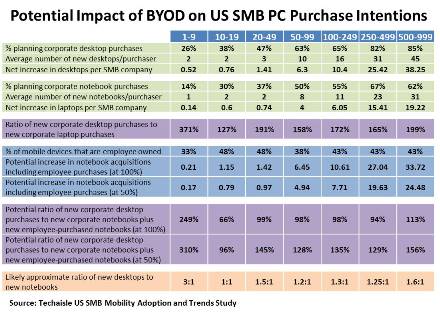
Figure below presents a perspective on corporate purchase plans and the impact of employee purchases of notebooks. The top two sections of the table, shaded in green, illustrate the proportion of businesses by employee size reporting desktop and/or notebook purchase intentions, and the number of units that they plan to acquire. These figures are used to prepare a “net increase” figure – the average number of new units expected to be deployed by businesses in each employee size category. These two grey sections are followed by a line of percentages, shaded in purple, which shows the ratio of corporate desktop purchases to corporate notebook acquisitions. It shows that microbusinesses with 1-9 employees are much more likely to be buying desktops than notebooks, and that other SMBs are planning to buy 25% to 99% more desktops than notebooks.

potential-impact-of-byod-on-smb-pc-purchase-intention-techaisle

The next section of the table, shaded in blue, begins with the BYOD penetration statistics that appear at the bottom of the figure. It then calculates the impact on notebook purchase intentions if this ratio is fully reflected in notebook purchases (the “at 100%” line) and if employees were to buy notebooks at half of the BYOD penetration rate (“at 50%), showing both corporate and employee purchases of these devices. These revised figures are used to calculate the desktop to notebook PC purchase proportions shown in the second set of purple-shaded cells. Here, we see that if employee purchases of notebooks are equivalent to current BYOD penetration levels, new notebook units would be about equal to new desktop purchases in most employee size segments, while a 50% scenario would result in ratios ranging from about 1:1 to 1:6 in all but the smallest employee size category.


Anurag Agrawal

Mobile App Adoption exploding within SMBs and Midmarket Businesses

Data drawn from the Techaisle SMB mobility survey shows that SMBs will go from a current average of 7 types of mobility applications in use to 14 in about a year. This 100%-ish growth pattern is demonstrated across most employee size segments.

When we overlay business size with Techaisle’s attitudinally-defined segments of “Pre-IT,” “Basic IT,” “Advanced IT” and “Enterprise IT,” some differences in app adoption emerge. Businesses in the “Pre-IT” segment (found only in the small business group) are currently using only 3 types of mobile apps, versus 7 type of mobile apps in use in each of the “Basic IT: Small Business” and “Advanced IT: Small Business” segments.

This same trend is visible across the three attitudinally-defined midmarket segments. “Basic IT” firms in the midmarket segment are using only 4 types of mobile apps, and planning to add 5 more; both figures are below the adoption rates seen in Basic IT in the small business community.

The more sophisticated segments, though, are adopting mobile applications much more rapidly. The Advanced IT: Midmarket group uses an average of 8 different types of mobile applications today, and is planning to add 6 more in in the next one year, figures that tie very closely to Advanced IT users in the small business community. And the Enterprise IT segment found only within midmarket firms is even more aggressive in mobile app deployment; these firms already use mobile applications in an average of 11 types of apps, and are planning to deploy 9 more.

Mobile applications: scope for growth in core apps and in other categories

The Techaisle SMB mobility adoption survey tracks 20 types of mobile applications. Although there is always overlap between different feature sets and application types, its possible – and useful – to group these into four categories:

Anurag Agrawal

2015 Predictions Review: did IT live up to the hype in 2015

December has traditionally served as the occasion for the publication of New Year forecasts. It’s understandable that we want to look ahead to the sources of opportunity that lie ahead. But in the business world, December also marks the beginning of the review season. And while detailed forecasts focus on the next twelve months, the planning horizon needs to look a little further, so that tactics provide support for business strategies, rather than simply delivering a series of course adjustments.

This is a two part blog article. The first part, below, reviews the predictions we made for 2015. Second part will focus on outlook for 2016 and for the longer term.

A look back – what was it we said was right around the corner, again?

Here are the issues we highlighted, “Ten predictions for 2015 – and five issues to keep an eye on for 2016 and beyond” and how we think we did in our prognostication.

The Top 10 for 2015

1. Hybrid arrives – not as a strategy but as the result of many discrete decisions

With the benefit of today’s perspective, we might fairly say that in 2015 and for several more years to come, a more apt description of hybrid is journey rather than destination. Digging into the detail, though, we believe our prediction that “an ability to manage hybrid infrastructure will become a key corporate IT requirement in 2015” has been borne out by the focus on tools and strategies (ranging from Docker to Agile) that we saw throughout the year. In Techaisle’ SMB Cloud adoption studies, there was a sense of growing ubiquity in the usage and plans for private, hybrid and public cloud. Use of hybrid cloud continued to increase as both a conscious strategy and as a reaction to use of both public and private resources within a single infrastructure; by the end of 2015, two-thirds of companies with 100-999 employees were using hybrid models.

2. Collaboration becomes a much bigger concept

In 2015, collaboration began to expand beyond file-sharing to become a necessary tool for driving decision-based agility, fostering innovation and extending customer intimacy. Collaboration is a process rather than a discrete outcome. Our key notion that collaboration “extends beyond the corporate staff (and as a result, beyond large enterprises) to include customers” clearly did reflect strategies and investments in 2015. Within the SMB segment collaboration is increasingly becoming a central component to virtually all business activities rather than a means to enable connections between discrete tasks. Other changes in this area will further reshape collaboration, but you’ll need to refer to the “forecast” part of the blog for that discussion.

3. Collabmobilicloud becomes a management reality

The core concept explained that despite vendor tendency towards defining collaboration, mobility and cloud as separate domains, both enterprise and SMB users have started viewing them as integrated components of business solutions. The user belief that collaboration, mobility and cloud should all be attributes of modern applications has become clearer, and even suppliers are starting to recognize the importance of an integrated collabmobilcloud approach.

Trusted Research | Strategic Insight

Techaisle - TA