










• TRUSTED RESEARCH

    TRUSTED RESEARCH | STRATEGIC INSIGHT

    SMB. CORE MIDMARKET. UPPER MIDMARKET. ECOSYSTEM
    LEARN MORE
  • BUYER JOURNEY

    BUYER JOURNEY

    SMB & Midmarket Buyers Journey Research
    LEARN MORE
  • BUYER PERSONAS

    BUYER PERSONAS

    SMB & Midmarket Technology Buyer Persona Research
    LEARN MORE
  • ARTIFICIAL INTELLIGENCE

    ARTIFICIAL INTELLIGENCE

    SMB & Midmarket Analytics & Artificial Intelligence Adoption
    LEARN MORE
  • DATACENTER SOLUTIONS

    DATACENTER SOLUTIONS

    SMB & Midmarket Datacenter Solution Adoption Trends
    LEARN MORE
  • INTERWORK 2.0: THE AGENTIC FUTURE OF CONNECTED BUSINESS

    INTERWORK 2.0: THE AGENTIC FUTURE OF CONNECTED BUSINESS

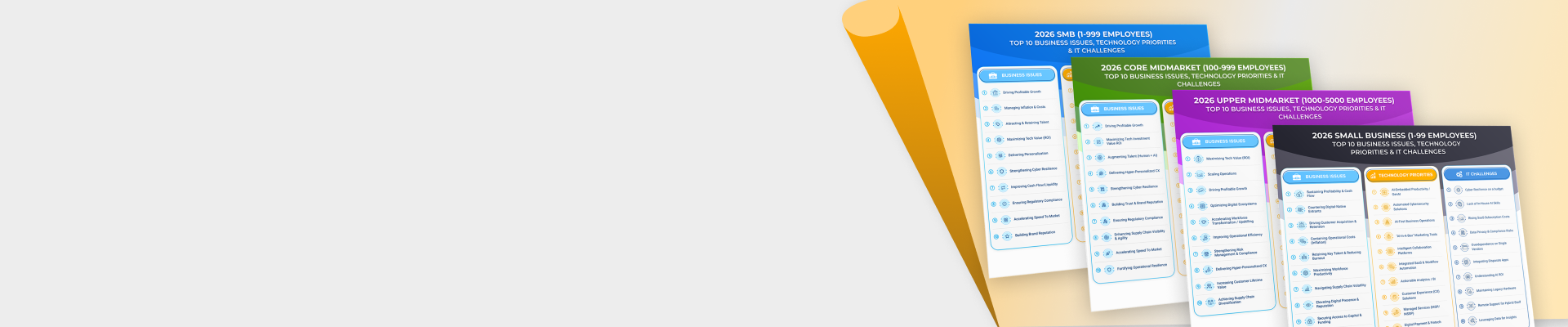
  • 2026 TOP 10 SMB BUSINESS ISSUES, IT PRIORITIES, IT CHALLENGES

    2026 TOP 10 SMB BUSINESS ISSUES, IT PRIORITIES, IT CHALLENGES

  • 2026 TOP 10 SMB PREDICTIONS

    2026 TOP 10 SMB PREDICTIONS

    SMB & Midmarket: Autonomous Business
    READ
  • 2026 TOP 10 PARTNER PREDICTIONS

    2026 TOP 10 PARTNER PREDICTIONS

    Partner & Ecosystem: Next Horizon
    READ
  • IT SECURITY TRENDS

    IT SECURITY TRENDS

    SMB & Midmarket Security Adoption Trends
    LATEST RESEARCH
  • PARTNER ECOSYSTEM

    PARTNER ECOSYSTEM

    Global Channel Partner Trends
    LATEST RESEARCH

Techaisle Analyst Insights

Trusted research and strategic insight decoding SMBs, the Midmarket, and the Partner Ecosystem.
Anurag Agrawal

Co-Marketing in the Channel: 64% of Partners Say It Works – Here is Why

Co-marketing is one of the most under-invested and under-appreciated tools in the channel enablement stack. Techaisle’s latest global survey (N=4500) of channel partners - spanning partners across revenue tiers, service models, and geographies - makes a data-driven case that should redirect how cloud providers allocate their channel marketing resources.

64% of channel partners report high or very high usage of co-marketing templates. That places co-marketing as the third most desired go-to-market asset in the entire enablement portfolio, behind only solution briefs and email templates, and ahead of TCO/ROI calculators, presentations, whitepapers, and ready-to-use digital campaigns. When nearly two-thirds of the channel actively seek co-marketing tools, the strategic question shifts from whether co-marketing works to why vendors are not building better co-marketing assets.

techaisle channel co marketing

Partners Have Marketing Teams, and They Know How to Use Them

One of the more persistent misconceptions in channel strategy is that partners lack marketing capability and that they are sales-led organizations without the staff or sophistication to execute marketing programs. The data says otherwise.

65% of all partners confirm that their marketing teams regularly use cloud provider GTM assets, rising to 81% among the largest partners. Marketing teams are the second-most frequent consumers of these assets, after sales teams (76%). These are not organizations where marketing is an afterthought or a single person writing blog posts. These are teams that are actively engaged in using vendor-provided tools to drive pipeline, when the tools are worth using. The question is not whether partners have marketing capability. The question is whether vendors are giving those teams assets that match their sophistication.

Anurag Agrawal

The Great Betrayal? Why the Channel is Pivoting from Vendor Allegiance to Buyer Value

For decades, the technology channel has operated on a simple, foundational premise: partnership with the vendor. The model was clear - partners were an extension of the vendor's sales force, armed with vendor certifications, aligned with vendor GTM strategies, and loyal to the brand. Their success was inextricably linked to the vendor's success. Techaisle’s latest channel research, a comprehensive study of 4,115 partners, signals that this era is not just ending; it has already been rendered obsolete by a force that vendors have ironically championed: Artificial Intelligence.

A seismic shift is underway. Partners are quietly - and not so quietly - pivoting their allegiance away from their vendor suppliers and toward the only constituency that matters in the long run: the end customer. This is not about disloyalty. It is about survival and relevance in an AI-driven world. Techaisle research identifies a key trend that should serve as a five-alarm fire for every channel chief: the channel will pivot from vendor dependency to buyer value. This is not a future prediction; it is a present-day reality unfolding in partner business models, technology choices, and investment priorities.

techaisle great betrayal channel blog

The Data Does not Lie: The Anatomy of a Power Shift

The traditional vendor-partner dynamic was built on a dependency on product. Vendors created technology, and partners resold it, adding a layer of service. This created a natural fealty. But the very nature of partner revenue is changing. Techaisle data indicates that partner revenue is now predominantly driven by services, with 53% coming from services versus 47% from product resale. This is a critical tipping point. When a partner's profitability is driven more by their own expertise and intellectual property (IP) than by the margin on a vendor's product, their strategic calculus fundamentally changes.

This is where AI becomes the great accelerator of independence.

Tags:
Anurag Agrawal

MSPs and the Cloud: A Successful Partnership or Not

Techaisle’s survey of 2115 partners shows that while many VARs offer managed services to their customers, only a small percentage successfully achieve consistent growth and profitability. In contrast, MSPs have been more successful in their managed services business model and have also begun to achieve success in the cloud. MSPs are well aligned with the business requirements associated with cloud sales. They can act as a logical extension to partner activities by providing discrete services that can be delivered efficiently. However, unique business requirements and partnering practices associated with cloud suppliers have proved challenging for MSPs.

Techaisle data shows that 65% of VARs offer managed services to their customers. Still, only 50%, less than one-third of all VARs, successfully achieve consistent growth and profitability within managed services. The data is similar to 2018. Conversely, 71% of MSPs have succeeded in their managed services business model, and 29% are still striving to achieve profitability and success. Unlike the last several years, MSPs have begun to achieve success in the cloud. 89% of MSPs currently offer cloud, and 72% have achieved cloud success. It is two-thirds of all MSPs, up from less than half in 2018.

Anurag Agrawal

Top 10 Channel Predictions for 2022

techaisle channel partner 2022

The predictions rely on an extensive research initiative conducted throughout 2021 – the year in which the impact of the pandemic on economic activity and IT consumption was becoming more apparent. Leveraging a panel of over 250K partners, Techaisle surveys more than 5000 partners and has qualitative conversations with hundreds of partners. Techaisle's 2022 in Focus research series illuminates issues and requirements in the vast and complex partner ecosystem.

1. Cloud economics and cost optimization consulting will challenge channel
Cloud cost optimization and economics will be the top cloud consulting service demanded by customers, challenging partners (and their vendors) to provide transparency into cloud costs and ensure that customers receive the best available Ts& Cs. To deliver value to the customer, both partners and suppliers will need to define the current state of workloads and a forecast for the future state, adding value through the development and deployment of processes to support cost optimization and compliance/risk management.

2. MSPs will expand their portfolio to include cloud managed services
Cloud technology velocity will open new services opportunities. For example, as businesses will increase their reliance on cloud-managed services to align IT with business strategies, deep-pocketed, progressive MSPs will increase investment in staff training to grow their professional services revenue. As a result, the MSPs will focus on containers (Kubernetes), microservices, open-source, agile development, API management, hybrid cloud workload management, and security and compliance management.

3. The gap between the cloud "haves" and "have nots" will increase
Cloud vendors will invest in cloud channel leaders rather than in the channel as a whole which will accelerate the gap between leaders and laggards and stress the viability of channel firms left behind. As a result, the year will see a separation between channel partners that have the expertise to combine transformative and traditional business models and those that do not.

4. Vendor and partner equilibrium will be unstable
Vendors have been mitigating channel conflicts through "double bubble" compensation models, creating clear guidelines around where the vendor will sell direct and reducing competition between dissimilar channels. However, the complexity associated with cloud consulting and digital transformation adoption acceleration will have vendors questioning the role of partners. Channel partners will be present in several accounts coveted by direct sales teams – increasing vendor/channel conflict. Vendors will manage conflicts and will not eliminate them.

5. The cloud marketplace will be lots of smoke, but the fire is nearer
ISVs and channel partners will have a tough time finding each other and ultimately finding the end customer. Despite low barriers to entry, few will find immediate profitability. Both partners and marketplace operators will need to build and manage relationships, plug into sales and marketing programs, drive investment in the implementation and support for end-users, and fund all of this on a fraction of the monthly fee associated with each service sold. A high percent of end-users will be marketplace curious and not committed customers. It is not how enterprise customers purchase, as yet. Marketplaces will not kill the channel; instead, channel partners will be a vital link in the buyer's journey.

Trusted Research | Strategic Insight

Techaisle - TA