









• TRUSTED RESEARCH

    TRUSTED RESEARCH | STRATEGIC INSIGHT

    SMB. CORE MIDMARKET. UPPER MIDMARKET. ECOSYSTEM
    LEARN MORE
  • INTERWORK 2.0: THE AGENTIC FUTURE OF CONNECTED BUSINESS

    INTERWORK 2.0: THE AGENTIC FUTURE OF CONNECTED BUSINESS

  • 2026 TOP 10 SMB BUSINESS ISSUES, IT PRIORITIES, IT CHALLENGES

    2026 TOP 10 SMB BUSINESS ISSUES, IT PRIORITIES, IT CHALLENGES

  • 2026 TOP 10 SMB PREDICTIONS

    2026 TOP 10 SMB PREDICTIONS

    SMB & Midmarket: Autonomous Business
    READ
  • 2026 TOP 10 PARTNER PREDICTIONS

    2026 TOP 10 PARTNER PREDICTIONS

    Partner & Ecosystem: Next Horizon
    READ
  • ARTIFICIAL INTELLIGENCE

    ARTIFICIAL INTELLIGENCE

    SMB & Midmarket Analytics & Artificial Intelligence Adoption
    LEARN MORE
  • IT SECURITY TRENDS

    IT SECURITY TRENDS

    SMB & Midmarket Security Adoption Trends
    LATEST RESEARCH
  • BUYERS JOURNEY

    BUYERS JOURNEY

    Technology Buyer Persona Research
    LEARN MORE
  • PARTNER ECOSYSTEM

    PARTNER ECOSYSTEM

    Global Channel Partner Trends
    LATEST RESEARCH
  • CLOUD ADOPTION TRENDS

    CLOUD ADOPTION TRENDS

    SMB & Midmarket Cloud Adoption
    LATEST RESEARCH
  • FUTURE OF PARTNER ECOSYSTEM

    FUTURE OF PARTNER ECOSYSTEM

    Networked, Engaged, Extended, Hybrid
    DOWNLOAD NOW
  • MANAGED SERVICES RESEARCH

    MANAGED SERVICES RESEARCH

    SMB & Midmarket Managed Services Adoption
    LEARN MORE

Techaisle Analyst Insights

Trusted research and strategic insight decoding SMBs, the Midmarket, and the Partner Ecosystem.
Anurag Agrawal

Dell XPS 13 – Perfection Personified

In 1818, John Keats, the famous romantic lyric poet wrote “a thing of beauty is a joy forever”. Two centuries later I opened the Dell XPS 13 9300 packaging to behold the beauty of a PC notebook. I let the XPS 13 sit on my desk for three days, lest I may spoil the serenity of the frost white / alpine white composite fiber chassis. But use it and review I must.

As an SMB analyst, I decided to evaluate the notebook through two lenses – the SMB and home user. Consumers & SMB employees already overlap in their use of technology usage between work, home, anywhere. Dell XPS 13 is a right-fit for both. The latest model that I am using is Intel 10th Generation i7 (Comet Lake six-core processor), 1TB SSD, 16GB RAM and FHD+ display.

The difference between the new Dell XPS 13 9300 and the older version XPS 13, which I am used to, is like chalk and cheese. Besides look and feel, power and productivity seem to be the core design tenets of the newest model. Productivity enhancement begins with the four-sided InfinityEdge 13.4" FHD+ Touch anti-reflective 500-Nit display. The original 16:9 screen has been replaced with 16:10 which as per Dell has 91.5% screen-to-body ratio. As a result, the 19.5mm bezel at the bottom of the display which used to house the webcam has been reduced to 4.6mm giving the entire screen an edge-to-edge display. PowerPoint and Excel or Excel and Word or PowerPoint and Word are three of the applications that I use side-by-side most often. With the new aspect ratio, I feel that I am successfully tricked into achieving better productivity because of more screen real estate. Working from home, my XPS 13 notebook is usually connected to Dell UltraSharp 27-inch monitors via a Dell dock but I remain productive even during my occasional trips to other rooms of my home (in the absence of travel). When I have to look at data all day long, full screen brightness works great for me – both indoors and outdoors.

In addition to a taller display, the edge-to-edge keyboard with larger keycaps and touchpad add to a productive experience. The left and right arrow keys are full-size, bigger than in previous models but the up and down arrow keys are still annoyingly narrow and tiny. The page up and page down keys are gone but I do not miss them. Normal travel of the keys makes for comfortable typing for both one-finger and ten-finger typists. The keyboard backlight is nice but the color against composite alpine keyboard deck threw me off initially because the contrast is unnoticeable. There is a slightly higher light bleed under the “U” key than other keys which leads me to believe that all keys may not be seated uniformly. But I am just nitpicking. It does not in any way hinder the performance, likeability and experience of the notebook. After many days of use I have managed to reprogram my muscle memory to look for delete key one space to the left because its rightful place has been taken over by the power button / fingerprint reader (which is easy to reach, perfect size and not bothersome and incredulously placed on the side in the Dell Latitude 7390). The glass touchpad is not only smooth but is also big in a small-sized notebook. In the absence of left-right click buttons the physical switch works great for me which I prefer over a haptic sensor (present in some PC brands). The ample space for palm rest is one of the best experience design elements of the keyboard.
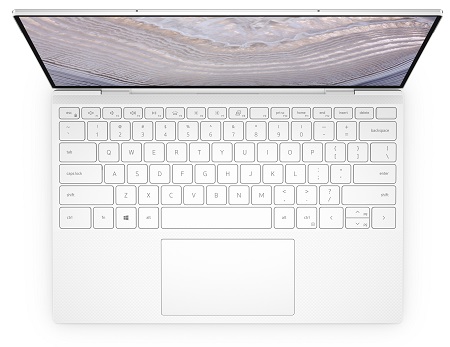
xps 13 white keyboard view resized

Anurag Agrawal

Look back on US SMB PC purchase intentions

Look back

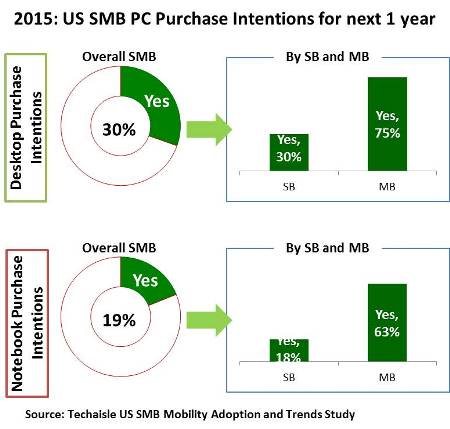
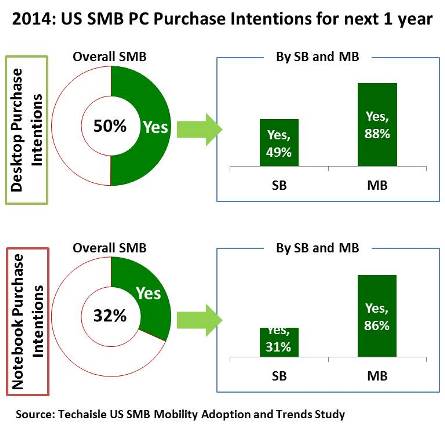
As is the case in each year’s SMB research, Techaisle SMB survey respondents are asked to detail their plans for acquisition of different types of client devices. Two of the major categories investigated by the surveys are desktop PCs and notebook PCs. To establish a baseline understanding of PC use and demand, Techaisle asks SMB respondents to specify the number of endpoint devices that are currently in use within their companies, and then asks them to specify the quantity that they are planning to buy over the next twelve months. To provide actionable insight to our clients, the question asks separately about desktop PCs, notebook PCs and tablets. While 2016 survey is in the field it is worth looking at the trends of last two years. In 2014, both the US small and midmarket businesses were bullish about new desktop and notebook purchases. But in 2015, the percent of US SMBs planning to buy PCs had dropped by 40% from 2014 for both desktops and notebooks. However, although the average number units of desktops planned to purchase dropped from 2014 to 2015 the average number of notebooks planned to purchase increased substantially from 2014 to 2015.

2014-us-smb-pc-purchase-intentions-techaisle

2015-us-smb-pc-purchase-intentions-techaisle

Many desktop buyers were motivated to replace existing units because they were reaching end-of-life and take advantage of Windows XP upgrade path. Desktops are also more of a planned/budgeted item than other client form factors (notebooks, tablets), meaning that desktop acquisitions are more likely to appear in formal purchase plans than the mobile units, and less likely to be acquired on an ad hoc basis. Notebooks are usually ad hoc purchase items – meaning that they would be underrepresented in research of this sort relative to desktops. Additionally many users upgrade their notebooks over time (to replace damaged units, to get features like touchscreen, to obtain lighter or smaller products, etc.).

However, corporate purchase intentions do not provide a complete perspective on mobile device acquisitions.

Potential Impact of BYOD on US SMB PC Purchases

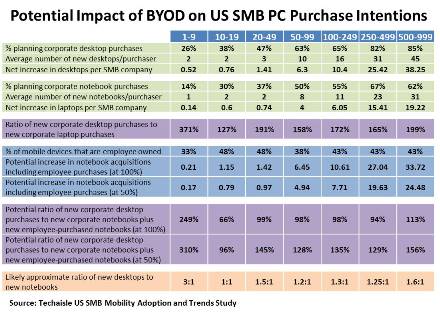
Figure below presents a perspective on corporate purchase plans and the impact of employee purchases of notebooks. The top two sections of the table, shaded in green, illustrate the proportion of businesses by employee size reporting desktop and/or notebook purchase intentions, and the number of units that they plan to acquire. These figures are used to prepare a “net increase” figure – the average number of new units expected to be deployed by businesses in each employee size category. These two grey sections are followed by a line of percentages, shaded in purple, which shows the ratio of corporate desktop purchases to corporate notebook acquisitions. It shows that microbusinesses with 1-9 employees are much more likely to be buying desktops than notebooks, and that other SMBs are planning to buy 25% to 99% more desktops than notebooks.

potential-impact-of-byod-on-smb-pc-purchase-intention-techaisle

The next section of the table, shaded in blue, begins with the BYOD penetration statistics that appear at the bottom of the figure. It then calculates the impact on notebook purchase intentions if this ratio is fully reflected in notebook purchases (the “at 100%” line) and if employees were to buy notebooks at half of the BYOD penetration rate (“at 50%), showing both corporate and employee purchases of these devices. These revised figures are used to calculate the desktop to notebook PC purchase proportions shown in the second set of purple-shaded cells. Here, we see that if employee purchases of notebooks are equivalent to current BYOD penetration levels, new notebook units would be about equal to new desktop purchases in most employee size segments, while a 50% scenario would result in ratios ranging from about 1:1 to 1:6 in all but the smallest employee size category.


Davis Blair

SMB IT Spend: Emerging Markets Push European Countries down the Rankings

Top 10 SMB IT Market Rankings by CountryIn the first part of a three-part series, this post examines the growth of BRIC SMB IT markets, and their ranking relative to other markets. Here we will discuss the Top 10 markets from an SMB IT Spending perspective, and while it is well known that emerging markets grow faster from a smaller base, the absolute rankings of large markets tend to be relatively stable except in the case of exceptional growth, making it an important milestone. This is the case for China, in this forecast as it replaces Germany in its’ longstanding position of the third largest SMB IT Market. Other changes in ranking are that Brazil replaces Italy, and India comes into the Top 10 by the end of the forecast period. Korea displaced Australia as #10 in 2011 and manages to stay within the group throughout the forecast. The primary reason for this displacement is similar to that of other economic segments: sheer volume increase based on population and higher GDP per capita.

According to this Forbes article, the equity value of the BRIC economy financial markets peaked at 18% of the global value in mid-2011, and grew four-fold in the previous ten years. As a general rule, technology adoption lags economic growth and depends on many factors. This accounts for the slower climb up the rankings when compared with the overall economy, and is exacerbated by the fact that SMB IT adoption radiates from Tier 1 Cities to Tiers 2 and 3 as infrastructure allows.

China and Germany SMB IT Market ComparisonEven so, we can see the fundamental differences in the market structures between Germany and China shown in this graph, despite the huge volume increase in China. Germany demonstrates a much more mature mix of IT products and services, weighted toward value-added segments of Software and Services, while the China market remains very hardware centric; almost half the opportunity is still hardware devices by the end of the forecast period. However, China is different than many other emerging markets because it is not only strategic as an end user market, it is also critical as a supplier to the world and to its’ own domestic market. The history of the IT market in Asia Pacific, especially since introduction of the standard PC architecture, has been a race between US brands and local manufacturers whose production is adopted in the domestic market through osmosis along with cultural and distribution advantages. In the case of China, this is more serious as it becomes an increasingly important global segment; on one hand there is a push to open the market while on the other US giants like Apple, IBM, Intel and Microsoft become more reliant on the Chinese Consumer and Enterprise IT markets.

There will be increasing international pressure to make sure there is a “level playing field” in China, as we have seen from initial forays like the Huawei controversy earlier this year. PC maker Lenovo is going very strong in the global market, having reached the #1 vendor in unit shipments worldwide in a relatively short period of time, and snatching three times more domestic market share than the nearest competitor. Lenovo and Huawei have also pushed Apple to sixth place in the Chinese mobile handset market, despite Apple manufacturing tens of millions of handsets and tablets in China. Welcome to the global economy.

Anurag Agrawal

SMB Purchase Intentions for Android PCs

29 percent of SMBs say that PC OEMs should offer Android OS PCs; 5 percent intent to purchase

Techaisle’s recent survey of SMBs in North America (UK, Australia data coming in March; China, India in April) suggests that the PC may be returning to its roots as a window to broader resources, less important as a content creation machine than as a portal to cloud-based systems. In the survey on SMB end-point device adoption trends, respondents were asked to use a scale to indicate the kinds of PCs that they would like to see from their PC suppliers: a “1” response indicated that they required only Windows-based PCs, a “10” indicated that they required only Android-based PCs, and responses towards the middle of the scale indicated a preference for choice between the two platforms.

techaisle-smb-android-pc-adoption-blog

The data shown in the graphic indicates that Windows is clearly still the #1 choice for PC buyers – but it also shows that many small and mid-market businesses are interested in having an Android alternative. 29 percent of SMB respondents said that PC vendors should offer Android OS based PCs.  In fact, in a follow-up question, 5 percent of small businesses and 18 percent of mid-market businesses stated that they would “most definitely” be interested in acquiring Android-based PCs. Almost twice as many BDMs (Business Decision Makers) as ITDMs (IT Decision Makers) are in the “most definitely” group.

What’s behind this? It’s very likely that Android-based PCs may not have the same level of capability as Windows-based PCs – but we can assume that buyers at SMBs understand this, particularly the traveling business decision makers. It appears that they are indicating that the needs associated with ‘personal productivity’ in a cloud-based world are changing, that in many cases, the PC is primarily a window into resources located elsewhere, and secondarily, a content-creation device.

The PC in 2014: more like the windshield than the engine

The PC has been a ‘content creation’ device in world dominated by consumption-oriented smartphones and tablets. Is its position eroding?

In the very early days (the 1980s), PCs in business led a dual existence. Especially in technology-poor small businesses, PCs provided access to tools like spreadsheets that allowed for automation of previously-manual, hard-to-manage tasks, while in larger enterprises, they were often used as terminal emulators – essentially, windows to larger systems offering the added bonus of local processing power.

Through time, the PC became the key personal productivity tool for staff in all industries, working for organizations of all sizes. In recent years, though, the PC’s pre-eminence has been assailed by the growing use of smartphones and tablets that offer limited local processing power, but access to the vast resources of the Internet. In many environments – and in the usage patterns of many ‘multi-screen’ workers who can choose between a PC, a smartphone and a tablet for a specific task – the PC has become niched as a ‘content creation’ device, useful for building presentations or spreadsheets or complex documents, but awkward for on-demand display of these kinds of content.

Good news for the monkeys. Whither the gorilla?

An increasing market for Android-based PCs would be hugely advantageous for companies that produce tools for Android users, and especially, for providers of open-source Office suites such as FreeOffice, OpenOffice and Kingsoft. However, it is Techaisle’s belief that the availability of a fully-functional version of Microsoft Office on Android will be essential for broad Android PC success, as many businesses require these applications for local PC activities.

How should Microsoft react to these market trends? On the one hand, delivering a complete version of Office for the Android platform would open up an enormous market opportunity, giving Microsoft the potential to continue positioning Office as the lynch-pin connecting PCs and content creation. On the other hand, Android’s gains in the PC market will come directly at the expense of Windows 8, diminishing Microsoft’s control of the platform, and accelerating Windows sales declines in an already-soft PC market.

There are likely widely-divergent views on this issue in Redmond. It is worth noting, though, that even a firm as omnipresent as Microsoft takes on risk if it attempts to thwart buyer demand for new technology. The “third hand” in the dichotomy above – that Microsoft continues not to offer full Office functionality for Android, that FreeOffice, OpenOffice, Kingsoft or something similar become embraced as ‘good enough,’ and that large swaths of the market decide they can live without Windows and Office – is clearly a nightmare scenario. We expect that as user demand mounts, Microsoft will feel increasingly-compelled to participate aggressively within the Android PC market segment, even as it touts the advantages of Windows within its native PC constituency, and as an alternative to Android (and iOS) in the smartphone and tablet environments.

More detailed data on end-point device preferences is available in Techaisle’s upcoming report titled “SMB End-Point Device Adoption Trends: Tablets, PCs, Smartphone” which covers:

    • Current and Planned purchase Intentions of client devices


    • Tablet OS & Application adoption – Behind the Screen


    • BYOD: Employers vs. Employees


    • Across the OS generations: XP, Windows 8 refresh intentions


    • New OS PCs: Chromebook, Android


    • Converged Mobility PCs: 2-in-1 PCs


    • Purchase Channel and Sources of Information


More details about the report can be found here

Related Research Articles

Techaisle survey data shows BYOD is a major force in the US SMB Market

Seven Key Trends and their Meaning: SMB Endpoint Device Market in 2014

Key Attributes of Successful SMB Mobility Solutions

Trusted Research | Strategic Insight

Techaisle - TA