









• TRUSTED RESEARCH

    TRUSTED RESEARCH | STRATEGIC INSIGHT

    SMB. CORE MIDMARKET. UPPER MIDMARKET. ECOSYSTEM
    LEARN MORE
  • INTERWORK 2.0: THE AGENTIC FUTURE OF CONNECTED BUSINESS

    INTERWORK 2.0: THE AGENTIC FUTURE OF CONNECTED BUSINESS

  • 2026 TOP 10 SMB BUSINESS ISSUES, IT PRIORITIES, IT CHALLENGES

    2026 TOP 10 SMB BUSINESS ISSUES, IT PRIORITIES, IT CHALLENGES

  • 2026 TOP 10 SMB PREDICTIONS

    2026 TOP 10 SMB PREDICTIONS

    SMB & Midmarket: Autonomous Business
    READ
  • 2026 TOP 10 PARTNER PREDICTIONS

    2026 TOP 10 PARTNER PREDICTIONS

    Partner & Ecosystem: Next Horizon
    READ
  • ARTIFICIAL INTELLIGENCE

    ARTIFICIAL INTELLIGENCE

    SMB & Midmarket Analytics & Artificial Intelligence Adoption
    LEARN MORE
  • IT SECURITY TRENDS

    IT SECURITY TRENDS

    SMB & Midmarket Security Adoption Trends
    LATEST RESEARCH
  • BUYERS JOURNEY

    BUYERS JOURNEY

    Technology Buyer Persona Research
    LEARN MORE
  • PARTNER ECOSYSTEM

    PARTNER ECOSYSTEM

    Global Channel Partner Trends
    LATEST RESEARCH
  • CLOUD ADOPTION TRENDS

    CLOUD ADOPTION TRENDS

    SMB & Midmarket Cloud Adoption
    LATEST RESEARCH
  • FUTURE OF PARTNER ECOSYSTEM

    FUTURE OF PARTNER ECOSYSTEM

    Networked, Engaged, Extended, Hybrid
    DOWNLOAD NOW
  • MANAGED SERVICES RESEARCH

    MANAGED SERVICES RESEARCH

    SMB & Midmarket Managed Services Adoption
    LEARN MORE

Techaisle Analyst Insights

Trusted research and strategic insight decoding SMBs, the Midmarket, and the Partner Ecosystem.
Anurag Agrawal

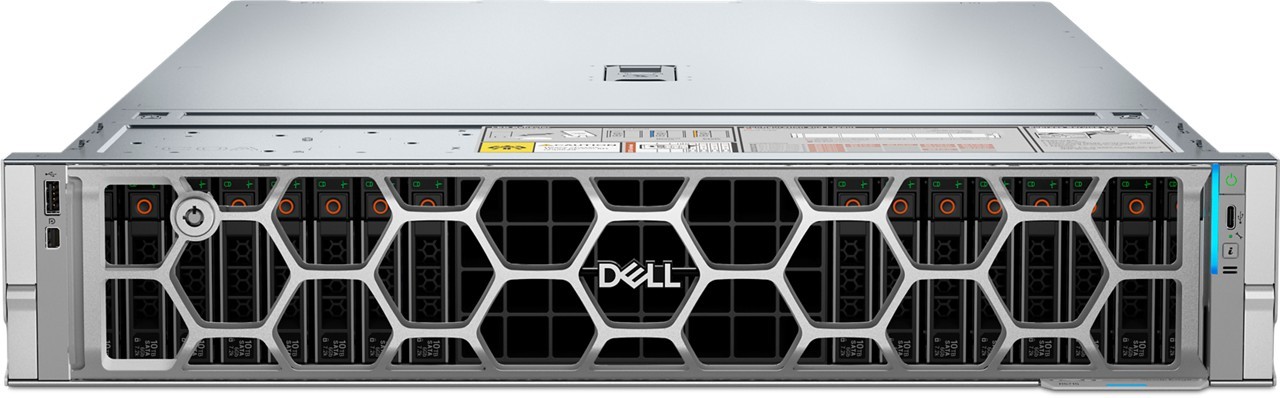
Dell PowerEdge with AMD: The Engine Fueling the Mid-Market's On-Premises Renaissance

Techaisle Research Highlights: The Mid-Market Infrastructure Shift

  • The Cloud Shift: 72% of mid-market firms now report that on-premises hardware delivers lower, more predictable TCO for stable workloads compared to the public cloud.
  • Security & Control: 76% of firms prioritize direct data oversight to mitigate the $11.1 million average cost of a security breach.
  • The "Socket Tax" Advantage: Transitioning to high-density, single-socket Dell PowerEdge servers with AMD EPYC processors is driving a 25-40% reduction in VMware licensing fees for interviewed firms.
  • Operational Speed: Modernizing on-premises infrastructure has yielded a 30-40% acceleration in data analytics workflows.

For nearly a decade, the IT industry has been guided by a single, powerful narrative: cloud-first. This approach championed the public cloud as the default destination for all workloads. It promised unparalleled agility, scalability, and operational simplicity. While the cloud has undeniably delivered transformative value, our recent, in-depth interviews and research with mid-market firms reveal that mid-market IT leaders are hitting the brakes on cloud-only strategies. The simplistic cloud-first edict is giving way to a more sophisticated, business-driven strategy: workload-first.

Mid-sized enterprises find themselves at a strategic crossroads. They face enterprise-level demands - from burgeoning data volumes and stringent compliance mandates to escalating real-time operational needs - often without the corresponding enterprise-scale resources. As they mature in their cloud journey, they are discovering that a wholesale commitment to the public cloud can introduce its own challenges, including rising and unpredictable costs, performance inconsistencies for critical applications, and persistent concerns about data sovereignty and control.

This has sparked a renaissance for modern on-premises infrastructure. It is no longer a legacy choice.  Instead, it serves as a strategic foundation for control, performance, and cost-predictability. The discussion is no longer a binary choice between cloud vs. on-premises, but a more intelligent dialog about architecting the optimal hybrid environment in which each workload resides where it runs best. At the heart of this shift, solutions like Dell PowerEdge servers with AMD EPYC™ processors are emerging as the critical enablers of this balanced, future-ready approach.

dell amd

Anurag Agrawal

Analyst Take: Why Dell’s AI-Powered 'Demand Signals' and Collaboration Tools Are the New Standard for Partner GTM

As an analyst who has covered the IT channel for decades, I will admit I have become somewhat cynical about "partner marketing." Too often, the term describes a tired playbook of top-down MDF, generic portal assets, and thinly-veiled lead-gen programs that dump low-quality contacts into a partner's CRM, wasting valuable sales cycles. I have been openly critical of many vendor programs in the past, including Dell’s, for failing to grasp the new realities of the channel fully.

Techaisle research consistently shows that partners are at a critical inflection point. The old "trusted advisor" model is evolving. Partners are being asked to pivot from "vendor dependency to buyer value", focus on "deep real-project skills" (specialization), and fundamentally "rethink the funnel" to target buyers before they make a decision. All this, while trying to navigate the "double-edged sword" of Artificial Intelligence.

It is a tall order. And frankly, most vendors are not helping.

That is why a recent detailed briefing and discussions I had with Dell on their partner intelligence program were, to put it plainly, genuinely illuminating. What Dell’s partner marketing has built is not just another lead-gen tool. It is a sophisticated, AI-driven intelligence engine designed to solve the channel's most pressing modern challenges. It is one of the most advanced and impressive partner-facing systems I have seen from any vendor, and it is at a level of maturity far beyond its competitors.

For Dell partners, my message is simple: listen up and take advantage. For other vendors, take notes. This is the new bar.

techaisle dell partner marketing 650

It’s Not "Leads," It's "Demand Signals"

Tags:
Anurag Agrawal

Dell Leads the Way with Simplified PC Branding, Cutting Through the Confusion

In the ever-evolving world of personal computing, one thing has become abundantly clear: the market is saturated with confusing branding schemes from PC OEMs. The result? Decision paralysis for customers. At least, in the context of SMBs and Midmarket firms, Techaisle research finds that for 72% of firms, choice and complexity create decision inertia.  Dell Technologies, however, is taking a bold step forward, cutting through the noise with a new, simplified branding strategy designed to make choosing the right PC easier than ever before. This isn't just about a name change; it's about creating clarity, building trust, and leading the industry towards a future where technology is accessible and straightforward.

The Problem: PC Brand Overload

For too long, users have been bombarded with a bewildering array of PC brands, each with seemingly arbitrary naming conventions. The sheer number of brands, models, and features can make it incredibly difficult to discern which PC is the right fit. It's like walking into a grocery store with 50 brands of cereal, each with its own unique box and promises, making a simple breakfast decision an exhausting task.

This confusion creates what I call "decision inertia." Faced with too many options and not enough clarity, customers postpone their purchase or, worse, opt for a PC that doesn't truly meet their needs. This hurts both customers and PC manufacturers, which is a sign that the industry needs a change.

Dell’s Solution: A Clear Path Forward

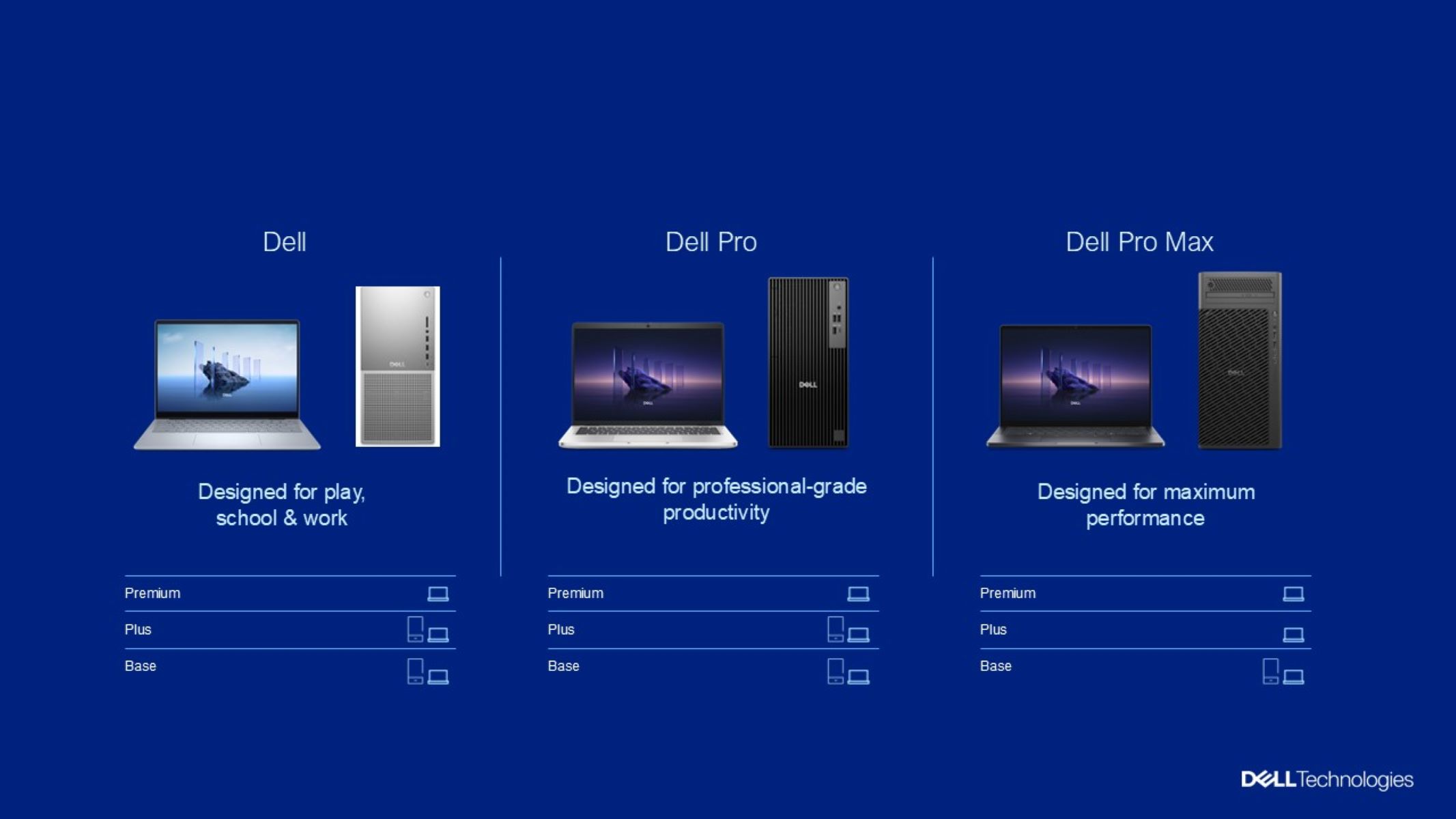
Dell's new branding strategy is a breath of fresh air in this chaotic landscape. Instead of adding to the confusion, Dell is simplifying its portfolio into three clear and distinct PC categories:

  • Dell: This category is designed for everyday users, encompassing laptops and desktops suitable for personal use, education, and light professional tasks. It's the "go-to" for reliable and affordable computing for individuals and families.
  • Dell Pro: This tier caters to professionals and businesses that require robust and secure devices for productivity and collaboration. This category offers laptops and desktops with enhanced security, durability, and manageability.
  • Dell Pro Max: This top-tier category is built for power users and demanding professionals who need maximum performance and cutting-edge technology. The Dell Pro Max lineup comprises high-performance workstations and laptops for complex workloads like content creation, data analysis, and scientific research.

This streamlined approach is more than just a name change. It is a commitment to providing customers with a clear understanding of what each category offers, making the buying experience more intuitive and less overwhelming. Putting the trusted "Dell" name front and center builds on decades of PC innovation and trust.

dell branding with tiers

The Merits of Simplified Branding

The move to a simplified branding strategy offers many benefits, not just for customers but also for Dell itself:

Tags:
Anurag Agrawal

A Comprehensive Look at Dell AI Factory and Strategies for AI Adoption

The rapid pace of AI innovation, coupled with the complexity of implementation, creates challenges for many businesses. Concerns around data security, intellectual property, and the high costs of running and managing AI models further complicate their AI journey. This is where Dell steps in, leveraging its extensive expertise in AI and innovative solutions to help businesses navigate these challenges. The company focuses on developing data management solutions, launching powerful computing hardware, and building partnerships to ensure businesses are equipped for the demands and opportunities of AI.

As part of its commitment to democratizing AI, Dell unveiled the Dell AI Factory at the recent Dell Technologies World (DTW) conference in May 2024. This unique initiative stands out for providing customers access to one of the industry's most comprehensive AI portfolio, from device to data center to cloud. The AI Factory, a distinctive combination of Dell's infrastructure, expanding partner ecosystem, and professional services, offers a simple, secure, and scalable approach to AI delivery. Its objective is to integrate AI capabilities directly within data sources, transforming raw data into actionable intelligence and thereby enhancing business operations and decision-making processes. In addition, Dell announced new channel programs to foster collaboration and accelerate AI adoption, recognizing the vital role of channel partners in driving revenue. With Dell's AI Factory, businesses can confidently embark on their AI journey, knowing they have a trusted partner to guide them every step of the way.

Understanding the AI Factory

To adopt AI on a large scale, a robust infrastructure is crucial. Conventional IT setups designed for regular computing often struggle to meet the complex demands of AI workloads. This is where the concept of an AI Factory becomes significant. Picture it as a specialized center with powerful computing systems, advanced data processing tools, and a team of AI experts. The AI Factory is designed to streamline AI solutions' development, deployment, and scaling, making it easier and faster. By consolidating these elements, an AI Factory ensures that AI innovations can be swiftly created and applied, reducing delays and increasing efficiency, thereby simplifying the complex process of AI deployment for businesses. With Dell's AI Factory, businesses can feel relieved of the implementation challenges, knowing they have a trusted partner to guide them every step of the way.

The Dell AI Factory simplifies AI deployment by offering essential components like servers, storage, and networking in one place. This streamlined approach eliminates the need for businesses to find and combine these components separately – and ensures they work well together, saving significant time and resources. Customers also gain access to Dell's AI expertise and a reliable ecosystem of partners. This comprehensive solution empowers businesses to choose from individual products or create custom configurations to fit their AI needs. The Dell AI Factory also offers different consumption models, including purchases, subscriptions, and as-a-service options, providing businesses the flexibility to adopt AI at their own pace. With Dell's comprehensive AI portfolio, businesses can feel secure knowing they have all the tools they need for successful AI adoption.

The Dell AI Factory is not just a collection of products. It is a comprehensive solution designed to simplify AI integration for businesses of all sizes.  Whether a business, like SMBs, is starting small with PCs or deploying AI across a server network, the Dell AI Factory equips the customers with the tools and expertise to achieve real-world results.

This powerful combination of high-performance infrastructure, industry-leading services, and deep AI knowledge can empower businesses to embrace AI confidently.  The Dell AI Factory goes beyond just hardware, offering a complete package that simplifies the entire AI adoption process, making Dell a key player in accelerating real-world AI applications. 

dell ai factory slide sg v6

Dell AI Factory Infrastructure

Training and deploying AI models require significant computational power and vast datasets. While convenient for many businesses, public cloud solutions can become expensive for these resource-intensive tasks and introduce security risks and the potential for IP infringement. Businesses increasingly seek on-premises solutions for greater control over data and resources and cost optimization. The Dell AI Factory addresses these challenges by providing a robust foundation built on Dell's core strengths in infrastructure solutions—servers, storage, data protection, and networking. This robust infrastructure delivers the necessary computational muscle and storage capacity for AI workloads.

Trusted Research | Strategic Insight

Techaisle - TA