










Techaisle Analyst Insights
Dell PowerEdge with AMD: The Engine Fueling the Mid-Market's On-Premises Renaissance
Techaisle Research Highlights: The Mid-Market Infrastructure Shift
- The Cloud Shift: 72% of mid-market firms now report that on-premises hardware delivers lower, more predictable TCO for stable workloads compared to the public cloud.
- Security & Control: 76% of firms prioritize direct data oversight to mitigate the $11.1 million average cost of a security breach.
- The "Socket Tax" Advantage: Transitioning to high-density, single-socket Dell PowerEdge servers with AMD EPYC processors is driving a 25-40% reduction in VMware licensing fees for interviewed firms.
- Operational Speed: Modernizing on-premises infrastructure has yielded a 30-40% acceleration in data analytics workflows.
For nearly a decade, the IT industry has been guided by a single, powerful narrative: cloud-first. This approach championed the public cloud as the default destination for all workloads. It promised unparalleled agility, scalability, and operational simplicity. While the cloud has undeniably delivered transformative value, our recent, in-depth interviews and research with mid-market firms reveal that mid-market IT leaders are hitting the brakes on cloud-only strategies. The simplistic cloud-first edict is giving way to a more sophisticated, business-driven strategy: workload-first.
Mid-sized enterprises find themselves at a strategic crossroads. They face enterprise-level demands - from burgeoning data volumes and stringent compliance mandates to escalating real-time operational needs - often without the corresponding enterprise-scale resources. As they mature in their cloud journey, they are discovering that a wholesale commitment to the public cloud can introduce its own challenges, including rising and unpredictable costs, performance inconsistencies for critical applications, and persistent concerns about data sovereignty and control.
This has sparked a renaissance for modern on-premises infrastructure. It is no longer a legacy choice. Instead, it serves as a strategic foundation for control, performance, and cost-predictability. The discussion is no longer a binary choice between cloud vs. on-premises, but a more intelligent dialog about architecting the optimal hybrid environment in which each workload resides where it runs best. At the heart of this shift, solutions like Dell PowerEdge servers with AMD EPYC™ processors are emerging as the critical enablers of this balanced, future-ready approach.
The Business Imperatives Driving the On-Premises Resurgence
To understand this strategic shift, we must look beyond technological preferences to the concrete business drivers shaping infrastructure decisions in the mid-market. Techaisle research identified data security and control as the paramount concern, with 76% of mid-market firms prioritizing direct oversight of their data amid complex regulations and escalating cyber threats. This focus is sharpened by the staggering $11.1 million average cost of a security breach, making robust, on-premises security a critical defense.
Financial predictability is another key driver, as 72% of firms now believe that for stable workloads, on-premises hardware delivers a lower, more predictable TCO, avoiding the "cloud bill shock" from volatile fees. This is complemented by the need for performance, with 64% of leaders prioritizing the consistent, low-latency computing required for mission-critical applications.
Beyond these top factors, regulatory pressures also play a significant role. For 59% of firms, on-premises infrastructure provides the most straightforward path to meeting stringent data sovereignty laws, such as HIPAA and GDPR, as direct control simplifies audits and reporting. Furthermore, 41% of companies with large datasets face the challenge of data gravity. The high costs and slow performance associated with transferring petabytes of data from the cloud make on-premises processing a far more efficient and cost-effective choice.
Right-Sizing Infrastructure with the PowerEdge R4715 and R5715
Dell PowerEdge servers with 5th Gen AMD EPYC processors are purpose-built as a future-ready foundation for evolving workloads, delivering an ideal blend of compute density, power efficiency, and robust security. Far from being rigid legacy systems, they are engineered for versatile deployment - from centralized data centers to distributed edge locations and traditional offices. This modern portfolio offers intelligent, software-defined capabilities that deliver cloud-like agility within a controlled, secure environment.
The latest generation of PowerEdge servers significantly enhances the value proposition for mid-market businesses. Designed with precision, the PowerEdge R4715 and R5715 single-socket servers empower organizations to optimize their infrastructure. These servers are tailored to address specific use cases efficiently, minimizing wasted compute resources and ensuring the firms invest only in the performance that aligns with midmarket needs.
The PowerEdge R4715 is a compact 1U server that fits perfectly into value-conscious organizations and remote office or branch office (ROBO) deployments. It delivers powerful performance in a dense form factor, making it ideal for workloads where physical space and budget are key considerations.
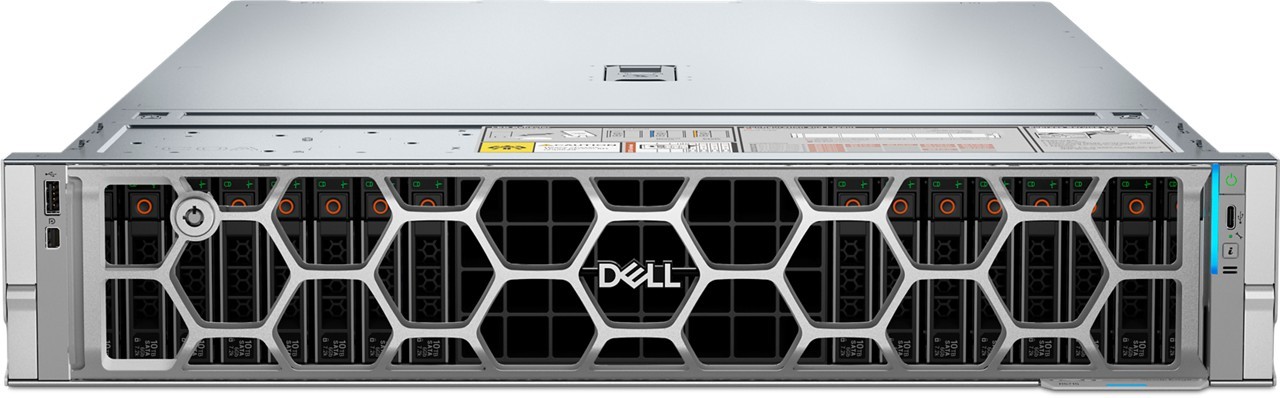
For businesses that require more storage flexibility, the PowerEdge R5715 offers a versatile 2U platform. It provides an excellent balance of compute and high-capacity internal storage. This makes it perfect for software-defined storage (SDS), video surveillance, and data analytics. By leveraging the advanced capabilities of a single AMD EPYC processor, both the PowerEdge R4715 and R5715 enable organizations to achieve performance levels previously only available with more expensive dual-socket systems. This directly impacts both capital expenditures and ongoing operational costs, empowering businesses to do more with less.
Scalability Without Compromise: The PowerEdge R6715 and R7715
As businesses grow, their infrastructure needs evolve. The beauty of the Dell PowerEdge portfolio lies in its scalability. While the R4715 and R5715 offer an incredible entry point for specific workloads, the PowerEdge R6715 and R7715 provide the next tier of single-socket performance for organizations ready to scale further. The PowerEdge R6715 delivers leading-edge performance in a dense 1U chassis. It is designed for high-performance computing (HPC) and dense virtualization environments (for complex financial modeling or manufacturing simulations). It allows organizations to maximize their data center footprint while minimizing energy consumption.
For the most demanding data-centric workloads, the PowerEdge R7715 offers a powerful 2U platform optimized for AI and machine learning training, inference, and complex data analytics. Together, these four servers create a comprehensive, scalable story. A mid-market firm can start with the efficient PowerEdge R4715 for edge locations and scale up to the PowerEdge R7715 for their core AI initiatives, all within a single, secure architecture.
While the technical specifications of the R4715 through R7715 clearly demonstrate architectural flexibility, the true value for mid-market organizations lies beyond compute density and form factors. For IT leaders tasked with navigating enterprise-level demands without enterprise-scale budgets, this unified portfolio directly addresses their most pressing financial and operational challenges.
For mid-sized enterprises, infrastructure selection is rarely about acquiring the maximum possible compute; it is about acquiring the optimal compute. Because these organizations face enterprise-level demands without the corresponding enterprise-scale resources, the granular right-sizing offered by the PowerEdge single-socket portfolio is not just a technical feature - it is a strategic financial lever. Here is why this specific architectural approach is critical for the mid-market:
- Eradicating Overprovisioning and Protecting Capital: Historically, mid-market firms were forced to overbuy dual-socket servers to ensure adequate performance headroom, trapping vital capital in underutilized hardware. By delivering dual-socket performance within a single-socket architecture, the R4715 and R5715 eliminate the need for this overprovisioning. This ensures organizations invest only in the performance that aligns with their immediate needs, fundamentally altering the capital expenditure (CapEx) equation.
- Defeating the Socket Tax: The operational expenditure (OpEx) benefits extend far beyond power and cooling. Software licensing is frequently a dominant data center cost. By relying on a single, high-density AMD EPYC processor, businesses can aggressively avoid the socket tax associated with per-socket software licensing models, delivering immediate and ongoing cost reductions.
- Aligning with the Workload-First Reality: Mid-market organizations are actively migrating away from blanket cloud-first edicts toward precise workload-first strategies. The purpose-built nature of this portfolio enables this precision. Whether deploying an R4715 for space-constrained remote offices or an R5715 for software-defined storage, IT leaders can architect an environment in which each workload resides on the hardware best suited to its demands.
- Avoiding the Forklift Upgrade for Future Workloads: As mid-market firms mature their digital initiatives, their infrastructure must seamlessly adapt without requiring costly, disruptive forklift upgrades. The inherent scalability of this portfolio means a business can start efficiently at the edge with the R4715 and scale up to the R7715 for advanced AI and machine learning initiatives, all while maintaining a single, unified, and secure architecture.
From Architecture to Business Outcomes: The Dell and AMD Advantage in Practice
The compelling business outcomes these companies are achieving are not accidental. Techaisle’s extensive interviews with numerous mid-market firms show a direct link between the architectural innovations in Dell PowerEdge servers with AMD EPYC processors and tangible business value, allowing firms to modernize without disruptive migrations.
One of the most impactful advantages highlighted in these interviews is the economic efficiency driven by AMD's leadership in processor core density. By packing more cores into each socket, organizations can drastically reduce software licensing costs for per-socket platforms, with firms interviewed reporting a 25-40% reduction in VMware fees. This density also enabled massive server consolidation, for example, allowing a single modern server to replace as many as seven older units. This directly lowers TCO, with one company cutting server acquisition costs by 10-15% and another slashing power consumption by 60-70%, saving thousands of dollars per rack each month.
The single-socket design of the PowerEdge R4715, R5715, R6715, and R7715 exemplifies this advantage. By design, this single-socket architecture fundamentally alters software licensing economics while delivering the necessary performance for demanding tasks. This level of granular control is key to achieving the workload-first model. It ensures every application runs on the most cost-effective and performant platform possible.
This efficiency is matched by performance that accelerates core business processes. The superior memory bandwidth and I/O capabilities of AMD EPYC processors, including support for PCIe Gen5, eliminate data bottlenecks for demanding applications. In practice, this translates to significant gains in operational speed, including a 30-40% acceleration in data analytics workflows and a 40% improvement in loan processing times.
Ultimately, this enhanced reliability and control translate into strategic business advantages. For customer-facing operations, improved infrastructure stability is not just a technical metric; it directly impacts the customer experience. Firms have seen a 70-80% improvement in reliability, leading to fewer service outages, which in turn boosts customer satisfaction and reduces support ticket volume by up to 15%. For organizations in regulated industries, such as finance, the clear data sovereignty and straightforward audit trails of an on-premises Dell PowerEdge solution are a crucial asset, simplifying compliance conversations.
The Bottom Line: Workload Realism Over Cloud Dogma
The era of default public cloud deployment in the mid-market is over. Today’s IT leaders can no longer afford to run predictable, data-heavy workloads in environments optimized for unpredictable costs. The deliberate shift back to modern on-premises infrastructure is not a technological regression; it is a calculated financial correction.
By leveraging the high core density and single-socket economics of Dell PowerEdge servers with AMD EPYC processors, mid-market organizations can finally break free from the traditional socket tax and relentless cloud toll booths. This architecture allows IT to match compute precisely to the workload without overprovisioning, turning infrastructure from a cost center into a lever for strict financial control.
For channel partners, the market mandate is clear: value is no longer derived from simply facilitating cloud migrations. The future belongs to strategic advisors capable of architecting mathematically sound, hybrid IT estates. Partners who fail to guide their clients toward the deep TCO advantages of right-sized, on-premises infrastructure will quickly lose relevance to those who do.
Ultimately, infrastructure strategy is now a CFO-level conversation. Winning in the mid-market requires prioritizing data control, operational performance, and rigid cost predictability - and for a growing subset of mission-critical workloads, the smartest path points firmly back to the modern data center.
When you subscribe to the blog, we will send you an e-mail when there are new updates on the site so you wouldn't miss them.