









• TRUSTED RESEARCH

    TRUSTED RESEARCH | STRATEIC INSIGHT

    SMB. CORE MIDMARKET. UPPER MIDMARKET. ECOSYSTEM
    LEARN MORE
  • INTERWORK 2.0: THE AGENTIC FUTURE OF CONNECTED BUSINESS

    INTERWORK 2.0: THE AGENTIC FUTURE OF CONNECTED BUSINESS

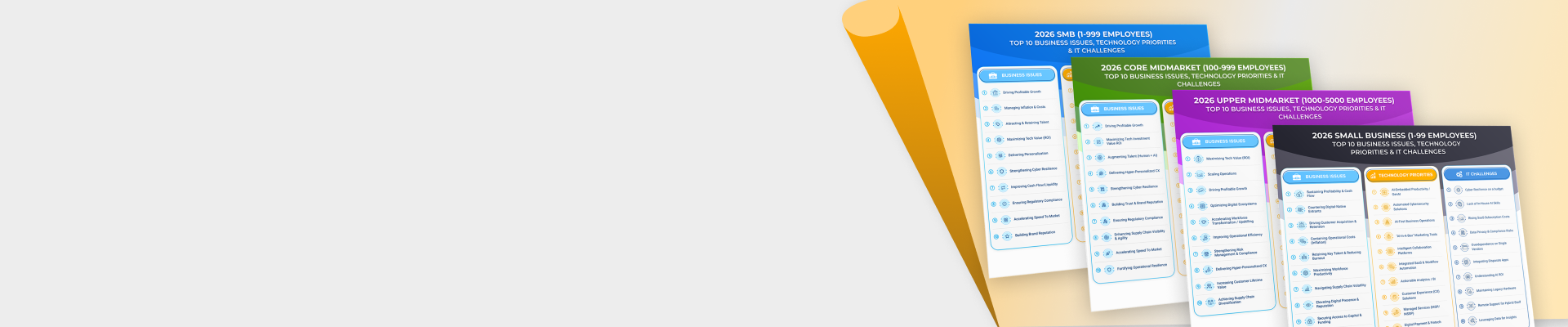
  • 2026 TOP 10 SMB BUSINESS ISSUES, IT PRIORITIES, IT CHALLENGES

    2026 TOP 10 SMB BUSINESS ISSUES, IT PRIORITIES, IT CHALLENGES

  • 2026 TOP 10 SMB PREDICTIONS

    2026 TOP 10 SMB PREDICTIONS

    SMB & Midmarket: Autonomous Business
    READ
  • 2026 TOP 10 PARTNER PREDICTIONS

    2026 TOP 10 PARTNER PREDICTIONS

    Partner & Ecosystem: Next Horizon
    READ
  • ARTIFICIAL INTELLIGENCE

    ARTIFICIAL INTELLIGENCE

    SMB & Midmarket Analytics & Artificial Intelligence Adoption
    LEARN MORE
  • IT SECURITY TRENDS

    IT SECURITY TRENDS

    SMB & Midmarket Security Adoption Trends
    LATEST RESEARCH
  • BUYERS JOURNEY

    BUYERS JOURNEY

    Technology Buyer Persona Research
    LEARN MORE
  • PARTNER ECOSYSTEM

    PARTNER ECOSYSTEM

    Global Channel Partner Trends
    LATEST RESEARCH
  • CLOUD ADOPTION TRENDS

    CLOUD ADOPTION TRENDS

    SMB & Midmarket Cloud Adoption
    LATEST RESEARCH
  • FUTURE OF PARTNER ECOSYSTEM

    FUTURE OF PARTNER ECOSYSTEM

    Networked, Engaged, Extended, Hybrid
    DOWNLOAD NOW
  • MANAGED SERVICES RESEARCH

    MANAGED SERVICES RESEARCH

    SMB & Midmarket Managed Services Adoption
    LEARN MORE

Techaisle Blog

Insightful research, flexible data, and deep analysis by a global SMB IT Market Research and Industry Analyst organization dedicated to tracking the Future of SMBs and Channels.
Anurag Agrawal

Zoho’s Quiet Ascent: Solving the Midmarket’s Valley of Death

The narrative that Zoho is merely a launchpad for startups is not just outdated; it is analytically lazy. For years, I have watched the company systematically lay the foundation for something far more ambitious than just serving the SMB. We are not witnessing a sudden pivot triggered by a press release or a quarterly update. Instead, we are seeing the fruition of a decade-long, deliberate architectural strategy. Zoho has been quietly building the scaffolding for scale, ensuring that when a business outgrows its startup roots, it does not have to uproot its digital operating system. The news here is not a specific feature launch; it is the realization that Zoho has effectively closed the capability gap that once forced growing firms to migrate to bloated legacy enterprise systems. Techaisle’s latest research confirms exactly why this matters: 71% of upper midmarket firms cite "Scaling Operations" as a top business issue, yet they are often held back by "Legacy Modernization Paralysis," which they rank as a top-4 IT challenge. Zoho built a landing zone for these midmarket firms—a place where complexity is managed, not punished.

techaisle zoho midmarket

Anurag Agrawal

Interwork 2.0: The Agentic Future of Connected Business

In 2017, Techaisle introduced the concept of Interwork, predicting that the future of business
would not be defined by the "net" (connectivity) but by the "work" enabled by a ubiquitously
connected platform. We argued that the destination was an "always-on, everywhere
connected Interwork platform" where cloud, edge, applications, and security formed a single
cohesive fabric.

The industry spent the last eight years building that connected foundation. But as we enter 2026, the goalpost has moved. Connectivity is no longer the destination; it is merely the nervous system. The new brain of the enterprise is Agentic AI.

In this new strategic white paper, Techaisle outlines the transition from the Connected Business to the Autonomous Enterprise. We analyze how the seven pillars of IT infrastructure—from the Cloud to the Edge—are evolving from passive "pipes" into active, intelligent participants that perceive, reason, and act.

Download this white paper to discover:

  • The 7 Pillars of Agentic Intelligence: How the "Connected Edge" is becoming the "Agentic Edge" and "Connected Security" is morphing into "Autonomous Defense."

  • The Vision vs. Reality Roadmap: A detailed look at how our 2017 predictions have materialized and where the market is heading for 2030.

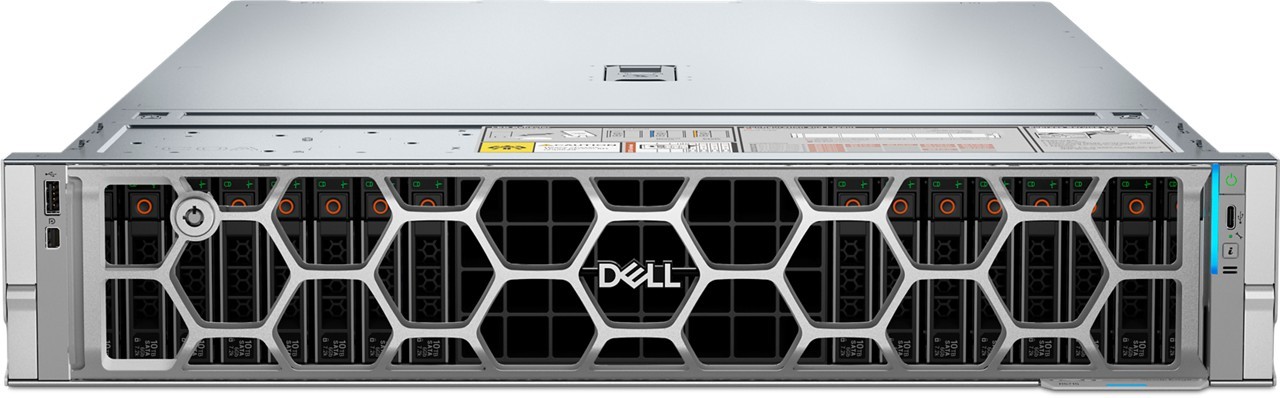
  • The Vendor Ecosystem: A comprehensive map of the "Agentic Grid Architects," "Edge Builders," and "Integrators" (including NVIDIA, Microsoft, Dell, Cisco, and Deloitte) who are powering this shift.

  • The Strategic Pivot: Why CIOs must stop selling "capacity" and start selling "autonomy."

techaisle the agentic future connected business

Anurag Agrawal

The Financial Control Plane: Xero’s High-Stakes Evolution in the Age of Agentic AI

The global small business technology landscape has reached a strategic tipping point. For much of the last decade, the digital transformation of the "back office" was defined by simple cloud connectivity. However, as we navigate 2026, the primary challenge for small businesses has evolved from merely possessing digital tools to integrating them into a coherent operational strategy. In an environment defined by persistent inflation and a global talent shortage, the most valuable asset for any business is no longer just data—it is velocity.

Xero’s H1 FY26 performance, highlighted by a Rule of 40 result of 44.5%, signals a business that has successfully moved beyond the "growth-at-all-costs" phase into a model of disciplined capital allocation. Yet, the recent US$2.5 billion acquisition of Melio and the launch of its AI financial superagent JAX (Just Ask Xero) represent more than just financial milestones; they are a high-conviction bet that the future of business management lies in owning the "Financial Control Plane."

The Velocity of Value: Why Fragmentation is the Real Competitor

Historically, a central critique of Xero was its difficulty in challenging incumbents' dominance in the North American market. The Melio acquisition serves as the definitive strategic answer. By transitioning from a standalone ledger to an integrated bill-pay platform, Xero has effectively bypassed years of organic development to buy market velocity. The result is a pro forma US revenue growth spike of 53% year-over-year—a direct outcome of this force-multiplier effect that finally gives Xero the specialized tools it needs to scale in the region.

For the small business owner, this is not a mere accounting upgrade; it is a direct solution to the "Frankenstein stack." Today’s SMBs are frequently over-tooled yet under-integrated, forced to juggle disparate payment gateways, bank feeds, and reconciliation modules that rarely communicate with one another. By embedding Melio’s technology directly into the core workflow, Xero is positioning itself as the connective tissue of the financial ecosystem. This shift moves the platform from a passive "System of Record" to an active "System of Agency," where the movement of capital occurs in the same environment where it is recorded.

Anurag Agrawal

Kyndryl's Agentic Pivot: Turning Mission-Critical Heritage into an AI-Native Future

As an analyst, I am trained to distinguish between strategic narrative and on-the-ground reality. I have watched Kyndryl’s journey since its spin-off with keen interest, tracking its core strategy of Alliances, Accounts, and Advanced Delivery. At its recent analyst briefing, Kyndryl provided compelling evidence that this strategy, particularly its alliance-led approach, is not just a narrative but a high-velocity revenue engine.

The company has successfully executed one of the most difficult pivots in the industry: shifting its center of gravity from a legacy infrastructure manager to an AI-first, consult-led transformation partner. The results are not trivial. Kyndryl is on a clear trajectory to grow its hyperscaler services revenue from $0.5B in FY24 to a projected $1.8B in FY26. Crucially, this shift implies a fundamental expansion in margin quality, as the company successfully breaks the linear link between revenue growth and labor intensity.

However, this success isn't just about reselling cloud services. The most profound insight from the briefing was the lynchpin for this entire pivot: the new Kyndryl Agentic AI Framework.

techaisle kyndryl write up 650

The Macro View: The End of Traditional Labor Arbitrage

To understand the magnitude of this pivot, we must contextualize it within the evolution of the IT services market. For two decades, the industry operated on a model of labor arbitrage—essentially engaging providers to manage legacy environments at a lower cost by shifting the work to lower-cost geographies. That model is now obsolete. The industry is undergoing a violent shift from labor-centric maintenance to IP-led modernization. "Keeping the lights on" is no longer a viable business strategy; value has migrated to "rewiring the building."

Trusted Research | Strategic Insight

Techaisle - TA