
Michael Dell is one of the very few CEOs I know that walks the hallways with almost no posse of overprotective PR and communications personnel. It was therefore no surprise that in my meeting with him he walked into the room unassumingly and on time to discuss his vision and focus on the Emerging Markets.
Much has been written about how happy and relaxed he looks after privatization. For me, however, the tell-tale signs of tranquility and a zip in his walk first appeared two years ago when he announced Dell’s intent to be an end-to-end solutions provider for businesses of all sizes. He had a roadmap to reach the flag at the end of a long, unpredictable race-track. And he knew that he was at the starting gate with the right set of acquisitions. He just had to make everyone believe in Dell.
Fast forward to present, privatization has emboldened Michael Dell and his entire leadership to take their message on the road that the new Dell is “100% customer focused, providing best value, ease of use & flexibility” aligned to the four tenets of Dell solutions – Transform, Connect, Inform, Protect.
Michael Dell is “Investing to Accelerate” around five key areas, one of which is the emerging markets, the topic of our meeting.
- Invest to expand solution offerings (R&D plus M&A plus Venture Fund)
- Enhance & Simplify customer experience
- Increase pressure in emerging markets around the globe
- Grow PCs, tablets and virtual computing services
- Expand sales force and channel relationships to better serve and support customers
Dell as a company made several major announcements at its recently concluded Dell World 2013:
- Public cloud ecosystem partnerships with Google Cloud, CenturyLink, Microsoft Azure
- Dell Red Hat OpenStack partnership for co-engineered enterprise-grade OpenStack private cloud solutions
- Partnering with Dropbox to enable businesses and their employees work in a mobile work-environment while providing the security and manageability with Dell’s data protection solutions
- Dell FluidCache for SAN storage delivering over 5 million IOPS in a converged infrastructure of storage, server and networking
- Revamped PartnerDirect program giving partners bigger profit opportunity than ever before – access to tens of thousands of Dell accounts
- US$300 million Strategic Innovation Venture Fund to help identify, fund and fuel visionary technologies that anticipate and address future IT needs
Not all of the above announcements are applicable to and can be used by businesses in the emerging markets immediately. Therefore, I began our conversation by asking him if there is a difference in his strategies for established and emerging markets and what top characteristics defined his emerging market strategy. Michael Dell recognizes that in many emerging market countries, there are essentially two markets (upgrade in automated environments, greenfield in businesses that are not yet automated) and therefore he has to gear up to address their needs accordingly and investing in localization of products and services for the emerging market buyers.
Looking back at my discussion with Michael Dell, I see one strategy but three approaches that are critical to Dell’s growth in emerging markets.
PC Led Go-to-market Approach
Regain its hegemony in end-point devices (excluding smartphones): by building innovative end-user computing products at extremely competitive prices. In countries like China, India and Brazil. Dell is aggressively opening its own Dell stores for customers to experience the products first-hand. Michael Dell does not view todays IT landscape as a post-PC era. He reminds me that when the term was first coined in 1999, approximately 100 million PCs were sold, but in 2012 over 300 million were sold, defying the very notion of the PC fading from view. “It certainly is not a post-PC era”, he insists.
Techaisle Take: It is certainly the right entry-point into most businesses. With global PC market slowdown, PC market penetration will continue to be driven by emerging market countries with new business formation and increase in PC to employee density. Our research shows that there are 1.26 billion addressable households in emerging markets but only one in four have a PC. Similarly, there are 44.7 million SMBs in emerging markets, but only two in five have a PC. Both of these figures indicate a huge opportunity for new PC sales as there are still 26.4 million SMBs and 994 million households that have yet to buy a PC – a huge gap indeed. Dell will need to exert more pressure than other PC OEMs in terms of customer pull: creating demand through marketing, and relying on its own stores and channel partners to close prospects after they are engaged.
Many of the emerging market countries are embracing mobility faster than established markets which create unique challenges for Dell to push its Tablets in the face of high adoption of Android and iOS devices. Market share of Android and iOS tablets vs. Win8 would seem stacked against Dell but one should not discount Dell’s expanded tablet portfolio including Android OS and Dell Chromebook plus well-received Win 8.1 tablets. Dell also has had emerging market success with Dell Wyse cloud clients and new opportunities with ultra-mobile cloud devices (Project Ophelia/Dell Wyse Cloud Connect) – all of which create customer entry points for Dell. Additionally, Dell’s mobility strategy extends beyond Dell-branded devices and includes software and services to ensure that any device is secure, manageable and reliable, part of the end-to-end solutions strategy.
Channel Partner Led Go-to-market Approach
Grow with channel partners: Channel partners are the essential cogs of the IT landscape, especially for the SMBs that are so important to PC growth – and this is truer in the emerging market countries than established markets. Dell plans to continue to recruit channel partners that align with Dell’s value proposition and can add business value to a customer’s needs by giving the customers choice of best-of-breed solution components. The recent announcements of the revamped PartnerDirect program and the corresponding re-organization of its channel organization were made to address the changing needs of the channel partners across all geographies. Apart from growing the channel base, Dell is also planning to increase spending on sales/marketing within the emerging markets thereby creating enough pull in the marketplace to enable channel partners not only sell more but also sell more effectively within and across its channel friendly solutions - PowerEdge VRTX, Storage, Networking, Software, Thin Client, Workstations, and SecureWorks. However, not all solutions, especially, software solutions, can be sold without proper localization; Dell recognizes this, and is investing in R&D to make sure that products and solutions are enabled for the emerging market countries.
Techaisle Take: As per Techaisle research there are over 340,000 channel partners in emerging market countries. To support growth Dell has to have a rich landscape and integrated fabric of channel partners that are moving in unison with Dell as its trusted supplier. As Dell moves to create better alignment with the channel, it needs to be mindful of two interesting changes that are occurring within the emerging market channel partner community – members now refer to themselves as solution providers, (not as VARs, SIs, or resellers), and they have started calling their customers “clients” much like a consulting organization would do. To be successful in emerging markets channels, Dell has to capitalize on these changes. It also has to quickly develop a timeline for the roll-out and implementation of its new PartnerDirect Programs and Incentives for countries outside of North America. Dell may not be able to make bold statements of how many accounts have been opened up (similar to the US) for collaborative sales efforts with channels but at a minimum it has still to identify named accounts that are being transitioned to channel-led, and a compensation accelerator to incent direct sales force to work with channel partners.
Solution & Services Led Go-to-market Approach
Provide end-to-end solutions for businesses of all sizes: No end-to-end solution portfolio is complete without software and applications. After a long slog, Dell software is finally coming together with its systems management offerings covering BI for IT, mobility management, data center management, cloud management as well as “connected security” that reduces the seams in a customer’s infrastructure. The software solutions are being complemented by Dell Services (which was given more visibility at Dell World than ever before, with keynote sessions led by services). Dell has achieved some great successes in countries like India within the healthcare segment, but it has still a lot to work on. In emerging markets as in North America, the mid-market segment is the primary target for Dell’s end-to-end solutions. As Michael Dell said, “it is not easy to put feet on the ground effectively and uniformly across all countries”. He also said, “Many new change vectors are going on and Dell has the ability to understand where the puck is going”. Taken together, we at Techaisle view these statements as outlining an approach where Dell will commit resources selectively to high-growth segments within the emerging economies.
Techaisle Take: Dell is almost at the finish line with its converged solutions that include storage, security, servers and networking, the services needed to deliver end-user solutions that help businesses compute in environments with pervasive data access. Growth in sales of this type of sophisticated solutions in emerging markets cannot be cracked without the support of channel partners. Dell has to articulate a message that serves the needs of customers of hybrid solutions that combine server, storage and networking hardware with systems management and security software to seamlessly support application delivery, data protection and backup. By offering a wide range of product types, and focusing on making the selling motion as clean as possible, Dell can enable its partners to focus on customer requirements rather than product silos.
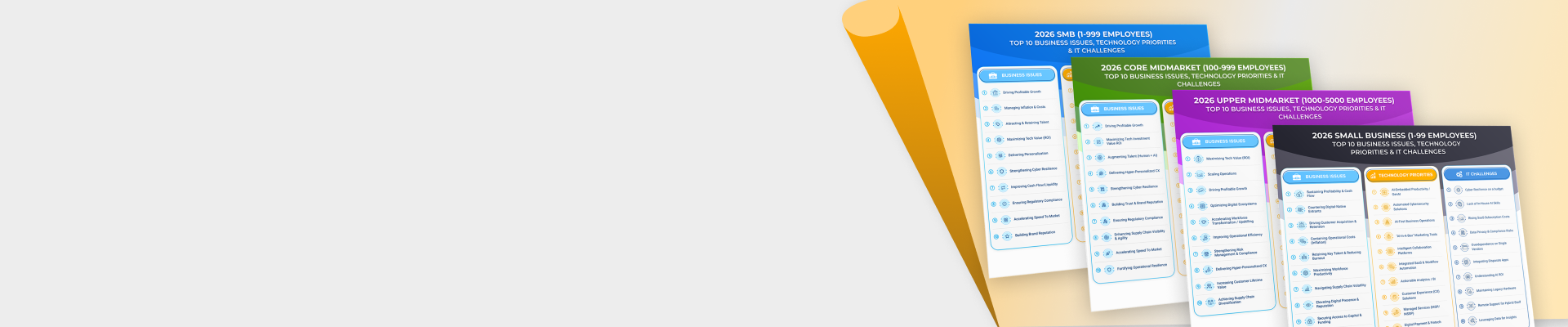
One early indication of the force of this direction is the fact that Dell has finally been able to put a stake into the ground with its cloud strategy. To put forth the point more forcefully Michael Dell said, “When you go with Cloud, go with Dell”. Dell’s mobility strategy has also started to take shape with aggressive roll-out of devices and its EMM (Enterprise Mobility Management) solution that includes both end-point and container management. Dell is still working on its Big Data/Analytics strategy. But more importantly, Dell clearly hits 7 out of Top 10 2014 SMB IT priorities and addresses 7 out of Top 10 2014 SMB IT Challenges. It is also in a strong position to speak to the Top 10 2014 SMB Business Issues.
Final Techaisle Take
Emerging markets are more complex than we usually imagine, having a mix of mature and very immature segments based on local infrastructure. For example, Tier 1 cities are akin to US as a country – they are advanced in their infrastructure development and employment and have a high GDP while Tier 4 cities are fast developing, less populated, in some cases even rural. When we analyze our SMB (a segment that Techaisle tracks globally) survey data across cities we see that SMBs in Tier 1 cities are the early adopters of cloud whereas Tier 3 and 4 cities although aware of cloud are constrained in their adoption by channel competency and vendor penetration. Reliable and high quality bandwidth is a critical factor in bringing the benefits of cloud to local business, one that underscores the importance of central government investment in telecommunications infrastructure and Internet access. Dell recognizes these challenges and short-comings, and the new Dell is primed to aggressively address the challenges.
There is yet no clear leader in the emerging markets in cloud, mobility and Big Data solutions. Specifically with respect to the SMB segment and the channel partners that serve it, the new IT solutions of cloud, mobility, social media, virtualization and analytics are rapidly moving SMBs from enablement to empowerment. Using technology, SMBs are reaching their full potential in the shortest period of time possible. The process of an SMB’s growth and steps to absorb IT are no longer steady and predictable as compared to five years ago. Understanding the drivers of SMB transformation and the relevance of cloud-based IT, and marketing to both customers and channels accordingly, will be critical steps in enabling Dell and its channel partners to achieve market success.
Over the last 2-3 years, Dell has heavily expanded and calibrated its enterprise solutions capabilities and more recently doubled down on further investment in its PCs and Tablet business. As the company has adjusted the levers of these key drivers for its business, it appears that these two critical areas for Dell are coming further into balance. Post-privatization Dell has begun the process of finding its feet on the ground and it knows where it wants to land. It will be a year before we will know if Dell has managed to land firmly or has caught the slippery slope.















 Among Mid-Market companies (between 500 and 999 employees) recently interviewed, over 75% described their business being completely “Network Dependent” with a large share planning to move beyond Virtualization to Software-Defined-Networking (SDN) and Software-Defined-Data-Centers (SDDC). Almost all had implemented Remote Managed Services (RMS), Cloud Computing, and Server Virtualization or VDI.
 As we move into the Late Majority of SMB Cloud Adopters, there is less perceived risk and enough pressure to move companies toward implementing the architecture, if only to remain competitive.
 Demand Generation from the fall of 2011. Partner enablement, training, certification and integration of acquisitions had percolated to the top of the team's agenda. For an IT company which is notorious in selling direct, drastic measures were needed to become “one” with the channel. Dell delivered 75,000 training modules to its partners, 30 percent of Dell’s commercial business had started to come from channels and 58,000 registration deals were closed. With the acquisition of Force10 Networks Dell announced enhanced network certification programs and 130 premier partners got their certifications. Emphasizing that the training modules were working, Greg Davis had mentioned that top 10 partners who invested most in training had seen 110 percent growth in revenue. Fall 2011 was also the time when partners started seeing the first glimpse of gentle motivations from Dell to push deeper into healthcare segment and drive revenue from datacenter solutions. Inroads were being made into smaller partners for SMBs as much as national and larger partners.
 enterprises and SMBs were moving to cloud, thus dis-intermediating the channel. Especially the VAR channels (which typically form the largest percent of channel partners of an IT Vendor) had been finding their traditional business models threatened by products and services that could be sold direct by a vendor over the Internet. To continue to adapt to the changing times and never taking its eye off the channel partners’ livelihood Dell launched cloud channel programs in the spring of 2012: