










• TRUSTED RESEARCH

    TRUSTED RESEARCH | STRATEGIC INSIGHT

    SMB. CORE MIDMARKET. UPPER MIDMARKET. ECOSYSTEM
    LEARN MORE
  • INTERWORK 2.0: THE AGENTIC FUTURE OF CONNECTED BUSINESS

    INTERWORK 2.0: THE AGENTIC FUTURE OF CONNECTED BUSINESS

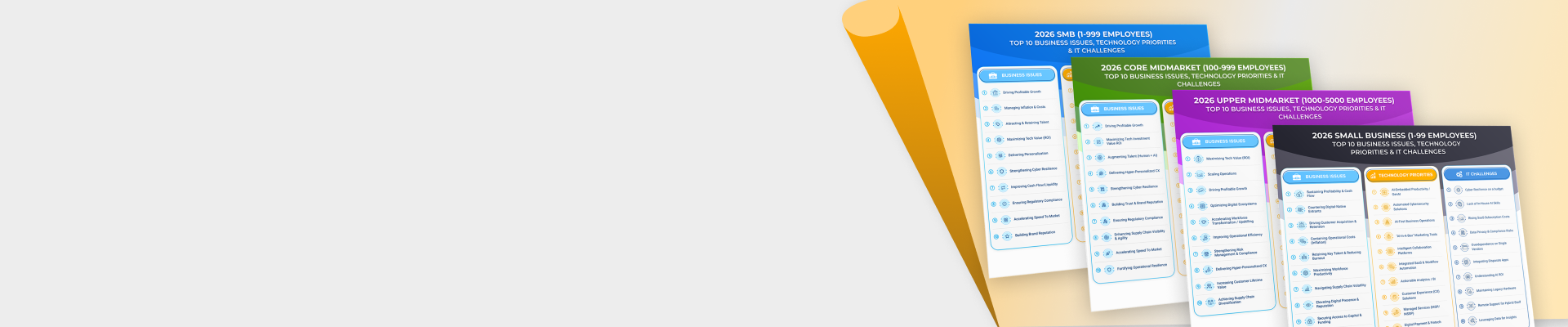
  • 2026 TOP 10 SMB BUSINESS ISSUES, IT PRIORITIES, IT CHALLENGES

    2026 TOP 10 SMB BUSINESS ISSUES, IT PRIORITIES, IT CHALLENGES

  • 2026 TOP 10 SMB PREDICTIONS

    2026 TOP 10 SMB PREDICTIONS

    SMB & Midmarket: Autonomous Business
    READ
  • 2026 TOP 10 PARTNER PREDICTIONS

    2026 TOP 10 PARTNER PREDICTIONS

    Partner & Ecosystem: Next Horizon
    READ
  • ARTIFICIAL INTELLIGENCE

    ARTIFICIAL INTELLIGENCE

    SMB & Midmarket Analytics & Artificial Intelligence Adoption
    LEARN MORE
  • IT SECURITY TRENDS

    IT SECURITY TRENDS

    SMB & Midmarket Security Adoption Trends
    LATEST RESEARCH
  • BUYERS JOURNEY

    BUYERS JOURNEY

    Technology Buyer Persona Research
    LEARN MORE
  • PARTNER ECOSYSTEM

    PARTNER ECOSYSTEM

    Global Channel Partner Trends
    LATEST RESEARCH
  • CLOUD ADOPTION TRENDS

    CLOUD ADOPTION TRENDS

    SMB & Midmarket Cloud Adoption
    LATEST RESEARCH
  • FUTURE OF PARTNER ECOSYSTEM

    FUTURE OF PARTNER ECOSYSTEM

    Networked, Engaged, Extended, Hybrid
    DOWNLOAD NOW
  • MANAGED SERVICES RESEARCH

    MANAGED SERVICES RESEARCH

    SMB & Midmarket Managed Services Adoption
    LEARN MORE

Techaisle Analyst Insights

Trusted research and strategic insight decoding SMBs, the Midmarket, and the Partner Ecosystem.
Anurag Agrawal

Let us talk Dell’s Commitment to Channels

Dusting off my notebooks (the notepad variety) I came upon some carefully documented notes of my conversations with Dell’s Channel team, in particular with Greg Davis, Vice President and General Manager of Global Commercial Channels.  Just reviewing the notes of the previous two years it hit me squarely in my face that Dell’s channels team has been on a restless pursuit of:

    • Simplicity,


    • Training & enablement,


    • Winning datacenter together with the channel, and


    • Partner profitability


Fall of 2011

Although Dell’s Partner Direct program was formally launched in 2007 with aggressive channel recruitment and courting happening in 2008, we will pick up on our conversations with Dell’s Greg Davis and Paul Shaffer, Executive Director Global Channel Marketing & channel partnerDemand Generation from the fall of 2011. Partner enablement, training, certification and integration of acquisitions had percolated to the top of the team's agenda. For an IT company which is notorious in selling direct, drastic measures were needed to become “one” with the channel. Dell delivered 75,000 training modules to its partners, 30 percent of Dell’s commercial business had started to come from channels and 58,000 registration deals were closed. With the acquisition of Force10 Networks Dell announced enhanced network certification programs and 130 premier partners got their certifications. Emphasizing that the training modules were working, Greg Davis had mentioned that top 10 partners who invested most in training had seen 110 percent growth in revenue. Fall 2011 was also the time when partners started seeing the first glimpse of gentle motivations from Dell to push deeper into healthcare segment and drive revenue from datacenter solutions. Inroads were being made into smaller partners for SMBs as much as national and larger partners.

Cloud Channel

During the same time period while Dell was building out its confidence and trust with the channels, dell-cloud-programenterprises and SMBs were moving to cloud, thus dis-intermediating the channel. Especially the VAR channels (which typically form the largest percent of channel partners of an IT Vendor) had been finding their traditional business models threatened by products and services that could be sold direct by a vendor over the Internet. To continue to adapt to the changing times and never taking its eye off the channel partners’ livelihood Dell launched cloud channel programs in the spring of 2012:

    • Cloud Builder,


    • Cloud Provider, &


    • Cloud Service Enabler


A technical services team was also put into place to help partners sell data center solutions namely, server and storage. Dell now had roughly 250 premium partners and had delivered 135,000 training modules in the year.

Work was far from complete. More acquisitions were taking place; these acquisitions had to be integrated and above all emerging market countries had to be targeted. Both Greg Davis and Amit Midha, President, Asia Pacific and Japan, Chairman, Global Emerging Markets underscored the fact that they were working to ensure a consistent channel engagement across every market covering:

    • Deal registration


    • Compensation neutrality


    • Conflict escalation process, and


    • Executive priority


Asia/Pacific

The channel commitment work in Asia/Pacific countries in our opinion is far from complete. There are still some major strides to be made, specifically in the Asia/Pacific region. By its own acknowledgement, Asia/Pacific is the fastest growing regions for Dell which requires a constant confidence and trust building process with the channels. In many of Techaisle’s analyst interactions with channel partners in 2012 in Asia/Pacific, it was found that channels had warmed up to Dell but some questioned Dell’s sincerity whenever bigger contracts were involved.

In both summer and fall of 2012 we asked Greg Davis and Amit Midha where they thought they were with consistency and confidence. Not only were they bullish but also recognized that they have some hills to climb. They were also candid that services remain a big component of any channel’s revenue mix and while typical services such as warranty, break-fix, and insurance were straightforward re-sale of Dell Services, partnering in consulting was a bit more challenging.

Summer 2012

By the summer of 2012, efforts were paying off, 62,000 deal registrations per quarter were coming through partners with 72 percent approval rate, 35,000 training modules were being delivered per quarter, the number of premier and preferred partners had jumped to 2500, Asia/Pacific channel programs were being strengthened, SonicWALL was integrated and specific courses were introduced on how to talk to a CIO, value of integrated datacenter. Above all social media training programs were launched for the benefit of the channels.

In late summer, in a conversation with Greg Davis and Bob Skelley, Executive Director, Global Certified Partner Program & Channel, they reiterated their commitment to make Dell “easy to work with” and restated their deep & maniacal focus on training and competencies. This focus resulted in 34 percent of global commercial business funneling through Dell channels, up from 30 percent in the fall of 2011. Number of deal registrations had jumped to 71,000 and an enhanced deal registration tool on mobile platforms was rolled-out. 47,000 training courses had been delivered in the quarter and Dell now had 113,000 channel partners. Initial focus on healthcare segment had resulted in a surge in end-user customers. A 40 percent growth in certifications was also achieved when compared with previous quarter. With the integration of Wyse, a desktop virtualization certification program was introduced. Dell channels had truly arrived and there was never a question of ever turning back.

One year later, Fall 2012

One year later, by fall of 2012, Dell had 130,000 channel partners, 35 percent of commercial business revenue was funneling through channels, 142,000 training courses had been delivered in the year, number of deal registrations had shot up to 65,000 and there were now 3600 preferred and premier channel partners. In the words of Greg Davis, “Dell has the most confident and competent channel partners in the world”. One year later, I saw an urgency to deliver with a profound focus on datacenters, systems management and cloud services. Virtualization was also beginning to take center stage. Kathy Schneider, Executive Director, Global Channel Marketing & Programs, drove home the point that she and her team were focused on driving best practices across four strategic pillars:

    1. Easy to do business with One Price and Sales Tools


    1. Win in the Enterprise using a comprehensive sales tool aptly named as Enterprise Master


    1. Training & enablement through expansion of training beyond Dell’s standard solutions to include social media


    1. Partner profitability through a simple, effective and rewarding incentives program


It has been a long way from direct PC selling to indirect solution selling. Real progress has been made. Dell’s channel executives are an end-to-end solutions empowering team for the channels. Not all channels will thrive but those that are equally committed to learn, adapt and practice will certainly succeed.

Anurag Agrawal
With contribution from Gitika Bajaj in Asia/Pacific


Anurag Agrawal

SMB and Midmarket File Sharing & Collaboration Adoption to Grow by 52 percent

Techaisle’s study on SMB Collaboration Solutions Adoption Trends shows that for 59 percent of US small businesses and 93 percent of US midmarket businesses, collaboration is among the Top 5 IT priorities for investments. In Asia/Pacific, 63 percent of SMBs are turning towards it as a business growth driver and in Western Europe, 68 percent of SMBs are finding that collaboration drives better teamwork and customer responsiveness.

Overall 38 percent of US SMBs are currently using one or more collaboration solutions and another 20 percent are planning to use one within the next year, a growth of 52 percent. Overwhelmingly, SMB customers view online file sharing as the most important aspect of a collaboration solution as 64 percent of SMBs using collaboration are currently using online file sharing (24 percent of all US SMBs) and another 32 percent are planning to use it within the next one year.

The survey data also shows that the next stage in the SMB collaboration adoption is their need for online interaction, that is, simultaneously share and edits files from PCs and mobile devices, mobile video collaboration, integration with social networks, and richer media escalations, such as using chat, text, voice, video at the same time.

As per the study, key business drivers for SMB collaboration adoption are also changing. While currently there is a strong desire to build robust content repositories, the next wave of SMB collaboration adopters are emphasizing speed of innovation, demands for improved productivity, and imperatives for faster time to market.

In terms of brand solution adoption, the SMB market is quite fragmented with Google, Microsoft, and Cisco leading, but there are many other smaller collaboration solution brands that are being used extensively by SMBs. Further analysis of data also underscores the importance and use of collaborative capabilities within SaaS applications such as CRM, ERP, accounting, project management, HR management, business intelligence and content publishing.

With respect to file sharing, Dropbox has had a very strong impact on the SMB collaboration solutions market. By enabling mobile users to share files freely, they at once underscored the central importance of mobility, enabled individual users to be drivers of corporate collaboration activity, and proved the centricity of file-first rather than person-first collaboration models.

Box (another important vendor in the space), on the other hand has gone on record saying that SMBs are not its target market segment. There is a market opportunity for traditional backup and file-sharing IT companies such as Hightail, Carbonite, Egnyte as well as those delivering mobile workspaces such as Citrix and managed services platform providers such as Continuum and security IT vendors such as Trend Micro. However, the reach for each of these will be limited to the reach of their respective SMB focused channel partners.

Techaisle believes that there are additional file-centric developments that will further shape the nature of SMB file sharing solutions in the years to come. Today, most files are intrinsically connected to the applications that created them. If cloud and mobility are the key determinants of IT delivery, then there would be a need for the decoupling of data from applications. Application-independent data wrapped in rich metadata would allow new cloud-based applications (potentially based on BI platforms) to combine existing data to meet new business requirements. In addition, freed of originating applications, it is also likely that data could be optimally formatted for a wide range of displays: large screen PCs, smaller screen smartphones and tablets, and new display types ranging from signage to digital paper to wearable heads-up displays.

For more details on the report, click SMB and Midmarket Collaboration Adoption Trends


Davis Blair

Distribution Channels - SMBs Search for the New Trusted Advisor

Optimization Nation...


“The production of too many useful things results in too many useless people.”
― Karl Marx

Channels - Techaisle - Global SMB, Midmarket and Channel Partner Analyst Firm - Techaisle Analyst Insights Cloud-market-changes1 Rarely will I quote Karl Marx, but in this case it works too well to ignore. Reviewing the latest research and surveys of technology adoption in the SMB space in an attempt to see a bigger picture, it struck us that the “decades-long Black Swan event” represented by accumulated IT investment impacting all at once, as mentioned by Nicholas Taleb in his great book: ”The Black Swan: The Impact of the Highly Improbable”, has come to pass. This, in combination with moving manufacturing industries offshore en masse and concentration of distribution away from small business retail into super warehouse outlets - whose singular objective is lower price - contributed to the economic upheaval. After ten more years of disproportionate IT investment in the Financial sector that enabled profits out of thin air by moving markets with super-high-speed trading and creation of financial instruments with no underlying value, we were almost there. Then optimization of every penny that could be squeezed from government programs – stated-income negative amortization ARMs, home equity extraction, wheelchairs, diabetes sensors, catheters, Social Security benefits, etc. - “at no cost to you whatsoever, we will even take care of all the paperwork”. These are all examples of how the economy has been changed forever using Information Technology as the key enabler.  But this post is not about the economy, it is about the influence of network technology and the resulting Virtual Solution Stack for Small and Medium Businesses (SMBs) that allows them to leverage the new IT adoption model that has emerged with Cloud Computing.

Things were getting a little expensive…

The Cloud Computing model has firmly emerged out of the ashes of the dotcom implosion and financial crisis of 2008 with the unrelenting objective of increasing production and reducing costs - more for less. Information Technology had become a critically important part of being competitive in a global marketplace, even for SMBs, but Channels - Techaisle - Global SMB, Midmarket and Channel Partner Analyst Firm - Techaisle Analyst Insights Cost-Control-Sized-for-Web unfortunately it had also become increasingly expensive and complicated to implement. By the time we started to realize the benefits of distributed network computing in the mid 2000s, we had created an insatiable appetite for this new technology that could eliminate space and time to truly optimize business. Ironically, by doing so we also created a huge business pain point: How to feed the Beast?

A New Financial Structure Please…

The reality is that no company, large or small, could drink from the fire hose of new technologies flooding the market and bringing the ever-increasing IT investment beyond reach. It begged the question of how to access these benefits through leverage rather than outright purchase.  What has emerged - directly or indirectly - is a Cloud Services model where infrastructure such as computing power, disk space, system software and databases can be centralized and distributed much like electrical power was at the beginning of the 20th century, allowing companies to stop buying their own generators; a new model where physical location of data is less important than the security protecting it, and where robust business functionality can be delivered remotely over the network using only a browser and an internet connection, with highly qualified experts at the other end whose costs can be distributed among many clients rather than a single company, and last but not least -  the ability to access all of this capability at very low risk, with low cost start-up and pay on a subscription basis rather than from capital budgets. Beginning with web hosting and co-location on the infrastructure side and CRM in the applications arena, SMBs began committing to the model and  we have arrived  at a stage where the majority of SMBs have adopted the new architecture using IaaS, SaaS, PaaS, and other services based on their needs; many in surveys already use multiple services, averaging over 3.5 per for small business and doubling every year. And there is an extremely high level of satisfaction - much higher than when customers owned and operated all of the solution components.

Being the Trusted Advisor for the Virtual Solution Stack

We have found that in the rush to implement Cloud Services, users especially among Small Businesses, are beginning to rely much more on independent IT Consultants as their new source of advice, threatening to dis-intermediate the traditional channel. SaaS and horizontal application service providers, such as Salesforce.com, Citrix and Central Desktop are putting pressure on at the other end with vendor-direct, centralized inbound marketing that also threatens opportunity for third-party value add in many cases. Although, it must be said that Salesforce.com has built a massive following of channel partners from independent consultants to corporate VARs. And it contributes to the success of Salesforce.com. We have also found that once decisions are made for Cloud Services, the incumbent channel has a big advantage for future business as both advisor and implementer. The critical issue, now more than ever, is to be the trusted advisor early in the SMB’s lifecycle. The following are some suggestions on how to accomplish this as a Cloud Services Vendor or partner.

Channels - Techaisle - Global SMB, Midmarket and Channel Partner Analyst Firm - Techaisle Analyst Insights 0801-Cloud-Comparison-1024x596


1)  The old Asset-Intensive model of IT Adoption is over; to be successful vendors and their partners will need to deliver and explain cost-effective Infrastructure and Applications, either together or as separate components, depending on offer and customer needs.

2)  IT as Cost Center is rapidly evolving into IT as Profit Center; applying Cloud Services to drive competitive advantages based on new marketing and business intelligence technology will usually be far more productive than having IT staff updating PC software, swapping out PCs, adding disks to storage, configuring a new server, etc. Offloading these tasks from SMB IT Teams and becoming the trusted advisor while the company is young will pay long term dividends for both vendors and channels.

3)  Staffing is usually the most expensive variable among business expenses. Demonstrate ROI and TCO models that emphasize the ability to reduce staffing, travel and distance from the equation and allow IT to be more productive with fewer staff.

4)  As they expand, SMBs typically have to grow their operational and IT footprint by hiring specialists in different domestic and international locations; helping customers reduce the growing pains by centralizing many IT operations and managing infrastructure, communications and applications from a headquarters location is a good approach to helping them expand more cost effectively.

5)  Purchasing, managing, configuring, updating, and patching software licenses is a major expense and headache for small companies and can be a full time position in many medium-sized organizations, not to mention internal user satisfaction, and ongoing maintenance fees. Cloud Services, particularly SaaS solutions, do an excellent job eliminating the majority of these issues, one reason why they continually rank extremely high on the satisfaction scale in our surveys. These are easily built into the ROI/TCO model.

6)  As new Cloud Services are rolled out across Infrastructure, Communications, Productivity and Vertical Market categories in ever changing variations of public and private clouds, it is not possible for most companies to maintain the internal expertise to make the most appropriate choices. Helping customers emerge without being overwhelmed and providing relevant knowledge of how to effectively apply the new technology will strengthen the relationship.

7)  SMB customers have made the leap to cloud-based infrastructure and will rapidly move to multiple services that leverage their investments. Much like the early days of client/server systems where HP had the hot box and Oracle provided the fastest affordable database engine, offers will consist of integration of infrastructure and software layers of the solution. Also as with client/server, users want the ease of dealing with a single supplier where possible, for simplicity and “one throat to choke”. The new solution stack is virtual and relatively standalone at this point; the next stage will require vendors of more complex applications (Integrated CRM, ERP, SCM) to make it as easy as possible for customers to buy their services, even if it means giving up some control and profit in exchange for more volume.

8)  The independent IT consultant as trusted advisor is a phenomenon that has arisen as a slew of relatively easy-to-deploy SaaS applications have matured to where individuals can configure them quickly. The current economy has also spurred a lot of activity among individuals to support their SMB friends with web presence, hosting, social media, part time IT support, etc. Although the influence wanes as companies grow in size, and with the complexity of their deployments, the independent IT consultant has emerged as a force to be reckoned with at the low end of the market and vendors should develop these evangelists while channels bring them into marketing to combine strengths for the benefit of the customer.

Davis Blair
Techaisle

Anurag Agrawal

Dell Channels – All the right moves?

Channel Momentum

As some IT companies continue to consolidate and others split up, Dell is promising its channel partners consistency, stability and increased profitability. And it is showing:

  • Dell Channel revenue now represents more than 40 percent of overall Dell commercial revenue and its channel business is growing faster than the overall market

  • Channel revenue growth is up double digits in 10 of Dell’s top 11 countries year-over-year

  • Dell solutions are now available through three of top Distributors - Ingram, TechData and Synnex - and where Dell is experiencing growth in excess of 50 percent


To keep the channel momentum intact, Dell is pledging US$125 million in enhanced incentives to help channel partners bid and close new customer acquisitions and also deploy towards retention deals with existing customers.

As always, not willing to take any hype on face value Techaisle took to the streets to really talk with Dell SMB channel partners and especially those who have partnered with both Dell and HP. Over the course of last three weeks, Techaisle conducted over 25 depth interviews with SMB channel partners. The discussions clearly revealed that the partners have started to look at Dell rather seriously. As one of them said, “Dell has changed its approach and outlook towards channel partners after it went private. They monitor and coordinate with their partners just like any other OEM. They have changed their ways in how they strategize and have created their training plans to cater to our needs and are succeeding by actively collaborating.”

Another partner, based in Texas and focused on SMBs was more direct, “Dell hasn’t been looking at channel partners as a key to gain market share unlike OEMs like HP. A few months back only about a 30 percent of sales were driven by the channel partners and the rest was a result of Dell’s direct sales efforts. The reason is that Dell itself had a large sales team managing sales accounts. However, after Dell went private they have mended their ways in how they look at us. They have kept the key sales accounts with themselves and the rest have been distributed amongst the channel partners for further management and revenue generation which is a good step as it inculcates trust and sense of real partnership.”

Impressive Numerics

At one of my sit-down meetings, Cheryl Cook, VP, Global Channels and Alliances shared some impressive statistics:

  • Dell has 167,000 channel partners out of which 4,255 are Preferred and Premium partners.

  • Nearly 700 channel partners chose to become premier or preferred partners of Dell in 2014, a testament to channel commitment

  • Training uptake, (a top requirement of channel partners as per Techaisle SMB Channel study), was up by 54 percent in 1H’14. But more importantly, training on software solutions increased by 102 percent.

  • Over 82,000 deal registrations were processed, up 8 percent YoY and software (security, device management, data protection, systems management) deal registration was up by 32 percent

  • Rebates processed was also up by 23 percent during the same time frame

  • 4400 new customers were acquired through channels, transacted 10,000 new orders out of which 1200 were for storage and 1600 for software


Although she deftly skipped my question on how many named accounts have been formally handed over to channel partners she reiterated that Dell is continuing to maintain its compensation accelerator program which is yielding good results. Recently, a little over 200,000 greenfield accounts have been posted on the Partner Portal.

Investment in Training, Support, Lead generation, Consultative partnerships

Most channel partners that Techaisle spoke with agreed that Dell has been concentrating on technical training sessions and regularly assessing partners’ performance with a clear objective of empowering them with required product knowledge to be able to pitch to the right set of SMB customers in the best possible way. Unlike the immediate past, account managers from Dell have suddenly become approachable. Some partners went to the extent of telling Techaisle “we specifically like the pre-sales and sales trainings that Dell has designed for Channel Partners. At times I feel that their efforts in the field of training annoy us as there are multiple and repetitive requests for attending or undergoing the same set of trainings that we have already gone through. They do not yet have a system to remove these redundancies”.

Channels are also having good experiences working with Dell’s consultative approach. “Lately, we were dealing with a few SMB customers and they wanted the account managers and few other technical experts to be available on call. We worked together with Dell and closed 3 deals where the consultative partnership worked in our favor”, said an SMB channel partner based in California.

Dell is also investing in supporting the channels when they bid for complex engagements. Their pre-sales support has improved as compared to before as channels now have access to their technical resources who work along with partners’ technical teams in understanding customer requirements, existing customer infrastructure to suggest suitable solutions.

In addition to training and support Dell is making a series of investments to help channel partners by:

  • Making available 5X demo gear to facilitate proof-of-concept

  • Increasing number of Solution centers for partners to showcase Dell end-to-end solutions to their customers (granted not many SMB channel partners will take advantage)

  • Improving areas of financing such as extending credit and payment terms thereby assisting channel partners in better managing their cash flows. The terms announced are 75 days interest-free financing on all Dell purchases for an introductory period of 180 days


Are conflicts a thing of the past? Channels are cautiously optimistic

Dell seems to be diligently working towards building trust within its channel partners. Dell and its partners have had a love-hate relationship due to conflicts with Dell’s strong direct sales force across all divisions. In fact, with the progress made, channels are wishing that Dell limits its investment in its internal sales teams as it would in all probability bring back the channels to “square one”.

The channel partner community reminded us of unpleasant past experiences of “Dell snatching customers from their partners and dealing with them directly”. But they quickly added, “We haven’t come across such a scenario (lately) and would never want to face a situation like that”.

Another partner said, “Dell has always been known for their direct business and has ramped up their efforts in the indirect sales through channels around a year ago. Earlier, we never knew if a deal which is routed through us will be closed keeping us in loop (with our margins intact) or Dell may go ahead and deal with the customer directly. Now, this has completely changed and Dell itself directs the customers to go through us”.

An HP and Dell partner was eager to get his point across regarding lead generation saying that Dell is managing a nice balance while sharing potential customer details with only one partner. HP is not following this approach triggering conflicts.

End-to-End Solutions message is resonating

Dell is steadfastly focused on its end-to-end solutions strategy and channels are paying attention. “Dell offers support in implementing end-to-end solutions. They work with us in consultation to determine the best product and solutions based on SMB customer requirements. Account Manager from Dell works with us closely when we deal with such deployments. We get all the technical help required, if skills are not available with us. Dell offers us access to experts (both on calls and physically, when required) from functional areas when we deal with SMBs for deployment of end-to-end solutions”.

Channels are finding that not only end-to-end solution deals give them extra margins but also makes it easier to deal with Dell, namely, channels get a better attention from Dell. Techaisle feels that if selective attention becomes the norm then many Dell SMB channel partners may flounder.

A mid-west Dell SMB channel partner was very vocal when we spoke with him. “Dell is important while we engage in end-to-end deals with our customers. Dell’s role starts from pre-sales to the deployment of such engagements. They offer the required marketing set-up for the products and solutions. If we have to take care of these things on our own, I think our margins will squeeze and it will be difficult to sustain our business”.

Having a full portfolio of offerings also allows “non-end-to-end solution channel partners” to sell adjacent technologies. For example, “we have clubbed and sold Dell hardware with Cisco, NetApp and IBM storage management and security solutions”.

Then there are other channel partners who try and build solutions with a product from Dell as the center-point. “Based on customer requirements we will see if there is a Dell product suited to meet the needs. If yes, we pitch for it and if there isn’t a product suited, we may bundle it up with other solutions and design an end-to-end solution for our customer. If the customer wants to go with a specific product and Dell doesn’t have promising product in the area; in these cases we will bundle it up with other product and present it as an end-to-end solution to our customers”.

Lingering Channel Challenges

To my question on what should channel partners be expecting next from Dell, Cheryl Cook quickly points out her focus on strategic pillars of mobility, security and Big Data with big push on converged infrastructure and innovative storage solutions.  She counters me with a question on VMware EVO:RAIL and its “fantastic” suitability for the SMB market segment.

Channels are listening and echoing that the fastest selling Dell solutions are Rack and Blade servers. But they feel that Dell has not yet been able to position its Force10 and SonicWall offerings effectively and channels are losing to Cisco or HP.

As conflict is disappearing, trust is settling in, channels have a new gripe. When a customer floats an RFP to a number of partners, Dell seizes the responsibility to directly speak with the customer, decides which partner is in the best position to offer most favorable terms and informs other partners to step aside and not waste their time on a deal which may not land with them at all. This annoys the channel partners as they would like a fair opportunity to win the deal and gain a customer by cutting down on own their margins.

No Regrets – but could have been bolder

Looking at the last one year since taking the helm, Cheryl Cook has no visible regrets. After much coaxing and cogitating she says, “Perhaps we could have been bolder in our move” referring to speed of Dell’s organizational moves and intuitive proactive thinking. The future is bright and she and her team are committed to helping all partners – “narrow or broadline”.

Trusted Research | Strategic Insight

Techaisle - TA