• TRUSTED RESEARCH

    TRUSTED RESEARCH | STRATEGIC INSIGHT

    SMB. CORE MIDMARKET. UPPER MIDMARKET. ECOSYSTEM
    LEARN MORE
  • INTERWORK 2.0: THE AGENTIC FUTURE OF CONNECTED BUSINESS

    INTERWORK 2.0: THE AGENTIC FUTURE OF CONNECTED BUSINESS

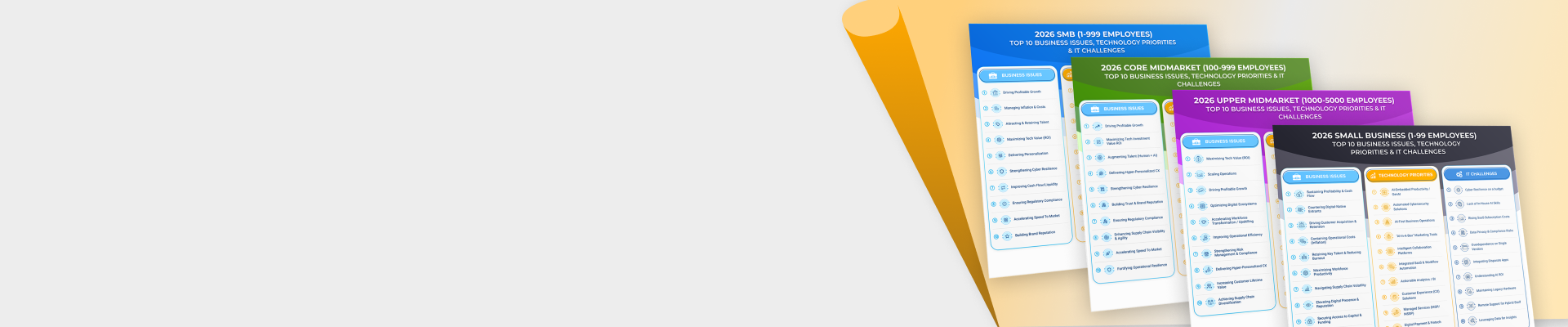
  • 2026 TOP 10 SMB BUSINESS ISSUES, IT PRIORITIES, IT CHALLENGES

    2026 TOP 10 SMB BUSINESS ISSUES, IT PRIORITIES, IT CHALLENGES

  • 2026 TOP 10 SMB PREDICTIONS

    2026 TOP 10 SMB PREDICTIONS

    SMB & Midmarket: Autonomous Business
    READ
  • 2026 TOP 10 PARTNER PREDICTIONS

    2026 TOP 10 PARTNER PREDICTIONS

    Partner & Ecosystem: Next Horizon
    READ
  • ARTIFICIAL INTELLIGENCE

    ARTIFICIAL INTELLIGENCE

    SMB & Midmarket Analytics & Artificial Intelligence Adoption
    LEARN MORE
  • IT SECURITY TRENDS

    IT SECURITY TRENDS

    SMB & Midmarket Security Adoption Trends
    LATEST RESEARCH
  • BUYERS JOURNEY

    BUYERS JOURNEY

    Technology Buyer Persona Research
    LEARN MORE
  • PARTNER ECOSYSTEM

    PARTNER ECOSYSTEM

    Global Channel Partner Trends
    LATEST RESEARCH
  • CLOUD ADOPTION TRENDS

    CLOUD ADOPTION TRENDS

    SMB & Midmarket Cloud Adoption
    LATEST RESEARCH
  • FUTURE OF PARTNER ECOSYSTEM

    FUTURE OF PARTNER ECOSYSTEM

    Networked, Engaged, Extended, Hybrid
    DOWNLOAD NOW
  • MANAGED SERVICES RESEARCH

    MANAGED SERVICES RESEARCH

    SMB & Midmarket Managed Services Adoption
    LEARN MORE

Techaisle Analyst Insights

Trusted research and strategic insight decoding SMBs, the Midmarket, and the Partner Ecosystem.
Anurag Agrawal

Channel challenges in selling cloud to SMBs – diminishing external barriers

What are the obstacles to channel members achieving scale for their cloud businesses? Techaisle’s SMB Channel Partner Trends research and accompanying research The State of the US SMB Cloud Channel shows that increasingly, Walt Kelly’s famous line (from the Pogo comic strip) “we have met the enemy, and he is us” describes the most pernicious challenges associated with development of a cloud business.

Techaisle’s research explored data on 10 cloud sales challenges faced by SMB channel partners in selling cloud to SMBs. Four of the top five – “lack of in-house expertise”, “do not have financial resources,” “lack of knowledge about cloud computing” and “do not know how to implement [cloud solutions]” refer to internal issues, and two others, “do not understand the [cloud] business model” and “offering cloud-based services will necessitate elimination of jobs at our company,” also reference internal issues or concerns.

Interestingly, external barriers to developing SMB cloud business practices seem to be diminishing in importance.

Davis Blair

Pick of the Week: IBM’s Clear Vision of Mid-Market Cloud Opportunity

On Wednesday this week, we attended a Channel Expert Hour webinar (sponsored by IBM) and produced by Nine Lives Media, Inc. It made our Pick of the Week for three reasons:

  1. Very clear statement of IBM’s Addressed Market
  2. Very clear statement of IBM’s Three Tier Mid-Market Cloud Offers
  3. Very clear statement of IBM’S SMB Channel Partner’s Opportunity

The format of the webinar was informal, with ongoing Q&A by channel partners and users. We started off with an overview of the SMB move to the cloud by VP Joel Raper of Azaleos, Inc., a 300+ employee, Seattle-based Service Provider focused on Microsoft UC&C Stack Managed Services (Cloud, Design, Deployment and Lifecycle Management) to the Mid-Market.


This was followed by an overview of the IBM Mid-Market Cloud Partner Program, by Ed Bottini, a Cloud Ecosystem Program Director at IBM Global Services. As mentioned, within three or four slides, it was clear where IBM saw the opportunity, what offers were available to address it and what partners could do to take advantage of IBM’s resources to sell into the market.

IBM’s Addressed Market


In typical IBM fashion, this graph represents the big picture very well: They believe half the Opportunity is SaaS growing at a compounded 25% rate, three-quarters is XaaS, compounding at ~25% - IaaS is growing at 35%. The remaining is ~25% Private Cloud and Non XaaS, growing at 20%.

This is not an acknowledgement of the IBM estimates, the point is that they see huge opportunity growing very rapidly in their base and it comes through when they talk about it. This answers WHERE REVENUE opportunity is for SMB Channel Partners.

IBM’s Three Tier Mid-Market Cloud Offers

IBM’s Cloud Solution Stack includes the Foundation layer of Servers, Networking, Storage and Secure Data, using a virtualized environment of IBM hardware, software and networking including PureFlex and Bladecenter Foundations for Cloud, along with IBM Cast Iron to integrate different clouds and applications.

On top of the Foundation is the Infrastructure as a Service layer, SmartCloud Services, which includes Pay-as-you-go Managed Backup Services, Tivoli System Management and Cloud Automation “middleware”,  Managed Security Services, and IBM SmartCloud Enterprise, which according to IBM delivers "enterprise-class public cloud infrastructure-as-a-service (IaaS)—delivers secure and scalable hosted IT infrastructure with on-demand access to virtual server and storage resources."

The top layer is the Applications Tier, Software as a service (SaaS), SmartCloud Solutions,  "a software model with applications centrally hosted in a cloud computing environment and accessed by users over the Internet."  As described in the first section, IBM has identified SaaS as half the opportunity growing at 25% CAGR; this is where the rubber hits the road. IBM has never been known as an Application Software vendor, preferring to invest in Systems Software, Database Technology, Tools, Middleware, etc. – which they have done very successfully. In addition, acquisitions over time have steadily been used to both plug holes and repurpose for gaps in applications - Cognos, CoreMetrics, SPSS and Unica being examples in Analytics, along with Sterling for e-Commerce, Merchandising and Supply Chain Management. The bold decision  (at the time) to fully embrace the Open Source movement in the '90s and leverage it with their tools like Websphere to participate in the rapid growth in web-based computing has also had a positive impact (i.e., SugarCRM). This answers WHAT SOLUTIONS offer the opportunity for SMB Channel Partners.

IBM’s Five Mid-Market Cloud Options for Channel Partners

The approaches SMB Channel Partners can choose to work with IBM is next, and  is  evident in this chart. Ranging from Tools, to Infrastructure, to Cloud Building, to SaaS Application Providers, Partners have a variety of options from which to select. This chart is pretty self-explanatory, so we won’t go into redundant detail here. This third leg of the stool is a clear view of HOW the Opportunity can be addressed by Partners.

This is not meant to be an endorsement for IBM - they are not the only Systems Vendor that 1) has a strategy, 2) has an integrated solution stack and 3) has a Cloud Partner Program. As a firm that helps companies sell more effectively into the SMB space, what appealed to us was the simplicity of the message and the ease with which the story was communicated and re-enforced using  credible, robust and tested Enterprise-level offers. In our opinion, IBM sounded a lot more like a young SaaS start-up than a hundred-year-old East Coast manufacturing company.

Postscript: When thinking through how the industry has consolidated around a few major system vendors, we wonder whether Cloud Computing strategy and execution have impacted confidence in the company?

Anurag Agrawal

Citrix cloud drives a new solutions category: Mobile Delivery Infrastructure (MDI)

Steve Daheb, Chief Marketing Officer, Citrix, says, “Citrix is a cloud solutions company that enables mobile workstyles”. This philosophy’s execution is anchored to its three product pillars:

  1. XenDesktop
  2. Netscaler, and
  3. XenMobile

Citrix has committed itself to an ambitious definition of enterprise mobility, with a framework spanning nine components; customers can use Citrix technologies to create an integrated, single vendor solution covering all nine areas, or can opt to plug competing products into any of the nine areas – an approach that Citrix has labeled “any-ness.”


Mobile Delivery Infrastructure (MDI)

We believe that there is current demand in the market for a reasoned approach to defining enterprise mobility. The suppliers of the endpoint products aren’t in a position to define the architecture and services needed to connect their products to corporate networks, applications and data, and the suppliers of data center infrastructure lack visibility into the endpoint side of the equation. Citrix is unique in spanning both environments, and its approach to enabling customers is, in our opinion, well-aligned with the need for architectural clarity that we have observed in the market. Accordingly, using the Citrix framework as a starting point, we have created a definition of enterprise mobility that we have dubbed “Mobile Delivery Infrastructure,” or MDI. MDI is comprised of three distinct, critical solution pillars: endpoint tracking and security, collaboration and sharing, and app delivery and management.


Mobility Delivery Infrastructure (MDI)


Endpoint Tracking & Security


Collaboration & Sharing


App Delivery & Management


  • MDM
  • Mobile network control
  • Single Sign-on & Identity Management

  • Sandboxed mail
  • Secure mobile data sharing Collaboration

  • App dev tools
  • Mobile app security Windows-as-a-Service


Unsurprisingly, given our starting point, Citrix can be seen as a standard-setter for MDI. Its approach to MDI will likely attract many firms in search of a consistent approach: Citrix’s fundamental belief that work is not a place, simpler is better and any-ness wins will resonate with many customers looking for a starting point for a mobility framework.

The breadth of the Citrix portfolio will also help prospective customers to understand the requirement for the full breadth of MDI technologies. While many other cloud companies are developing either one solution or several for mobile workforce enablement, Citrix’s strategy seems akin to Microsoft’s during its formative years: it owned the platform (the operating system) for the PC, attracting an ecosystem of hardware, software and networking companies which built products and solutions extending the utility of the core product. To that extent, Citrix seems to have created a corporate mobility delivery infrastructure that can either be utilized stand alone or combined with other solutions.

SMB Market Potential

Citrix‘s main target has been the enterprise segment, which has served it well. It has yet to develop a coherent strategy for marketing and selling to the SMB segment, relying on partners to address the market. However, Techaisle research demonstrates that the SMB focused channel partners themselves want tremendous help from their vendors. For example US channel partner data clearly shows the help required on multiple fronts.

Nevertheless, the SMB market has huge potential with nearly 300 million mobile workers by 2016.The SMBs investing in mobile enablement will need MDI solutions to supporting these 300 million mobile workers – which will create demand for one or more solutions within Citrix’s MDI platform.


Techaisle outlook: We believe that mobility is transitioning from being defined by devices to being defined by management strategies – and that this will create demand for MDI. With products covering each aspect of MDI – and with an approach that supports both single-vendor and best-of-breed deployments – Citrix is extremely well positioned to benefit from this transition.


Davis Blair

Citrix Seeds the Cloud

While unveiling a very lucid product and service strategy today, Citrix announced several significant products and alliances that fill gaps in the SMB Cloud Computing marketplace. These include:

  • An expanded Me@Work mobile applications suite, with new and improved apps,
  • A strategic alliance with Microsoft to distribute Windows and Office365 as Cloud Services through XenDesktop,
  • A VDI-embedded and secure Ultrabook Client,
  • Next generation Gateway and next generation cross-cloud bridge,
  • A certified cloud platform developed in collaboration with Apache CloudStack,
  • Improvements to the NetScaler line.

And the most consequential announcement of the day - a wide and deep strategic alliance with Cisco that if well executed, will offer a true 1+1=3 result for both sides and have a major impact in the industry.


As the Cloud matures, Techaisle believes that integration is key and the market will coalesce around virtual versions of the client and server concepts – with communication at the core of the client suite and a collaborative, front office multi-user suite in the middle of the Server environment. With today’s announcements, Citrix moves us closer to this concept.

We will focus on three of the announcements with a point of view on how we consider them to be both strategic and timely, and finish up with huge potential impact of the slew of new alliance announcements.

Part of the achieving the vision is to ensure collaboration is possible across all hardware environments, that application objects can be executed regardless of proprietary operating systems and formats. By supporting all the formats shown here through their Receiver, Citrix already enables apps and data on three billion devices, which is expected to grow to ten billion in the next five years – Like many Korean manufacturers, Citrix is thinking in terms of screens, and knows that consumers are driving adoption of connected screens as part of the lifestyle – my teenage daughter has a MacBook, iPhone, and Satellite TV running all at the same time, each screen running multiple applications. When selecting a workplace, surveys show this generation would rather give up a more lucrative employment opportunity than give up their devices or right to use social media. As Kevin Kelly observed in his visionary work, New Rules of the New Economy, back in 1998:

“Because communication—which in the end is what the digital technology
and media are all about—is not just a sector of the economy. Communication is the economy.”
- Kevin Kelly, New Rules for the New Economy, 1998


We could not agree more, and the ME@Work announcement shows Citrix is taking the long view.

The ME@Work mobile app suite includes several productivity and collaborative applications, including the #1 web-conferencing solution, GoToMeeting. We found it interesting that Citrix is simultaneously introducing some competitive products in conjunction with the partnership; an email client – most important component of the collaborative desktop – as well as strong offers in file sharing, personal collaboration, and web conferencing. It is a bold move; for those of us who have been watching the industry for a while,  we remember when there was a triumvirate – Windows, Intel and Novell - and then there was NT with OS-embedded LAN capabilities - and then there were two. And then Netscape came out swinging with a better web browser that seriously pressured Microsoft - and then there was Windows-embedded Explorer - and then there was one.

But Microsoft gets a lot out of these announcements, especially if execution can follow strategy. Microsoft revenue is over 25 times that of Citrix, but they can use the excitement brought by a fast-growing, deeply technical, and cloud-focused next-generation partner. Especially in the SMB space - the 100-249 & 500-999 segments of the mid-market are a real sweet spot for this partnership.

By partnering with Microsoft to bring Windows, Office365 and the SkyDrive to market, Citrix benefits from the practically ubiquitous Windows installed base and opportunity for widespread adoption of Office365, (which we expect to have a banner year in 2013). And access to the most mature global software distribution ecosystem in the world. Microsoft gains an ally that provides substantial support and momentum against Google Apps, a catalyst to move away from packaged software,  additional credibility in collaboration, and adds 10,000 channel partners at the same time.

The Ultrabook client is a strategic offer because it supports the tide of BYOD and it is another route to market for XenDesktop VDI. It also aligns Citrix with Intel and the major OEMs who are looking for returns on large investments in the Ultrabook line.

While the Microsoft news is a big deal, the even larger news was a strategic alliance with Cisco that involves major commitments of joint R&D, integration of product lines and joint manufacturing in the future. Key Points:

Citrix and Cisco announced broad cooperation in three major areas: Mobile WorkStyles, Cloud Orchestration and Cloud Networking.

Mobile WorkStyles
The big idea here is any data on any device (the billions of screens mentioned above) to support the growing BYOD wave, and leveraging joint strengths to deliver a unified secure environment for applications, data, voice and collaboration. Cisco contributes Jabber and substantial collaboration expertise gained from the Webex acquisition, Virtual Experience Infrastructure (VXI) technology, and MediaNet Technology. For Mobile WorkStyles, Citrix brings a new and improved CloudGateway and Receiver, a new and improved ShareFile service and XenApp & XenDesktop. The alliance aims to bring a richer experience with seamless security and a leveraged support infrastructure than covers the entire stack 24x7 on a global basis.

From a business perspective, Citrix can ride on the back of the 800 pound gorilla straight into the Enterprise, leveraging the industrial-strength performance of Cisco’s premium product lines at a reduced price point. As with Microsoft, Citrix is aligning itself with an old-guard industry titan, in this case, one whose revenue is 16 times that of Citrix. And as with Microsoft, the deal looks like a win for both sides. Our opinion is that it could help revitalize Cisco, whose foray in to software based business created some great products in Webex, but the model was different enough to shake them up. We continue to write on the rise of the digital channel at the expense of a traditional HW VAR Channel. When Cisco acquired Webex they entered a software-based, inbound sales, price sensitive, online-marketed, sold and delivered, six-week sales cycle, user-configured business model that was almost the antithesis of what they were best at: premium quality enterprise hardware-based solutions that are differentiated by making the value of the whole network exceed the sum of its’ parts - sold by an enterprise sales force and delivered by top shelf VARs and SIs. Especially within SMBs, the right combination of price and SLA to solve business, not technical problems, are overriding criteria when buying, and traditional hands-on VARs might not even be called - cut out by online marketing and inbound sales teams. In hardware, it is more about scale economies, quality engineering and brand management - software is all about market share and developing accelerating returns and an ecosystem of fellow travelers.

Cloud Orchestration
The second key area of cooperation is in what is being called Cloud Orchestration, where the objective is to manage the traditional data center functions of computing, network, storage, security, and management, delivered across physical, virtual and cloud environments using Unified Computing, Unified Management and Unified Fabric. This is clearly Cisco’s home territory and they bring expertise and technology including Unified Computing System (UCS), Open Network Environment (ONE) and the Nexus Series of switch technologies to bear on these challenges. Citrix contributes the newest CloudPlatform, a new open source CloudStack and the XenServer to this effort. Using Cloud Orchestration, the alliance aims to deploy Public, Private and Hybrid Cloud environments with unified management that reduces complexity and improves agility, something SMB customers will be happy to see. Embracing Open Source is also a good move for Citrix to increase the footprint.

Cloud Networking
The third leg of the alliance is centered on the Citrix NetScaler Cloud Networking Platform. Here the objective is to adopt NetScaler as the go-to technology and jointly develop the next generation through the alliance. This will be accomplished by offering NetScaler as a strategic component within the Cisco Cloud Network Services Architecture, with seamless integration at the product level in areas including Security and WAN optimization. The order of implementation is that Cisco will adopt, sell and market the NetScaler, it will be manufactured according to a certified Cisco Design specification followed by a joint road-map for product interoperability, development and go-to-market strategy over the long term.

Through these announcements, Citrix has taken several steps to advance Cloud-based services and fill gaps in the market; they have introduced a new channel for Windows and Office365, brought to market their own collaborative suite, and a VDI-embedded client to further the VDI and BYO trends in the SMB space. Other technology announcements were also significant but for reasons of brevity we have not covered them in detail. One thing is for sure - no one can accuse Citrix of being timid. Of course, when snuggling up with the big guys the way they are, Citrix themselves said it best in the announcement: "POs are better than PR". It all falls on execution at this point.


Trusted Research | Strategic Insight

Techaisle - TA