











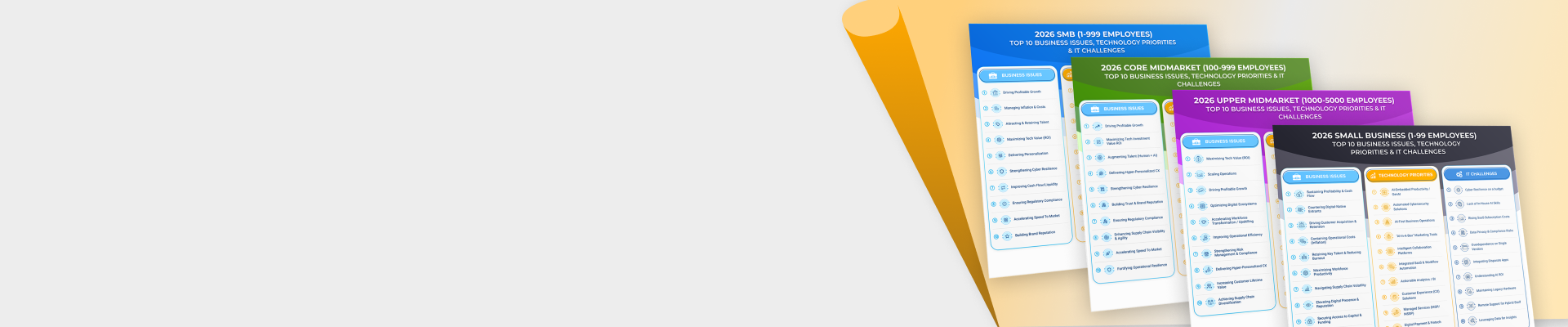



How big is the SMB IT market opportunity? What is the potential market size of mobility, cloud, datacenter, PCs/Tablets? What is the growth in spend in regions? What are average the spends per business? What are the key business issues?
That is the topic of our Infographic. Click the image to download.
 Global SMB IT Spend is poised to reach ~600 Billion dollar by 2016. Worldwide, there are still 26 million SMBs yet to buy a PC, 30 million SMBs do not have a server; some of these may directly move to cloud. They are already using internet to a very large extent. Granted that many of them are less than 20 employees but they are not going to be static. Approximately 560,000 new businesses were started each month in 2012. About 10,000 of small businesses become mid-market businesses each year.
North America and EMEA are infrastructure, software and services driven while Asia/Pacific is product driven. North America has the highest average IT spend per business spend while Asia/Pacific and Latin America the lowest. There is a vast difference between emerging market and mature market SMBs in terms of average spend per business. It is also useful to note that while Asia/Pacific has the highest number of SMB cloud users, average spend per user is less than 1/5th of SMB user in North America.
In terms of business issues, SMBs in the US are focused on collaboration and communications. The three business issues feeding into this focus are reducing operational costs, focusing on new markets and improving effectiveness of sales and marketing. On the other hand Western Europe SMBs are concerned about workforce efficiency with focus on costs was a key driver for SMBs in in that region, improving workforce productivity (getting more out of the workforce) and reducing operational costs. On the other hand Asia/Pacific SMBs want to grow faster than the market and are constantly worrying about market penetration. If they do not act now, they think that the opportunity will slip by.
Download the Infographic (click on image) to get a great snapshot of SMB opportunity including spend on PCs/Tablets, Mobility, Cloud, Data Center, Security.
Techaisle Analyst Insights
"As a general rule, the most successful man in life is the man who has the best information."
- Benjamin Disraeli (1804 - 1881), British Prime Minister
We are in a transformational time for Mobility and Mobile Business Intelligence, with lots of innovation happening in both hardware and software. Factors such as declining data plan prices, improved broadband availability, software investment, and widespread access to Smart Phone applications will continue to drive market acceptance as barriers to adoption fall away.
 Taking a channel partner view of the market, this chart shows what SMB Channel Partners (50%+ Revenue from SMBs) are hearing from their customers: overall 60% report that customers are asking for Mobile Solutions, including ~80% of ISVs, 54% of VAR/Sis and 47% of Service Providers.
One of the trends in BI overall is a large increase in embedded BI functionality into software applications. This arose through the enterprise-level dashboards and reporting capabilities that SMBs saw with Salesforce.com functionality and quickly become must-have features for serious software applications, especially those delivered as a Service (SaaS). On premise and SaaS versions have been updated through development of new internal code or OEM arrangements and open source code from players like Pentaho and Jaspersoft.
Enabling BI mobility is accomplished by moving existing functionality to a mobile environment, using the new technologies on top of the old, which is more complicated than starting from scratch in many cases. The larger companies such as Oracle, IBM and SAP are approaching this through acquisition of smaller companies and integrating them into existing products. But in a classic build vs. buy fashion, smaller companies offering SaaS BI services have been building new offers from the ground up, directly employing the newest technologies like HTML5, iOS and Android for delivery to Apple devices, smartphones and the burgeoning number of tablets in the market. Smaller providers in many cases have gained a timing advantage; using native technology brings existing mobile functionality to bear on the problem; instead of simple links to server data, the presentation of the information can immediately be rich and interactive using screen manipulation, i.e., pinch and squeeze or geo-location awareness, as part of the data exploration and visualization experience.
 Other features of “true” mobility integrated with “true” BI include the ability to interact with data objects on the screen, such as search, filters, check-boxes, drill-down and drill-through to the record level and other interactive functionality. Of course, then being able to use the built-in device communications capabilities is also important once the information has been isolated – SMS, email and forms should be available for manipulation and dissemination of the information.
Many use case scenarios present themselves from the low end retail – such as immediate revenue and profit reporting from the new generation of card swipers into QuickBooks or MS Dynamics and received on a smartphone, to a mid-market electronic component manufacturer checking inventory turns in the Singapore distribution center using SAP Business Objects or IBM Cognos 10 through a Samsung Galaxy Note Tablet.
Among the pure-play SaaS Mobile BI firms to have emerged in the last few years is Exxova, based out of Atlanta, which we chose as our Cloud Vendor Pick of the Week. We chose Exxova because they have a unique value proposition: although they use some of the most powerful back end analytics technology – SAP, Business Objects, Oracle, etc., they have managed to simplify this technology and allow administration of database structure and reporting by literally dragging and dropping fields in a web-based interface, creating new groups and calculations, and having the results delivered immediately through mobile devices running iOS and Android as described earlier. Having separated the reporting layer from the analytical engine allows them to provide deep BI capabilities to end users without the additional cost of licenses for all the back end tools, while at the same time allowing Flash and Flex to be delivered in original format to the Apple environment.
We interviewed their President Mark Hillam, a BI industry veteran and former Business Objects executive for this post. In response to how Exxova reduces complexity for the users and administrators of Mobile BI, Mr. Hillam replied:
“Every report, dashboard, and analytic is rendered with perfect fidelity to the original source. All of this is accomplished without any modification or changes to the Enterprise BI platform or the existing content. Even full report editing is capable from the mobile platforms.”
Exxova offers a strong example of true Mobile BI functionality which is relatively easy to administer and use at a good price point. There are others in the market such as SAP, Microstrategy, Oracle and IBM, who also have strong mobile solutions. For the SMB marketplace there will always be a balance between cost, complexity and functionality to be taken into account before long term commitments are made, Exxova seems to fit this space well. For more information, see it in action below.
Small and Medium Businesses (SMBs) and their channel partners are benefiting from adoption of Marketing Automation tools and applications, according to one of our recent surveys. SMBs have embraced Cloud-based Services, including Marketing Automation, in large numbers to control costs and stay competitive. The ability to leverage robust offsite infrastructure, systems software, applications software licenses, upgrades and maintenance services as a monthly subscription bundle allows companies, and especially SMBs, to tackle much more complex competitive challenges than in the past.
What are SMBs doing with Marketing Automation?
With Marketing Automation point solutions and add-on modules, SMBs are able to add very powerful communications, filtering, data management and workflow components to the base CRM system; enabling more efficient sales process management. For many SMBs, especially at the lower end of the spectrum, sales lead management is done on spreadsheets with a move to a CRM system when the firm gets to the point where there are three or more staff working sales and marketing roles. Ultimately the core functions of lead generation, opportunity conversion and lifecycle customer relationship management remain at the center of marketing objectives and are the focus of automation. Substantial improvements of any of these areas can offer big dividends to companies in terms of ROMI.
Eighty Percent Satisfaction Level

Our survey revealed consistent praise from the ~80% of “satisfied and very satisfied” SMBs, who reported better demand generation, lead management, improved ROMI, better customer targeting and communication and several other benefits that help bring more structure and better capabilities to small organizations.
Benefits Differ by Company Size
As companies deployed Marketing Automation solutions, the benefits they realized were slightly different: all saw a broad variety of benefits but both small and medium businesses reported relatively more benefit in specific areas. For example, as seen in the chart below that Small Business reported “More Leads” by 18%, and “Shorter Sales Cycles” 12% respectively, compared to what medium companies stated. Small companies also reported relatively “Better Lead Quality”, “Lower Sales Costs”, and “Improved Personalization and Targeted Messaging”. Medium Businesses said they saw better productivity through identification of “Sales-Ready Leads”, “better understanding of prospect behavior”, “Better Campaign Reporting”, etc.

Generally it appears the results reported by the Small Business are more likely to cover basic issues involved in getting a sales process up and running, while the Medium Business results seem to revolve around improving an existing process, improving collaboration and process integration.
The important takeaways here are that 1) there is an increasingly high level of adoption of Cloud Services by SMBs, 2) the Cloud model is working for them, and 3) the benefits are tangible and supported by an ~80% level of satisfaction.
We will continue to share results from recent surveys covering several important topics for SMBs and Channel partners.
Davis Blair
Techaisle

As mentioned in a previous post on Marketing Automation, the adoption patterns and benefits of these applications and services differ by size of company. In this post we will focus on the applications and functionality currently used and planned for purchase by Mid-Market companies, from 100-999 employees.

What we found in a recent SMB survey of just over 1,200 respondents is that typically, the larger the company the more likely they are to be using Marketing Automation Apps/Functions within their existing software solutions. By the time SMBs reach the 500-999 employee level, certain applications such as outsourced email and campaign management are used in 70%+ of the accounts surveyed, expected to reach 90%+ by this time next year. Other fast growing areas include Personalization, CRM Integration and Web Analytics, all expected to reach a penetration level of at least 80% by 2013 in the upper segments of the SMB market.
Research also shows that adoption has been spurred by the changing characteristics of the market today; there is much less risk involved in adopting SaaS and/or Cloud-based software applications than there used to be - when internal groups were responsible for rolling out complex solutions involving purchase and configuration of hardware, software licenses and provisioning of datacenter services. Ability to take advantage of this Enterprise-level functionality based on a monthly subscription and minimal impact on HR requirements is a no-brainer for most SMBs.
In the coming few weeks, we will provide additional analysis from our latest including Virtualization, Mobility and Managed Services as well as Cloud Computing.
Davis Blair
Techaisle
