










Techaisle’s latest SMB and Channel partner research shows that Dell more than doubled its approval scores among channel partners since 2013, and improved 15% among SMB tech buyers compared to 2014. 52% of US SMBs say they like Dell, which is up from 45% in 2014 and 53% of SMB channel partners, up from 26% in 2013. Dell is still vying to acquire a seat at the enterprise CIO table but at least within SMBs and midmarket firms Dell’s impact is being felt.
Dell is in a good place. Bolstered by its decade of purposeful targeted acquisitions and thrust into the center as its competitors disintegrate and regroup. Perhaps, without the confluence of these fortuitous events Dell may have been the engine that could but did not. While it has some ways to go before it reaches its destination, Dell’s end-to-end solutions train is on the move, on the right track and making good progress. Faster, stronger, better infrastructure solutions that span from the center of IT to the edge of network can only fuel growth to a certain extent. In an industry which is vying for the mindshare of buyers, Dell has to rise above with expanded branding and general awareness initiatives, including thought leadership campaigns, and not rely exclusively on its massive sales strengths. There is some good work being done by Dr. Jai Menon, Chief Research Officer & Vice President on technology evolution such as SBDC (Software-based Data Centers), HVC (High Velocity Clouds), NVM (Non-Volatile Memory) and DLP (Data Loss Prevention). Dell is also doing a great job of leading conversations on the importance of entrepreneurship around the globe to help spur innovation, employment and economic growth. Dell acquired more patents in 2014 (20+% growth) than any year in Dell history. However, most SMB buyers are yet unaware about Dell’s full capabilities and investments in these areas and how they affect the future readiness of SMB and midmarket firms' own IT.
Let us break down some key areas of SMB IT investment and Dell’s relevance.
Mobility
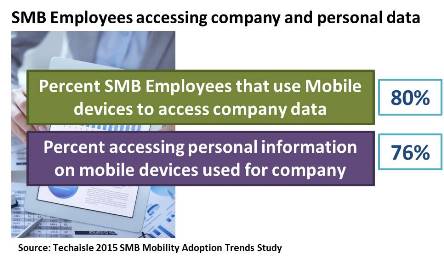
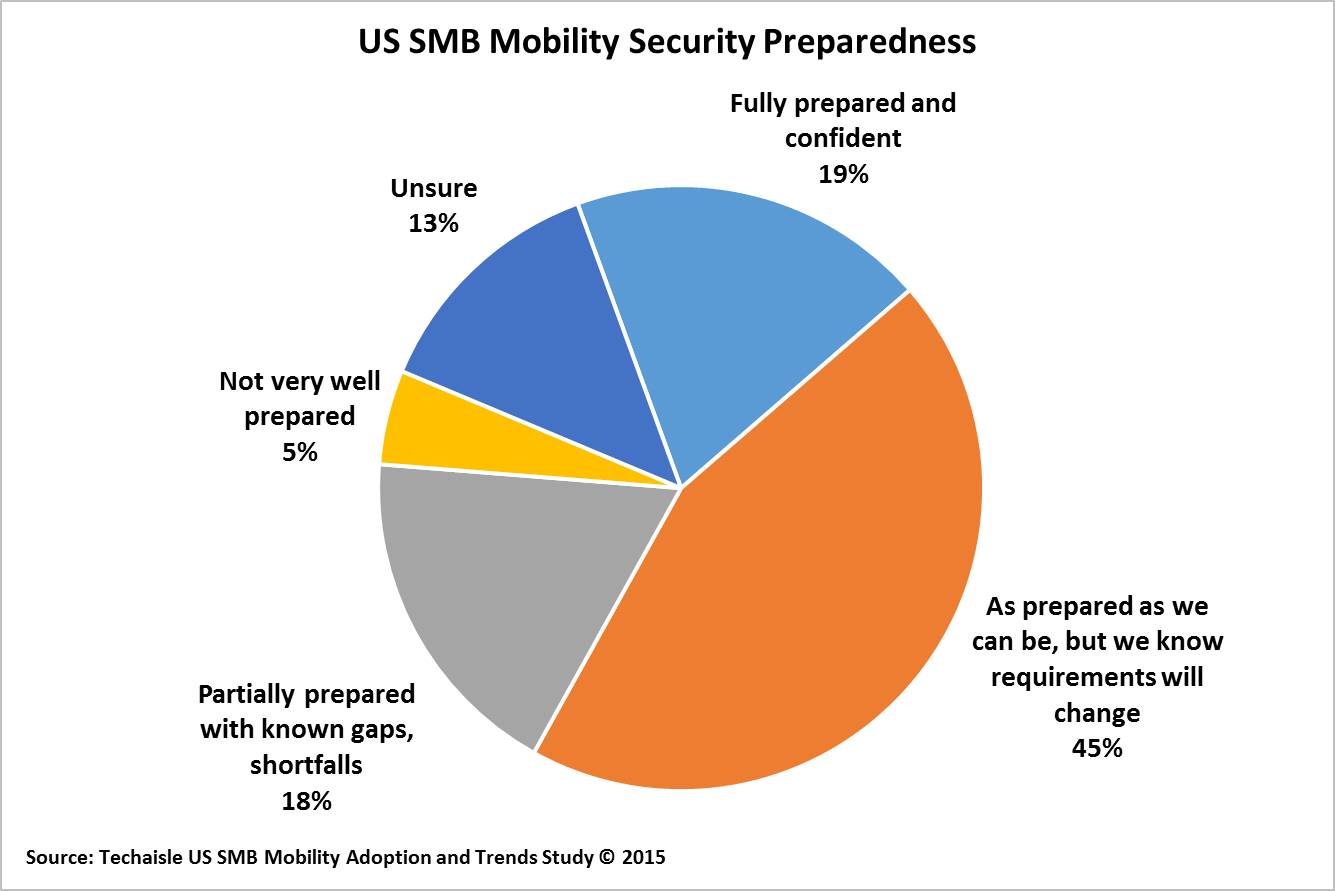
Mobility is a top IT priority for 76% of global SMBs and in US alone SMBs spent US$50B on mobility in 2014 (Source: Techaisle 2015 global SMB and Midmarket Mobility Adoption Study). There is no doubt that Dell has a strong presence in the mobile device segment with its laptops (especially XPS13), and Venue tablets. Dell has chosen not to participate in the Smartphone segment and rightfully so. But question remains: How does Dell stay relevant in emerging economies such as India which have moved overwhelmingly to the mobile phone and are moving rapidly to the smartphone, where Dell is not a significant player? The answer may lie in Dell’s focus on commercial PC segment where the market is both under-penetrated and has low PC to employee density.
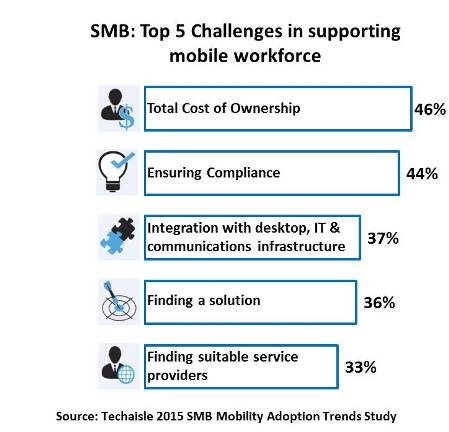
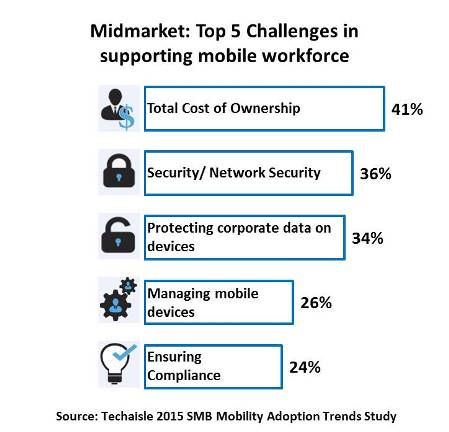
SMB mobility is usually defined not by devices but by the workplace where those devices and their users are. Accordingly, SMBs are not only planning to adopt mobility applications, but are also seeking mobility solutions that enable their mobile workforce - specifically solutions that provide management, security and infrastructure needed to connect mobile devices and applications into corporate IT environment. Mobility solution is Dell’s strongest suite of offerings built from various components such as Dell KACE, Dell SonicWALL, Dell Cloud Client Computing (Wyse thin clients), Dell Data Protection software and Dell Mobile as well as Desktop Workspace (Wyse vWorkspace).
However, Dell is not the first mobility solution supplier that comes to mind. A category that is in high growth mode today, which responds to a rapidly-growing SMB market need and drives high spending levels within SMB accounts is clearly attractive to a wide range of potential suppliers. Ordinarily, one would expect to find that large horizontal IT vendors like Dell with its portfolio of mobility security and mobile management offerings have staked out the high ground in a market of this type, and that channel members are acting as guides to their SMB clients. However, data from Techaisle’s SMB Mobility Adoption survey shows that SMB buyers are predominantly turning to specialized firms for mobility solutions.
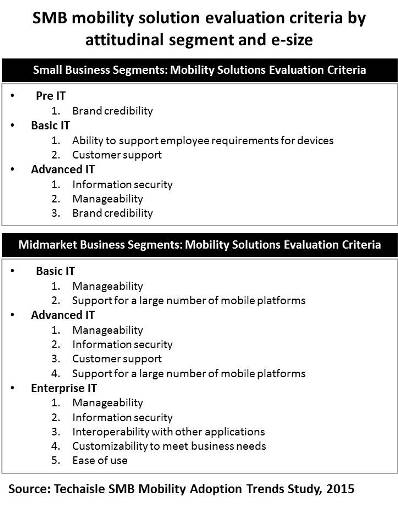
Recognizing the need to be front and center Dell is investing in training its channel partners on mobility solution offerings but to be really successful Dell must define its offerings in more commonly understood categories - Mobile device management, Enterprise mobile management, Windows-as-a-service, thin clients and mobile app security.
Cloud
Cloud is no longer a trend that is discrete from mainstream IT. Techaisle’s global SMB and Midmarket Cloud Adoption trends survey data shows that cloud computing is viewed as an IT priority by 96% of US SMBs and a similar percent globally. Within the US alone, SMBs spent US$30B on cloud in 2014. Cloud is established as essential IT infrastructure for SMBs and Techaisle expects cloud momentum to continue as cloud addresses some of the key IT issues faced by SMBs.
Data shows that the larger SMB cloud trend is towards deeper use of SaaS. There is still scope for additional use of cloud infrastructure to replace and/or supplement physical back-office gear, but there is a limit to how much infrastructure is required by an SMB. Dell is a cloud infrastructure supplier with a formidable set of offerings and services which includes its converged infrastructure solutions, cloud client computing capabilities, and infrastructure management and integration solutions for cloud environments. But again, despite its investments, Dell is not the most widely recognized suppliers of converged infrastructure by SMB end-users and SMB channel partners (Sources: Techaisle SMB Converged Infrastructure Adoption Study & SMB Channel Partner Trends study). Nor is it mentioned among the top 5 IT suppliers for cloud infrastructure solutions by SMBs as per Techaisle’s recent survey.
But for those SMBs and midmarket firms that are moving rapidly to private or hybrid cloud deployments Dell combines the scale and efficiencies of its PowerEdge FX portfolio with solutions like Active Systems Manager and Dell Cloud Manager to deliver the infrastructure building blocks and management capabilities needed for private or hybrid environments. Furthermore, Dell works closely with partners, such as VMware (for EVO: RAIL) and Microsoft (for Azure) in delivering tightly integrated and engineered cloud solutions. There is tremendous merit in what Dell is doing and specific SMB segments are paying attention. As per Techaisle’s SMB attitudinal segmentation, Dell is becoming a go-to supplier of on-premise cloud infrastructure for “growth-aspiring” and “innovation-driven” SMBs and Midmarket firms.
Big Data
Techaisle’s study on SMB and Midmarket Big Data Adoption and Trends shows that 7 percent of small businesses and 20 percent of midmarket businesses are currently using Big Data solutions and that another 17 percent & 38 percent respectively is planning to adopt within the next 1-2 years. The promise of superior data-driven decision making is motivating SMBs to invest in Big Data technology. This represents a sizable opportunity considering that the segment is relatively new, it requires a certain level of IT sophistication and a history in linear investment in IT enablers to be successful. In 2014 US SMBs spent slightly over US$3B on big data. Specifically, midmarket attitude towards Big Data has transitioned from “over-hype” to must-have technology with the increase in employee size.
Dell has certainly dipped its toes into big data analytics with its acquisition of StatSoft and its Statistica advanced analytics solution. Its other two big data products Dell Kitenga and Dell Toad Data Point are incidental yet complementary to Dell’s big data solution stack. It is not out of place to mention that both Kitenga and Toad Data Point came from acquisitions. But the overarching anchors of Dell’s big data strategy are its partnerships with Cloudera & Intel (integration of Dell’s in-memory appliance with Cloudera Enterprise) and Dell’s professional services. Statistica may have one leg up on SAS due to its visualization capability and another leg up on Tableau with its statistical functionality. But it will be interesting to see where and how much of resources will Dell commit to drive its big data solution stack adoption beyond the healthcare vertical (where it has tremendous strength due to acquisition of Perot Systems). For now, most SMBs and midmarket firms are turning to Dell for their big data infrastructure platform. In a most recent set of depth interviews conducted with midmarket firms, Techaisle found that almost 9 out of 10 big data implementations were on Dell platform. Techaisle’s expectations are that, in true Dell fashion, Dell may be best positioned to commoditize big data solution and bring it out from the farmers’ market to the freezer aisle for SMBs to accelerate adoption.
Supplemental to big data, IoT is another relevant area for SMBs. Techaisle’s most recent global SMB technology adoption study shows that 52% of US midmarket firms and 18% of small businesses are either currently investing or planning to invest in IoT predominantly for security, fleet management, asset tracking and supply-chain visibility. Dell has a new IoT division and its first product is a US$500 gateway (re-purposed Wyse Thin Client) which supports Ubuntu, Wind River and Thinkworks PTC. Although one may argue that Dell is going back to its product DNA and building commoditized IoT solution but Dell may well have an advantage. By combining security from SecureWorks, analytical engine of Statistica and wrapping with Dell professional services, it may be well ahead with an end-to-end IoT solution. At least, Dell’s IoT offering is easy to understand and deploy for small and midmarket businesses.
Security and Virtualization are two other areas of importance for an SMB organization. Dell is present in both these areas. In security Dell has its own IP whereas for virtualization Dell is platform agnostic and has designed a set of blueprints that works with VMware, Citrix and Nutanix. However when the security market is growing at double digits, Dell’s software security growth in the area has been 7% (Dell does not disclose its entire security revenue details). Dell may well be suffering from a 1 vs. 1 selling as opposed to wider knowledge of Dell’s security offerings.
Final Techaisle Take
Dell has successfully put together a full set of flexible and scalable technology solution building blocks. Its sales organization is learning how to use these “blocks” successfully to build robust and future ready IT solutions for its SMB customers. Dell’s channel organization has also been focusing on equipping its channel partners with the same level of understanding. Dell has also set up cross-functional teams as Centers of Excellence that are empowered to educate and guide channel partners. These blocks may look very easy to assemble but articulation of their capabilities is very tough unless a complete picture of the end outcome is shown beforehand. And Dell has its homework assigned – demonstrate business outcomes through use cases and show thought leadership by expounding forward thinking because within the eyes of many SMBs and SMB channel partners, Dell still lags other IT suppliers on innovative and cutting edge technology front (Source: Techaisle 2015 SMB survey). That said, Dell Blueprints, for integrating piece parts into whole solutions, may just be the answer that SMBs and channel partners are looking for.