• TRUSTED RESEARCH

    TRUSTED RESEARCH | STRATEGIC INSIGHT

    SMB. CORE MIDMARKET. UPPER MIDMARKET. ECOSYSTEM
    LEARN MORE
  • INTERWORK 2.0: THE AGENTIC FUTURE OF CONNECTED BUSINESS

    INTERWORK 2.0: THE AGENTIC FUTURE OF CONNECTED BUSINESS

  • 2026 TOP 10 SMB BUSINESS ISSUES, IT PRIORITIES, IT CHALLENGES

    2026 TOP 10 SMB BUSINESS ISSUES, IT PRIORITIES, IT CHALLENGES

  • 2026 TOP 10 SMB PREDICTIONS

    2026 TOP 10 SMB PREDICTIONS

    SMB & Midmarket: Autonomous Business
    READ
  • 2026 TOP 10 PARTNER PREDICTIONS

    2026 TOP 10 PARTNER PREDICTIONS

    Partner & Ecosystem: Next Horizon
    READ
  • ARTIFICIAL INTELLIGENCE

    ARTIFICIAL INTELLIGENCE

    SMB & Midmarket Analytics & Artificial Intelligence Adoption
    LEARN MORE
  • IT SECURITY TRENDS

    IT SECURITY TRENDS

    SMB & Midmarket Security Adoption Trends
    LATEST RESEARCH
  • BUYERS JOURNEY

    BUYERS JOURNEY

    Technology Buyer Persona Research
    LEARN MORE
  • PARTNER ECOSYSTEM

    PARTNER ECOSYSTEM

    Global Channel Partner Trends
    LATEST RESEARCH
  • CLOUD ADOPTION TRENDS

    CLOUD ADOPTION TRENDS

    SMB & Midmarket Cloud Adoption
    LATEST RESEARCH
  • FUTURE OF PARTNER ECOSYSTEM

    FUTURE OF PARTNER ECOSYSTEM

    Networked, Engaged, Extended, Hybrid
    DOWNLOAD NOW
  • MANAGED SERVICES RESEARCH

    MANAGED SERVICES RESEARCH

    SMB & Midmarket Managed Services Adoption
    LEARN MORE

Techaisle Analyst Insights

Trusted research and strategic insight decoding SMBs, the Midmarket, and the Partner Ecosystem.
Anurag Agrawal

BYOD in the SMB and its impact on mobile device purchase

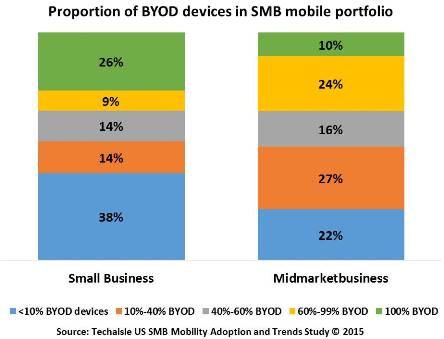
Techaisle SMB and Midmarket Mobility Adoption Trends data shows that BYOD is not a factor in every SMB’s mobility strategy: more than half of small business (1-99 employees) respondents to the Techaisle SMB survey report that all or essentially all of the mobile devices in use are owned by the business, and nearly 25% of midmarket enterprises own 90%+ of their mobile device portfolios. However, BYOD is widespread within this group: 36% of the devices used by small businesses and 43% of those in use within midmarket firms are owned by employees.

techaisle-smb-byod-and-notebook-purchase-resized

The term BYOD has only been around since 2009, when it is said to have originated at Intel – but it has since become ubiquitous. A web search on the term will return nearly 10 million hits, and IT managers at organizations of all sizes and from nearly all industry sectors are very familiar with demands for connecting employee-owned mobile devices to corporate IT networks, applications and data resources.

Techaisle survey data shows that BYOD within SMBs comes in several ‘flavors.’ One of them is where employee both selects and pays for a new device, delighting the SMB finance, but causing problems for IT. Another flavor is CYOD, where employee pays for the device but selects it based on guidelines or an approved list. It appeals to both the SMB and IT but is not completely satisfactory for the employee. Third flavor is where it is a mix of two with some level of reimbursement for the purchase from the company and/or technical support for the devices. This has an upside because the employee selects technology that he/she is comfortable with but the downside is that the cost burden rests, at least to some extent, with the company rather than the employee.

Techaisle SMB and Midmarket mobility adoption survey data also shows that BYOD has implications on desktop and notebook purchases.

Anurag Agrawal

SMB and Midmarket mobility security risk sources

Techaisle’s global SMB survey shows that mobility security is the 2nd top IT challenge for small businesses and 4th top IT challenge for midmarket businesses. To delve deeper, during the course of the Techaisle SMB 2015 Mobility Adoption & Trends survey, respondents were asked “When it comes to security risk in the mobile computing context, which of the following represents a source of exposure or uncertainty within your organization?” To a surprisingly high degree of candidness SMB concerns with mobility security revolved around users. As figure below demonstrates, SMB IT respondents ranked three user-attributable issues

  1. User neglect/irresponsibility,
  2. Lack of user knowledge/awareness, and
  3. User mishap

amongst their top five concerns, trailing only “general malware infection” as a mobility security threat. Data is where the user is and to say that the enemy is inside the tent would be an understatement.

SMBs recognize the exposure and vulnerability but Techaisle survey shows that only 16% of SMBs worldwide are fully prepared to handle mobility security challenges. Data also shows that like manageability, security is an important constraint on mobility adoption within the SMB market. Most MSPs, channel partners and suppliers continue to focus on BDR and/or anti-malware security as they are easy to offer and deploy but they represent a very narrow approach to larger security issues within SMBs.

Anurag Agrawal

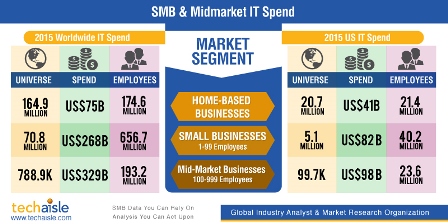
2015 WW SMB IT spend nearing US$600B

Techaisle forecasts that global SMB IT spend could very well reach US$597 billion in 2015 which is an average of US$700 per full-time employee and slightly over US$8K per SMB business. Corresponding US SMB IT spend will most likely be US$180 billion in 2015. Techaisle defines SMBs with 1-999 employees.

At worldwide level, 42% of SMB employees will be mobile by end 2015. US will have the highest percent of SMB mobile employees at 53% and Asia/Pacific excluding Japan will be at 45%.

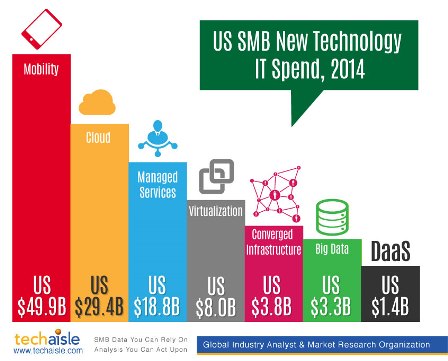
Going back a year, the 2014 combined cloud and managed services spend by US SMBs was US$48 billion representing 27% of total US SMB IT spend.

techaisle-ww-us-smb-it-spend-resized

techaisle-us-smb-new-technology-it-spend-2014-resized

The global small and mid-market businesses, SMB (1-999 employee size) market has been the growth engine for the IT industry at large. The reason is quite simply that SMBs account for over 80 percent of businesses in any country – developed or developing. And over the last few years there has been an ongoing change in SMB IT priorities – Techaisle calls this as “Value Shift”. It signals the change in priorities from Enablement to Empowerment and refers to the new priorities among SMBs to invest in tools and technologies that allow their employees to make better business decisions, improve market reaction time and better serve their customers. In other words, SMB business executives are looking to improve return on Human Capital as a way forward.

No doubt the trend is towards increased spending on cloud and mobility but there are some other key spending trends to note:

Anurag Agrawal

SMB Channel Partners – Top 10 Business Issues, IT Offerings

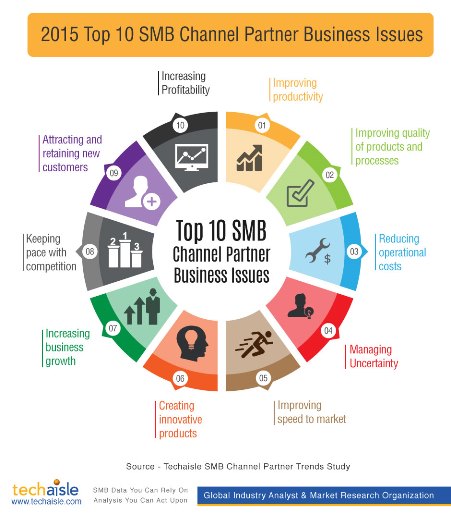
Top 10 SMB Channel Partner Business Issues

Figure below from Techaisle’s SMB Channel Partner Trends coverage lists top 10 business issues being addressed by SMB channel partners in the next one year - a question that parallels the one that Techaisle uses to develop perspective on SMB buy-side business issues.
techaisle-2015-smb-channel-partner-business-issues-infographic-resized-small

There are many ways that SMB channel partners can attack these business issues; in some areas, cloud is part of the problem, while in others, it helps form some of the solution. For example, cloud creates a requirement for new products and processes, which opens opportunity for firms that are effective in rolling out new offerings, but cloud itself is a major source of channel business uncertainty.

Improving productivity as well as improving quality of products and services are the top 2 business issues - they are ranked way higher than business growth and customer acquisition. It makes for a compelling attention that channel partners have realized the shift in technology and its acquisition and SMB channels are struggling to address these issues. Improved productivity is also often seen within the channel as a core attribution of managed services delivery – but growth in managed services portfolios will very likely encompass cloud-based systems. Cloud allows for new offerings to be brought to market quickly. And given the growth of cloud within the SMB market it could be fairly stated that cloud is central to both increasing business growth and keeping pace with competition. The impact of cloud on business activities expands beyond the SMB buy-side community into the channel itself. Cloud’s virtues are therefore apparent in several of the business issues that are of most concern to SMB channel businesses.

It is interesting to point out that "improving sales and marketing" is also among the business issues being addressed by SMB channel partners, but it not within the top 10 business issues.

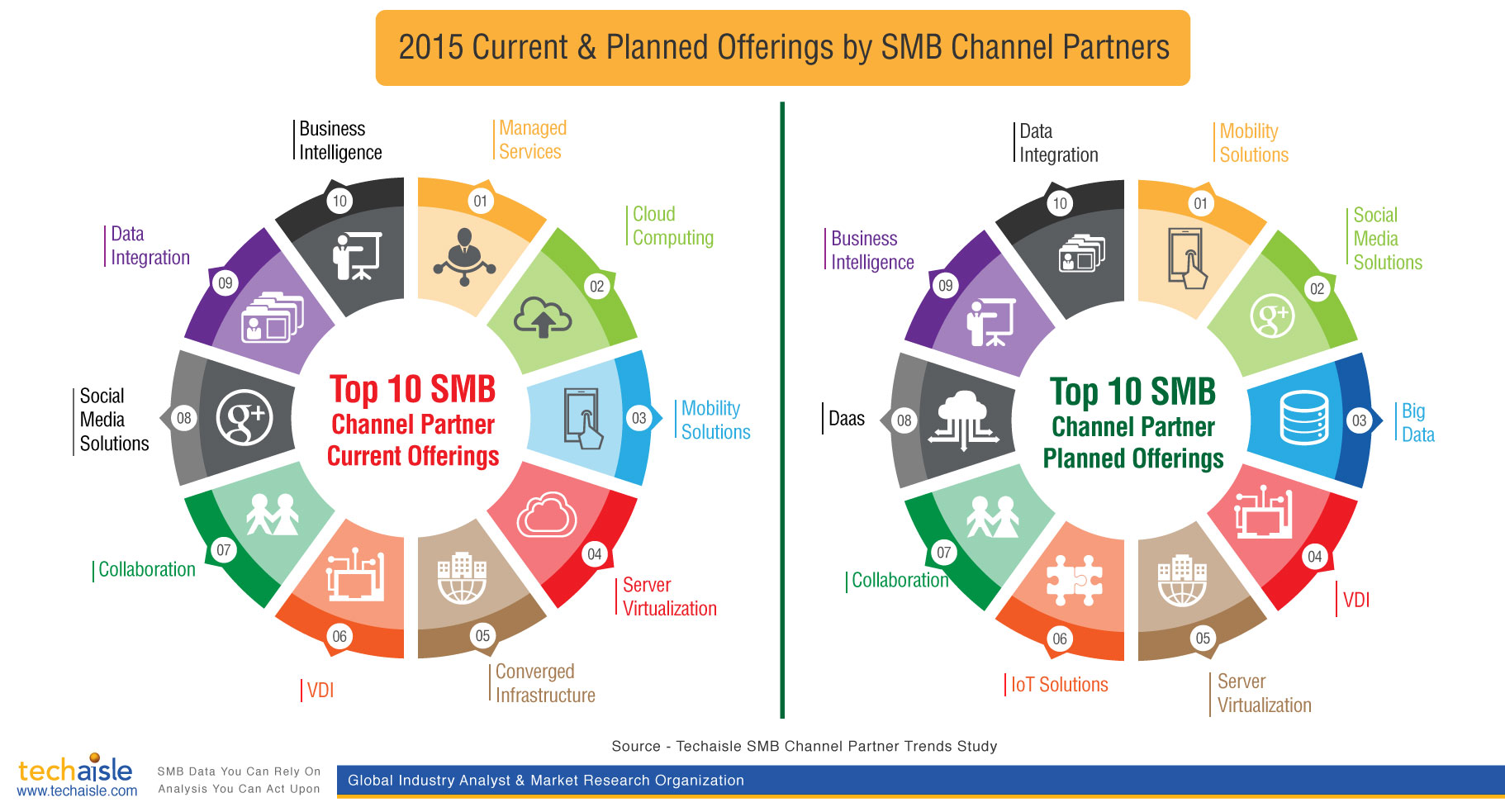
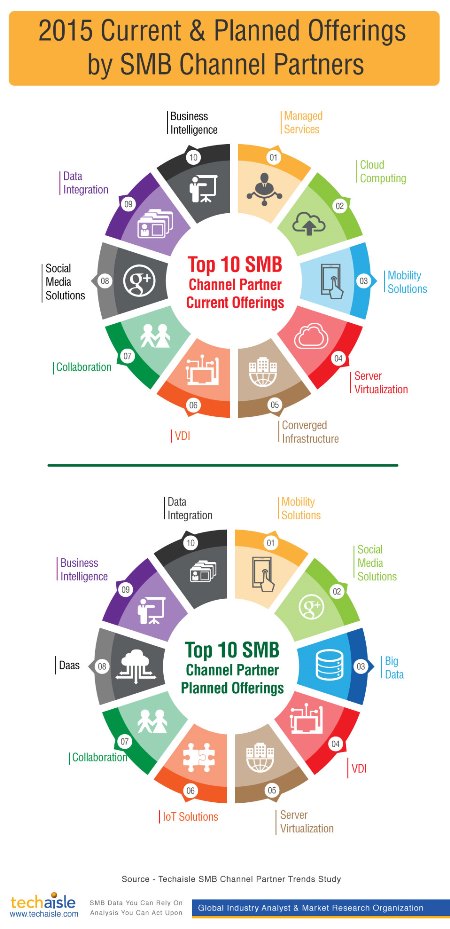
Top 10 Current & Planned IT Offerings

Figure below lists the top 10 current and planned technology offerings, which can be treated as the starting point and the “next steps” in SMB channel migration. The findings illustrate the breadth of business opportunities available to the SMB channel – and also, the essential pervasiveness of the cloud as well as managed services.
techaisle-smb-channel-partner-current-and-planned-offerings-vertical-resized-small

Cloud is at the core of many of the IT solution offerings enumerated in both the “current” and “planned” lists, for example, managed services and of mobility management. It is intrinsic to social media, VDI, desktop as a service and IoT. It is the best, most cost-effective and most scalable approach to supporting collaboration and BI/Big Data. And cloud enablement and management is the key objective of deployments of server virtualization and converged infrastructure, and the key requirement for on premise/off-premise data integration.

Today, many of these IT solution offerings and their associated channel capabilities are largely commingled but within the next three years the depth requirements associated with these will force them to concentrate on some areas and de-emphasize others. Techaisle believes that channel organizations serving the SMB market will become increasingly defined by pursuit of one or two of four primary product/delivery areas.

There will also come points in the SMB Channel Partner migration where the connection between the starting point (for example, mobility) and the next application (for example, Big Data) will become tenuous. These cases will call for partner-to-partner collaboration structured around meeting evolving SMB customer needs. There is already evidence that firms adept in partner-to-partner collaboration are better positioned to build successful businesses in areas such as cloud than those that cling to a "go it alone" approach in all situations (Source: Techaisle’s Winning Strategies of Successful SMB Cloud Channel Partners). Partners and vendors who are effective in inculcating these relationships within their ecosystems will both achieve above-market growth rates. In the meanwhile IT vendors and distributors should really pay attention to the top business issues being faced by SMB channel partners. 

Trusted Research | Strategic Insight

Techaisle - TA