










• TRUSTED RESEARCH

    TRUSTED RESEARCH | STRATEGIC INSIGHT

    SMB. CORE MIDMARKET. UPPER MIDMARKET. ECOSYSTEM
    LEARN MORE
  • INTERWORK 2.0: THE AGENTIC FUTURE OF CONNECTED BUSINESS

    INTERWORK 2.0: THE AGENTIC FUTURE OF CONNECTED BUSINESS

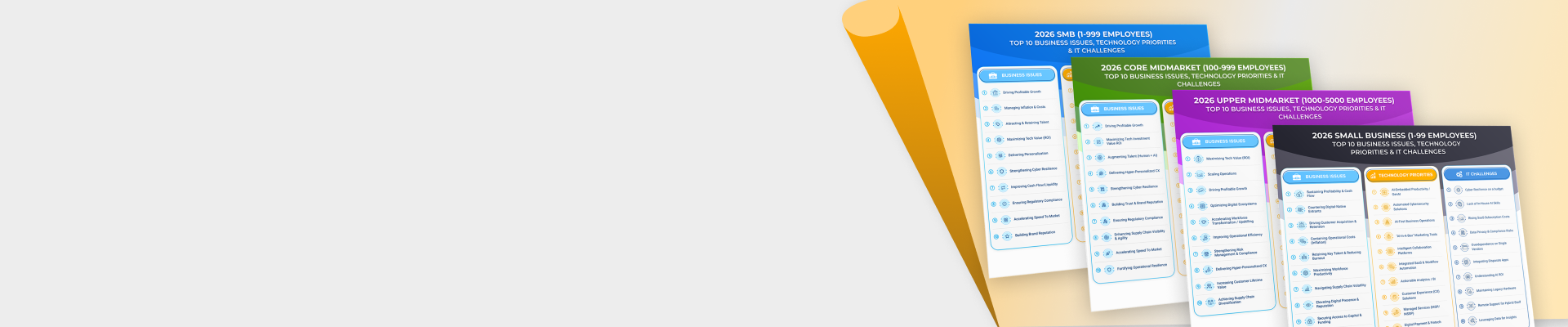
  • 2026 TOP 10 SMB BUSINESS ISSUES, IT PRIORITIES, IT CHALLENGES

    2026 TOP 10 SMB BUSINESS ISSUES, IT PRIORITIES, IT CHALLENGES

  • 2026 TOP 10 SMB PREDICTIONS

    2026 TOP 10 SMB PREDICTIONS

    SMB & Midmarket: Autonomous Business
    READ
  • 2026 TOP 10 PARTNER PREDICTIONS

    2026 TOP 10 PARTNER PREDICTIONS

    Partner & Ecosystem: Next Horizon
    READ
  • ARTIFICIAL INTELLIGENCE

    ARTIFICIAL INTELLIGENCE

    SMB & Midmarket Analytics & Artificial Intelligence Adoption
    LEARN MORE
  • IT SECURITY TRENDS

    IT SECURITY TRENDS

    SMB & Midmarket Security Adoption Trends
    LATEST RESEARCH
  • BUYERS JOURNEY

    BUYERS JOURNEY

    Technology Buyer Persona Research
    LEARN MORE
  • PARTNER ECOSYSTEM

    PARTNER ECOSYSTEM

    Global Channel Partner Trends
    LATEST RESEARCH
  • CLOUD ADOPTION TRENDS

    CLOUD ADOPTION TRENDS

    SMB & Midmarket Cloud Adoption
    LATEST RESEARCH
  • FUTURE OF PARTNER ECOSYSTEM

    FUTURE OF PARTNER ECOSYSTEM

    Networked, Engaged, Extended, Hybrid
    DOWNLOAD NOW
  • MANAGED SERVICES RESEARCH

    MANAGED SERVICES RESEARCH

    SMB & Midmarket Managed Services Adoption
    LEARN MORE

Techaisle Analyst Insights

Trusted research and strategic insight decoding SMBs, the Midmarket, and the Partner Ecosystem.
Shirish Netke

Blessed are the Mid-Markets, for they shall Scale Big Data

In a parody of Start Trek, Silicon Valley technology companies describe their business goal as “Scale, the final frontier…”.  Mid-market companies, defined as those having 100-2500 employees, may indeed provide an opportunity to emerging technology vendors to scale their business. According to Techaisle, a market research firm, these 800,000 global companies spend $300B on IT and are sought after by technology vendors big and small. In the last decade, technologies such as Cloud, SAAS and Virtualization have reached scale with a large number of mid-market companies as early adopters. Intuit, Salesforce.com, NetSuite and Amazon are just a few examples of companies who have relied upon mid-market companies as a key building block for their business.

What does this mean for Big Data? To find out, Carpe Datum Rx spoke to “SMB Guru”, Anurag Agrawal, CEO of Techaisle and the former Head of Worldwide Research Operations at the Gartner Group. Techaisle recently talked to 3,300 global businesses about their Big Data adoption plans. Here is an excerpt from our discussion.

The SMB Market is considered the Holy Grail for technology vendors because it is hard to penetrate. Does your research show that mid-market companies will adopt Big Data before large enterprises do? Are they the early adopters of this technology?


Yes, you are right the SMB Market is the Holy Grail as it is hard to penetrate but with the highest potential. To elaborate, there are slightly over 70 million small businesses and 800,000 mid-market businesses worldwide. They constitute over 97 percent of the business segment. And their collective IT spend is projected to grow by 6.5% between 2013 and 2016 which is quite a lot faster than the Enterprise segment. To really identify the SMB segments and their type of technology spend is a mind-numbing exercise due to the sheer volume of data points. This is compared to the enterprise segment where there are fewer companies and larger dollar amounts being spent.

To answer your second question about whether mid-market businesses will adopt big data before large enterprises, let us look at some facts. Cloud computing started as an enterprise play, however, it was quickly discovered that SMBs would be the more relevant target segment with a faster path to adoption. Similarly, as enterprises adopted Virtualization, vendors shifted their focus to the SMBs with some very creative solutions. Mid-market companies, defined as those with 100 to 2500 employees could certainly be the early adopters of Big Data. We recently did a study where we surveyed 3,360 mid-market businesses worldwide covering all regions – North America, Europe, Asia/Pacific and Latin America. What we found is that the promise of superior data-driven decision making is motivating 43 percent of global mid-market businesses to at least look at Big Data technology. And above all, 18 percent of mid-market businesses are now investing in big data related projects.

In the mid-market segment, there is also a competitive imperative to understand customers, create innovate products and improve operational efficiencies. They are not burdened with too many silos and large legacy systems deployments. The absence of large legacy systems is an important point to consider because it makes mid-market businesses more agile to implement new types of solutions that solve their business problems. It is expected that in year 2016, global SMBs would spend US$3.6 Billion on big data solutions exhibiting a growth rate that is faster than what was exhibited by cloud computing solutions.

We understand that you cast a very wide net to get your 43% number. Is there a consistency in the sentiment on big data across different parts of the world? 


Yes, we had to cast a wide net to really understand the adoption and trends within mid-market businesses. And yes, there is a difference across geographies and employee sizes. North America has both the largest market and the highest level of adoption in Big Data overall. In terms of actual deployment activity, the market grows in relation to the size of the companies. Additionally, mid-market business attitude towards Big Data transitions from “Over-Hype” to must-have technology with the increase in employee size. Let me give you some examples. A small-to-mid-sized bank is developing a Proof of Concept for fraud analytics. Another example is of a small advertising agency that is trying to deploy digital advertising analytics. So big data is not only within the radar of enterprises, the same problems exist across all sizes of business, only the volume of data, available budget and the required simplicity varies. The problem is that we all get caught up in technology which instills a sense of fear. We have to shift the conversation from technology to solving business problems.

Big Data adoption is often stalled by a lack of knowledge or understanding of the technology and its capabilities. Do mid-market companies have a better understanding of this technology than large enterprises? Do they have an advantage over large enterprises in implementing effective solutions?


You are right. Three things – Technology, Resources and Data are the biggest roadblocks for big data project implementations within mid-market businesses. In recent years technology and technology options have evolved extremely rapidly for an average business to understand, evaluate, purchase and implement. Big data is no different. Mid-market businesses consider big data as very complex resulting in very steep learning curves. The complexity gets further exacerbated with lack of experience, lack of skilled manpower and innate difficulty in identifying external consultants who would be the right fit for their big data business objectives and budget availability. In spite of challenges, the study shows that there have been some successes when business units, IT & data analysts exhibit extraordinary alignment.

Our study shows that mid-market businesses typically start their big data journey in one of four ways and the highest success rates have been achieved when IT and data analysts work with external consultants from project inception. It is still very early days for these businesses to fully embrace big data but the seeds are being planted. And we believe that these businesses may very well race ahead of enterprises with their deployments as technology becomes simpler and consultants become experienced. As we like to say it, SMBs could be the path to big data simplicity.

You talk about the linking of structured and unstructured data. Why is this problem so important compared to all the others? 


The issue of analyzing data from diverse sources leads a mid-market business to naturally consider linking structured and unstructured data. If we look back, CRM solutions had first established the need for analyzing customer data. However, the data was mostly two-way transactional structured data. This changed when customers began visiting business websites to explore, browse and perhaps make purchases thus leaving behind a trail of information. And everything changed with the onset of social media, blogs, forums, wikis and opinion platforms where the identification of false positives and negatives became difficult and knowledge about the customer and resulting segmentation became an inaccurate undertaking. Big data analytics presents the possibilities of connecting together a variety of data sets from disconnected sources to produce business insights for generating sales, improving products or detecting fraud. Thus the importance of linking structured and unstructured data to analyze social media data, web data, customer and sales data along with click-stream machine generated data and even communications data in the form of emails, chat, and voice mails. But extremely limited expertise creates a major challenge. If they can figure it out, one-fourth of mid-market businesses say that they will use big data as an integral part of their overall analytics efforts. The possibility of analyzing a variety of data producing action-driven business insights is too big to ignore for mid-market businesses.

How are big data projects getting started globally? Are they championed by LOB managers? Are they getting adequate support from executive management? Are customers demanding it?


The study reveals that the initiators are marketing, finance or operations and the ultimate user of the analytics is the business user. Big data requires a new type of alignment between business heads, namely, marketing and finance (main drivers of big data projects), IT and a completely new set of players known as data scientists or data analysts. As I mentioned before, once the decision is made mid-market businesses show an extraordinary alignment across departments. Our study shows that mid-market businesses typically started their big data journey in one of four ways. However, the highest success rate was achieved when an external consultant or organization was brought in to develop proof of concept, advise on database architecture and ultimately develop the big data analytics solution right from the moment of project inception.

What is one piece of advice or Carpe Datum prescription can you share for our members?


You have adopted cloud, you have adopted mobility, you have adopted social media so do not be afraid to develop Big Data analytics proof of concepts. Do not ignore big data just because of perceived complexity and big data solution providers’ inability to create bite-sized messaging that directly address pain-points. Do not forget that business intelligence has now become one of the fastest solutions to be adopted by SMBs and mid-market businesses. If done right, big data will address three key pain points: Increased sales, More Efficient operations, Improved Customer service.


Davis Blair

Citrix Seeds the Cloud

While unveiling a very lucid product and service strategy today, Citrix announced several significant products and alliances that fill gaps in the SMB Cloud Computing marketplace. These include:

  • An expanded Me@Work mobile applications suite, with new and improved apps,
  • A strategic alliance with Microsoft to distribute Windows and Office365 as Cloud Services through XenDesktop,
  • A VDI-embedded and secure Ultrabook Client,
  • Next generation Gateway and next generation cross-cloud bridge,
  • A certified cloud platform developed in collaboration with Apache CloudStack,
  • Improvements to the NetScaler line.

And the most consequential announcement of the day - a wide and deep strategic alliance with Cisco that if well executed, will offer a true 1+1=3 result for both sides and have a major impact in the industry.


As the Cloud matures, Techaisle believes that integration is key and the market will coalesce around virtual versions of the client and server concepts – with communication at the core of the client suite and a collaborative, front office multi-user suite in the middle of the Server environment. With today’s announcements, Citrix moves us closer to this concept.

We will focus on three of the announcements with a point of view on how we consider them to be both strategic and timely, and finish up with huge potential impact of the slew of new alliance announcements.

Part of the achieving the vision is to ensure collaboration is possible across all hardware environments, that application objects can be executed regardless of proprietary operating systems and formats. By supporting all the formats shown here through their Receiver, Citrix already enables apps and data on three billion devices, which is expected to grow to ten billion in the next five years – Like many Korean manufacturers, Citrix is thinking in terms of screens, and knows that consumers are driving adoption of connected screens as part of the lifestyle – my teenage daughter has a MacBook, iPhone, and Satellite TV running all at the same time, each screen running multiple applications. When selecting a workplace, surveys show this generation would rather give up a more lucrative employment opportunity than give up their devices or right to use social media. As Kevin Kelly observed in his visionary work, New Rules of the New Economy, back in 1998:

“Because communication—which in the end is what the digital technology
and media are all about—is not just a sector of the economy. Communication is the economy.”
- Kevin Kelly, New Rules for the New Economy, 1998


We could not agree more, and the ME@Work announcement shows Citrix is taking the long view.

The ME@Work mobile app suite includes several productivity and collaborative applications, including the #1 web-conferencing solution, GoToMeeting. We found it interesting that Citrix is simultaneously introducing some competitive products in conjunction with the partnership; an email client – most important component of the collaborative desktop – as well as strong offers in file sharing, personal collaboration, and web conferencing. It is a bold move; for those of us who have been watching the industry for a while,  we remember when there was a triumvirate – Windows, Intel and Novell - and then there was NT with OS-embedded LAN capabilities - and then there were two. And then Netscape came out swinging with a better web browser that seriously pressured Microsoft - and then there was Windows-embedded Explorer - and then there was one.

But Microsoft gets a lot out of these announcements, especially if execution can follow strategy. Microsoft revenue is over 25 times that of Citrix, but they can use the excitement brought by a fast-growing, deeply technical, and cloud-focused next-generation partner. Especially in the SMB space - the 100-249 & 500-999 segments of the mid-market are a real sweet spot for this partnership.

By partnering with Microsoft to bring Windows, Office365 and the SkyDrive to market, Citrix benefits from the practically ubiquitous Windows installed base and opportunity for widespread adoption of Office365, (which we expect to have a banner year in 2013). And access to the most mature global software distribution ecosystem in the world. Microsoft gains an ally that provides substantial support and momentum against Google Apps, a catalyst to move away from packaged software,  additional credibility in collaboration, and adds 10,000 channel partners at the same time.

The Ultrabook client is a strategic offer because it supports the tide of BYOD and it is another route to market for XenDesktop VDI. It also aligns Citrix with Intel and the major OEMs who are looking for returns on large investments in the Ultrabook line.

While the Microsoft news is a big deal, the even larger news was a strategic alliance with Cisco that involves major commitments of joint R&D, integration of product lines and joint manufacturing in the future. Key Points:

Citrix and Cisco announced broad cooperation in three major areas: Mobile WorkStyles, Cloud Orchestration and Cloud Networking.

Mobile WorkStyles
The big idea here is any data on any device (the billions of screens mentioned above) to support the growing BYOD wave, and leveraging joint strengths to deliver a unified secure environment for applications, data, voice and collaboration. Cisco contributes Jabber and substantial collaboration expertise gained from the Webex acquisition, Virtual Experience Infrastructure (VXI) technology, and MediaNet Technology. For Mobile WorkStyles, Citrix brings a new and improved CloudGateway and Receiver, a new and improved ShareFile service and XenApp & XenDesktop. The alliance aims to bring a richer experience with seamless security and a leveraged support infrastructure than covers the entire stack 24x7 on a global basis.

From a business perspective, Citrix can ride on the back of the 800 pound gorilla straight into the Enterprise, leveraging the industrial-strength performance of Cisco’s premium product lines at a reduced price point. As with Microsoft, Citrix is aligning itself with an old-guard industry titan, in this case, one whose revenue is 16 times that of Citrix. And as with Microsoft, the deal looks like a win for both sides. Our opinion is that it could help revitalize Cisco, whose foray in to software based business created some great products in Webex, but the model was different enough to shake them up. We continue to write on the rise of the digital channel at the expense of a traditional HW VAR Channel. When Cisco acquired Webex they entered a software-based, inbound sales, price sensitive, online-marketed, sold and delivered, six-week sales cycle, user-configured business model that was almost the antithesis of what they were best at: premium quality enterprise hardware-based solutions that are differentiated by making the value of the whole network exceed the sum of its’ parts - sold by an enterprise sales force and delivered by top shelf VARs and SIs. Especially within SMBs, the right combination of price and SLA to solve business, not technical problems, are overriding criteria when buying, and traditional hands-on VARs might not even be called - cut out by online marketing and inbound sales teams. In hardware, it is more about scale economies, quality engineering and brand management - software is all about market share and developing accelerating returns and an ecosystem of fellow travelers.

Cloud Orchestration
The second key area of cooperation is in what is being called Cloud Orchestration, where the objective is to manage the traditional data center functions of computing, network, storage, security, and management, delivered across physical, virtual and cloud environments using Unified Computing, Unified Management and Unified Fabric. This is clearly Cisco’s home territory and they bring expertise and technology including Unified Computing System (UCS), Open Network Environment (ONE) and the Nexus Series of switch technologies to bear on these challenges. Citrix contributes the newest CloudPlatform, a new open source CloudStack and the XenServer to this effort. Using Cloud Orchestration, the alliance aims to deploy Public, Private and Hybrid Cloud environments with unified management that reduces complexity and improves agility, something SMB customers will be happy to see. Embracing Open Source is also a good move for Citrix to increase the footprint.

Cloud Networking
The third leg of the alliance is centered on the Citrix NetScaler Cloud Networking Platform. Here the objective is to adopt NetScaler as the go-to technology and jointly develop the next generation through the alliance. This will be accomplished by offering NetScaler as a strategic component within the Cisco Cloud Network Services Architecture, with seamless integration at the product level in areas including Security and WAN optimization. The order of implementation is that Cisco will adopt, sell and market the NetScaler, it will be manufactured according to a certified Cisco Design specification followed by a joint road-map for product interoperability, development and go-to-market strategy over the long term.

Through these announcements, Citrix has taken several steps to advance Cloud-based services and fill gaps in the market; they have introduced a new channel for Windows and Office365, brought to market their own collaborative suite, and a VDI-embedded client to further the VDI and BYO trends in the SMB space. Other technology announcements were also significant but for reasons of brevity we have not covered them in detail. One thing is for sure - no one can accuse Citrix of being timid. Of course, when snuggling up with the big guys the way they are, Citrix themselves said it best in the announcement: "POs are better than PR". It all falls on execution at this point.


Anurag Agrawal

Outage Immune, Distributed, Scalable Database-as-a-Service for SMBs from GenieDB

Since the time Amazon announced its Database-as-a-Service, most IT vendors, big and small, have either spun off services utilizing Amazon or built services that are complementary to Amazon. And many others have rolled out competing products. Each of them is targeting SMBs with the promise of agility, reliability, scalability and integration capability. The market has become crowded with options that are very difficult to sift through for SMBs. Nevertheless, the interest in database-as-a-service has never been higher. As per Techaisle’s 2013 SMB Cloud Computing study, between 6% and 64% (varies by employee sizes) of SMBs are either using or planning to use database-as-a service. However with  an average number of formal IT staff at 4.2 and percentage of SMBs having formal IT staff varying from a low of 3% (for 1-4 employee size) to high of 97% (for 500-999 employee size) businesses the adoption is sporadic and hindered because of inherent possibility of “lights-out” situation due to outages, network latency and connectivity issues.

GenieDB, a company founded in 2011, has brought into the market a MySQL-database-as-a-service that that removes outages from the equation. Phyken Media, a video game studio for mobile platforms, developer of “Wizard Ops Tactics” is GenieDB’s marquee customer. Kunal Patel, President of Phyken Media, was faced with two huge challenges;
 

1/ during development of the game he had to have access to robust technology that could scale to production rapidly,

2/ be able to deploy into multiple geo locations for multiple-cross-region-player challenges without having to install and manage multiple servers.

In such a rapid-fire environment, where all the data is “hot”, Kunal and his team of developer-artists turned to GenieDB to utilize its MySQL database-as-a-service offering which he said is hugely disruptive enabling globally distributed databases where all nodes remain synchronized.

To get to know more about GenieDB we had a very detailed Q&A with Sumeet Sheokand, CTO, GenieDB. Given below is an excerpt from the interview.

Techaisle: What is the motivation behind GenieDB and in particular MySQL-as-a-Service?

Sumeet Sheokand, CTO: GenieDB is built with the aim of dramatically simplifying database management in the cloud for business critical applications. Dealing with cloud outages, network latency, redundancy, replication, tuning, etc. can be very painful and time consuming, distracting precious IT resources away from other core business areas.  We want to evolve this vision to the point where you no longer need a team of DBAs to manage complex, distributed database platforms. We will either automate processes or provide a very simple interface to manage hundreds of highly available, low latency MySQL databases ready for any cloud infrastructure, anywhere in the world. It is well known that the only way of overcoming the challenges of cloud outages and network latency is to distribute copies of the database across wide geographical areas, a historically difficult problem for relational database architectures. GenieDB makes this critical functionality available to all businesses and all budget sizes, in a very easy-to-use package. In keeping with the theme of making it easy, we offer our core technology as a Database as a Service (DBaaS). This allows us to offer our users a point and click ability to deploy geographically distributed database servers with automated management and monitoring already in place.

Techaisle: What problem are you trying to solve? Especially, how can small and mid-market businesses benefit from GenieDB?

Sumeet Sheokand, CTO: We have created a geographically distributed database fabric that removes the database as a single point of failure and makes cloud-enabled MySQL database provisioning, management and monitoring an exceedingly simple affair.  With our service, the small and mid-market businesses can focus on running their businesses or building their applications rather than worrying about architecting complex distribution, replication and failover systems, not to mention installing, patching and maintaining backups. All the rote tasks of using databases will be taken care of by our service.

Techaisle: Is the service a better mousetrap than others that are available in the market?

Sumeet Sheokand, CTO: The comparison between what is available in the marketplace today and GenieDB can best be described as the difference between a database-in-the-cloud vs. a Cloud Database.  The existing DBaaS solutions are simply databases which have been put into the cloud utilizing a variety of scripts (i.e. "A Few Scripts-as-a-Service").  These offerings are partial solutions as they do not remove the complexity of building distributed systems in the cloud.  Some only offer single locations; some only offer it in certain locations, while others don’t offer an easy path to grow the database with business traffic. Through our proprietary storage engine, GenieDB has fundamentally transformed the way a relational database functions in the cloud, removing all of these common pain points within the database layer. Businesses can choose their cloud providers, their locations and size, and know that their database will be available, responsive and grow as their business grows, with minimal effort.

Techaisle: How do you think it is different from Translattice, NuoDB, Galera?

Sumeet Sheokand, CTO:  GenieDB stays true to MySQL, the most commonly used database in the world, as compared to Translattice (Postgres) or NuoDB (Not MySQL, custom). GenieDB also offers an ‘Eventually Consistent’ model that allows us to place the nodes as far apart around the world as the business needs and deliver local database performance, instead of being limited by network distance (Galera).

Techaisle: Is GenieDB’s approach similar to Google’s Spanner?

Sumeet Sheokand, CTO: GenieDB has some conceptual similarities to Google Spanner, such as a consistent Clock around the cluster. GenieDB uses software Lamport Timestamp based clock compared to Google’s hardware based clock. Even though there are similarities, GenieDB was developed independent of the Spanner effort. It was nonetheless a great validation of our vision and approach. Google Spanner is also not available as a product for businesses at large to use in their own applications. GenieDB is available today to reap the same benefits.

Techaisle: Can it be deployed only across Amazon or other cloud providers as well? Do end-users have a choice of cloud provider they feel comfortable with?

Sumeet Sheokand, CTO: GenieDB is currently available across Amazon, Rackspace and Google’s cloud services. We are actively working on integrating a handful of other popular providers, including HP, into the service. We will be happy to work with our customers to accelerate their cloud of choice for integration.

Techaisle: The future is Hybrid as we all know it, so how does it work if in a customer’s environment there are both on-premise and cloud based MySQL databases?

Sumeet Sheokand, CTO:  GenieDB core software is agnostic to machine location. It just needs a Linux machine with network access. It is because of this capability, that we can build a database cluster across multiple cloud providers. Hence, we can support any Hybrid configuration, if we have access to the machines. There are business and security concerns on providing full access that would need to be figured out.

Techaisle: Why did you choose MySQL for database-as-a-service?

Sumeet Sheokand, CTO: MySQL is the ubiquitous database for modern applications. It is by far the most widely installed and used database in the cloud today and hence is the basis of our service.

Techaisle: Most of the SMBs do not have IT staff let alone database administrators. Can it still be deployed with limited technology knowledge?

Sumeet Sheokand, CTO:  Deploying GenieDB does not need any technical knowledge, staff or application changes besides pointing the application to the GenieDB provided database location.  It is this [SMB] specific target audience for which we designed GenieDB.

Techaisle: How do you help SMBs in understanding the technology and how the service solves their business pain points?

Sumeet Sheokand, CTO: GenieDB has extensive amount of information available at its site including FAQs, White Papers and Demonstrations. We also offer a one week, free trial of the service and support so that potential customers can experience the service before buying.  We are of course happy to spend as much time as necessary to get any new client comfortable with our service.

Techaisle: For type of SMB customer is this solution most suitable?

Sumeet Sheokand, CTO: GenieDB is a Storage Engine for MySQL and as such is a general solution. Hence, GenieDB works with any application that works with MySQL today. From a business perspective, any business that is running a critical application on a single database could benefit from GenieDB, so that if one database server goes down, others are still available and the application will continue to work without any downtime.  Typically we see customers that are starting a new project or that have an existing project that is anticipating growing traffic or is becoming more business critical.

Techaisle: What is a typical deployment timeframe?

Sumeet Sheokand, CTO: Nodes are spun up and the cluster made available within minutes. Most applications can be up and running against GenieDB under an hour, including data transfer. The actual duration does depend on the amount of data to transfer and the upload capacity available from the customer site.

Techaisle Take

At last count, MySQL is still the most widely used database for cloud deployments and is easily the one that SMBs use extensively. However, MySQL’s continued dominance is being questioned since it was ingested by Oracle through its Sun acquisition. Although Postgres is usually considered to be more powerful and meant for big data sets, there is yet no visible mass migration from MySQL to Postgres. The success of GenieDB and the decision to use its DBaaS is not dependent upon the debate of MySQL vs. Postgres but GenieDB’s relevance for the most-used open source database. GenieDB has created a very useful solution for SMBs but will be challenged to capture mind-share of IT consultants, service providers and the developers who are advisors to SMBs for development of applications based on multi-nodal, geographically dispersed, tightly synchronized MySQL databases. Apart from focusing on growing its customer base GenieDB will have to continue to add feature sets, capabilities and integrate with different regional cloud providers. For now, GenieDB’s MySQL-as-a-Service receives check marks for its simplified usage, ability to integrate with all MySQL applications, rapid deployment, cloud portability (not being locked-in with a single provider) and above all making the database immune to outages.

Anurag Agrawal

Seven Lessons for Successful deployment from Current SMB VDI and DaaS Users

Where is the market for client devices going – and what does it mean to corporate strategy? These are questions that Techaisle and its clients – and the industry as a whole – has been wrestling with ever since the decline of the traditional PC opened the door for alternative client technologies.

In many cases, users now combine mobile and fixed devices, and with this multi-device approach, consistency and security become even more important than they were in the laptop era. Many organizations are responding to a need to securely manage and distribute user data and applications by investigating virtual desktop (VDI) technologies enabling delivering of “desktop as a service,” or DaaS. With VDI/DaaS, businesses deploy client virtualization technologies from suppliers like Citrix and VMware to ensure that users have anywhere/any time/any device access to current information, their applications and their desktops. These technologies allow for better data security and auditability, and often offer the additional benefits of reduced CAPEX and OPEX.

The allure of VDI and DaaS is clear – but the technology itself and the path to realizing its benefits can still seem somewhat mysterious to many small and mid-sized businesses. To understand implementation challenges and lessons learned, Techaisle conducted depth interviews with small and mid-market businesses (from 50 employees to 999 employees) that are currently using VDI and/or DaaS solutions. Based on a random sampling these businesses belonged to financial services, professional services, manufacturing, construction, utilities, retail and private education segments. These early adopter SMBs have rolled out VDI and/or DaaS solutions within their organizations. The number of users using VDI and/or DaaS within the businesses interviewed ranged from a low of 30 employees for a small business to a high of 600 employees within a mid-market business.

Techaisle’s quantitative VDI/DaaS research shows that the key user objectives in adopting either on-premise or hosted VDI/DaaS solutions revolved around mobility, application availability from anywhere and on any device, disaster recovery, centralized management and administration of end-point devices at the same time reducing costs. Based on users’ real-world experiences and feedback, Techaisle has compiled a list of seven key lessons for success for small and mid-market businesses planning to adopt VDI/DaaS solutions.

1.       Prepare a roadmap of the solution and a blueprint of implementation process

Before starting the implementation process and before even considering a pilot, current VDI/DaaS users advise potential users to create a roadmap of the solution and a blueprint of implementation process. The roadmap and blueprints should include solution and brand selection criteria, a list of solution components and their objectives, changes required (if any) to the core infrastructure to support the solution, costs involved and budgets for cost overruns, security vulnerabilities, phase-in of users and their training process and timeframe for enhancements post implementation.

2.       Hire external consultants - people who have experience

It is almost impossible to develop a roadmap and blueprint without the guidance and close involvement of experts.  All SMBs that we interviewed had contracted with external consultants varying in size from a group of 4-5 to a maximum of 40-50 people. In each case, consultants were preferred over resellers and service providers due to their focused deep expertise and track record. However, each of the current users of VDI/DaaS had decided on either Citrix or VMware solution prior to engaging with consultants with corresponding expertise.

“We approached our known consultant which is a small company formed by 6 to 7 people and have expertise in VMware solution. They are highly technical professionals providing free infrastructure and free connectivity support and covering infrastructure maintenance and end user connectivity”.

“We preferred going with Consultants as they had solution specific expertise. They gave optimal options taking into consideration both cost and technology sound solution. They even offered technical assistance even after post implementation and maintenance for one year. They are a small company with VMware expertise formed by a core group of people”.

“We approached consultants, a small group of people, with deep Citrix expertise, because they had relevant qualifications and certification”.

3.       Ensure that the solution supports legacy software

Not all SMBs are using all modern applications; many mid-market businesses have core legacy applications and/or applications that are essential to a specific department and workgroup. Current SMB users of VDI/DaaS advise that the blueprint prepared should include a list of applications currently being used within the organization and to systematically test to ensure that they will continue to be supported in the new DaaS environment.

The VDI/DaaS SMB users also advise that businesses should also revisit the current licensing arrangement they have for some of their applications and ensure that in a virtualized environment those licenses are valid and applicable.

“We learned during the implementation phase that not every application is supported by VDI or DaaS solution. It is difficult to understand and analyze the amount of storage used by different departments”.

“The main concern was with software licensing concerns. Few of our application’ licenses restricted the use of software on systems accessed by terminal servers. There were issues coming up initially that affected our end users as these applications were not accessible on multiple virtual desktops”.

“The main concerns were the length of the project, the cost of the project and back end integration. Backend integration was a major concern as we have legacy application running on the system”.

4.       Get the business users ready

Business users do not like changes that affect their interfaces – it takes time to build new usage habits, and this can (and generally does) have a short-term impact on productivity. Although a VDI/DaaS roll-out is often used to deliver better mobile systems to business users – generally, a well-received benefit – it is essential to prepare the business users with new interfaces, log-ins, support mechanism, and training on the use of thin clients. This will require IT to manage a number of VDI/DaaS-specific issues, including application downloads to user devices, management of persistent or non-persistent desktop experiences, and tactics to address latency if/where it impacts performance.

“A challenge we faced post implementation was to manage new rounds of user trainings. The new solution meant introduction of a different system to the users and one where users had to undergo a series of trainings to become comfortable with it”.

“The main challenge that we faced was user training and that was a really big concern for us”. 

“We had to give training to users in about two weeks which was taken out of their operational hours and once the service was put in place the learning was steep, the users were not very productive during that time”.

“Most of the issues were to do with the users who were unable to come to terms with the changes and the content that could access easily”.

5.       Conduct a pilot

Conducting a pilot helps in fine tuning the roadmap and blueprint for implementation.

“During the pilot test, we observed a need to modify our terminal server as they were not responding to the end users request. Then we decided and made changes in terminal server by making a cluster of terminal servers so that similar end users request would be sent to desired terminal server, to cut down network traffic congestion”.

“At the initial stage we started facing issues which were basically related with bandwidth or poor network response. We decided to increase our bandwidth for offering end-users customizable experience similar to that of a physical desktop”.

“In the pilot stage some issues popped out. First of all, the expected cost for the pilot stage rose considerably. Also we got a mixed reaction from the team using it as some said they were able to fully utilize the resources, whereas when we tested it over other networks like WLAN, the data was not accessible”.

6.       Create a detailed budget, be prepared for cost overruns

The current users of VDI/DaaS suggest that potential adopters should budget 25 percent for software, 20 percent for services, 20 percent for networking and one-third for hardware. The percentages vary for small businesses where the budget allocation for hardware varies between 10-15 percent and the proportional cost of software rises to 30-35 percent. Current users advise businesses that have legacy applications to allocate higher budgets for hardware and services, as high as 45 percent and 35 percent respectively.

As many as 40 percent of SMBs indicate that cost overruns of 10-20 percent is a given.

“There was additional expenditure required. The testing phase was difficult as we had to change our server and switches”.

“In testing phase we found out that the users had to get software assurance which delayed the project, delayed purchase of licenses and forced additional expenditure”.

7.       Upgrade server and network infrastructure

The most common and almost universal changes to the IT infrastructure to prepare for VDI/DaaS usage are installation or upgrades of blade servers, upgrading cabling to fiber optics cable thus enabling substantially higher data bandwidth, replacement of switches for routing higher throughputs, installation of thin clients and in some cases increasing storage.

Current users generally opted for specific server and thin client brands based on either recommendation from their consultants or because of existing relationships. Brands most often used were IBM, HP and Dell. Most SMBs preferred to use Blade Servers.

“We upgraded cabling by using fiber optics cable which boosted our bandwidth and smooth flow of data from the data center to the end users. We used fiber optics as it was a cost effective solution for us rather than going on with existing metal cabling which had an impact on bandwidth”.

“Networking and replacement of cabling was one issue as it did not work with the solution initially, the cabling between the server switches and office switches and for this we looked for fiber cabling”.

Concluding observations

The need for VDI/DaaS as a mobility enabling technology is clear, and its corresponding benefits for user experience and data management are compelling. However, the path to VDI/DaaS can be tricky to navigate. By capitalizing on the advice provided by current users, SMBs interested in adopting VDI/DaaS can set realistic objectives and expectations, and can manage confidently towards effective deployment.

Trusted Research | Strategic Insight

Techaisle - TA