










• TRUSTED RESEARCH

    TRUSTED RESEARCH | STRATEGIC INSIGHT

    SMB. CORE MIDMARKET. UPPER MIDMARKET. ECOSYSTEM
    LEARN MORE
  • INTERWORK 2.0: THE AGENTIC FUTURE OF CONNECTED BUSINESS

    INTERWORK 2.0: THE AGENTIC FUTURE OF CONNECTED BUSINESS

  • 2026 TOP 10 SMB BUSINESS ISSUES, IT PRIORITIES, IT CHALLENGES

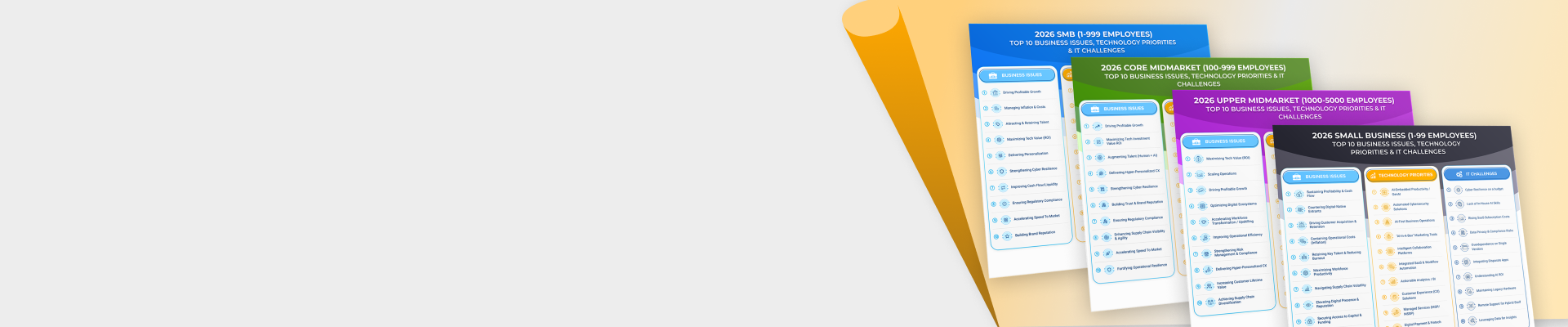
    2026 TOP 10 SMB BUSINESS ISSUES, IT PRIORITIES, IT CHALLENGES

  • 2026 TOP 10 SMB PREDICTIONS

    2026 TOP 10 SMB PREDICTIONS

    SMB & Midmarket: Autonomous Business
    READ
  • 2026 TOP 10 PARTNER PREDICTIONS

    2026 TOP 10 PARTNER PREDICTIONS

    Partner & Ecosystem: Next Horizon
    READ
  • ARTIFICIAL INTELLIGENCE

    ARTIFICIAL INTELLIGENCE

    SMB & Midmarket Analytics & Artificial Intelligence Adoption
    LEARN MORE
  • IT SECURITY TRENDS

    IT SECURITY TRENDS

    SMB & Midmarket Security Adoption Trends
    LATEST RESEARCH
  • BUYERS JOURNEY

    BUYERS JOURNEY

    Technology Buyer Persona Research
    LEARN MORE
  • PARTNER ECOSYSTEM

    PARTNER ECOSYSTEM

    Global Channel Partner Trends
    LATEST RESEARCH
  • CLOUD ADOPTION TRENDS

    CLOUD ADOPTION TRENDS

    SMB & Midmarket Cloud Adoption
    LATEST RESEARCH
  • FUTURE OF PARTNER ECOSYSTEM

    FUTURE OF PARTNER ECOSYSTEM

    Networked, Engaged, Extended, Hybrid
    DOWNLOAD NOW
  • MANAGED SERVICES RESEARCH

    MANAGED SERVICES RESEARCH

    SMB & Midmarket Managed Services Adoption
    LEARN MORE

Techaisle Analyst Insights

Trusted research and strategic insight decoding SMBs, the Midmarket, and the Partner Ecosystem.
Tavishi Agrawal

Mobile Apps: Forget About Content. Context is King

As of March of this year, half of all US mobile phone subscribers had a Smartphone. This in my opinion is more than just a number. It is a tipping point for applications. It is safe to say that we are now in an app economy as far as mobile phones are concerned. But the number has significance beyond just being a tipping point because it is a tipping point for thinking about applications.

Cloud Computing - Techaisle - Global SMB, Midmarket and Channel Partner Analyst Firm - Techaisle Analyst Insights SocMedicons-fb What do I mean by that? Applications designed for the desktop or enterprise environments typically exist in a sandbox. That sandbox can be as small as a user’s desk or the entire enterprise but nonetheless a sandbox. Their function and focus is to provide the tools needed to complete a task within the confines of that sandbox. But these apps for the most part ignore user contexts. For example, a CRM application typically does not take into consideration a user’s location nor does an app like MS Office (other than language localization). But mobile apps need to be different because mobile is different. A mobile phone is not just another device. It is a beacon in your pocket that is constantly aware of where you are, what’s around you. It is also aware of your preferences and social network and what transactions you prefer. And one more thing – mobile identifies the user uniquely, not just from a device standpoint but as an aggregate of all the factors mentioned above. So it follows then that Context must define Content. But what are these contexts that app developers should consider? There are fundamentally three.

    • Location


    • Contacts/social network


    • Calendar/time


Not all apps can take advantage of all three but should take advantage of at least one. It is hard to say that one of the above mentioned contexts is more powerful or more important than the others. Each can be powerful depending upon the app or the content. For example, ecommerce applications benefit significantly from taking advantage of location while for a CRM app, contacts and calendar are more critical than other contexts.

Context = Creative Destruction

The use of contexts in app development is not just about driving new user experience and value for users; it is about driving new business models as well. The use of contexts increases the app’s value to the point where in many instances a new revenue model can be implemented. For example, wireless phone companies that by design are able to capture user locations can monetize this “data” in a variety of ways, advertising being one of them. Similarly apps that used to be sold on a per license basis can shift their revenue models to leveraging contextual data as opposed to per user charges. In that respect, context is not only valuable, it is disruptive. The first wave of context aware apps we see have typically been those that would anyway have been free - Apps such as Instagram, Pinterest and Zoomingo (local shopping application).

Increasingly, I predict that we will see whole industries that shift their business models to take advantage of contexts. Newspapers and media are a prime example. While many newspapers are experimenting with paywalls, I believe that a larger opportunity exists for them to exploit user contexts. News publishing today uses what could be termed as an “in-out” model, that is publishers and editors decide what content should be created, publish it and hope that readers will find it interesting. It is the traditional content first driven approach. But what is relevant to me as a reader depends upon my current context. And what is relevant for me today may not be relevant tomorrow. It calls for a more dynamic approach to presenting content, where content to be presented is selected based on a combination of contexts. In other words, an “out-in” model. Doing so improves their ability to deliver advertising thereby potentially increasing revenue.

The same is true for retail. Most mobile retail websites are mere reproductions of online properties but should they be? Online retail websites suffer from the same contextual ignorance as other apps. For example, a mobile retail app would be much more powerful if it could detect a person’s physical proximity to a store. Imagine how small business retailers could benefit from such capabilities. Think about applications like Endomondo that track your physical fitness activities. Well over 5 million users have downloaded and use Endomondo. Consider how useful that data would be to an outfit like REI for targeting and creating customized offers. Here’s another example and a personal one. I am an avid photographer, but not a very good one. I try to learn about photography but that typically happens before or after I am out taking photographs. But the most appropriate context for me to quickly learn tips is when I am taking photographs. Cameras already track locations and embed them in pictures. They already sense light conditions. But this data is not used to educate the photographer! Could it be used to provide tips at the time the photo was being taken? Or could suggestions be given as to how to improve the photograph with examples of the best possible settings? Would it make amateurs like me to more likely to buy a particular camera brand? Would it facilitate brand loyalty? I believe the answers to all of the above are a resounding yes!

Context = Engagement

Indeed, most websites retail or not suffer from the same issue. Even corporate, customer facing websites are mere one-way information dispensing media rather than a context aware, interactive medium that facilitates two way engagements. In fact the very term “engagement” needs to be redefined in the mobile age.  Engagement was largely defined in terms of giving users the content they want/need. But in the mobile age, I believe that engagement should be about the interaction users want and need. It follows then that if context defines interaction then adding contexts fuels a more powerful engagement that can impact costs and revenue.

In Conclusion

Successful mobile applications need to score high on relevance. Relevance is a function that takes into consideration not just content but also all the factors that surround and influence the appeal of that content. This means that app developers have to re-think their applications for the mobile age. And not just re-think but they have to get mobile DNA into the entire organization.


Davis Blair

Global SMB IT Spending in 2016 - Infographic

How big is the SMB IT market opportunity? What is the potential market size of mobility, cloud, datacenter, PCs/Tablets? What is the growth in spend in regions? What are average the spends per business? What are the key business issues?

That is the topic of our Infographic. Click the image to download.

Cloud Computing - Techaisle - Global SMB, Midmarket and Channel Partner Analyst Firm - Techaisle Analyst Insights techaisle_2016_global_smb_spend_infographic-85x300 Global SMB IT Spend is poised to reach ~600 Billion dollar by 2016. Worldwide, there are still 26 million SMBs yet to buy a PC, 30 million SMBs do not have a server; some of these may directly move to cloud. They are already using internet to a very large extent. Granted that many of them are less than 20 employees but they are not going to be static. Approximately 560,000 new businesses were started each month in 2012. About 10,000 of small businesses become mid-market businesses each year.

North America and EMEA are infrastructure, software and services driven while Asia/Pacific is product driven. North America has the highest average IT spend per business spend while Asia/Pacific and Latin America the lowest. There is a vast difference between emerging market and mature market SMBs in terms of average spend per business. It is also useful to note that while Asia/Pacific has the highest number of SMB cloud users, average spend per user is less than 1/5th of SMB user in North America.

In terms of business issues, SMBs in the US are focused on collaboration and communications. The three business issues feeding into this focus are reducing operational costs, focusing on new markets and improving effectiveness of sales and marketing. On the other hand Western Europe SMBs are concerned about workforce efficiency with focus on costs was a key driver for SMBs in in that region, improving workforce productivity (getting more out of the workforce) and reducing operational costs. On the other hand Asia/Pacific SMBs want to grow faster than the market and are constantly worrying about market penetration. If they do not act now, they think that the opportunity will slip by.

Download the Infographic (click on image) to get a great snapshot of SMB opportunity including spend on PCs/Tablets, Mobility, Cloud, Data Center, Security.

Anurag Agrawal

SMB and Midmarket: Cloud Software acquisition and the importance of “deep carpet selling”

Linoleum vs. Deep Carpet Selling

There is an old story about a consultant who was advising a client about changes in his market, and what they would mean to sales strategy. The consultant went through a series of tables demonstrating that, due to increased interconnectivity with other corporate systems, products in the client’s segment were increasingly purchased by senior managers rather than shop floor managers. The consultant stressed the importance of developing new marketing material and directing the sales force to call on the senior managers instead of the shop floor, to which the client replied, “You are talking about deep carpet selling. We don’t do deep carpet selling. We do linoleum selling here.”

Most IT vendors engage in a variation of “linoleum selling”, focused on engaging IT professionals in discussions that focus on the technical attributes of their products. However, BDMs (Business Decision Makers) – who tend to inhabit the “carpeted” realms of their businesses – are more likely to be engaged by discussions about business benefits and objectives than by “feeds and speeds”. In categories where the BDM is central to the needs identification and budget process, sales reps will need to develop “deep carpet” language and skills.

The data from Techaisle’s SMB and Midmarket IT Decision Making Authority survey demonstrates that we have already reached that point in cloud applications and software in both the small and midmarket segments.

Need vs. Enhancements

Survey data shows that in both micro/very small businesses (1-19 employees) and the smaller midmarket businesses (100-499 employees), BDMs are the primary drivers for determining the need for new cloud business applications.

These findings are broadly consistent with the results from the survey question on determining the need for enhancements to existing cloud solutions. While in most cases, IT has more influence in determining the need for enhancements than it does in determining the need for new solutions, BDMs are still generally the most important voice in the discussion. ITDM’s (IT Decision Maker) influence is directly attributable to the extent that enhancements are driven by technological rather than functional requirements.

Conclusively, survey data shows that business requirements are the prime mover for identifying the need for both new solutions and significant enhancements/upgrades in micro and very small businesses, and that technology concerns play a meaningful role in instigating discussions about enhancements to existing solutions in businesses with 20-499 employees.

Interestingly, within the 500-999 segments, there is more BDM influence over identifying the need for meaningful enhancements than for new applications. Following the logic applied to the other segments, this suggests that enhancements within these near-enterprise accounts result primarily from process optimization requirements, rather than from a need to upgrade the underlying technology.

Cloud Software budget authority

“Determining the need for” a new business application or a “meaningful enhancement” to an existing application is not, of course, identical to signing off on the purchase of a new solution. When Techaisle extended its questioning to include “budgetary control and authority,” it resulted in two interesting findings:

    • The proportion of SMBs where budgetary control and purchasing authority for new applications rests entirely with BDMs increases in all employee size segments, relative to the statistics for determining need in these segments. This means that BDM control over the final purchase decision is even higher than the “determining the need for” statistics suggest.


    • The proportion of respondents reporting that responsibility resides entirely with either IT or business – but is not shared between them – increases in five out of seven employee size segments (missing only the 10-19 and 20-49 employees groups). This suggests that needs identification may be more collaborative than final purchase decisions.


Both findings point to the same conclusion: that BDMs are extremely important to suppliers of cloud software. Chart below provides a graphical representation of the determining need vs. final purchase decision authority balance by employee size.

techaisle-blog-smb-midmarket-decision-making

Anurag Agrawal

SMB Shadow IT, BDM spending amount to nearly $100 billion in the US alone

Is IT losing its authority over IT expenditures and directions? Data from the Techaisle report “The 360 on SMB & Midmarket IT Decision Making Authority” suggests that increasingly, business decision makers (BDMs) make technology-related decisions and control technology-related budgets.

The report finds that SMB “Shadow IT” in the US – expenditures made by business management without IT involvement – will amount to $27 billion in 2015. Added to the “formal” IT budget that is visible to IT but under BDM management, technology spending by US SMBs that is outside the control of the IT department will reach $99 billion, a figure that is greater than Microsoft’s annual revenue, twice the revenue of Cisco, and nearly 25 times larger than the revenue recorded by Salesforce.com in its fiscal 2014.

The data clearly illustrates that the earth has shifted from underneath the IT department within small and midmarket businesses. Executives in these companies need to understand what these new spending patterns mean to IT deployment and efficiency within their operations, while suppliers to this market – business application vendors like Microsoft and Salesforce.com, hardware vendors like HP and Dell, and the thousands of services firms that help US SMBs to make sense of technology – need to adjust to the changing patterns of SMB IT investment and control.

Shadow IT is a commonly-understood phenomenon: it represents spending on IT products and services by BDMs that are made without the IT department’s approval, guidance, or in some cases, even without IT’s knowledge. IT itself generally portrays these purchases as dangerous to the organization, creating the potential for security breaches, incompatibility between corporate systems, inconsistency in corporate systems of record, and/or loss of critical data. BDMs tend to portray them differently, positioning these purchases as IT extensions to current business activities that respond to business needs more quickly and directly than the IT department is capable of doing.

Whatever one’s perspective on shadow IT, it is clearly an important force in the SMB IT market. How important has been a matter of conjecture, since by its nature, shadow IT is difficult to isolate and quantify. However, by comparing multiple data sets from surveys that capture both ITDM and BDM perspectives, Techaisle is able to provide fact-based estimates of shadow IT activity within US SMBs. Highlights of these findings include:

Shadow IT spending on business applications

Authority for “formal” business application spending varies widely between small and midmarket businesses. However, the overall level of shadow IT spending on business applications is very consistent across the two SMB segments, at 15 percent of total small business application spending and 14 percent of midmarket business spending. In addition, business management (BDMs) within SMBs formally controls over 50 percent of business application expenditures.

Shadow IT spending on infrastructure products

The infrastructure products market is much different than the business application market – both across small and midmarket businesses and with respect to the influence of IT over “formal” purchases. The influence of IT is much greater in the infrastructure category than in business applications: IT is responsible for 23 percent of infrastructure spending within small businesses and controls well over 50 percent of total spending on infrastructure within midmarket businesses.

Overall, shadow IT accounts for 56 percent of small business infrastructure expenditures. The enormous shadow infrastructure spends by small business indicates a clear problem for small business IT managers, and realistically, for small businesses themselves: the notions that shadow IT creates security and related issues are not merely an IT construct, it is a real issue. Suppliers with solutions that help address shadow infrastructure problems (such as MDM, managed app stores, etc.) will find a very substantial potential market in the US small business segment.

Shadow IT spending on IT services

BDM-led spending on IT services has different implications in different employee size categories: in small business, it often represents an authorized or “formal” spending on mainstream IT services, while in larger businesses, it may represent a means of avoiding IT department involvement in new IT/business initiatives. Techaisle data supports this perspective. BDMs control 35 percent of IT services spend in midmarket businesses. The shadow IT spending within the midmarket – pegged by Techaisle at 48 percent of the total – creates an intriguing opportunity for IT services suppliers. “Official” suppliers to midmarket businesses may continue to sell to IT, which controls a higher proportion of the formal IT services budget than their BDM colleagues. However, when shadow IT is added into the opportunity pool, BDMs are as potent a force in the midmarket business IT services market as ITDMs. This suggests that two different approaches – positioning IT services firm as an extension to IT, or as an alternative to IT – have equivalent market opportunity today.

Trusted Research | Strategic Insight

Techaisle - TA