














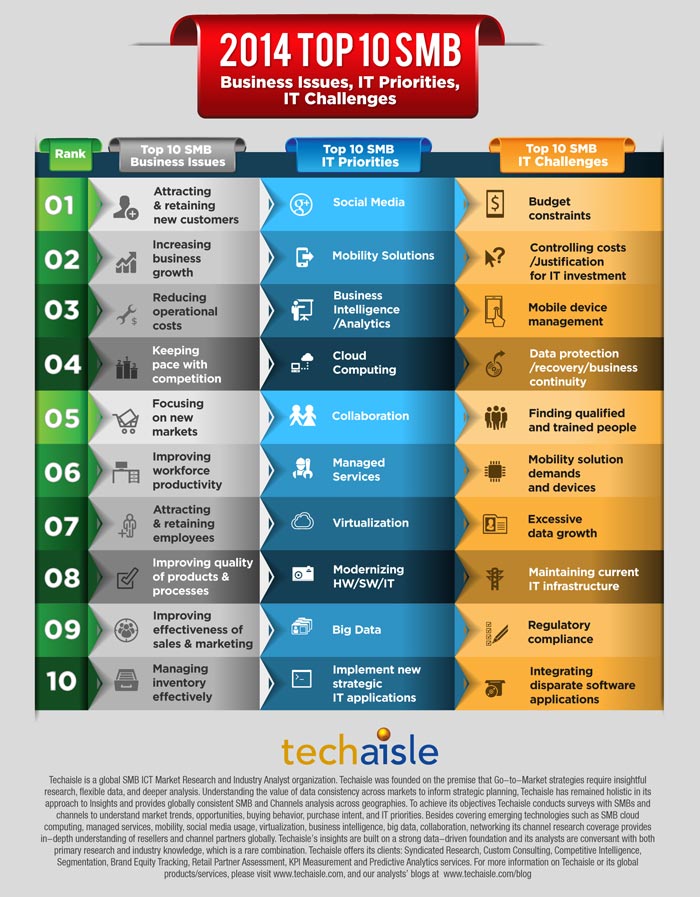
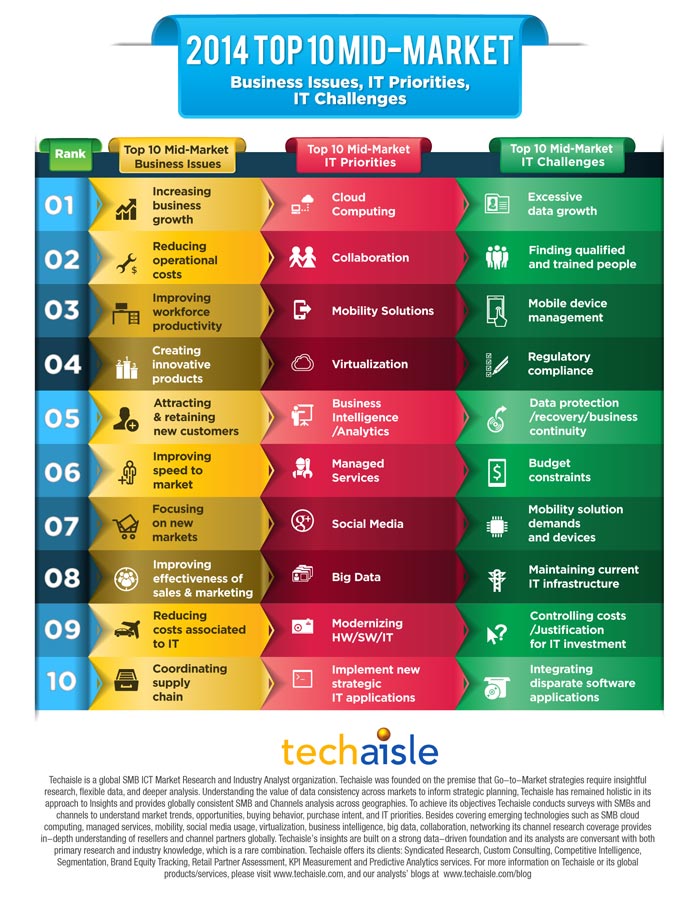
Techaisle's just completed survey of SMBs and Mid-market companies reveals the following Top 10 IT Priorities, IT Challenges and Business Issues that the IT and Business Decision makers are facing in 2014.
Techaisle Analyst Insights
Trusted research and strategic insight decoding SMBs, the Midmarket, and the Partner Ecosystem.
Many organizations are starting to think about “analytics-as-a-service” (no acronym allowed) as they struggle to cope with the problem of analyzing massive amounts of data to find patterns, extract signals from background noise and make predictions. In our discussions with CIOs and others, we are increasingly talking about leveraging the private or public cloud computing to build an analytics-as-a-service model.
The strategic goal is to harness data to drive insights and better decisions faster than competition as a core competency. Executing this goal requires developing state-of-the-art capabilities around three facets: algorithms, platform building blocks, and infrastructure.
Analytics is moving out of the IT function and into business — marketing, research and development, into strategy. As a result of this shift, the focus is greater on speed-to-insight than on common or low-cost platforms. In most IT organizations it takes anywhere from 6 weeks to 6 months to procure and configure servers. Then another several months to load configure and test software. Not very fast for a business user who needs to churn data and test hypothesis. Hence cloud-as-a-analytics alternative is gaining traction with business users.
The “analytics-as-a-service” operating model that businesses are thinking about is already being facilitated by Amazon, Opera Solutions, eBay and others like LiquidHub. They are anticipating the value migrating from traditional outmoded BI to an Analytics-as-a-service model. We believe that Amazon’s analytics-as-a-service model provides a directional and aspirational target for IT organizations who want to build an on-premise equivalent.
Situation/Problem Summary: The Challenges of Departmental or Functional Analytics
The dominant design of analytics today is static or dependent on specific questions or dimensions. With the need for predictive analytics-driven business insights growing at ever increasing speeds, it’s clear that current departmental stove-pipe implementations are unable to meet the demands of increasingly complex KPIs, metrics and dashboards that will define the coming generation of Enterprise Performance Management. The fact that this capability will also be available to SMBs follows the trend of embedded BI and dashboards that is already sweeping the market as an integral part of SaaS applications. As we have written in the past, the move to true mobile BI can be provided as an application "bolt-ons" that work in conjunction with an existing Enterprise Applications or as pure play developed from scratch BI applications that take advantage of new technologies like HTML5. Generally, the large companies do the former through acquisition with existing technology and integration and with start-ups for the latter. Whether at the Departmental or Enterprise level, the requirements to hold down costs, minimize complexity and increase access and usability are pretty much universal, especially for SMBs, who are quickly moving away from on-premise equipment, software and services.
After years of cost cutting, organizations are looking for top-line growth again and finding that with the proliferation of front-end analytics tools and back-end BI tools, platforms and data marts, the burden/overhead of managing, maintaining and developing the “raw data to insights” value chain is growing in cost and complexity - a balance that brings SaaS and on-premise benefits together is needed.
The perennial challenge of a good BI deployment remains: it is becoming increasingly necessary to bring the disparate platforms/tools/information into a more centralized but flexible analytical architecture. Add to this the growth in volume of Big Data across all company types and the challenges accelerate.
Centralization of analytics infrastructure conflicts with the business requirement of time-to-impact, high quality and rate of user adoption - time can be more important than money if the application is strategic. Line of Business teams need usable, adaptable, and flexible and constantly changing insights to keep up with customers. The front-line teams care about revenue, alignment with customers and sales opportunities. So how do you bridge the two worlds and deliver the ultimate flexibility with the lowest possible cost of ownership?
The solution is Analytics-as-a-Service.
Emerging Operating Model: Analytics-as-a-Service
It’s clear that sophisticated firms are moving along a trajectory of consolidating their departmental platforms into general purpose analytical platforms (either inside or outside the firewall) and then packaging them into a shared services utility.
This model is about providing a cloud computing model for analytics to anyone within or even outside an organization. Fundamental building blocks (or enablers) like – Information Security, Data Integrity, Data and Storage Management, iPad and Mobile capabilities and other aspects – which are critical, don’t have to be designed, developed, tested again and again. More complex enablers like Operations Research, Data Mining, Machine Learning, Statistical models are also thought of as services.
Enterprise architects are migrating to “analytics-as-a-service” because they want to address three core challenges – size, speed, type – in every organization:
- The vast amount of data that needs to be processed to produce accurate and actionable results
- The speed at which one needs to analyze data to produce results
- The type of data that one analyzes - structured versus unstructured
The real value of this service bureau model lies in achieving the economies of scale and scope…the more virtual analytical apps one deploys, the better the overall scalability and higher the cost savings. With growing data volumes and dozens of virtual analytical apps, chances are that more and more of them leverage processing at different times, usage patterns and frequencies, one of the main selling points of service pooling in the first place.
Amazon Analytics-as-a-Service in the Cloud
Amazon.com is becoming a market leader in supporting the analytics-as-a-service concept. They are attacking this as a cloud-enabled business model innovation opportunity than an incremental BI extension. This is a great example of value migration from outmoded methods to new architectural patterns that are better able to satisfy business’ priorities.
Amazon is aiming at firms that deal with lots and lots of data and need elastic/flexible infrastructure. This can be domain areas like Gene Sequencing, Clickstream analysis, Sensors, Instrumentation, Logs, Cyber-Security, Fraud, Geolocation, Oil Exploration modeling, HR/workforce analytics and others. The challenge is to harness data and derive insights without spending years building complex infrastructure.
Amazon is betting that traditional enterprise “hard-coded” BI infrastructure will be unable to handle the data volume growth, data structure flexibility and data dimensionality issues. Also even if the IT organization wants to evolve from the status quo they are hamstrung with resource constraints, talent shortage and tight budgets. Predicting infrastructure needs for emerging (and yet-to-be-defined) analytics scenarios is not trivial.
Analytics-as-a-service that supports dynamic requirements requires some serious heavy lifting and complex infrastructure. Enter the AWS cloud. The cloud offers some interesting value 1) on demand; 2) pay-as-you-go; 3) elastic; 4) programmable; 5) abstraction; and in many cases 6) better security.
The core differentiator for Amazon is parallel efficiency - the effectiveness of distributing large amounts of workload over pools and grids of servers coupled with techniques like MapReduce and Hadoop.
Amazon has analyzed the core requirements for general analytics-as-a-service infrastructure and is providing core building blocks that include 1) scalable persistent storage like Amazon Elastic Block Store; 2) scalable storage like Amazon S3; 3) elastic on-demand resources like Amazon Elastic Compute Cloud (Amazon EC2); and 4) tools like Amazon Elastic MapReduce. It offers choice in the database images (Amazon RDS, Oracle, MySQL, etc.)
How does Amazon Analytics-in-the-Cloud work?
BestBuy had a clickstream analysis problem — 3.5 billion records, 71 million unique cookies, 1.7 million targeted ads required per day. How to make sense of this data? They used a partner to implement an analytic solution on Amazon Web Services and Elastic MapReduce. Solution was a 100 node cluster on demand; processing time was reduced from 2+ days to 8 hours.
Predictive exploration of data, separating “signals from noise” is the base use case. This manifests in different problem spaces like targeted advertising / clickstream analysis; data warehousing applications; bioinformatics; financial modeling; file processing; web indexing; data mining and BI. Amazon analytics-as-a-service is perfect for compute intensive scenarios in financial services like Credit Ratings, Fraud Models, Portfolio analysis, and VaR calculations.
The ultimate goal for Amazon in Analytics-as-a-Service is to provide unconstrained tools for unconstrained growth. What is interesting is that an architecture of mixing commercial off-the-shelf packages with core Amazon services is also possible.
The Power of Amazon’s Analytics-as-a-Service
So what does the future hold? The market in predictive analytics is shifting. It is moving from “Data-at-Rest” to “Data-in-motion” Analytics.
The service infrastructure to do “data-in-motion” analytics is pretty complicated to setup and execute. The complexity ranges from the core (e.g., analytics and query optimization), to the practical (e.g., horizontal scaling), to the mundane (e.g., backup and recovery). Doing all these well while insulating the end-user is where Amazon.com will be most dominant.
Data in motion analytics
Data “in motion” analytics is the analysis of data before it has come to rest on a hard drive or other storage medium. Due to the vast amount of data being collected today, it is often not feasible to store the data first before analyzing it. In addition, even if you have the space to store the data first, additional time is required to store and then analyze. This time delay is often not acceptable in some use cases.
Data at rest analytics
Due to the vast amounts of data stored, technology is needed to sift through it, make sense of it, and draw conclusions from it. Much data is stored in relational or OLAP stores. But, more data today is not stored in a structured manner. With the explosive growth of unstructured data, technology is required to provide analytics on relational, non-relational, structured, and unstructured data sources.
Now Amazon AWS is not the only show in town attempting to provide analytics-as-a-service. Competitors like Google BigQuery, a managed data analytics service in the cloud is aimed at analyzing big sets of data… one can run query analysis on big data sets — 5 to ten terabytes — and get a response back pretty quickly, in a matter of seconds, ten to twenty seconds. That’s pretty useful when you just want a standardized self-service machine learning service. How is BigQuery used? Claritic has built an application for game developers to gather real-time insights into gaming behavior. Another firm, Crystalloids, built an application to help a resort network “analyze customer reservations, optimize marketing and maximize revenue.” (THINKstrategies’ Cloud Analytics Summit in April, Ju-kay Kwek, product manager for Google’s cloud platform).
Bottom-line and Takeaways
Analytics is moving from the domain of departments to the enterprise level. As the demand for analytics grows rapidly the CIOs and IT organizations are going to be under increasing pressure to deliver. It will be especially interesting to watch how companies that have outsourced and offshored extensively (50+%) to Infosys, TCS, IBM, Wipro, Cognizant, Accenture, HP, CapGemini and others will adapt and leverage their partners to deliver analytics innovation.
At the enterprise level a shared utility model is the right operating model. But given the multiple BI projects already in progress and vendor stacks in place (sunk cost and effort); it is going to be extraordinarily difficult in most large corporations to rip-and-replace. They will instead take a conservative and incremental integrate-and-enhance-what-we-have approach which will put them at a disadvantage. Users will increasingly complain that IT is not able to deliver what innovators like Amazon Web Services are providing.
Amazon’s analytics-as-a-service platform strategy shows exactly where the enterprise analytics marketplace is moving to or needs to go. But most IT groups are going to struggle to implement this trajectory without some strong leadership support, experimentation and program management. We expect this enterprise analytics transformation trend will take a decade to play out (innovation to maturity cycle).
Shirish Netke
Until a few years ago a set of scary questions used to be debated in many business board rooms. “Fire the CEO, CFO or SAP?” Nobody dared to fire SAP. Fast forward today, are we reaching the same set of questions with a difference - replacing SAP with Salesforce.com? Recent Dreamforce 2014, Salesforce.com’s annual gala event firmly established the company’s foothold in the industry and its increasing grip on the enterprise and businesses of all sizes. This year, there was also an increased focus on SMBs, a “back-to-the-roots” story, the backbone on which Salesforce.com launched its “no software” business but somewhere along the way lost sight of SMBs. But then Salesforce.com is no longer a software company, it is a platform company. Is the “no software” logo still valid? Is the company still suitable for SMBs?
The Best
Over the last three years, Salesforce.com has successfully added solutions to its portfolio and has checked off an important spoke in the SMB Wheel of CRM Productivity with business intelligence, one of key elements in the overall CRM productivity suite. Many of the other issues are addressed by the rich Salesforce.com partner ecosystem that connects via Force.com. Combined, these applications provide a 360 degree view of the sales and marketing process. Experience shows that as a software category matures, suite providers eventually win out against point product players. And Salesforce.com is winning.
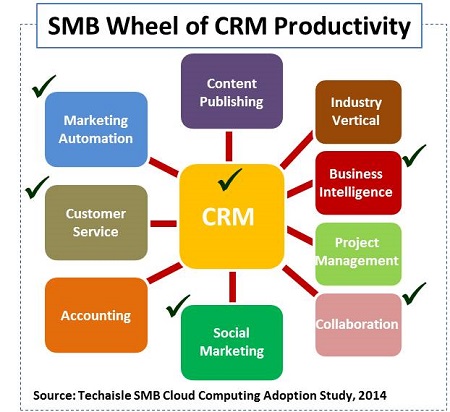
As Salesforce began its foray into the enterprise world, it seemed that it neglected its SMB market, which grew almost in spite of Salesforce’s lack of attention. However, from 2015 onwards, SFDC promises change as it is committing to doubling its investments in SMB education and driving growth. In fact, this year’s Dreamforce had nearly twice as many sessions for SMBs as in 2013.
Techaisle’s SMB segmentation, based on cloud and mobility adoption, finds that there are six major SMB segments:
- Smart Investors
- Growth Aspirers
- Dynamic IT
- Productivity-centric,
- Innovation-Driven, and
- Passive Followers
Of these, Dynamic SMBs, followed by Smart Investor SMBs, are most likely to benefit from CRM suites.
The Good
The new Wave analytics platform, announced and demoed with fanfare at Dreamforce 2014, is one of the most important products to have been introduced by Salesforce.com recently. It gives some credence to Salesforce’s newly christened Analytical Cloud. But is it really that impressive beyond the flashy demo at Dreamforce 2014? Is it really analytics or a series of reports cleverly put together?
Let us set the context first. Business analytics is fast becoming an integral technology investment for an SMB organization, directly contributing to its revenue growth and reduction in operating costs by enabling informed decision making. Techaisle’s survey of SMBs across numerous countries shows that number of SMBs using one or more type of business intelligence is nearly doubling each year. Business Intelligence tools have matured and become more widely available through cloud-based services. As a result, enterprise-grade ETL, analytics, reporting, collaboration, dashboards and other functionalities are now within affordable reach of SMBs.
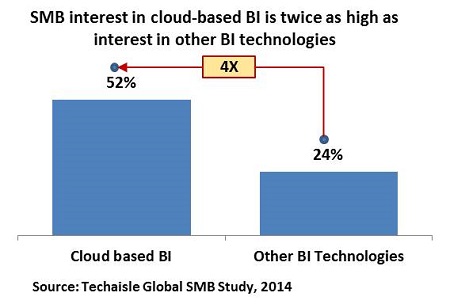
We are also in a transformative time for mobility and thereby mobile business Intelligence. The move to mobile BI has largely up until now been accomplished by migrating existing functionality to a mobile environment by using new technologies on top of the old. Companies such as Oracle, IBM and SAP are doing this through acquisition of smaller companies and integrating them into existing products. On the other hand, in a classic build vs. buy fashion, smaller companies, not hampered by existing architectural constraints are offering SaaS BI services and building new offers from scratch. Smaller BI vendors in many cases have gained a timing advantage, using native technology to bring existing mobile functionality to BI. Instead of simply providing mobile links to server data, these new products offer the rich, interactive capabilities, with the ability to use rich interactive screen manipulation, i.e., pinch and squeeze or geo-location awareness, as part of the data exploration and visualization experience. True mobile business intelligence includes ability to interact with data objects on the screen, such as filters, check-boxes, search, drill-down and drill-through to the record level and other interactive functions. Of course, being able to then use built-in device communications capabilities is also of importance once the information has been identified – SMS, email and Internet forms for dissemination of the information, as well as secure access to collaborative destinations.
Techaisle survey data also shows that the right information for SMBs centers on intelligence that helps them make sound financial decisions. This is reflected in the top three analytics areas reported by SMB respondents:
- Financial analysis (47% of SMBs)
- Sales tracking (44% of SMBs)
- Business activity monitoring (43% of SMBs)
These findings show that SMBs are looking to analyze data that helps to manage DSO (Days Sales Outstanding, the core accounts receivable issue), maximize inventory turns, determine the return on marketing investment for a new route to market, and/or examine the potential lifetime value of a customer through various distribution channels. SMB business intelligence/analytics tools need to deliver across this set of expectations.
What Wave Analytics is not
Wave analytics is mobile business intelligence and not analytics. It can answer one question at a time, but can’t analyze a set of questions based on multi-dimensional data and queries allowing a small business executive to make informed decisions across multiple business factors. Wave analytics cloud offers some but not all of the above functionalities. And Wave’s capabilities are tied to Salesforce.com data unless an SMB is willing to invest in the customization needed to extend analysis across other data sets, thereby increasing TCO. And that is where the bad begins. As one SMB told Techaisle, “Business intelligence and analytics is big need for an SMB, but the platform must provide easy to build reports and dashboards capabilities. If you need to hire a developer for everything, we are back to square one”.
The Bad
To quote Marc Benioff’s tweet, “What skills do you need to find a job today? #5 Salesforce”, quoting an article in Infoworld. Is it SAP redux - was there not a complete industry that had popped up and thrived for SAP developers? In many cases, the level of complexity and cost of deploying Wave solutions, beyond parametric reporting, may be out of reach for many SMBs and may instead be more attractive in the enterprise segment.
Dashboards with ad hoc exploration and structured reports are becoming the ‘new normal’, empowering the SMBs to look at information within the right context depending upon the demands of the business. Right context is not just about driving new user experience, something that Salesforce.com has focused on; it is about driving new business models as well by increasing the value of business intelligence tool to the point where it informs and supports the creation of new SMB revenue models. There are some excellent examples of embedded analysis capabilities that allow very flexible use of KPIs by SMBs across all areas of their business, including creating and analyzing the impact of new KPIs on the fly. Out-of-the-box Wave analytics cloud falls short and does not adequately address SMB BI/analytics needs.
At the outset, the Wave analytics cloud looks like it is targeted towards dashboard-saturated executives who have not been exposed to new technologies. It looks great because it is on Salesforce.com platform and it is mobile. For a CEO, running a company means determining what he/she must track and what he/she can safely de-emphasize. For this, a CEO typically requires multiple dashboards delivering “what-if” analysis capabilities; these CEOs need the ability to generate KPIs quickly and easily, measure them and refine them with time. Keeping true to “no software” rule, there should be either no or very little customization required. It’s clear that Wave needs more IT involvement – and the Wave platform partners announced at Dreamforce were all ‘big names’ such as Accenture and Deloitte, which are not the typical developers for SMBs. The expectation that an SMB has programmers sitting around eager to extract, integrate, and develop dashboards to provide one view of the business is clearly mistaken – and it certainly stretches the limits of “no software” rule.
The Ugly – Have we seen this movie before?
Mark Twain said history does not repeat itself but it does rhyme. The evolution of Salesforce.com represents a remake of a movie and we are not sure it ends well for SMBs. SFDC, which was the SMB champion ten years ago, is starting to look like Napoleon from Orwell’s Animal Farm novel.
Marc Benioff’s Dreamforce keynotes always showcase large enterprise customers, and no SMBs. However, on the 2nd day, in an SMB keynote by Tony Rodoni and Brian Millham there were three case studies of SMBs. However, all three were “born in the cloud” SMBs, not representative of over 90 percent of small businesses. Even Tony Rodoni, SVP of Small Business, Salesforce.com referred to high-growth, scalable small businesses (read startups) in Silicon Valley – again not representative of most of the world. Where have the real-world examples gone? One VP of information technology for an SMB aptly observed that, “SMB for them (SFDC) is always the next Facebook”.
In a Techaisle survey of 2155 SMBs (US, Canada, Germany) to understand cloud adoption, 42 percent mentioned that they are afraid of losing control of their data and another 31 percent said that they are fearful of vendor lock-in. These businesses worry about vendor control of data as they have neither the technical expertise nor the purchasing power to extricate themselves from supplier relationships if they experience difficulties. This concern extends to Salesforce: as the CIO of a financial services SMB said, “SFDC does not play nice when you have to import data from non-cloud solutions, and it is a challenge even with cloud applications.”
With Salesforce.com an SMB could experience both the fear factors – lock-in, loss of control on data - the concerns that are common to enterprise software suites. When software becomes a platform it develops a tendency to move over to the ‘dark side’: It unconsciously forces a lock-in, reduces the pace of innovation, limits price protection and restricts future proofing. SFDC SMB customers are already experiencing this; as one said, “They (SFDC) list per-month prices, but the contracts are executed in years’ terms”. Taken as a whole it flies in the face of everything that is cloud. Is it time for SMBs to find a new champion? And can they, or is the Salesforce grip already too tight? As a platform, Salesforce.com is like a runaway train, very difficult to stop by numerous point solution players.

In a parody of Start Trek, Silicon Valley technology companies describe their business goal as “Scale, the final frontier…”. Mid-market companies, defined as those having 100-2500 employees, may indeed provide an opportunity to emerging technology vendors to scale their business. According to Techaisle, a market research firm, these 800,000 global companies spend $300B on IT and are sought after by technology vendors big and small. In the last decade, technologies such as Cloud, SAAS and Virtualization have reached scale with a large number of mid-market companies as early adopters. Intuit, Salesforce.com, NetSuite and Amazon are just a few examples of companies who have relied upon mid-market companies as a key building block for their business.
What does this mean for Big Data? To find out, Carpe Datum Rx spoke to “SMB Guru”, Anurag Agrawal, CEO of Techaisle and the former Head of Worldwide Research Operations at the Gartner Group. Techaisle recently talked to 3,300 global businesses about their Big Data adoption plans. Here is an excerpt from our discussion.
The SMB Market is considered the Holy Grail for technology vendors because it is hard to penetrate. Does your research show that mid-market companies will adopt Big Data before large enterprises do? Are they the early adopters of this technology?
Yes, you are right the SMB Market is the Holy Grail as it is hard to penetrate but with the highest potential. To elaborate, there are slightly over 70 million small businesses and 800,000 mid-market businesses worldwide. They constitute over 97 percent of the business segment. And their collective IT spend is projected to grow by 6.5% between 2013 and 2016 which is quite a lot faster than the Enterprise segment. To really identify the SMB segments and their type of technology spend is a mind-numbing exercise due to the sheer volume of data points. This is compared to the enterprise segment where there are fewer companies and larger dollar amounts being spent.
To answer your second question about whether mid-market businesses will adopt big data before large enterprises, let us look at some facts. Cloud computing started as an enterprise play, however, it was quickly discovered that SMBs would be the more relevant target segment with a faster path to adoption. Similarly, as enterprises adopted Virtualization, vendors shifted their focus to the SMBs with some very creative solutions. Mid-market companies, defined as those with 100 to 2500 employees could certainly be the early adopters of Big Data. We recently did a study where we surveyed 3,360 mid-market businesses worldwide covering all regions – North America, Europe, Asia/Pacific and Latin America. What we found is that the promise of superior data-driven decision making is motivating 43 percent of global mid-market businesses to at least look at Big Data technology. And above all, 18 percent of mid-market businesses are now investing in big data related projects.
In the mid-market segment, there is also a competitive imperative to understand customers, create innovate products and improve operational efficiencies. They are not burdened with too many silos and large legacy systems deployments. The absence of large legacy systems is an important point to consider because it makes mid-market businesses more agile to implement new types of solutions that solve their business problems. It is expected that in year 2016, global SMBs would spend US$3.6 Billion on big data solutions exhibiting a growth rate that is faster than what was exhibited by cloud computing solutions.
We understand that you cast a very wide net to get your 43% number. Is there a consistency in the sentiment on big data across different parts of the world?
Yes, we had to cast a wide net to really understand the adoption and trends within mid-market businesses. And yes, there is a difference across geographies and employee sizes. North America has both the largest market and the highest level of adoption in Big Data overall. In terms of actual deployment activity, the market grows in relation to the size of the companies. Additionally, mid-market business attitude towards Big Data transitions from “Over-Hype” to must-have technology with the increase in employee size. Let me give you some examples. A small-to-mid-sized bank is developing a Proof of Concept for fraud analytics. Another example is of a small advertising agency that is trying to deploy digital advertising analytics. So big data is not only within the radar of enterprises, the same problems exist across all sizes of business, only the volume of data, available budget and the required simplicity varies. The problem is that we all get caught up in technology which instills a sense of fear. We have to shift the conversation from technology to solving business problems.
Big Data adoption is often stalled by a lack of knowledge or understanding of the technology and its capabilities. Do mid-market companies have a better understanding of this technology than large enterprises? Do they have an advantage over large enterprises in implementing effective solutions?
You are right. Three things – Technology, Resources and Data are the biggest roadblocks for big data project implementations within mid-market businesses. In recent years technology and technology options have evolved extremely rapidly for an average business to understand, evaluate, purchase and implement. Big data is no different. Mid-market businesses consider big data as very complex resulting in very steep learning curves. The complexity gets further exacerbated with lack of experience, lack of skilled manpower and innate difficulty in identifying external consultants who would be the right fit for their big data business objectives and budget availability. In spite of challenges, the study shows that there have been some successes when business units, IT & data analysts exhibit extraordinary alignment.
Our study shows that mid-market businesses typically start their big data journey in one of four ways and the highest success rates have been achieved when IT and data analysts work with external consultants from project inception. It is still very early days for these businesses to fully embrace big data but the seeds are being planted. And we believe that these businesses may very well race ahead of enterprises with their deployments as technology becomes simpler and consultants become experienced. As we like to say it, SMBs could be the path to big data simplicity.
You talk about the linking of structured and unstructured data. Why is this problem so important compared to all the others?
The issue of analyzing data from diverse sources leads a mid-market business to naturally consider linking structured and unstructured data. If we look back, CRM solutions had first established the need for analyzing customer data. However, the data was mostly two-way transactional structured data. This changed when customers began visiting business websites to explore, browse and perhaps make purchases thus leaving behind a trail of information. And everything changed with the onset of social media, blogs, forums, wikis and opinion platforms where the identification of false positives and negatives became difficult and knowledge about the customer and resulting segmentation became an inaccurate undertaking. Big data analytics presents the possibilities of connecting together a variety of data sets from disconnected sources to produce business insights for generating sales, improving products or detecting fraud. Thus the importance of linking structured and unstructured data to analyze social media data, web data, customer and sales data along with click-stream machine generated data and even communications data in the form of emails, chat, and voice mails. But extremely limited expertise creates a major challenge. If they can figure it out, one-fourth of mid-market businesses say that they will use big data as an integral part of their overall analytics efforts. The possibility of analyzing a variety of data producing action-driven business insights is too big to ignore for mid-market businesses.
How are big data projects getting started globally? Are they championed by LOB managers? Are they getting adequate support from executive management? Are customers demanding it?
The study reveals that the initiators are marketing, finance or operations and the ultimate user of the analytics is the business user. Big data requires a new type of alignment between business heads, namely, marketing and finance (main drivers of big data projects), IT and a completely new set of players known as data scientists or data analysts. As I mentioned before, once the decision is made mid-market businesses show an extraordinary alignment across departments. Our study shows that mid-market businesses typically started their big data journey in one of four ways. However, the highest success rate was achieved when an external consultant or organization was brought in to develop proof of concept, advise on database architecture and ultimately develop the big data analytics solution right from the moment of project inception.
What is one piece of advice or Carpe Datum prescription can you share for our members?
You have adopted cloud, you have adopted mobility, you have adopted social media so do not be afraid to develop Big Data analytics proof of concepts. Do not ignore big data just because of perceived complexity and big data solution providers’ inability to create bite-sized messaging that directly address pain-points. Do not forget that business intelligence has now become one of the fastest solutions to be adopted by SMBs and mid-market businesses. If done right, big data will address three key pain points: Increased sales, More Efficient operations, Improved Customer service.
