










• TRUSTED RESEARCH

    TRUSTED RESEARCH | STRATEGIC INSIGHT

    SMB. CORE MIDMARKET. UPPER MIDMARKET. ECOSYSTEM
    LEARN MORE
  • BUYER JOURNEY

    BUYER JOURNEY

    SMB & Midmarket Buyers Journey Research
    LEARN MORE
  • BUYER PERSONAS

    BUYER PERSONAS

    SMB & Midmarket Technology Buyer Persona Research
    LEARN MORE
  • ARTIFICIAL INTELLIGENCE

    ARTIFICIAL INTELLIGENCE

    SMB & Midmarket Analytics & Artificial Intelligence Adoption
    LEARN MORE
  • DATACENTER SOLUTIONS

    DATACENTER SOLUTIONS

    SMB & Midmarket Datacenter Solution Adoption Trends
    LEARN MORE
  • INTERWORK 2.0: THE AGENTIC FUTURE OF CONNECTED BUSINESS

    INTERWORK 2.0: THE AGENTIC FUTURE OF CONNECTED BUSINESS

  • 2026 TOP 10 SMB BUSINESS ISSUES, IT PRIORITIES, IT CHALLENGES

    2026 TOP 10 SMB BUSINESS ISSUES, IT PRIORITIES, IT CHALLENGES

  • 2026 TOP 10 SMB PREDICTIONS

    2026 TOP 10 SMB PREDICTIONS

    SMB & Midmarket: Autonomous Business
    READ
  • 2026 TOP 10 PARTNER PREDICTIONS

    2026 TOP 10 PARTNER PREDICTIONS

    Partner & Ecosystem: Next Horizon
    READ
  • IT SECURITY TRENDS

    IT SECURITY TRENDS

    SMB & Midmarket Security Adoption Trends
    LATEST RESEARCH
  • PARTNER ECOSYSTEM

    PARTNER ECOSYSTEM

    Global Channel Partner Trends
    LATEST RESEARCH

Techaisle Analyst Insights

Trusted research and strategic insight decoding SMBs, the Midmarket, and the Partner Ecosystem.
Anurag Agrawal

The Application Reabsorption Era: AWS’s Agentic Shift into the Application Layer

For two decades, the bargain between AWS and the software industry was clear and mutually profitable. AWS sold the substrate - compute, storage, networking, databases, and models. Independent software vendors built the experiences that customers actually used. The hyperscaler captured rent on the floor; the ISVs captured rent on the ceiling. Every Salesforce, Workday, ServiceNow, Epic, and SAP transaction reinforced this division of labor.

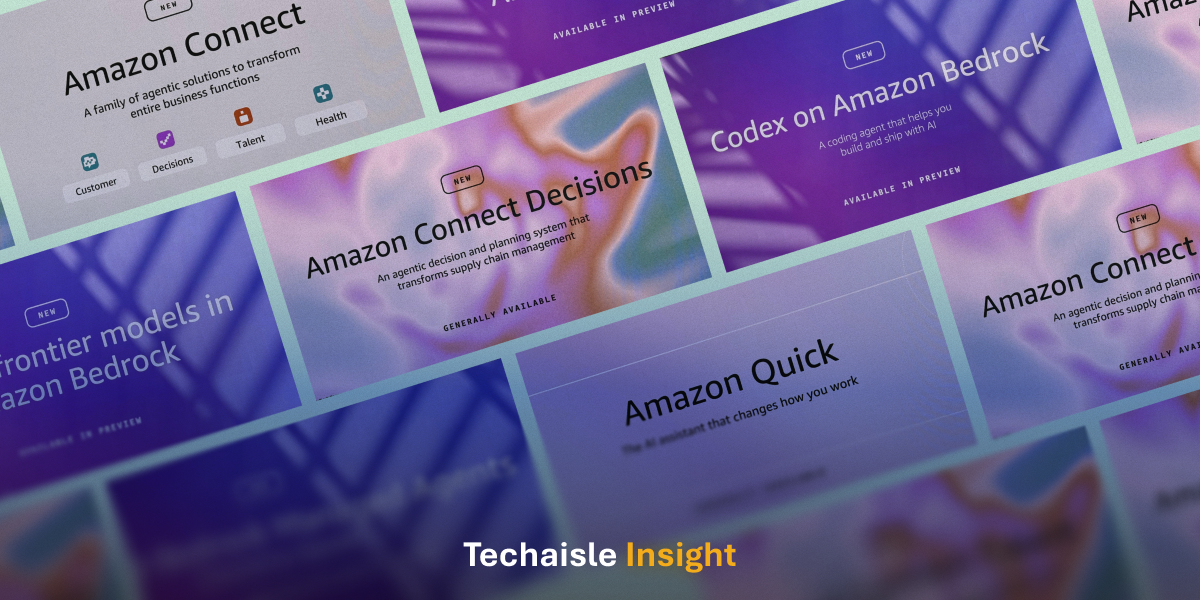
That traditional division of labor evolved on April 28. With the rebranding of Amazon Connect into a four-product family, the launch of Amazon Quick on desktop, and the introduction of Managed Agents for OpenAI within Amazon Bedrock, AWS has recognized that infrastructure alone cannot solve the enterprise activation void. AWS is no longer just selling the picks and shovels; it is delivering the fully operational gold mine. And it is doing so armed with a moat that no SaaS incumbent - not Salesforce, not Workday, not Epic - can replicate: the operational record of having actually run the world’s largest retailer, logistics network, hiring engine, and primary care practice. This is not a feature update. It is a category change.

techaisle aws what is next

The End of the Substrate Bargain

The most strategically loaded announcement of the day was the one that sounded most boring: Amazon Connect is now a family of agentic solutions to transform entire business functions. The Connect family will house four products - Customer AI (the original contact-center solution), Decisions (supply chain), Talent (hiring), and Health (clinical workflow) - each one introducing an agentic alternative to established SaaS categories.

The signal is unmistakable in what AWS chose to absorb rather than build new. Connect Decisions is, in the words of AWS’s own product leadership, the next generation of AWS Supply Chain - the prior product has been “essentially assimilated.” This is the same playbook AWS used with Amazon SageMaker AI: take a workbench tool, rebuild it as an industrial system, reposition the category. Except this time, the categories are not “machine learning platforms.” They are enterprise hiring, clinical documentation, and supply chain planning. The vendors who traditionally own those categories are publicly traded SaaS giants, and AWS has just fundamentally altered their competitive baseline. While AWS will undoubtedly continue to host and support these competitors, the philosophical shift is unambiguous: the application layer is no longer a passive ecosystem. It is an active arena for AWS innovation.

techaisle aws connect announcements

Operational Provenance: The New Moat

The puzzle is how AWS plans to differentiate in domains where incumbents have spent twenty years building depth. The answer is something I will call operational provenance - the strategic asset of having actually run the workflow at planetary scale, and being able to encode that experience into software.

Tags:
Anurag Agrawal

Harnessing the Power of Generative AI: The AWS Advantage

Generative AI is revolutionizing how businesses operate, offering unprecedented opportunities for innovation and efficiency. As per Techaisle’s research of 2400 businesses, 94% are expected to use GenAI within the next 12 months. Amazon Web Services (AWS) is at the forefront of this transformation, guiding business leaders through the adoption and implementation of generative AI technologies. AWS emphasizes the importance of understanding the potential of generative AI and identifying relevant use cases that can drive significant business value. By leveraging tools such as Amazon Bedrock, AWS Trainium, and AWS Inferentia, businesses can build and scale generative AI applications tailored to their specific needs. These tools provide the necessary infrastructure and performance to handle large-scale AI workloads, ensuring businesses can achieve their goals effectively. Moreover, AWS highlights the critical role of high-quality data in the success of generative AI projects. A robust data strategy, encompassing data versioning, lineage, and governance, is essential for maintaining data quality and consistency, enhancing model performance and accuracy. Additionally, AWS advocates responsible AI development, emphasizing the need for ethical considerations and risk management. Businesses can establish clear guidelines and safeguards to ensure their AI initiatives are innovative and responsible. Real-world success stories, such as those of Adidas and Merck, demonstrate the tangible benefits of generative AI, from personalized customer experiences to improved manufacturing processes. As businesses continue to explore and implement generative AI, they must prioritize adaptability, continuous learning, and a commitment to ethical practices to fully harness this technology's transformative power. AWS is taking a pivotal role in guiding businesses through the adoption and implementation of generative AI by encouraging business leaders to consider the possibilities if limitations were removed.

AWS’ Roadmap for Generative AI Success

Despite widespread GenAI adoption plans, Techaisle found that 50% of businesses struggle to define an AI-first strategy. Most businesses, from small to large corporations, struggle to define specific GenAI implementation strategies. This is particularly evident among small businesses (81%), midmarket firms (45%), and enterprises (41%). As Tom Godden, AWS Enterprise Strategist, said, “The question on every CEO’s mind is ‘What is our generative AI strategy?” To facilitate this journey, AWS outlines a clear roadmap encompassing several key stages: Learn, Build, Establish, Lead, and Act.

In the Learn phase, AWS recommends understanding the possibilities of generative AI and identifying relevant use cases. They offer resources like the AI Use Case Explorer, which provides practical guidance and real-world examples of successful implementations. Moving to the Build stage, AWS stresses the importance of effectively choosing the right tools and scaling. They provide a range of infrastructure and tools, including Amazon Bedrock, AWS Trainium and AWS Inferentia, Amazon EC2 UltraClusters, and SageMaker. These tools help businesses balance accuracy, performance, and cost while developing and scaling generative AI applications.

The Establish phase centers around data, a crucial component for successful generative AI implementation. AWS highlights the need for a robust data strategy that includes data versioning, documentation, lineage, cleaning, collection, annotation, and ontology. This ensures data quality and consistency, which is essential for optimal model training. In the Lead stage, AWS emphasizes the importance of humanizing work and using generative AI to empower employees rather than replace them. They recommend redesigning workflows to leverage AI effectively, adopting successful AI governance models, and preparing the workforce for new roles through upskilling and reskilling.

Finally, the Act phase focuses on building and implementing a responsible AI program to ensure generative AI's ethical and safe use. AWS advises proactively addressing potential risks and challenges, establishing clear risk assessment frameworks, and implementing controls and safeguards to prevent misuse. They also emphasize the importance of providing training and resources to ensure security and compliance teams are confident in the organization's AI practices.

AWS provides a comprehensive approach to guiding businesses through the adoption and implementation of generative AI. AWS helps leaders navigate this transformative technology and unlock its immense potential by offering a clear framework, practical tools, and real-world examples.

Amazon Bedrock: A Comprehensive Platform for Generative AI

Building upon this foundation, Amazon Bedrock emerges as a pivotal tool for businesses seeking to harness the transformative power of generative AI. By providing a curated selection of foundation models and simplifying their implementation, Bedrock empowers organizations to experiment, iterate, and scale their AI initiatives rapidly.

Anurag Agrawal

Amazon's Role in Emerging Cloud Service: Analytics-as-a-Service (no acronym allowed)

Many organizations are starting to think about “analytics-as-a-service” (no acronym allowed) as they struggle to cope with the problem of analyzing massive amounts of data to find patterns, extract signals from background noise and make predictions. In our discussions with CIOs and others, we are increasingly talking about leveraging the private or public cloud computing to build an analytics-as-a-service model.


The strategic goal is to harness data to drive insights and better decisions faster than competition as a core competency.  Executing this goal requires developing state-of-the-art capabilities around three facets:  algorithms, platform building blocks, and infrastructure.


Analytics is moving out of the IT function and into business — marketing, research and development, into strategy.  As a result of this shift, the focus is greater on speed-to-insight than on common or low-cost platforms.   In most IT organizations it takes anywhere from 6 weeks to 6 months to procure and configure servers.  Then another several months to load configure and test software. Not very fast for a business user who needs to churn data and test hypothesis. Hence cloud-as-a-analytics alternative is gaining traction with business users.


The “analytics-as-a-service” operating model that businesses are thinking about is already being facilitated by Amazon, Opera Solutions, eBay and others like LiquidHub.  They are anticipating the value migrating from traditional outmoded BI to an Analytics-as-a-service model.  We believe that Amazon’s analytics-as-a-service model provides a directional and aspirational target for IT organizations who want to build an on-premise equivalent.


Situation/Problem Summary: The Challenges of Departmental or Functional Analytics


The dominant design of analytics today is static or dependent on specific questions or dimensions. With the need for predictive analytics-driven business insights growing at ever increasing speeds, it’s clear that current departmental stove-pipe implementations are unable to meet the demands of increasingly complex KPIs, metrics and dashboards that will define the coming generation of Enterprise Performance Management. The fact that this capability will also be available to SMBs follows the trend of embedded BI and dashboards that is already sweeping the market as an integral part of SaaS applications. As we have written in the past, the move to true mobile BI can be provided as an application "bolt-ons" that work in conjunction with an existing Enterprise Applications or as pure play developed from scratch BI applications that take advantage of new technologies like HTML5. Generally, the large companies do the former through acquisition with existing technology and integration and with start-ups for the latter. Whether at the Departmental or Enterprise level, the requirements to hold down costs, minimize complexity and increase access and usability are pretty much universal, especially for SMBs, who are quickly moving away from on-premise equipment, software and services.


After years of cost cutting, organizations are looking for top-line growth again and finding that with the proliferation of front-end analytics tools and back-end BI tools, platforms and data marts, the burden/overhead of managing, maintaining and developing the “raw data to insights” value chain is growing in cost and complexity - a balance that brings SaaS and on-premise benefits together is needed.


The perennial challenge of a good BI deployment remains: it is becoming increasingly necessary to bring the disparate platforms/tools/information into a more centralized but flexible analytical architecture. Add to this the growth in volume of Big Data across all company types and the challenges accelerate.


Centralization of analytics infrastructure conflicts with the business requirement of time-to-impact, high quality and rate of user adoption - time can be more important than money if the application is strategic.  Line of Business teams need usable, adaptable, and flexible and constantly changing insights to keep up with customers.  The front-line teams care about revenue, alignment with customers and sales opportunities. So how do you bridge the two worlds and deliver the ultimate flexibility with the lowest possible cost of ownership?


The solution is Analytics-as-a-Service.


Emerging Operating Model:  Analytics-as-a-Service


It’s clear that sophisticated firms are moving along a trajectory of consolidating their departmental platforms into general purpose analytical platforms (either inside or outside the firewall) and then packaging them into a shared services utility.


This model is about providing a cloud computing model for analytics to anyone within or even outside an organization.  Fundamental building blocks (or enablers) like – Information Security, Data Integrity, Data and Storage Management, iPad and Mobile capabilities and other aspects – which are critical, don’t have to be designed, developed, tested again and again. More complex enablers like Operations Research, Data Mining, Machine Learning, Statistical models are also thought of as services.


Enterprise architects are migrating to “analytics-as-a-service” because they want to address three core challenges – size, speed, type – in every organization:

    • The vast amount of data that needs to be processed to produce accurate and actionable results


    • The speed at which one needs to analyze data to produce results


    • The type of data that one analyzes - structured versus unstructured


The real value of this service bureau model lies in achieving the economies of scale and scope…the more virtual analytical apps one deploys, the better the overall scalability and higher the cost savings. With growing data volumes and dozens of virtual analytical apps, chances are that more and more of them leverage processing at different times, usage patterns and frequencies, one of the main selling points of service pooling in the first place.


Amazon Analytics-as-a-Service in the Cloud


Amazon.com is becoming a market leader in supporting the analytics-as-a-service concept. They are attacking this as a cloud-enabled business model innovation opportunity than an incremental BI extension.  This is a great example of value migration from outmoded methods to new architectural patterns that are better able to satisfy business’ priorities.


Amazon is aiming at firms that deal with lots and lots of data and need elastic/flexible infrastructure.  This can be domain areas like Gene Sequencing, Clickstream analysis, Sensors, Instrumentation, Logs, Cyber-Security, Fraud, Geolocation, Oil Exploration modeling, HR/workforce analytics and others. The challenge is to harness data and derive insights without spending years building complex infrastructure.


Amazon is betting that traditional enterprise “hard-coded” BI infrastructure will be unable to handle the data volume growth, data structure flexibility and data dimensionality issues.  Also even if the IT organization wants to evolve from the status quo they are hamstrung with resource constraints, talent shortage and tight budgets. Predicting infrastructure needs for emerging (and yet-to-be-defined) analytics scenarios is not trivial.


Analytics-as-a-service that supports dynamic requirements requires some serious heavy lifting and complex infrastructure. Enter the AWS cloud.  The cloud offers some interesting value 1) on demand; 2) pay-as-you-go; 3) elastic; 4) programmable; 5) abstraction; and in many cases 6) better security.


The core differentiator for Amazon is parallel efficiency - the effectiveness of distributing large amounts of workload over pools and grids of servers coupled with techniques like MapReduce and Hadoop.


Amazon has analyzed the core requirements for general analytics-as-a-service infrastructure and is providing core building blocks that include 1) scalable persistent storage like Amazon Elastic Block Store; 2) scalable storage like Amazon S3; 3) elastic on-demand resources like Amazon Elastic Compute Cloud (Amazon EC2); and 4) tools like Amazon Elastic MapReduce.  It offers choice in the database images (Amazon RDS, Oracle, MySQL, etc.)


How does Amazon Analytics-in-the-Cloud work?


BestBuy had a clickstream analysis problem — 3.5 billion records, 71 million unique cookies, 1.7 million targeted ads required per day. How to make sense of this data? They used a partner to implement an analytic solution on Amazon Web Services and Elastic MapReduce. Solution was a 100 node cluster on demand; processing time was reduced from 2+ days to 8 hours.


Predictive exploration of data, separating “signals from noise” is the base use case. This manifests in different problem spaces like targeted advertising / clickstream analysis; data warehousing applications; bioinformatics; financial modeling; file processing; web indexing; data mining and BI.  Amazon analytics-as-a-service is perfect for compute intensive scenarios in financial services like Credit Ratings, Fraud Models, Portfolio analysis, and VaR calculations.


The ultimate goal for Amazon in Analytics-as-a-Service is to provide unconstrained tools for unconstrained growth. What is interesting is that an architecture of mixing commercial off-the-shelf packages with core Amazon services is also possible.


The Power of Amazon’s Analytics-as-a-Service


So what does the future hold?  The market in predictive analytics is shifting.  It is moving from “Data-at-Rest” to “Data-in-motion” Analytics.


The service infrastructure to do “data-in-motion” analytics is pretty complicated to setup and execute.  The complexity ranges from the core (e.g., analytics and query optimization), to the practical (e.g., horizontal scaling), to the mundane (e.g., backup and recovery).  Doing all these well while insulating the end-user is where Amazon.com will be most dominant.


Data in motion analytics


Data “in motion” analytics is the analysis of data before it has come to rest on a hard drive or other storage medium. Due to the vast amount of data being collected today, it is often not feasible to store the data first before analyzing it. In addition, even if you have the space to store the data first, additional time is required to store and then analyze. This time delay is often not acceptable in some use cases.


Data at rest analytics


Due to the vast amounts of data stored, technology is needed to sift through it, make sense of it, and draw conclusions from it. Much data is stored in relational or OLAP stores. But, more data today is not stored in a structured manner. With the explosive growth of unstructured data, technology is required to provide analytics on relational, non-relational, structured, and unstructured data sources.


Now Amazon AWS is not the only show in town attempting to provide analytics-as-a-service.  Competitors like Google BigQuery, a managed data analytics service in the cloud is aimed at analyzing big sets of data… one can run query analysis on big data sets — 5 to ten terabytes — and get a response back pretty quickly, in a matter of seconds, ten to twenty seconds. That’s pretty useful when you just want a standardized self-service machine learning service. How is BigQuery used? Claritic has built an application for game developers to gather real-time insights into gaming behavior. Another firm, Crystalloids, built an application to help a resort network “analyze customer reservations, optimize marketing and maximize revenue.” (THINKstrategies’ Cloud Analytics Summit in April, Ju-kay Kwek, product manager for Google’s cloud platform).


Bottom-line and Takeaways


Analytics is moving from the domain of departments to the enterprise level.   As the demand for analytics grows rapidly the CIOs and IT organizations are going to be under increasing pressure to deliver.  It will be especially interesting to watch how companies that have outsourced and offshored extensively (50+%) to Infosys, TCS, IBM,  Wipro, Cognizant, Accenture, HP, CapGemini and others will adapt and leverage their partners to deliver analytics innovation.


At the enterprise level a shared utility model is the right operating model.  But given the multiple BI projects already in progress and vendor stacks in place (sunk cost and effort); it is going to be extraordinarily difficult in most large corporations to rip-and-replace.  They will instead take a conservative and incremental integrate-and-enhance-what-we-have approach which will put them at a disadvantage. Users will increasingly complain that IT is not able to deliver what innovators like Amazon Web Services are providing.


Amazon’s analytics-as-a-service platform strategy shows exactly where the enterprise analytics marketplace is moving to or needs to go. But most IT groups are going to struggle to implement this trajectory without some strong leadership support, experimentation and program management. We expect this enterprise analytics transformation trend will take a decade to play out (innovation to maturity cycle).


Shirish Netke

Anurag Agrawal

Techaisle survey shows The Rise of Generative-AI in SMBs and Midmarket Firms

According to recent survey data from Techaisle, the use of Generative-AI is rapidly increasing within SMBs and midmarket firms. The survey found that AI has become a priority for 53% of small businesses, up from 41% in April 2023. Among core-midmarket firms, 87% prioritize AI, up from 75% in April 2023. Similarly, 89% of upper-midmarket firms prioritize AI, compared to 87% in April 2023. Overall, 60% of SMBs and 84% of midmarket firms are either using or planning to use Generative-AI within the next six months.

The survey also found that between 40% and 45% of midmarket firms have developers and architects specializing in AI/ML, DevOps, hybrid cloud, and app modernization. Additionally, between 35% and 45% of these firms plan to increase their investments in Edge computing, Containers, Open-source technologies, app development, and analytics. Most notably, 72% of midmarket firms are increasing their in-house hiring for Generative-AI.

techaisle generative ai

Trusted Research | Strategic Insight

Techaisle - TA