











• TRUSTED RESEARCH

    TRUSTED RESEARCH | STRATEGIC INSIGHT

    SMB. CORE MIDMARKET. UPPER MIDMARKET. ECOSYSTEM
    LEARN MORE
  • INTERWORK 2.0: THE AGENTIC FUTURE OF CONNECTED BUSINESS

    INTERWORK 2.0: THE AGENTIC FUTURE OF CONNECTED BUSINESS

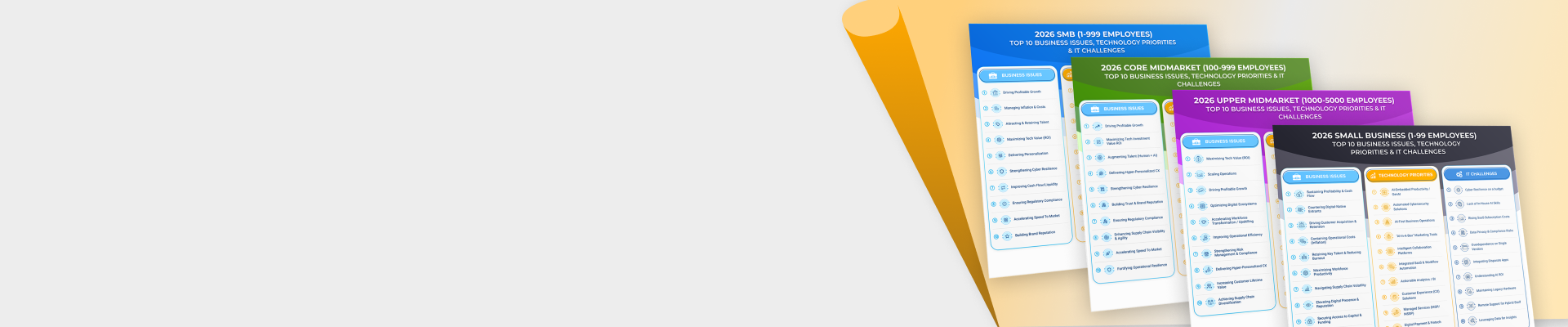
  • 2026 TOP 10 SMB BUSINESS ISSUES, IT PRIORITIES, IT CHALLENGES

    2026 TOP 10 SMB BUSINESS ISSUES, IT PRIORITIES, IT CHALLENGES

  • 2026 TOP 10 SMB PREDICTIONS

    2026 TOP 10 SMB PREDICTIONS

    SMB & Midmarket: Autonomous Business
    READ
  • 2026 TOP 10 PARTNER PREDICTIONS

    2026 TOP 10 PARTNER PREDICTIONS

    Partner & Ecosystem: Next Horizon
    READ
  • ARTIFICIAL INTELLIGENCE

    ARTIFICIAL INTELLIGENCE

    SMB & Midmarket Analytics & Artificial Intelligence Adoption
    LEARN MORE
  • IT SECURITY TRENDS

    IT SECURITY TRENDS

    SMB & Midmarket Security Adoption Trends
    LATEST RESEARCH
  • BUYERS JOURNEY

    BUYERS JOURNEY

    Technology Buyer Persona Research
    LEARN MORE
  • PARTNER ECOSYSTEM

    PARTNER ECOSYSTEM

    Global Channel Partner Trends
    LATEST RESEARCH
  • CLOUD ADOPTION TRENDS

    CLOUD ADOPTION TRENDS

    SMB & Midmarket Cloud Adoption
    LATEST RESEARCH
  • FUTURE OF PARTNER ECOSYSTEM

    FUTURE OF PARTNER ECOSYSTEM

    Networked, Engaged, Extended, Hybrid
    DOWNLOAD NOW
  • MANAGED SERVICES RESEARCH

    MANAGED SERVICES RESEARCH

    SMB & Midmarket Managed Services Adoption
    LEARN MORE

Techaisle Analyst Insights

Trusted research and strategic insight decoding SMBs, the Midmarket, and the Partner Ecosystem.
Anurag Agrawal

15 Predictions for 2015: SMB Channel Trends

Trends in the channel are felt throughout the IT ecosystem: they affect the pace at which new products gain market acceptance, play a role in determining which vendors rise and fall in market share, and have an enormous effect on the ability of small and even midmarket businesses to absorb new technologies and apply them successfully to business challenges. The epicenter of the trend impact is, of course, channel businesses themselves as they act as a key connection point in the IT product lifecycle.

What will we see in the channel in 2015?

Davis Blair

SMB Channels Mobility Solutions Snapshot

Having the right information in the right context in the right format at the right time is critical to making business decisions these days, and increasingly that means access through mobile devices – whether it is the roughly 30% of consumers who own tablets or those tens of millions who get information from a Smartphone. A recent Techaisle survey of over 600 channel partners uncovered several important similarities and differences between how SMB channels are approaching three of the most important trends in the market: Cloud-Computing, Mobility Solutions and Remote Managed Services. In this post we will offer a snapshot of some characteristics of Mobility in the SMB Channel.

SMBs Requesting Mobility Solutions from the ChannelFrom a demand perspective, 60% of partners reported having SMB customers request Mobility Services, with almost 80% of ISV customers topping the list. Not surprisingly, email – the killer app, is the most used and offered service with about 50%, followed by Payment Processing with over a quarter. As we have found in other surveys, the front-office, revenue-related applications of CRM, especially among ISVs, and SFA, especially among SPs and Social Media Marketing, especially among SPs, were all being adopted by almost a quarter of respondents. We expect a rapid uptake in 2013 in the area of Mobile Analytics, which is being embedded into many front office SaaS applications in the form of dashboards and self-configured KPI management with proactive communications, or from the several cloud-based pure-play BI vendors in the market. As mentioned following the recent Citrix announcements, we also believe the market is ripe for adoption of Cloud-based Productivity Suites, which will also drive adoption of mobility among SMBs.

In many areas of Cloud Computing and especially Remote Managed Services, the big inflection point in both adoption and average spending does not happen until the 100-249 employee segment, but not so with Mobility; approximately 60% of the demand comes from the 1-9 and 10-49 employee segments, with the increase in email (across the board) and Social Media Marketing and Mobile Advertising (ISVs, SPs) driving the trend.

SMB Partner Mobility ChallengesThere are differences in the approaches, needs and challenges between SMB channel types when offering Mobility Solutions to customers, typically falling into Cost and Complexity, Management and Employee, Network and Device and Security categories. In this example, we see some key differences between the VAR/SI and SP partners related to the provision of Mobility solutions. Poor Network Service is the biggest challenge for VAR/SI partners, followed by Insufficient Network Speeds, Lack of Integration/Compatibility, and Immature Platform Choices. Both were challenged equally by Slow Performance of Mobile Apps and Device Management issues. SPs biggest challenges relative to VAR/Sis included Lack of Applications Availability, followed by Poor Mobile Web browsers, and Network and Device Issues.

As the market matures, these challenges should dissipate with increased mobile responsiveness built into websites and applications, more affordable device and data plan pricing and wider adoption of smart mobile devices. For now, the perennial SMB issue of cost and complexity of new technology balanced against perceived and demonstrated return on investment remains the most important barrier for channels to overcome.

Anurag Agrawal

Let us talk Dell’s Commitment to Channels

Dusting off my notebooks (the notepad variety) I came upon some carefully documented notes of my conversations with Dell’s Channel team, in particular with Greg Davis, Vice President and General Manager of Global Commercial Channels.  Just reviewing the notes of the previous two years it hit me squarely in my face that Dell’s channels team has been on a restless pursuit of:

    • Simplicity,


    • Training & enablement,


    • Winning datacenter together with the channel, and


    • Partner profitability


Fall of 2011

Although Dell’s Partner Direct program was formally launched in 2007 with aggressive channel recruitment and courting happening in 2008, we will pick up on our conversations with Dell’s Greg Davis and Paul Shaffer, Executive Director Global Channel Marketing & channel partnerDemand Generation from the fall of 2011. Partner enablement, training, certification and integration of acquisitions had percolated to the top of the team's agenda. For an IT company which is notorious in selling direct, drastic measures were needed to become “one” with the channel. Dell delivered 75,000 training modules to its partners, 30 percent of Dell’s commercial business had started to come from channels and 58,000 registration deals were closed. With the acquisition of Force10 Networks Dell announced enhanced network certification programs and 130 premier partners got their certifications. Emphasizing that the training modules were working, Greg Davis had mentioned that top 10 partners who invested most in training had seen 110 percent growth in revenue. Fall 2011 was also the time when partners started seeing the first glimpse of gentle motivations from Dell to push deeper into healthcare segment and drive revenue from datacenter solutions. Inroads were being made into smaller partners for SMBs as much as national and larger partners.

Cloud Channel

During the same time period while Dell was building out its confidence and trust with the channels, dell-cloud-programenterprises and SMBs were moving to cloud, thus dis-intermediating the channel. Especially the VAR channels (which typically form the largest percent of channel partners of an IT Vendor) had been finding their traditional business models threatened by products and services that could be sold direct by a vendor over the Internet. To continue to adapt to the changing times and never taking its eye off the channel partners’ livelihood Dell launched cloud channel programs in the spring of 2012:

    • Cloud Builder,


    • Cloud Provider, &


    • Cloud Service Enabler


A technical services team was also put into place to help partners sell data center solutions namely, server and storage. Dell now had roughly 250 premium partners and had delivered 135,000 training modules in the year.

Work was far from complete. More acquisitions were taking place; these acquisitions had to be integrated and above all emerging market countries had to be targeted. Both Greg Davis and Amit Midha, President, Asia Pacific and Japan, Chairman, Global Emerging Markets underscored the fact that they were working to ensure a consistent channel engagement across every market covering:

    • Deal registration


    • Compensation neutrality


    • Conflict escalation process, and


    • Executive priority


Asia/Pacific

The channel commitment work in Asia/Pacific countries in our opinion is far from complete. There are still some major strides to be made, specifically in the Asia/Pacific region. By its own acknowledgement, Asia/Pacific is the fastest growing regions for Dell which requires a constant confidence and trust building process with the channels. In many of Techaisle’s analyst interactions with channel partners in 2012 in Asia/Pacific, it was found that channels had warmed up to Dell but some questioned Dell’s sincerity whenever bigger contracts were involved.

In both summer and fall of 2012 we asked Greg Davis and Amit Midha where they thought they were with consistency and confidence. Not only were they bullish but also recognized that they have some hills to climb. They were also candid that services remain a big component of any channel’s revenue mix and while typical services such as warranty, break-fix, and insurance were straightforward re-sale of Dell Services, partnering in consulting was a bit more challenging.

Summer 2012

By the summer of 2012, efforts were paying off, 62,000 deal registrations per quarter were coming through partners with 72 percent approval rate, 35,000 training modules were being delivered per quarter, the number of premier and preferred partners had jumped to 2500, Asia/Pacific channel programs were being strengthened, SonicWALL was integrated and specific courses were introduced on how to talk to a CIO, value of integrated datacenter. Above all social media training programs were launched for the benefit of the channels.

In late summer, in a conversation with Greg Davis and Bob Skelley, Executive Director, Global Certified Partner Program & Channel, they reiterated their commitment to make Dell “easy to work with” and restated their deep & maniacal focus on training and competencies. This focus resulted in 34 percent of global commercial business funneling through Dell channels, up from 30 percent in the fall of 2011. Number of deal registrations had jumped to 71,000 and an enhanced deal registration tool on mobile platforms was rolled-out. 47,000 training courses had been delivered in the quarter and Dell now had 113,000 channel partners. Initial focus on healthcare segment had resulted in a surge in end-user customers. A 40 percent growth in certifications was also achieved when compared with previous quarter. With the integration of Wyse, a desktop virtualization certification program was introduced. Dell channels had truly arrived and there was never a question of ever turning back.

One year later, Fall 2012

One year later, by fall of 2012, Dell had 130,000 channel partners, 35 percent of commercial business revenue was funneling through channels, 142,000 training courses had been delivered in the year, number of deal registrations had shot up to 65,000 and there were now 3600 preferred and premier channel partners. In the words of Greg Davis, “Dell has the most confident and competent channel partners in the world”. One year later, I saw an urgency to deliver with a profound focus on datacenters, systems management and cloud services. Virtualization was also beginning to take center stage. Kathy Schneider, Executive Director, Global Channel Marketing & Programs, drove home the point that she and her team were focused on driving best practices across four strategic pillars:

    1. Easy to do business with One Price and Sales Tools


    1. Win in the Enterprise using a comprehensive sales tool aptly named as Enterprise Master


    1. Training & enablement through expansion of training beyond Dell’s standard solutions to include social media


    1. Partner profitability through a simple, effective and rewarding incentives program


It has been a long way from direct PC selling to indirect solution selling. Real progress has been made. Dell’s channel executives are an end-to-end solutions empowering team for the channels. Not all channels will thrive but those that are equally committed to learn, adapt and practice will certainly succeed.

Anurag Agrawal
With contribution from Gitika Bajaj in Asia/Pacific


Gitika Bajaj

Indian VARs/SIs Creating First Server Demand within SMBs

ML110 Proliant from HP is a favorite of VARs/SIs in India to sell to SMBs, especially small businesses. It is “robust, configurable and affordable”. In India where there has been considerable drop in sales of commercial servers within enterprises and government segments, VARs/SIs have turned their attention to the ever-elusive SMB market segment.

VARs/SIs from Delhi to Chennai, Mumbai to Kolkata, Lucknow to Jamshedpur, Pune to Hyderabad – you get the picture – hold the key to opening up demand for first server opportunity within the SMBs. They are doing so by delivering two key messages:

    1. Servers help in Business Process Consolidation: With an on-premise server SMBs can install software solutions such as locally available ERP (not SAP), accounting and financial management, CRM and many different vertical applications to improve business processes and thereby grow revenue


    1. Servers help in Email Consolidation: With an on-premise server SMBs can use email applications that promote scheduling, calendaring and sharing within the same domain name. There are still way too many SMBs in India that have employees using individual emails with no common folders


The messaging seems to be working. Channels are optimistic that the small business server spend in India will reach US$75 million in 2013, a jump of 13 percent from previous year. But they also say that the path to influence small businesses will not be easy.

The question is, why have the VARs/SIs taken the lead in creating server demand.

Let us take the example of VARs/SIs in Kolkata. West Bengal is a “dead state”; State government is not spending on IT, Central government is not giving any budgets to the State to spend on IT; therefore VARs/SIs instead of sitting idle are busy pounding the streets of Kolkata, seeking out SMBs and discussing the above two key simple messages which seem to be resonating well. On the other hand, in Delhi NCR region, a hot bed of technology adoption, VARs/SIs are targeting pockets of areas such as Gurgaon and Noida.

Selling to SMBs is a very time consuming and pain-staking process. As one SI put it mildly, “there are no green pastures anywhere; we have to plant the seeds”. These channel partners have to overcome three important barriers to adoption:

    1. Lack of awareness of technologies: Too much information and technical jargon is being thrown at the SMBs forcing them to “tune-off” creating lack of awareness. VARs/SIs therefore are engaging SMBs, one at a time, to make them aware what servers can do for their business


    1. Lack of time: SMBs generally do not have time on their hands to search for a channel partner to help them understand technology. Even if they have the time, business priorities in many cases trumps technology and decisions get pushed to the proverbial eleventh hour


    1. Affordability: Price is still a major factor for purchase of servers and accompanying solutions.


At the other extremes are cities in southern India (beyond Bengaluru and Chennai) such as Kochi, Madurai, etc. where channels are fighting a different battle, the infamous “power-cuts” for nearly 8-10 hours each day. The SMBs in this region are first focused on their usual business continuity before turning their attention to IT adoption. But the relentless channels are not giving up on their pursuit and messaging.

Server vendors like IBM that do not have affordable server products for the small business segment are paying attention to the messaging from VARs/SIs and have begun working with them selectively to organize road-shows in Tier 2 cities from northern to western India, from Lucknow to Nagpur and Bhopal.

Still there are many SIs across the country in India who are unhappy by the continuous evaporation of margins on hardware. Some even have gone to the extreme and said that “the way some vendors are working on lowering the margins on servers and storage, SIs will be forced to alternate business models in the next few years”.

India is a more complex IT market than we usually imagine. Based on local infrastructure capabilities and capacities, India has three different segments:

    1. Totally mature,


    1. Immature, and


    1. Not Mature at all


Nevertheless, the SMB server market is still a massive, slow-moving glacier which has not yet reached the precipice of a waterfall. Till that happens, VARs/SIs are creating the demand and trying to grab the opportunity.

Gitika Bajaj

Trusted Research | Strategic Insight

Techaisle - TA