











• TRUSTED RESEARCH

    TRUSTED RESEARCH | STRATEGIC INSIGHT

    SMB. CORE MIDMARKET. UPPER MIDMARKET. ECOSYSTEM
    LEARN MORE
  • INTERWORK 2.0: THE AGENTIC FUTURE OF CONNECTED BUSINESS

    INTERWORK 2.0: THE AGENTIC FUTURE OF CONNECTED BUSINESS

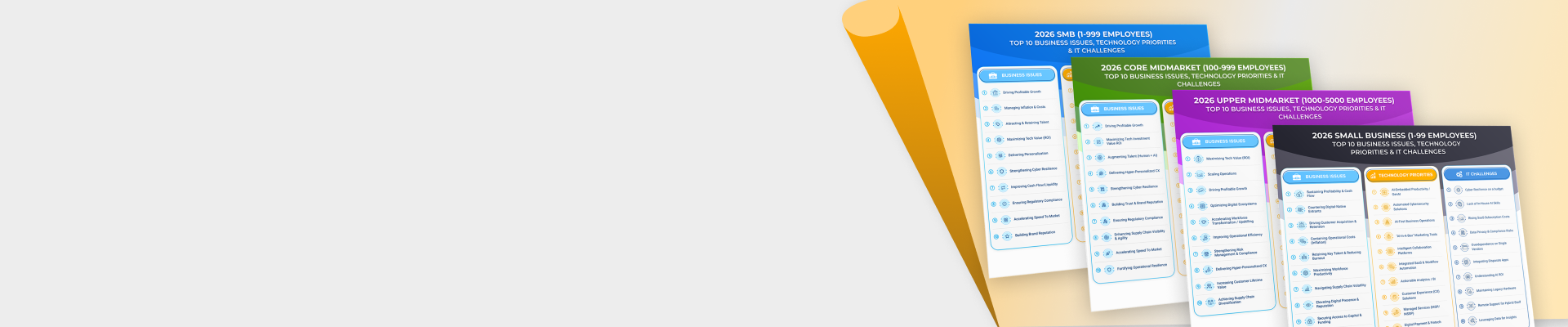
  • 2026 TOP 10 SMB BUSINESS ISSUES, IT PRIORITIES, IT CHALLENGES

    2026 TOP 10 SMB BUSINESS ISSUES, IT PRIORITIES, IT CHALLENGES

  • 2026 TOP 10 SMB PREDICTIONS

    2026 TOP 10 SMB PREDICTIONS

    SMB & Midmarket: Autonomous Business
    READ
  • 2026 TOP 10 PARTNER PREDICTIONS

    2026 TOP 10 PARTNER PREDICTIONS

    Partner & Ecosystem: Next Horizon
    READ
  • ARTIFICIAL INTELLIGENCE

    ARTIFICIAL INTELLIGENCE

    SMB & Midmarket Analytics & Artificial Intelligence Adoption
    LEARN MORE
  • IT SECURITY TRENDS

    IT SECURITY TRENDS

    SMB & Midmarket Security Adoption Trends
    LATEST RESEARCH
  • BUYERS JOURNEY

    BUYERS JOURNEY

    Technology Buyer Persona Research
    LEARN MORE
  • PARTNER ECOSYSTEM

    PARTNER ECOSYSTEM

    Global Channel Partner Trends
    LATEST RESEARCH
  • CLOUD ADOPTION TRENDS

    CLOUD ADOPTION TRENDS

    SMB & Midmarket Cloud Adoption
    LATEST RESEARCH
  • FUTURE OF PARTNER ECOSYSTEM

    FUTURE OF PARTNER ECOSYSTEM

    Networked, Engaged, Extended, Hybrid
    DOWNLOAD NOW
  • MANAGED SERVICES RESEARCH

    MANAGED SERVICES RESEARCH

    SMB & Midmarket Managed Services Adoption
    LEARN MORE

Techaisle Analyst Insights

Trusted research and strategic insight decoding SMBs, the Midmarket, and the Partner Ecosystem.
Anurag Agrawal

2015 Predictions Review: did IT live up to the hype in 2015

December has traditionally served as the occasion for the publication of New Year forecasts. It’s understandable that we want to look ahead to the sources of opportunity that lie ahead. But in the business world, December also marks the beginning of the review season. And while detailed forecasts focus on the next twelve months, the planning horizon needs to look a little further, so that tactics provide support for business strategies, rather than simply delivering a series of course adjustments.

This is a two part blog article. The first part, below, reviews the predictions we made for 2015. Second part will focus on outlook for 2016 and for the longer term.

A look back – what was it we said was right around the corner, again?

Here are the issues we highlighted, “Ten predictions for 2015 – and five issues to keep an eye on for 2016 and beyond” and how we think we did in our prognostication.

The Top 10 for 2015

1. Hybrid arrives – not as a strategy but as the result of many discrete decisions

With the benefit of today’s perspective, we might fairly say that in 2015 and for several more years to come, a more apt description of hybrid is journey rather than destination. Digging into the detail, though, we believe our prediction that “an ability to manage hybrid infrastructure will become a key corporate IT requirement in 2015” has been borne out by the focus on tools and strategies (ranging from Docker to Agile) that we saw throughout the year. In Techaisle’ SMB Cloud adoption studies, there was a sense of growing ubiquity in the usage and plans for private, hybrid and public cloud. Use of hybrid cloud continued to increase as both a conscious strategy and as a reaction to use of both public and private resources within a single infrastructure; by the end of 2015, two-thirds of companies with 100-999 employees were using hybrid models.

2. Collaboration becomes a much bigger concept

In 2015, collaboration began to expand beyond file-sharing to become a necessary tool for driving decision-based agility, fostering innovation and extending customer intimacy. Collaboration is a process rather than a discrete outcome. Our key notion that collaboration “extends beyond the corporate staff (and as a result, beyond large enterprises) to include customers” clearly did reflect strategies and investments in 2015. Within the SMB segment collaboration is increasingly becoming a central component to virtually all business activities rather than a means to enable connections between discrete tasks. Other changes in this area will further reshape collaboration, but you’ll need to refer to the “forecast” part of the blog for that discussion.

3. Collabmobilicloud becomes a management reality

The core concept explained that despite vendor tendency towards defining collaboration, mobility and cloud as separate domains, both enterprise and SMB users have started viewing them as integrated components of business solutions. The user belief that collaboration, mobility and cloud should all be attributes of modern applications has become clearer, and even suppliers are starting to recognize the importance of an integrated collabmobilcloud approach.

Anurag Agrawal

SMB cloud and MSP channel business by the numbers

A strictly “by the numbers” review of the state of the SMB channel in the US paints a portrait of a well-balanced but fragmenting industry. Techaisle’s survey of SMB channel partners finds that revenues from products and services are approximately equal, and that services revenue are being derived from transactions that do not include products as well as from product-inclusive deals. SMB channel respondents report that 58% of revenue is attributable to services-led contracts and that a similar proportion of revenue is derived from recurring sources, vastly different from 2012, 2013 and 2014.

It is worth noting that while measures of this type provide a very useful benchmark for channel partners, some interpretation of the benchmark data is necessary. For example, the proportion of business attributable to services is only part of the issue that SMB channel management is wrestling with: what kind of services (for example, managed PCs or device maintenance?) is an important consideration in evaluating the impact of a channel services revenue stream.

Similarly, growth in services revenue is not necessarily a proxy for progress, as it can result from simple reductions in product revenue rather than effective transition to a business model properly aligned with the market as a whole. Techaisle believes that SMB channel partners that are looking to be part of the “managed services” channel should be targeting just over 20% of services revenue derived from managed services in 2016, and more than 40% by 2018.

The revenue growth expectations are also interesting. Although 63% of SMB channel partners are expecting revenue increases in the next one year, the scenario is quite dismal for VARs as compared to MSPs. 54% more VARs than MSPs are expecting their revenues to remain flat and a percentage of VARs are expecting their revenues to decline by an average of 30%. Even some MSPs are expecting their revenues to decline by an average of 20%.

However, the overall optimism for growth provides some insight into how and where the channel is growing.

Anurag Agrawal

HPE – doubling down to be SMB’s IT partner of choice

HP has split into two – HP Inc. and Hewlett Packard Enterprise (HPE). Almost all SMB relevant products and solutions (except PCs and printers) now reside within the HPE organization. The global small and midmarket businesses, SMB (1-999 employee size) market has been the growth engine for the IT industry at large. The reason is quite simply that SMBs account for over 80 percent of businesses in any country – developed or developing. As per Techaisle, SMBs are forecast to spend US$597 billion on IT in 2015. Their IT requirements range from servers, networking and storage to cloud, mobility, analytics, managed services and collaboration solutions. Today, most SMBs are looking towards IT suppliers that offer appealing value propositions in either of three IT delivery models – traditional infrastructure built on-site from hardware and software components; hosted solutions and/or applications most often purchased on a “pay as you go” model; and, cloud infrastructure delivered on-demand.

HPE – the new incarnation of HP and its focus on SMBs with Flex solutions

Since the launch of its “Just Right IT” portfolio (September 2010) for SMBs, HPE has been striving to better serve its SMB customers by consciously lowering cost of solutions, improving agility in deployment and enabling faster time to value in managing IT assets. Just Right IT includes products, services and solutions specifically engineered for SMBs. The portfolio offers management, data protection, communications and connectivity solutions that are designed and priced "just right" to deliver affordability and value to SMBs. These solutions revolve around HPE’s core offerings of servers, storage and networking which comprises of:

  • Servers: ProLiant MicroServer, ProLiant 10 Series Servers, ProLiant 100 Series Servers, ProLiant 300 Series Servers
  • Networking: 1950 Switch Series, R100 Wireless VPN Router Series, Cloud Managed Networking, and 2920 Switch Series
  • Storage: Solutions for the virtualization, SQL Server, Exchange, File sharing and Backup

In November 2015, soon after the split, HPE announced a new portfolio of ProLiant Generation 9 (Gen9) Servers (ProLiant DL20 Gen9 and ProLiantML30 Gen9) that are specifically engineered for SMBs to help reduce cost and complexity to run the new style of IT, web, collaboration, and business workloads. HPE is hoping that the new server portfolio advances its vision for compute and the future of data center technology.

HPE also announced its Flex solutions which bundles various services around its server, storage and networking products including support services, financial services, ISV software, distribution services, and management. It is specifically targeted at three different segments of SMB market at the low end of which are the SMBs who are “starting out” and at the high-end are the SMBs who are “expanding their business”. This does align well with what Techaisle analysts find in Techaisle’s SMB & Midmarket IT Sophistication Segmentation as shown below.

Anurag Agrawal

New wave of SMB channel conflict in building a cloud practice

This is a two-part blog article. The first part dealt with “SMB IT channel reaching an inflection point”. Second part, below is on “New wave of SMB channel conflict in building a cloud practice”.

Turning a supertanker

Building an effective cloud practice within a channel business is a complex undertaking. Using an old metaphor, it has been compared to “turning a supertanker.” This is an inapt comparison, and not just because the vast majority of channel businesses are far smaller than a large ocean vessel. The real problem with the comparison is that turning a supertanker refers to an exercise whose success rests on an anticipation of future change. Certainly, this is part of the problem for the channel – what is the best time to invest in ramping up cloud practice resources? – but the issue has a much greater scope.

A successful cloud business practice requires new management metrics, new financial models, new sales processes (and generally, compensation models), new vendor relationships, new marketing activities, new consulting capabilities and new technical support capabilities. To use a nautical analogy, creating a cloud practice within an existing channel business is like building a second boat within your ship, sailing it off in a different direction, and maintaining alignment between the two courses in order to maximize synergies and benefits and reduce expensive discontinuities.

Abundantly Complex

If this sounds difficult and complex, well…it is. However, there is abundant reason to believe that the exercise is necessary for future viability and success. Roughly 80% of channel firms either offer some type of cloud solution today or are planning to offer cloud solutions; of these, more than 60% expect cloud revenue increases in in next one year (Techaisle’s SMB Channel Partner Trends study). This is not a single-year issue, though: the business impact of cloud within the channel is expected to continue to increase over time. Techaisle expects that over the next several years, the position of the generalist channel firm – the “one stop shop for solutions” – will become untenable, squeezed by market forces requiring higher degrees of specialization. Some channel firms will specialize in cloud, while others will link cloud with one or two other specialties, such as mobility, virtualization and converged infrastructure, and/or managed services. But very few channel businesses will remain viable without having a credible cloud business practice.

Trusted Research | Strategic Insight

Techaisle - TA