











• TRUSTED RESEARCH

    TRUSTED RESEARCH | STRATEIC INSIGHT

    SMB. CORE MIDMARKET. UPPER MIDMARKET. ECOSYSTEM
    LEARN MORE
  • INTERWORK 2.0: THE AGENTIC FUTURE OF CONNECTED BUSINESS

    INTERWORK 2.0: THE AGENTIC FUTURE OF CONNECTED BUSINESS

  • 2026 TOP 10 SMB BUSINESS ISSUES, IT PRIORITIES, IT CHALLENGES

    2026 TOP 10 SMB BUSINESS ISSUES, IT PRIORITIES, IT CHALLENGES

  • 2026 TOP 10 SMB PREDICTIONS

    2026 TOP 10 SMB PREDICTIONS

    SMB & Midmarket: Autonomous Business
    READ
  • 2026 TOP 10 PARTNER PREDICTIONS

    2026 TOP 10 PARTNER PREDICTIONS

    Partner & Ecosystem: Next Horizon
    READ
  • ARTIFICIAL INTELLIGENCE

    ARTIFICIAL INTELLIGENCE

    SMB & Midmarket Analytics & Artificial Intelligence Adoption
    LEARN MORE
  • IT SECURITY TRENDS

    IT SECURITY TRENDS

    SMB & Midmarket Security Adoption Trends
    LATEST RESEARCH
  • BUYERS JOURNEY

    BUYERS JOURNEY

    Technology Buyer Persona Research
    LEARN MORE
  • PARTNER ECOSYSTEM

    PARTNER ECOSYSTEM

    Global Channel Partner Trends
    LATEST RESEARCH
  • CLOUD ADOPTION TRENDS

    CLOUD ADOPTION TRENDS

    SMB & Midmarket Cloud Adoption
    LATEST RESEARCH
  • FUTURE OF PARTNER ECOSYSTEM

    FUTURE OF PARTNER ECOSYSTEM

    Networked, Engaged, Extended, Hybrid
    DOWNLOAD NOW
  • MANAGED SERVICES RESEARCH

    MANAGED SERVICES RESEARCH

    SMB & Midmarket Managed Services Adoption
    LEARN MORE

Techaisle Blog

Insightful research, flexible data, and deep analysis by a global SMB IT Market Research and Industry Analyst organization dedicated to tracking the Future of SMBs and Channels.
Anurag Agrawal

Beyond the Network: Cisco’s Pivot to Distributed AI Orchestrator

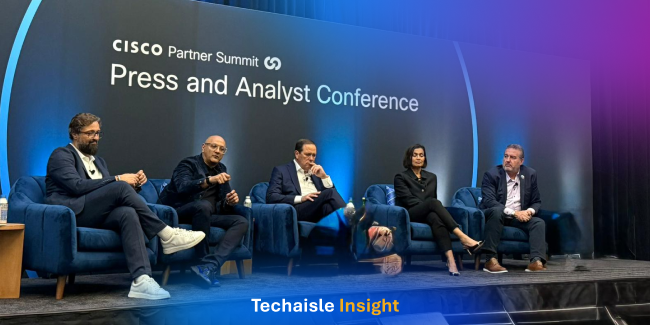
At its recent Partner Summit, Cisco’s executive team, led by CPO Jeetu Patel, made a declaration that was as bold as it was inevitable: "Cisco is the critical infrastructure company for the AI era." For an organization built on connecting the internet, this is a profound pivot. However, according to my analysis, even this claim is too modest. Cisco is not just building infrastructure; it is building the integrated stack to simplify and secure customer deployments. A more accurate title is the "Distributed AI Infrastructure Orchestrator." This pivot to orchestration is not one Cisco can make alone. It is a co-dependent strategy built to capture a once-in-a-generation install base refresh—an opportunity CEO Chuck Robbins pegged at $40 billion for Cisco. From my Techaisle analysis, Cisco's blueprint for capturing this opportunity rests on three interdependent pillars:

  1. A Reframed Platform Strategy: Solving the core-to-edge infrastructure and data barriers to AI.
  2. A Comprehensive Security Doctrine: Weaving trust into the fabric of the network as a prerequisite for AI adoption.
  3. A Modernized Economic Engine: The new Cisco 360 Partner Program is designed to shift partner business models from resale to high-value lifecycle services.

Cisco PArner Summit 650

1. Reframing the Platform: Beyond "AI Infrastructure"

Jeetu Patel’s claim is the new north star, but I believe "critical infrastructure for the AI era" is too modest a description. It fails to capture the scale of Cisco’s ambition. Cisco’s strategy is designed to address what it identifies as the three fundamental "impediments" holding back AI: infrastructure constraints, a trust deficit, and a data gap.

Anurag Agrawal

Architecting the Future-Ready Midmarket: Lenovo's New Playbook for IT Modernization and AI

The global midmarket is a tricky beast. It possesses the ambition and complexity of a large enterprise but often operates with the resource constraints of a small business. For years, Techaisle has maintained that the midmarket is the true battleground for technology growth, urging vendors to address its unique needs. In 2025, it seems that the call has been answered.

These organizations are the engine of economic growth. In fact, Techaisle data reveals this segment is a hotbed of high-growth businesses. Within the upper midmarket (1000-4999 employees), a remarkable 67% of firms are classified as high-growth, projecting an average revenue increase of 7.4% for the coming year. This trend continues in the core midmarket (100-999 employees), where 57% of firms are on a high-growth trajectory, anticipating revenue growth of 6.2%.

Yet, this very growth creates a constant tug-of-war between the need to modernize and the practical limitations of budget, time, and in-house IT expertise. According to Techaisle research, 78% of midmarket firms identify IT complexity as a significant obstacle to digital transformation, and 59% cite a lack of specialized skills as the primary barrier to adopting new technologies like AI. It is precisely this market reality that Lenovo is targeting with its latest suite of flexible solutions for SMBs and midmarket businesses.

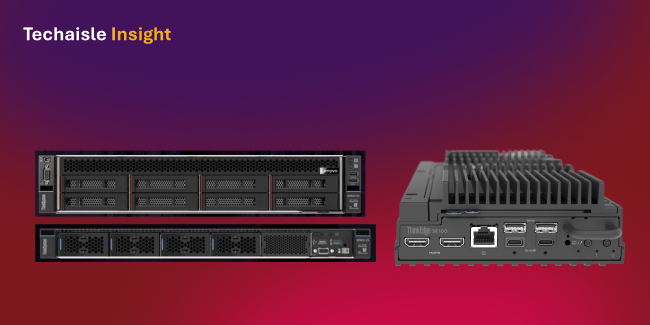
Lenovo's announcement is not merely a product refresh; it is a strategic, cohesive, and channel-centric approach designed to de-risk technology adoption and accelerate time-to-value for the midmarket. The strategy is built on three interconnected pillars: simplified, pre-validated Business Solutions in a Box; accessible, outcome-focused AI Solutions; and flexible, intelligent Services & Platforms. This analysis will deconstruct these announcements to explore why they are differentiated and why they matter deeply to midmarket businesses and the channel partners who serve them.

The "In-a-Box" Approach – Building the Foundation for Growth

For SMBs and midmarket firms, unstable IT is like a cracked foundation—nothing innovative or ambitious can be built upon it. Yet, for years, midmarket IT teams have been forced to act as systems integrators, painstakingly assembling servers, storage, networking, and software into functional solutions. This process is time-consuming, fraught with risk, and diverts scarce IT resources from value-added projects. Lenovo’s "in-a-box" concept directly attacks this foundational pain point.

techaisle lenovo midmarket smb 650

Anurag Agrawal

Techaisle Take - SUSE's Integrated Four-Pillar Strategy: A Blueprint for Resilience from Core to Cloud and Edge

In a rapidly evolving IT landscape, where complexity is the new constant, technology vendors face immense pressure to deliver not just products, but cohesive and integrated strategies that address real-world business challenges. SUSE recently provided the analyst community with its "State of the Nation" update, offering a detailed look into its strategy, recent momentum, and future direction. The briefing reinforced SUSE's commitment to a four-pillar strategy, with a sharpened focus on integration and addressing critical market imperatives, including AI-driven operations, pragmatic modernization, and digital sovereignty.

At Techaisle, we see this as a pivotal move. SUSE is framing its value proposition not as a collection of open-source components, but as a unified blueprint designed to empower enterprises to innovate anywhere—from the datacenter to the cloud and the far edge—with choice and confidence.

techaisle suse blog

The Four Pillars: An Integrated Stack, Not a Siloed Portfolio

SUSE's strategy is built on four interconnected pillars: Business-Critical Linux, Enterprise Cloud Native, Edge, and AI. While these pillars represent distinct technology domains, the real insight lies in how SUSE is architecting them as a synergistic stack designed to run anywhere, from developer environments to datacenters, the cloud, branch offices, and the edge.

Tags:
Anurag Agrawal

Xero: Charting the Future of Accounting with an AI-Powered 'Just Done' Philosophy

The accounting industry stands at a critical juncture. Small and mid-sized businesses (SMBs) and the accountants and bookkeepers who serve them are navigating a complex landscape defined by talent shortages, mounting regulatory pressures, and persistent economic uncertainty. In this environment, the traditional role of accounting software as a mere system of record is no longer sufficient. The market demands a shift towards a system of intelligence—one that not only records transactions but automates workflows, anticipates needs, and delivers actionable insights.

At its recent Xerocon Brisbane event, Xero articulated its response to this demand with a series of announcements that signal a profound strategic evolution. Moving beyond incremental feature updates, Xero unveiled a cohesive vision centered on a supercharged AI financial agent, a unified partner platform, and strategic acquisitions to bolster its payments ecosystem. This is not just about making accounting easier; it is about fundamentally reimagining the nature of financial management for SMBs and redefining the value proposition for their advisors.

xero revised blog

The AI Superagent: JAX's Evolution from 'Just Ask' to 'Just Done'

The centerpiece of Xero's future vision is the evolution of JAX (‘Just Ask Xero’), its AI business companion. Xero is moving JAX from a "just ask" tool to a "just done" financial superagent, built on an agentic AI platform. This is a critical distinction. While many vendors are adding conversational AI interfaces, Xero's ambition is to create a system that proactively automates manual, repetitive tasks across bookkeeping, tax, payments, and reporting.

Trusted Research | Strategic Insight

Techaisle - TA