










• TRUSTED RESEARCH

    TRUSTED RESEARCH | STRATEGIC INSIGHT

    SMB. CORE MIDMARKET. UPPER MIDMARKET. ECOSYSTEM
    LEARN MORE
  • BUYER JOURNEY

    BUYER JOURNEY

    SMB & Midmarket Buyers Journey Research
    LEARN MORE
  • BUYER PERSONAS

    BUYER PERSONAS

    SMB & Midmarket Technology Buyer Persona Research
    LEARN MORE
  • ARTIFICIAL INTELLIGENCE

    ARTIFICIAL INTELLIGENCE

    SMB & Midmarket Analytics & Artificial Intelligence Adoption
    LEARN MORE
  • DATACENTER SOLUTIONS

    DATACENTER SOLUTIONS

    SMB & Midmarket Datacenter Solution Adoption Trends
    LEARN MORE
  • INTERWORK 2.0: THE AGENTIC FUTURE OF CONNECTED BUSINESS

    INTERWORK 2.0: THE AGENTIC FUTURE OF CONNECTED BUSINESS

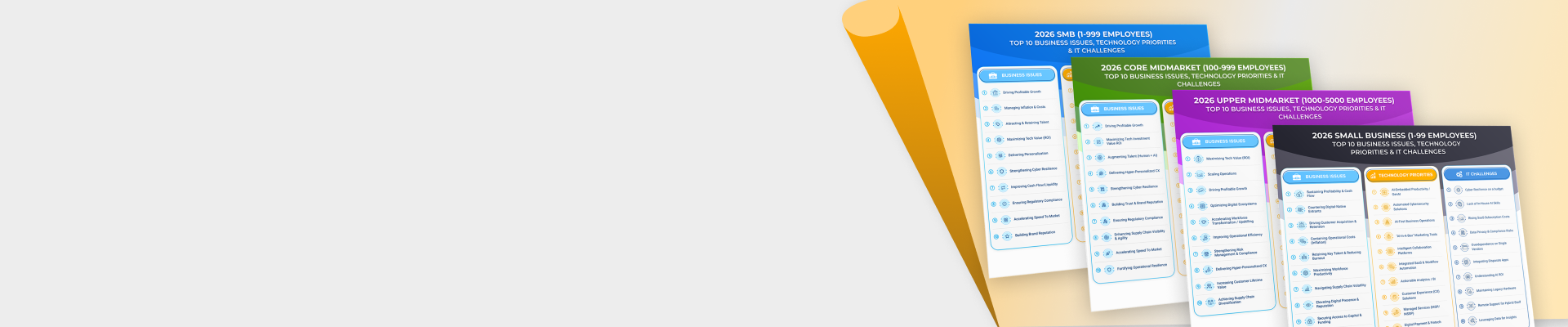
  • 2026 TOP 10 SMB BUSINESS ISSUES, IT PRIORITIES, IT CHALLENGES

    2026 TOP 10 SMB BUSINESS ISSUES, IT PRIORITIES, IT CHALLENGES

  • 2026 TOP 10 SMB PREDICTIONS

    2026 TOP 10 SMB PREDICTIONS

    SMB & Midmarket: Autonomous Business
    READ
  • 2026 TOP 10 PARTNER PREDICTIONS

    2026 TOP 10 PARTNER PREDICTIONS

    Partner & Ecosystem: Next Horizon
    READ
  • IT SECURITY TRENDS

    IT SECURITY TRENDS

    SMB & Midmarket Security Adoption Trends
    LATEST RESEARCH
  • PARTNER ECOSYSTEM

    PARTNER ECOSYSTEM

    Global Channel Partner Trends
    LATEST RESEARCH

Techaisle Analyst Insights

Trusted research and strategic insight decoding SMBs, the Midmarket, and the Partner Ecosystem.
Anurag Agrawal

Dell Technologies emerges as a new compelling challenger in the as-a-service market

HPE is not the only game in town. Dell had announced its entry into the aaS arena in 2017 with PCaaS on the client-side. Dell Technologies, the only IT supplier with an end-to-end portfolio, announced its latest foray into the "as-a-service" (aaS) arena with Project Apex, which it hopes will take Dell Technologies' aaS capabilities to the next level. Its objective is to unify Dell's as-a-service and cloud strategies to provide a consistent experience wherever a workload runs - on-premise, at the edge, or in the public cloud. Project Apex aims to simplify customers' and Dell Technologies partners' access to Dell's as-a-service portfolio. The first product, Dell Technologies Storage as a Service (ST-as-a-service), delivers a pay-per-use model and elastic capacity and is deployed on-prem but fully managed by Dell at the initial launch. The key enabler of Project Apex is the Dell Technologies Cloud Console. This single web interface enables customers to manage their cloud workloads and services, available to a few select early customers with a wider roll-out in 2021. Dell has a long road ahead with "everything-as-a-service" as a final destination. After STaaS, Dell is expected to roll out compute-as-a-service (COMPUTEaaS), PCaaS, Data-protection-as-a-Service (DPaaS) and vertical solutions (SAPaaS). PC-as-a-Service (PCaaS) is already available. Apex will enable it to move from a bundled, "leased" offer tying software and services to each device in an annual price per seat to modern, flexible aaS capabilities providing customers with tailored offers of hardware, software and services delivered over the air and accessed/ managed through a single portal enabling customers to seamlessly scale up and down specific to their unique needs and renew effortlessly, with one simple price per month.

HPE may have the lead, but nobody can claim a victory lap as yet. It is too early to declare a winner. Dell is a compelling challenger. It matters to SMBs, Midmarket firms, Enterprise customers and Partners.

Cloud, private cloud, and conventional infrastructure are three parts of a whole. Dell Technologies is currently betting on it by providing simplicity, consistency, and flexibility. However, the current branding of solution offerings of Dell Technologies Cloud Platform and Dell Technologies On Demand will need to merge quickly to avoid digressing and having complex customer conversations on the merits of each. And then, there is the VMware Cloud, which adds to the choice complexity.

Let us discuss why the as-a-service challanger status matters to SMBs, Midmarket firms and Dell Technologies' Partners.

Why the announcement matters to SMBs and Midmarket firms

Anurag Agrawal

Remote work is escalating need for connected digital workplace platform within SMB and Midmarket

Distributed, remote, mobile – these are the realities of today’s workforce. The workspace isn’t defined by windows and walls and common area couches. For millions of SMB employees, the workspace isn’t a physical location – it’s a virtual space defined by access from multiple screens which are used from multiple locations. Consider these data points from Techaisle’s SMB survey research. Pre-pandemic, 24% of SMB global workforce was mobile. Today, the number has jumped to 51% within small businesses and 47% in midmarket firms. These numbers are down from a high of 78% during country lockdowns. The category, “mobile workers”, is increasingly indistinguishable from “workers.” This means new ways of working, taking advantage of new technologies and capabilities to build an agile, mobile, secure work-style enabled by cloud, remote work, security and collaboration. When working remotely, 47% of SMB mobile workforce are using notebook to access corporate data, 9% tablets and 44% smartphones. If the office of an SMB is defined by devices, workplace is defined by the ability to work from wherever those devices and their users are located. As a result, 64% of SMBs are increasing investments in remote work solutions, and survey data shows there will likely be a whopping 380% increase in digital workplace adoption in the next one year within small businesses and 48% increase within midmarket firms.

The key focus is about the ‘future of work’: workflow, workspaces, workforce and the ways that an increasingly-connected world can support pursuit of previously-unattainable objectives for the SMBs and midmarket firms. Their most important technology-related effort is on connectedness – connected cloud, edge, applications, security, collaboration, workspaces and insights. Cloud and mobility are navigation routes but the always-on, everywhere-connected unified platform is the destination. These SMBs are looking for benefits arising from the interconnection of all types of resources: platforms/environments, information, devices and applications. Depth discussions and quantitative survey research with SMBs and midmarket firms points to a trend that is playing out across seven key areas as shown in the chart below:

Anurag Agrawal

COVID-19 Impact on SMB Tech Investments

Precision is impossible but agility and resilience are realizable. In every crisis, there is opportunity. If history is any indication then the SMBs are well-placed to narrow the banks of uncertainty. With integrative thinking SMBs will be adept at maneuvering around the edges of flames that have been fanned by COVID-19. 

Over 12 years of Techaisle tracking data paints a fascinating picture in which SMB business goals established by unexpected challenges drove new IT priorities. Klaus Schwab, Founder, World Economic Forum observed that, "In the new world, it is not the big fish which eat the small fish, it's the fast fish which eat the slow fish." SMBs are the fast fish as compared to enterprise segment.

After every downturn, SMB IT spend has rebounded higher and faster than overall (consumer + SMB + enterprise + government + education) IT spends. Techaisle had published its forecast scenarios here.

But the questions remain. Is today the same as the past? Will the future be different? We know that to be uncertain is to be uncomfortable, but to be certain is to be ridiculous. There are already many discussions and surveys conducted by various firms on today’s devastating impact on SMBs. At Techaisle we agree that SMBs are currently desperately operating between the raindrops but our objective is to square the circle, to simplify the path forward for IT vendors and channel partners and see past the blind corner.

To understand the impact of COVID-19 on future of IT we conducted a survey of N=2427 SMBs in several countries. Regardless of the uncertainty, over 50% of SMB business leaders in Asia/Pacific and some countries in Europe are optimistic and are confident about a V-shaped recovery as compared to US and UK SMBs who believe in more of a U-shaped recovery.

Download free Techaisle Take document to understand:

  • Why agility and adaptability will accelerate recovery for SMBs Worldwide? Global SMB IT spend vs Overall IT spend vs GDP growth rates
  • Why SMB technology and business alignment will result in resiliency, agility and adaptability?
  • What will be post COVID-19 impact on business and IT operations? Uncertainty and status quo.
  • What will be the impact on tech investments? Increase, decrease, delay, no change
  • Will digital transformation be the agility enabler for SMBs?
  • What is the current non-technology related work-from-home challenge for SMBs?

button

Anurag Agrawal

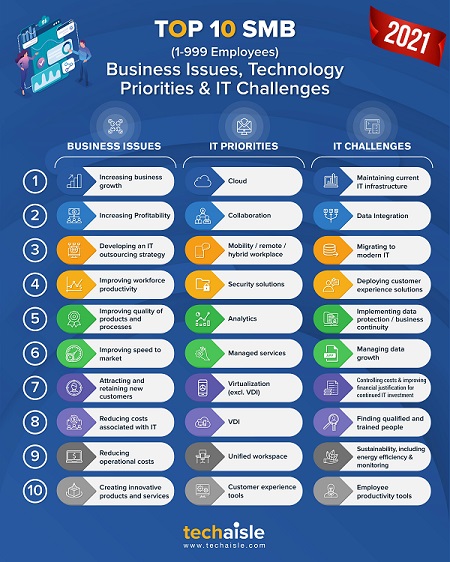
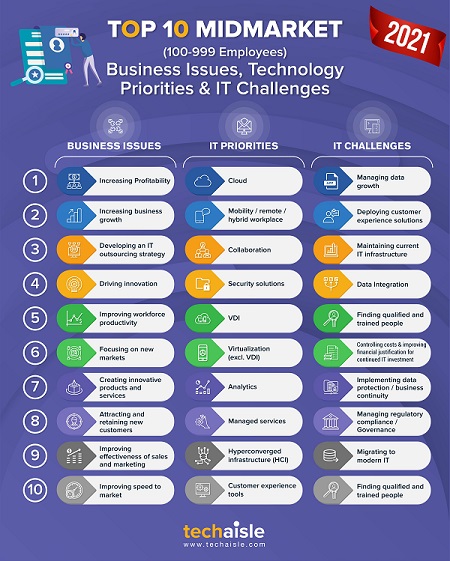
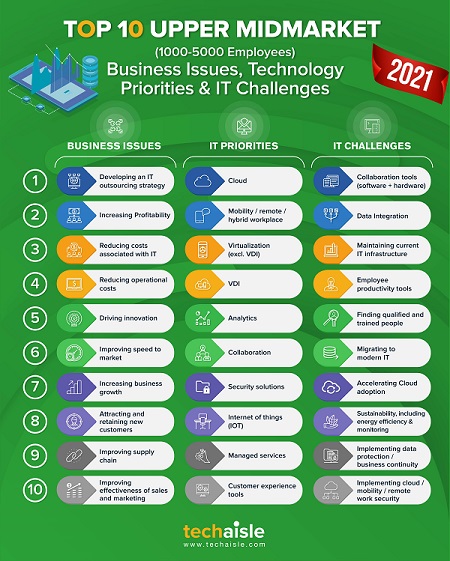
2020 Top 10 SMB and Midmarket business issues-challenges-priorities

Techaisle has released its annual research infographics on top 10 IT priorities, business issues and IT challenges of SMBs (1-999 employees), midmarket firms (100-999 employees) and small businesses (1-99 employees) for 2020. In its detailed SMB survey Techaisle investigated 27 different technology areas and several technology sub-categories, 25 different IT challenges and 24 different business issues. This is the 10th year of Techaisle’s annual survey research initiative that probes for top business issues, IT priorities and IT challenges. Tracking history provides a fascinating evolution in which new business goals drive new IT priorities and uncover challenges that must be addressed to enable progress on business objectives. Primary research was conducted among senior IT and business decision makers from Techaisle network of 1.8M B2B IT professionals spread across 30+ countries.

WW SMBs are expected to spend US$1 trillion on IT in 2028, growing at a faster rate than the enterprise segment. Innovation is increasingly becoming a line-item of IT budgets. 40% of midmarket firms and 15% of small businesses are carving out budgets specifically for technology-driven innovation. But there is a flip-side as well. Within 47% of small businesses and 22% of midmarket firms, IT is not expected to actively drive innovation. As data suggest, nearly half of the SMBs assert that either they do not have the right IT skills or not enough IT staff. However, data does show that move to pay-as-you-use/consumption-based financing is likely to reach an irreversible trend with 14% of SMBs either currently using or planning for it. But a mass-move to only OPEX-based technology acquisitions is still in distant future with 30% of SMBs still preferring a mix of CAPEX and OPEX.

2020 top10 smb it priorities business issues techaisle infographics blog

Download 2020 SMB infographic here

For 2020, data shows that for the first-time customer experience has appeared within the top 5 challenges being faced by IT within SMBs which has a direct correlation to the top business issue of attracting and retaining customers. A direct result of the new challenge and focus is in the increase in plans for adopting integrated CRM and customer service solutions (in some cases replacing one brand of CRM with another), acceleration in use of artificial intelligence and analytics. A small business CEO of a manufacturing firm told Techaisle, “we are planning to purchase more cloud-based applications to save time and effort. See being a start-up, currently we do not use many cloud applications and we know that there are requests from our sales and HR department to purchase additional cloud applications. Right now, we are not using any cloud application for customer service and for evaluating our progress, growth and tackle pain point of our business, we need to be more connected to our consumers. So, we are trying to purchase a cloud application like Salesforce or Zoho that can enable us connect with our consumers for feedback and registering customer support / complaints”.

For small businesses, upgrading to digital marketing and utilizing social media is among the top 10 IT challenges. These small businesses are not only experimenting themselves but seeking external assistance in how best to use major digital platforms like Google and LinkedIn to make their customers aware of the services and products that they have to offer. They are also hoping that such initiatives may help them get valuable feedback from their customers.

Security is not only the biggest IT challenge but it is also a key top priority in every region and across all employee size segments. As one SMB CIO told Techaisle, “security has been our biggest concern. The more we try to deploy latest technologies and software hackers always find new ways to breach. So, we are hiring more experts in our cyber security team and we are evaluating more vendors to have the best software and tools for security”. In fact, US survey data shows that 3% of small businesses and 94% of midmarket firms have employed IT security specialists within their organizations. If data from 1-19 employee size segment is excluded, then the percent of small businesses with full-time cybersecurity staff increases to 25% within 20-49 segment and 57% with 50-99 employee segment. The data is no different in Europe and Asia/Pacific, in fact, the percentages are higher in Europe. A small business IT director in Germany told Techaisle “as our company grows and evolves, security concerns are increasing. There are increasing number of cyber risks and we have plans to implement new security solutions, amending policies and hiring additional security professionals for protecting our organization from any cyber breaches or threats”.

Controlling IT costs, although number nine on the top 10 list is a challenge for SMBs. IT is known to be kinetic, complex and risky and costs can spiral out of control rapidly or SMBs are unable to realize the ROI of the investment in the shortest time. Most SMBs find controlling cost to be a major challenged because there have been situations where their spend was higher than budget allocation resulted in losses. Therefore, SMBs are becoming better on their budget forecasts and moving towards cloud eliminating Capex.

Accelerating cloud adoption is a given but there is a new initiative to consolidate IT workloads. A Vice President of IT in Asia/Pacific elaborated on this topic, “we have a lot of IT workloads that is spread over public and private cloud. It is very important for us to have our data consolidated at a single place that would be a private cloud so that only our internal team has access to it and no one else could access the data without our permission. We have plans to work on private cloud provided by Microsoft Azure and AWS”. There are many other SMBs and midmarket firms who have tasked their IT departments to research and add new cloud technologies based on business requirements.

Hyperconverged Infrastructure (HCI) has moved up in its list of IT priorities driven by the promise of agility, reduced costs, scalability and centralized management. SMBs and midmarket firms are showing their preference for VMware, Cisco and Nutanix HCI offerings.

Cloud-managed SD-WAN service is a new top 10 IT priority for midmarket firms because of faster deployment, optimization of WAN bandwidth and improved operational efficiency due to automation and self-provisioning.

Scroll down or  click read more for infographics

Trusted Research | Strategic Insight

Techaisle - TA