• TRUSTED RESEARCH

    TRUSTED RESEARCH | STRATEGIC INSIGHT

    SMB. CORE MIDMARKET. UPPER MIDMARKET. ECOSYSTEM
    LEARN MORE
  • COMMS, COLLAB, CONTACT CENTER

    COMMS, COLLAB, CONTACT CENTER

    SMB & Midmarket Buyers Collaboration, Contact Center Study
    LATEST RESEARCH
  • DATACENTER SOLUTIONS

    DATACENTER SOLUTIONS

    SMB & Midmarket Datacenter Solution Adoption Trends
    LATEST RESEARCH
  • PARTNER ECOSYSTEM

    PARTNER ECOSYSTEM

    CHANNEL PARTNER ECOSYSTEM TRENDS STUDY
    LATEST RESEARCH
  • BUYER JOURNEY

    BUYER JOURNEY

    SMB & Midmarket Buyers Journey Research
    LATEST RESEARCH
  • BUYER PERSONAS

    BUYER PERSONAS

    SMB & Midmarket Technology Buyer Persona Research
    LATEST RESEARCH
  • ARTIFICIAL INTELLIGENCE

    ARTIFICIAL INTELLIGENCE

    SMB & Midmarket Analytics & Artificial Intelligence Adoption
    LATEST RESEARCH
  • IT SECURITY TRENDS

    IT SECURITY TRENDS

    SMB & Midmarket Security Solutions Adoption Trends
    LATEST RESEARCH
  • 2026 TOP 10 SMB BUSINESS ISSUES, IT PRIORITIES, IT CHALLENGES

    2026 TOP 10 SMB BUSINESS ISSUES, IT PRIORITIES, IT CHALLENGES

  • 2026 TOP 10 SMB PREDICTIONS

    2026 TOP 10 SMB PREDICTIONS

    SMB & Midmarket: Autonomous Business
    READ
  • 2026 TOP 10 PARTNER PREDICTIONS

    2026 TOP 10 PARTNER PREDICTIONS

    Partner & Ecosystem: Next Horizon
    READ

Techaisle Analyst Insights

Trusted research and strategic insight decoding SMBs, the Midmarket, and the Partner Ecosystem.
Anurag Agrawal

Interwork - the next step in connected businesses

Internet and the web are the navigation routes that we have been developing since the 1970s; the always-on, everywhere-connected Interwork platform is the destination that we will be creating in 2018 and for years to come.

As we enter 2018, it seems that online capabilities and activities are entering a new era. There are still advances to be made in the ‘net’ realm: there is constant pressure to expand the speed of the Internet, enabling it to handle the voracious demands of unstructured content like video, and the rise of IoT portends a coming tsunami of data from billions of connected devices. However, the key focus of web-based business investment is now less about the ‘net’ and more about the ‘work’: the ways that an increasingly-connected world supports pursuit of previously-unattainable objectives. The most important IT-related development in 2018 will be this focus on connectedness – connected cloud, connected edge, connected applications, connected security, conected collaboration, connected workspaces and connected insights. (Download your free white paper here)

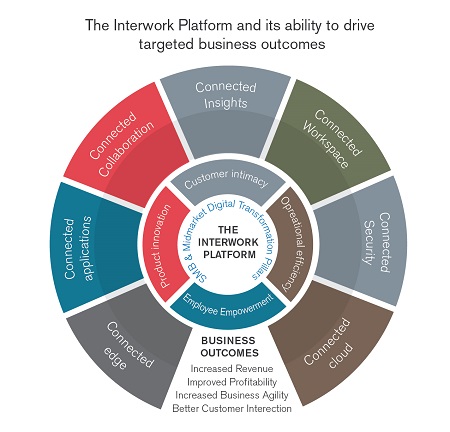
Techaisle calls it the “Interwork platform” (as described in Techaisle's latest white paper). This refers to Techaisle’s belief that 2018 will mark a transition point at which corporate focus on developing and deploying systems that offer the capacity to connect diverse resources (the Internet platform) will be surpassed by a focus on capitalizing on the benefits of connected information, assets and users and teams – the ‘Interwork platform’ - to deliver on the four pillars of digital transformation: operational efficiency, customer intimacy, employee empowerment and innovation.


In the early 1970s, computer science pioneers Vint Cerf and Robert E. Kahn developed the networking protocol TCP/IP – Transmission Control Protocol/Internet Protocol – which enabled interconnections between networks to form a ‘network of networks’. Fifteen years later, in 1989, Tim Berners-Lee developed the World Wide Web, allowing browsers to follow hypertext links to far-flung resources. The Web was released to the general public in August 1991 – and businesses and individuals around the world have spent more than 25 years developing a vast array of content, process and interactive capabilities that are set within and rely on the network of networks.

Techaisle’s position is that from the perspective of the technology world, 2018 – and quite possibly, several years following 2018 – will be defined by the benefits arising from the interconnection of all types of resources: platforms/environments, information, devices and applications. With the connective fabric now (or rapidly becoming) ubiquitous, businesses of all types and sizes will move beyond a focus on network access, and concentrate instead on using Interwork technologies to drive progress across the four pillars of digital transformation: operational efficiency, customer intimacy, employee empowerment and product innovation.

Techaisle’s recent point-of-view on the Interwork platform highlights seven key areas and trends playing out across seven key technology areas:

  1. Connected cloud, which provides the foundation for Interwork, the bedrock on which Interwork platforms are built
  2. Connected edge, which completes that foundation and will work with connected cloud to deliver the ‘yin and yang’ of the Interwork platform’s infrastructure
  3. Connected applications, that represent the best path forward for corporate workloads and processes – and represent a critical component of the Interwork platform
  4. Connected security, is an essential property of the Interwork platform as security strategies no longer resemble a ‘wrapper’ around assets
  5. Connected collaboration, as it becomes part of the fabric of business activity, rather than as a means of enabling connections between discrete tasks
  6. Connected workspaces, which draw together assets and users, delivering increased benefit within each category while simultaneously extending and strengthening the core of the Interwork platform; and
  7. Connected insights, the information gained/accessed through the platform, which enables businesses to address constantly-advancing expectations for speed (of operational decisions) and completeness (of strategic decisions).
techaisle interwork platform description resized

Business and IT executives who are able to grasp the benefits associated with these seven key areas – and who are able to profit from the points at which multiple connected business resources combine to build the broader Interwork platforms – will emerge as leaders in and beyond 2018. Their organizations will participate in shaping rapidly-evolving business and consumer expectations for responsiveness and agility. Businesses that capitalize on Interwork capabilities will capture preferred positions within their markets, and within the millennial labor pool that defines a key area of near-term competition.

There are many powerful rationales for investing in each of the seven components of an Interwork platform, and as Techaisle's white paper demonstrates, each component in turn delivers greater value when it is connected with the other links in the Interwork chain.

Download your free white paper here


Anurag Agrawal

Digital Transformation and the future of Reseller channel

The past 15 years have been tough for traditional resellers. Digital transformation will benefit the reseller channel. Today, the IT industry is abuzz with discussion of digital transformation. Unlike smartphones and cloud, however, DX may actually provide upside for traditional channel members. In this document, Techaisle, in its latest white paper argues in favor of the proposition “DX will deliver new opportunity for traditional VAR businesses”. VARs are best positioned to scale “the twin ladders” to deliver digital transformation technology building blocks and the Interwork platform helps the channel position digital transformation initiatives in successfully navigating through and across digital transformation delivery stages.

In many cases, channel organizations that describe digital transformation to prospective clients are really talking about digitization, or some combination of digitization and digitalization. This is particularly true of MSPs or cloud (SaaS, IaaS) suppliers who are positioning their infrastructure management offerings – which are, for the most part, vehicles for augmentation – as a means of achieving DX. However, in its transformational end stages, DX is defined not by supplier delivery but by customer processes and objectives.

Anurag Agrawal

Techaisle midmarket study shows cloud maturity does not always equal high digitization

Techaisle’s US midmarket digital transformation trends study shows that maturity of cloud adoption does not equate to high digitization of the business. Study data shows that only half of the 47% of mature midmarket cloud adopters are holistic adopters of digitalization. It is true that these firms believe in cloud and its effect on digitization but they also believe that true digital transformation requires advanced adoption of multiple technology solutions. Data also shows that the midmarket firms that have a siloed strategy of digital transformation are intermediate adopters of cloud, mostly driven by non-IT business units which need cloud to further their business objectives.

However, it is also clear from data that the Holistic segment includes a disproportionate number of mature cloud adopters, and mature cloud adopters in turn are much more likely to be Holistic in their approach to digitalization than firms in the intermediate category. A smaller (7% of total) third group of midmarket businesses, ‘born in the cloud’ (i.e., have all IT resident in the cloud) largely echo the patterns of the mature cloud users.

From a digitalization product/service marketer’s perspective, this is an important finding: it shows that those who can identify mature cloud adopters are likely to find greater receptivity to their messages and offerings than those that engage equally with the similarly-populous group of intermediate (in terms of cloud adoption) midmarket businesses.

High adoption of diverse technology solutions determines digitalization success

Even considering planned adoption, Siloed midmarket digital segment is likely to remain far behind the Holistic midmarket digital segment. The Siloed segment even lags being in the technology areas which midmarket firms see having the most impact in their business for the next 5 years.

Anurag Agrawal

SMB market is not a monolith – 32 percent are in Advanced IT sophistication segment

  • ‘The’ IT market is comprised of many segments: large enterprises act at a different pace than SMBs.
  • The ‘run rate’ revenue in the IT industry is attributable to products that are mature, accessible to buyers in all segments.
  • In many cases, the IT industry focuses on new product categories (e.g., IoT) appealing to sophisticated buyers as growth drivers.
  • For the most part, adoption begins in large accounts, and ‘filters down’ into SMBs over time.
  • Techaisle research demonstrates that the SMB market is not a monolith – and provides the insight needed to understand advanced IT adopters within the SMB community. And trend analysis serves as an important illustration of the impact that IT’s relentless progress has on different buying segments within SMBs

IT products are often described as having ‘a market’ – but ‘the’ IT market is comprised of many segments, each of which has its own approach to IT adoption. Some industry sectors (e.g., aerospace) tend to move faster than others (e.g., retail); large enterprises tend to adopt technology earlier than SMBs; and different countries and regions invest in new technologies at different rates.

Unless/until they are supplanted by new solutions, mature IT products (e.g., printers, desktop computers) are acquired at about the same rate by all buyers: large enterprises, SMBs, and various industries all have well-defined needs and acquisition patterns for these technologies. These technologies generate the majority of ‘run rate’ revenue in the IT industry.

When IT industry growth opportunities are discussed, the focus often turns to earlier-stage technologies – witness current enthusiasm over IoT, analytics/Big Data and cloud. Sellers of these technologies tend to focus on advanced segments (large accounts, particularly in leading-edge industries). SMBs are generally viewed as a secondary market. 


IT sophistication segmentation

However, the SMB market is not a monolith. Techaisle research, SMB & Midmarket IT Sophistication driven technology adoption trends has identified four attitudinal/behavioral segments that have different approaches to IT adoption. Suppliers who understand the scope and characteristics of these segments are able to expand their target markets and develop strategies geared to reaching high-potential SMB prospects. These suppliers ultimately have access to an expanded TAM, and have the insight needed to align marketing investments with priority customers. Sophistication is a crucial issue in SMB technology adoption – but it is often overlooked, and even when it is not, it is poorly defined and quantified. This report provides the insight needed to align SMB targets and strategies with highest-potential segments.

techaisle smb it sophistication segments

The above chart provides a high-level illustration of the four IT sophistication-defined buyer segments found within the SMB market. The first group, “Pre IT,” represents firms – all of which are found in the small (1-99 employees) rather than midmarket (100-999 employees) market – that have not embraced IT as part of their business operations.

The second group, “Basic IT,” is the largest of the four segments, and most closely resembles the approach that is commonly thought of as ‘the SMB IT market’. These firms invest in mature (run-rate) technologies, but lack the internal business demand and IT understanding to expand into more advanced solutions. In the small business market, Techaisle categorizes these firms as “old-fashioned yet entrepreneurial” – firms that are not sophisticated in their use of IT, but who will buy proven solutions to address clearly-defined impediments to business success. In the midmarket, Techaisle classifies these organizations as “proactive yet cautious” – committed to investment in technologies that have been proven to enhance individual productivity or firm-level capabilities.

The third group, “Advanced IT,” represents the approach that is often considered to be characteristic of leading-edge SMBs. These firms are actively exploring advanced solutions: ‘second-order’ applications (such as analytics and ERP) that build on the more basic capabilities that are already deployed within the organization, and emerging applications (such as IoT) that provide entirely new, IT-enabled expansion opportunities to their businesses.

The fourth group, “Enterprise IT,” functions like the IT operations within large accounts. In an SMB context, Enterprise IT refers to organizations where IT is run as a business, providing support for IT-enabled innovation across all functions and processes. This group, which is found only in midmarket accounts, represents about 17% of the SMB market total.

Technology progress creating segment separations

Comparing the latest 2017 analysis with similar segmentation analysis conducted in 2015, we see that in 2015, 10% of small businesses were classified as Pre-IT, 59% as Basic IT, and 31% as Advanced IT. Over the next two years, IT complexity spiked at a historically high rate: cloud and mobility went from PoCs to essential infrastructure, analytics (and increasingly, Big Data) moved swiftly from early adopter to early mass market status, IoT is rapidly following this path, AI is migrating from science fiction to data centers, and entirely-new options like Blockchain are having real impact on IT strategy in advanced IT environments. Against this backdrop, small businesses see that their capabilities are not adequate for this increasingly-complex world: nearly 70% are in the “Basic” category, and the proportion that can claim to be “Advanced” has halved, from 31% to 16% and the Pre IT has increased.

At the same time, analysis shows that more sophisticated segments are able to grow with this expanding constellation of options. One-third of midmarket businesses were categorized as “Basic” in 2015; by 2017, this group had shrunk to just 11% of midmarket firms. At the same time, midmarket firms boasting “Enterprise” level capabilities grew from 14% to 37% of midmarket organizations.

Taken together, the data illustrated in the research reinforces the need to understand ‘the SMB market’ at a more detailed level. The ability to identify buyer segments within this dynamic environment is critical to a supplier’s ability to adequately scope and target SMB opportunity.


Trusted Research | Strategic Insight

Techaisle - TA