











• TRUSTED RESEARCH

    TRUSTED RESEARCH | STRATEGIC INSIGHT

    SMB. CORE MIDMARKET. UPPER MIDMARKET. ECOSYSTEM
    LEARN MORE
  • INTERWORK 2.0: THE AGENTIC FUTURE OF CONNECTED BUSINESS

    INTERWORK 2.0: THE AGENTIC FUTURE OF CONNECTED BUSINESS

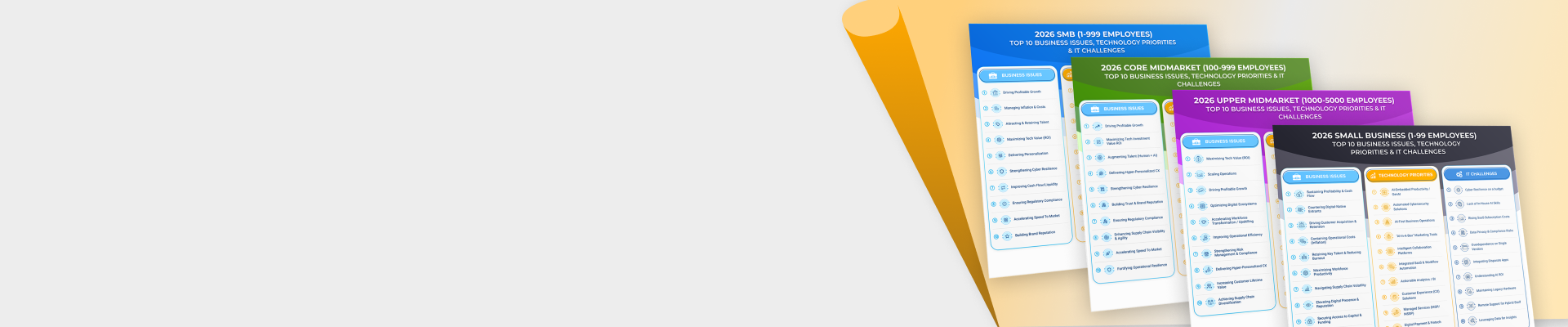
  • 2026 TOP 10 SMB BUSINESS ISSUES, IT PRIORITIES, IT CHALLENGES

    2026 TOP 10 SMB BUSINESS ISSUES, IT PRIORITIES, IT CHALLENGES

  • 2026 TOP 10 SMB PREDICTIONS

    2026 TOP 10 SMB PREDICTIONS

    SMB & Midmarket: Autonomous Business
    READ
  • 2026 TOP 10 PARTNER PREDICTIONS

    2026 TOP 10 PARTNER PREDICTIONS

    Partner & Ecosystem: Next Horizon
    READ
  • ARTIFICIAL INTELLIGENCE

    ARTIFICIAL INTELLIGENCE

    SMB & Midmarket Analytics & Artificial Intelligence Adoption
    LEARN MORE
  • IT SECURITY TRENDS

    IT SECURITY TRENDS

    SMB & Midmarket Security Adoption Trends
    LATEST RESEARCH
  • BUYERS JOURNEY

    BUYERS JOURNEY

    Technology Buyer Persona Research
    LEARN MORE
  • PARTNER ECOSYSTEM

    PARTNER ECOSYSTEM

    Global Channel Partner Trends
    LATEST RESEARCH
  • CLOUD ADOPTION TRENDS

    CLOUD ADOPTION TRENDS

    SMB & Midmarket Cloud Adoption
    LATEST RESEARCH
  • FUTURE OF PARTNER ECOSYSTEM

    FUTURE OF PARTNER ECOSYSTEM

    Networked, Engaged, Extended, Hybrid
    DOWNLOAD NOW
  • MANAGED SERVICES RESEARCH

    MANAGED SERVICES RESEARCH

    SMB & Midmarket Managed Services Adoption
    LEARN MORE

Techaisle Analyst Insights

Trusted research and strategic insight decoding SMBs, the Midmarket, and the Partner Ecosystem.
Anurag Agrawal

Zoho: A Mid-Market and Up-Market Powerhouse - Examining its Suitability and Strengths

In an era of globalization, businesses often pursue economies of scale and standardized solutions. Zoho, a global software behemoth with Indian origins, is carving a distinctive path. It has embraced a unique business strategy known as “transnational localism.” This approach intertwines global connectivity and local grounding, fostering local economies while partaking in the exchange of knowledge and culture. Transnational localism, as defined by Zoho, is a decentralized strategy that harnesses the benefits of a global scale while maintaining deep roots in local communities. It transcends the conventional “think global, act local” mantra, offering a more nuanced and influential method to tackle today’s complexities. This strategy is implemented through a tripartite approach:

  • Developing a Global Technology Stack: Zoho creates its software products suite, ensuring total control and adaptability.
  • Empowering Local Teams: Zoho sets up regional offices staffed with local talent, enabling them to tailor solutions to specific market requirements.
  • Prioritizing Local Communities: Zoho invests in local talent development, infrastructure, and social initiatives, nurturing a sense of collective responsibility and growth.

Transnational localism strikes a balance between global outreach and local engagement. It involves establishing offices in less affluent locations globally, injecting investment, expenditure, and job creation into these areas. The company stays globally connected, not just digitally, but also through a shared ethos and culture, while remaining locally anchored.

Zoho’s CEO, Sridhar Vembu, characterizes transnational localism as a strategy that sources talent from regions often neglected by other companies. These are typically areas experiencing talent emigration, leading to hollow communities. Zoho strives to reintroduce opportunities into these regions, commonly drained into urban centers.

Zoho IMG 9649

Beyond the Numbers: Real-World Examples

Zoho’s dedication to transnational localism extends beyond mere theory. It has actualized this philosophy by setting up a global network of over 25 offices in rural areas. Many IT suppliers overlook these locations for opportunities compared to their metropolitan counterparts. For instance, Zoho has an office in McAllen, Texas, with nearly 150,000 residents within a metropolitan area housing over a million people.

Another notable instance is Tenkasi in India, where Zoho inaugurated its first rural office. Despite being a city of nearly 100,000 people, Tenkasi is considered rural compared to India’s major metropolitan areas. In Tenkasi, Zoho operates a remote farm and an elementary school, both flagship initiatives in its rural revival strategy.

Zoho demonstrates its commitment to social responsibility in several ways. It has invested in rural India through its "10,000 Schools" program, which bridges the digital divide by providing digital infrastructure and training to schools. Additionally, Zoho empowers local communities by establishing offices in smaller towns across the US and Europe, fostering diversity and creating local job opportunities. Finally, Zoho tailors its product suite to specific market needs, showcasing its commitment to global inclusivity by respecting cultural and regulatory contexts.

The Impact on Zoho's Business: A Multi-Faceted Success Story

Transnational localism has significantly influenced Zoho’s business, propelling its remarkable growth. By the end of 2021, Zoho had amassed 500,000 customers, over 70 million users, and 40,000 customers on Zoho One, a product launched in 2017. One of these customers had 32,000 employees utilizing Zoho One. Fast-forwarding to 2024, Zoho’s customer base has expanded to over 750,000, with over 100 million users across 150+ countries.

Anurag Agrawal

2024 Top 10 SMB and Midmarket business issues, IT priorities and challenges

Focused on growth and committed to new solutions that expand business horizons – the SMB market is on the brink of a multi-year growth trajectory.

They are here - Techaisle's annual SMB, Core Midmarket and Upper Midmarket Top 10 IT Priorities, IT Challenges, and Business Issues infographics, 13th year of Techaisle tracking at a WW level, and is sought after by IT vendors, channel partners, and media. Techaisle surveyed nearly 5000 SMBs and Midmarket firms, quota sampled to ensure adequate coverage of four small businesses (1-9, 10-19, 20-49, and 50-99 employees), three core midmarket (100-249, 250-499, and 500-999 employees) and two upper midmarket (1000-2499, 2500-4999) segments. As a result, the data represents a robust and reliable sampling of the market segment for IT products and services.

Techaisle surveys thousands of small and midsized businesses (SMBs) to understand technology imperatives and directions. The annual survey establishes context by asking respondents to identify their top business goals, technology priorities, and IT challenges for the upcoming year.

2024 top10 smb it priorities business issues techaisle infographic

Redefining the art of the possible

The SMB market is a study in contrasts: the tension between boundless aspiration and a constrained reality. However, data shows that a market that has mastered the cloud and is excited by AI will dedicate itself to growth in 2024.

Anurag Agrawal

2024 Top 10 SMB and Midmarket Predictions

In 2021, we predicted that AI would permeate small and medium-sized businesses (SMBs) and midmarket firms, not as an independent solution but as an integral feature within other products. As SMBs fully comprehend the inherent nature of AI, they will increasingly seek AI-powered solutions to prescribe actions that mitigate risks and enhance decision-making, business agility, and innovation proactively.

We also predicted that AI technology would evolve so rapidly that by the time SMBs become comfortable with data-driven decision-making, AI would be executing decisions that might be beyond the comprehension of business executives. The challenge with AI would shift from trusting data over intuition to trusting AI when insights into its decision-making process are not readily available in the cloud applications used by SMBs and midmarket firms. We expect this trend to continue into 2024.

After surveying over 3000 SMBs and midmarket firms, Techaisle has announced its top 10 SMB and midmarket predictions for 2024. There is intense market pressure on SMB and midmarket executives to deliver tangible progress towards – and benefits from – application innovation and digital business. At least some of this results from a worldwide fascination with Generative AI and its anticipated potential to transform nearly any function it might apply to. Gen-AI offers significant potential for SMBs and midmarket firms to enhance their operations and drive innovation. By leveraging this technology effectively, these businesses can improve efficiency, productivity, and customer satisfaction.

techaisle 2024 top10 smb midmarket predictions

In 2024, SMBs and Midmarket business and technology leaders will maintain a practical perspective as they move into the digital future powered by AI. SMBs will invest in AI-infused, AI-embedded, tailor-made technology solutions to streamline operations and expand their customer base. To improve manageability, reduce complexity, and limit sprawl, pragmatism will overtake progressiveness. Technology choice and deployment complexity will create purchase inertia, empowering SMBs to seek suppliers capable of supporting a roadmap from the current state to a future-ready organization. SMBs will look for proof points in AI solutions that deliver tangible benefits within their environment. SMBs will adjust their own pricing strategies and implement cost-control measures. Labor shortages will prompt them to invest in employee training and retention initiatives to ensure smooth operations and efficiency. Additionally, SMBs will opt for proactive supply chain management and diversification strategies to minimize disruptions and exploit growth opportunities.

Here are Techaisle’s top 10 SMB and Midmarket predictions for 2024.

Anurag Agrawal

Cisco Meraki masterfully enabling digital workplaces for SMBs

New work patterns and the acceleration of distributed workplaces are resulting in a range of productivity benefits for SMBs today. As such, businesses see increased workforce efficiencies and talent recruitment while minimizing cost by reducing intermediaries and integrating contract professionals – and even improved environmental performance through reduced commuting and building footprints.

In the quest to deploy a perfect hybrid workplace technology infrastructure, SMBs often overlook networking – wireless, routers, firewalls, and beyond. Similarly, as small business retailers and other small commercial offices struggle with re-opening uncertainties, they also grapple with the daunting task of enabling secure and safe environments for their employees and customers. Digitization with minimum IT disruption and low manageability is on their minds.

Cash flow constraints, limited access to finances, competitive landscapes, the need for innovation, erratic revenue, uncertainties, the pace of technology change, and many more are drivers for achieving cost efficiencies within SMBs. Digital transformation is no longer the domain of only upper midmarket firms and enterprises. Techaisle's SMB and Midmarket Digital transformation survey research shows that 46% of SMBs are adopting digital transformation to reduce costs, and 38% are planning for innovation in customer engagement and services.

Helping SMBs thrive with robust IT solutions

Unbeknownst to many, the Cisco Meraki platform and the solutions it powers is a critical foundational technology to fast-forward digital transformation for SMBs. Much of this comes from its ease of use, simplicity, and flexibility for lean IT to innovate by doing more with less.

Cisco acquired Meraki in 2012, around the same time (2013), when it divested Linksys to Belkin. Over the years, Cisco has continued to innovate on its highly successful Meraki platform. It is no secret that Cisco Meraki invented cloud-managed networking technology in 2006. It has continued to innovate and expand the networking portfolio to IoT solutions and cover any business need or use case. The Meraki platform consists of switching, security & SD-WAN, wireless access points, mobile device management, and extending to IoT, including smart cameras and AI-equipped sensors to drive business intelligence.

Regarding deep intelligence and analytics, Meraki Health and Meraki Insight allow SMBs to monitor all aspects of their network and applications from the Meraki dashboard or API and easily detect and fix potential issues in minutes. Techaisle's survey shows that only 4% of small businesses have internal full-time IT staff. They spend 79% of their time on support, maintenance, and troubleshooting— creating an IT efficiency deficit and negatively impacting organizational productivity. Meraki Health's objective is to simplify troubleshooting for the lean, almost non-existent, or over-burdened small business owner/manager. Small businesses need to propel growth and enable new business initiatives freeing up time and resources. To ease the digital transformation, Meraki provides many capabilities that protect SMBs of any size, including:

  • Preventing cyber-attacks: Meraki MX Security & SD-WAN appliances protect SMB businesses, users, and devices. Meraki security has the backing of Cisco Talos, one of the largest commercial threat intelligence teams globally.
  • Deploying remote workers: Meraki Z3 teleworker gateways provide connectivity and secure and seamless in-office experiences. Meraki Insight delivers deep visibility into critical business applications and proactive troubleshooting for remote workers.
  • Ensuring safe occupancy: Meraki MV smart cameras let SMBs maintain social distancing guidelines by remotely monitoring and tracking safe occupancy levels in physical environments through intelligent analytics, such as object detection and tracking.
  • Cost savings from simplicity: All Meraki products are deployed and controlled from a single pane of glass. Meraki Health is available for all devices, saving many troubleshooting times by pinpointing specific problematic devices and clients via root cause analysis.

SMBs agree that Meraki solutions can be quickly deployed with zero-touch provisioning and configuration and remotely managed through a cloud-based GUI dashboard (single pane of glass), with all-inclusive licensing. Meraki provides 24/7 technical support (email or phone) and a lifetime warranty on devices (except cameras & outdoor APs) with advanced replacement.

Challenges in small business security

Techaisle's SMB security survey research data shows that security is a top IT priority and challenge for 76% of SMBs, and 65% are planning to increase IT security investments. Within the SMB segment, small businesses often lack the skills required to work with software-based security solutions and are 25%-33% less likely than midmarket firms to work with managed service providers.

Most small businesses are not proactive in addressing security issues, but that may not be the whole problem or perhaps even the greatest obstacle to small businesses’ adoption of security technology. Relative to midmarket firms, small businesses have limited to no internal IT security staff, are not generally working with a managed service provider capable of handling security needs, and are about 50% less likely to embrace external vendors' software-based security solutions.

While small businesses could theoretically pursue some strategies used by larger competitors, they lack the experience and skills to identify, deploy, and manage the products and relationships used to develop shields protecting valuable corporate data, applications, and human assets.

Meraki addresses these issues by providing a secure in-office experience to remote workers—giving access to applications while maintaining visibility and control from anywhere with a cloud-managed dashboard. It also encrypts data with Auto VPN, allowing employees to quickly, securely, and remotely connect to corporate locations.

Meraki smart cameras also address physical security, remote monitoring, and intelligence by including on-device storage and flexibility to access data through the cloud. The cameras allow for many playback features with machine learning and AI to compress the data and provide business intelligence instantly gleaned from long recordings. It is an ideal product for SMBs implementing social distancing guidelines, remotely monitoring physical spaces, reducing in-person exposure on-site, and ensuring comprehensive security.

How SMBs can adapt and digitize

As I said earlier, there is increasing importance for innovation and digitization (not referring strictly to the substitution of digital records for physical documents, but more broadly to the use of digital technologies to meet business goals) in SMB strategy. Dependence on technology as a critical element of business success, burgeoning complexity, and cost constraint has created a perfect storm for small businesses to adapt to changing environments using specifically designed technology.

Over the last few months, we studied use cases and Meraki's usefulness within the SMB segment. Meraki addresses real and compelling issues, and I believe it will continue to expand within the SMB community. Verticals such as healthcare, manufacturing, retail, and financial services have been quick adopters of Meraki, specifically for launching new business models, deploying remote workers, transitioning to hybrid workplaces, cybersecurity, location analysis, contact tracing, social distancing, personal safety, curbside pickup, and more.

SMB owners and executives are concerned with issues that extend beyond technology. Yet, today's business environments are increasingly dependent on IT support, products, and services that improve productivity and efficiency or expand market reach and potential.

Final Techaisle Take

IT initiatives that can be linked meaningfully to broader business objectives can attract SMB executive support – meaning that products and services that address key business priorities have the most significant growth potential. Meraki is well on its way.

Today's economy demands that technology support SMB activities. The future will be defined by them capitalizing on technology-enabled business options. If SMBs are thinking about the path forward, from today's foundation to tomorrow's opportunity, they should include Meraki in their evaluations. Writing this analysis reminds me that I work from home and should probably replace my mesh routers with Meraki devices.

Trusted Research | Strategic Insight

Techaisle - TA