










• TRUSTED RESEARCH

    TRUSTED RESEARCH | STRATEGIC INSIGHT

    SMB. CORE MIDMARKET. UPPER MIDMARKET. ECOSYSTEM
    LEARN MORE
  • INTERWORK 2.0: THE AGENTIC FUTURE OF CONNECTED BUSINESS

    INTERWORK 2.0: THE AGENTIC FUTURE OF CONNECTED BUSINESS

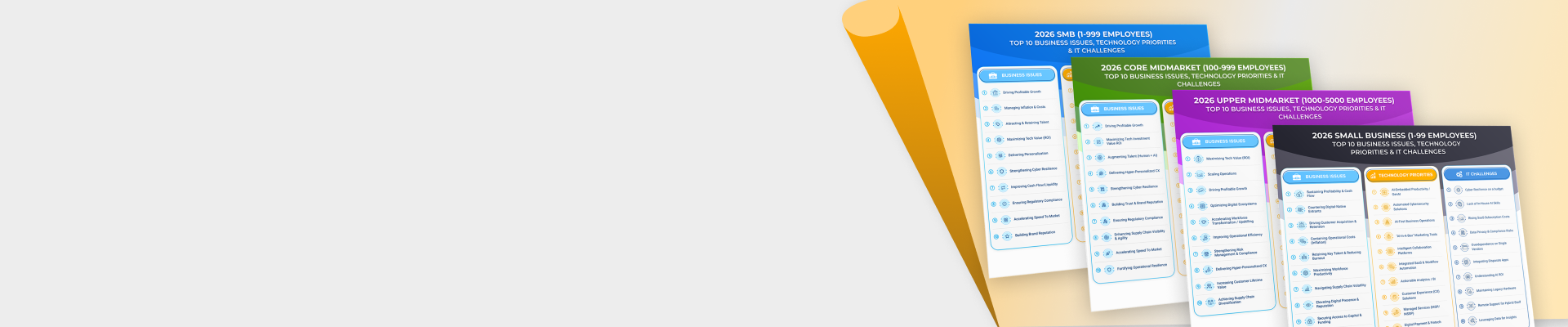
  • 2026 TOP 10 SMB BUSINESS ISSUES, IT PRIORITIES, IT CHALLENGES

    2026 TOP 10 SMB BUSINESS ISSUES, IT PRIORITIES, IT CHALLENGES

  • 2026 TOP 10 SMB PREDICTIONS

    2026 TOP 10 SMB PREDICTIONS

    SMB & Midmarket: Autonomous Business
    READ
  • 2026 TOP 10 PARTNER PREDICTIONS

    2026 TOP 10 PARTNER PREDICTIONS

    Partner & Ecosystem: Next Horizon
    READ
  • ARTIFICIAL INTELLIGENCE

    ARTIFICIAL INTELLIGENCE

    SMB & Midmarket Analytics & Artificial Intelligence Adoption
    LEARN MORE
  • IT SECURITY TRENDS

    IT SECURITY TRENDS

    SMB & Midmarket Security Adoption Trends
    LATEST RESEARCH
  • BUYERS JOURNEY

    BUYERS JOURNEY

    Technology Buyer Persona Research
    LEARN MORE
  • PARTNER ECOSYSTEM

    PARTNER ECOSYSTEM

    Global Channel Partner Trends
    LATEST RESEARCH
  • CLOUD ADOPTION TRENDS

    CLOUD ADOPTION TRENDS

    SMB & Midmarket Cloud Adoption
    LATEST RESEARCH
  • FUTURE OF PARTNER ECOSYSTEM

    FUTURE OF PARTNER ECOSYSTEM

    Networked, Engaged, Extended, Hybrid
    DOWNLOAD NOW
  • MANAGED SERVICES RESEARCH

    MANAGED SERVICES RESEARCH

    SMB & Midmarket Managed Services Adoption
    LEARN MORE

Techaisle Analyst Insights

Trusted research and strategic insight decoding SMBs, the Midmarket, and the Partner Ecosystem.
Anurag Agrawal

Brand Equity - A New Prescription for Cisco’s SMB Channel Partner Success

Cisco and the SMB market

Cisco has established an undisputed leadership position in the enterprise market. The company combines a widely-adopted and well-integrated portfolio of networking products with a highly-skilled (and paid) direct sales force to manage/expand its presence within major accounts.

The SMB market is a separate challenge. Here, buyers are less likely to require integration across multiple network components and more likely to emphasize price. They are also more likely to receive advice/management from channel partners, further reducing Cisco’s control over the acquisition process.

Against this backdrop, Techaisle’s SMB Channel Trends research illustrates the strengths and challenges Cisco must manage, as it looks to expand its share in the SMB segment.

Cisco Commands High Trust and Reputation

Within the channel community, Cisco enjoys a sound reputation and a high degree of trust. Techaisle’s latest SMB channel partner survey shows that 78 percent of Cisco’s SMB channel partners trust Cisco, a higher percentage than is registered by competitors such as HP and IBM. Nearly 70 percent of the partners believe that Cisco has quality products – again, the highest ranking recorded within the ‘hardware leader’ group including Cisco, HP, IBM and others. However, only 52 percent mention that Cisco has cutting edge technology, a percentage lower than that for both IBM and Microsoft. Moreover, 60 percent of Cisco’s SMB channel partners say that they Like Cisco, lower than corresponding rates for HP and Microsoft, only slightly higher than is found for IBM.

In its 2013 Annual report Cisco has written, “A substantial portion of our products and services is sold through our channel partners, and the remainder is sold through direct sales.” With specific reference to SMBs, Cisco wrote, “Generally, we define commercial businesses as companies with fewer than 1,000 employees. The larger, or midmarket, customers within the commercial market are served by a combination of our direct salesforce and our channel partners. These customers typically require the latest advanced technologies that our enterprise customers demand, but with less complexity. Small businesses, or companies with fewer than 100 employees, require information technologies and communication products that are easy to configure, install, and maintain. These smaller companies within the commercial market are primarily served by our channel partners.” Techaisle’s data shows that Cisco has attracted positive attention within this channel partner community, but that its technology and relationships do not leave it especially differentiated from competitors.

Technology Shift has Created SMB Messaging Challenges

In recent years SMB technology demands have shifted to cloud, mobility, analytics, social media, collaboration, managed services and virtualization. Cisco is seeking to capitalize on this market transition through the development of cloud-based product and service offerings that enable its customers develop and deploy their own cloud-based IT solutions.

In communications channel partners in the U.S. including those specializing in the SMB segment – Cisco has been steadily driving them to offer products and services that deploy cloud, mobility, virtualization, managed services and data center solutions. This is by no means an easy task as most SMB channel partners are being actively courted by competitive vendors that also want to grow their emerging technologies’ business. SMB channel partners selling advanced technologies have an average of 3.46 vendor partnerships which average jumps to 4.21 for Cisco SMB partners, a difference of 21 percent. With this increased contention for mind/market/wallet share, it can be difficult for Cisco to manage brand identity and its related messaging.

This difficulty is illustrated by study findings showing that of all the Cisco SMB channel partners, 44 percent consider Cisco to be their top partner. The other 56 percent mention Microsoft, Oracle, HP, IBM and several others. Within the VAR/SI community, Cisco’s share of preference is 48 percent and drops to 39 percent amongst the MSPs/SPs that are viewed as critical to the success of future cloud initiatives.

Cisco’s SMB Channel Partner Brand Equity

Techaisle believes that it is time for a new metric to represent presence (and opportunities for growth) within the SMB market. Techaisle refers to this second-generation measurement approach as Brand Equity Management. It is measured by a robust proprietary index, the Techaisle Brand Equity Score (BES-360).

Techaisle believes that it is important for IT vendors to measure their Brand Equity within SMB channel partners as well as SMBs. Techaisle’s Brand Equity Score, BES-360, helps to identify areas where IT vendors can improve to increase share of wallet. BES-360 is a KPI (Key Performance Indicator) that measures the strength of brand within a segment.

Cisco’s Brand Equity Score within its SMB channel partners is higher than most competitors – but lower than scores for both IBM and Microsoft. The implication of these findings is that even through Cisco has high brand equity amongst its channel partners; it is not necessarily true that its entire SMB-focused channel base is firmly wedded to Cisco’s game plan.

SMB Channel Partner Brand Equity Measurement– the New Prescription

Breaking down the data for Cisco, Techaisle’s study finds that almost 25 percent of Cisco’s channel partners have a Brand Equity rating of 80+. This group forms Cisco’s core partners. The data also shows that almost 35 percent of Cisco’s SMB channel partners have equity of less than 40. These are the partners that Cisco needs to work on.

Interestingly, small business focused channel partners give a higher Brand Equity Score to Cisco than mid-market focused channel partners. This is a segment that Cisco should address as the mid-market has become a battleground for most IT vendors and there is yet no clear dominant player.

Among all SMB channel partners of Cisco, VARs are actually driving up the Brand Equity Score. In fact 41 percent of VARs constitute the HBE (High Brand Equity) group. On the other hand, MSPs constitute only 20 percent. In order for Cisco to continue to grow its CMSP program and build on its initial successes, Cisco has to turn its attention to the MSPs that serve the SMBs to understand the key reasons for lower brand equity which when fixed can lead to better wallet share among MSPs.

Drilling down further into the data, Techaisle finds that Cisco is not doing better within the overall managed services community than it is within MSPs focused on cloud. A higher percentage of Cisco’s HBE partners are offering managed services to SMBs whereas a higher percentage of ABE (Average Brand Equity) partners are offering Cloud to SMBs. Cisco’s SMB cloud ambitions would benefit from moving some of these ABE cloud partners to HBE segment. The HBE segment offering cloud services need extensive training on cloud solutions to become more successful in offering cloud to their SMB customers. More than 40 percent of these channel partners are working with SMB customers that have private cloud. This may be good for Cisco in the short-term but it does not represent best practice in this segment, and it is misaligned with the ongoing acceptance of public cloud as a preferred IT delivery platform.

Product resale revenue is 43 percent for HBE partners as compared to 38 percent for ABE. Similarly, recurring revenue is 57 percent for HBE as compared to 61 percent for ABE. Naturally, this bodes well for Cisco’s current revenue as the High Brand Equity partners are driving higher revenues from products. However, if Cisco plans to increasingly promote service-centric partners then a lot more work is required to identify partners with higher services revenues and move them into the High Brand Equity segment.

Practicing the Prescription

Techaisle’s brand management work is anchored in the belief that if a vendor’s brand equity is good, then it can compete successfully with vendors with lower brand equity for sales of comparable products or services. Vendors with sound products/services but low brand equity will struggle to maintain parity with competitors that have higher brand equity, even if that vendor’s products/services are (somewhat) inferior. Hence, Brand Equity Score findings help indicate potential areas of expansion or exposure as vendors, like Cisco, assess their potential for expanding the footprint of their brands within the SMB channel partner community. The composition of Cisco’s BES across its channel indicates the core strength of its brand. Techaisle’s analysis indicates that Cisco has both strengths to build on and areas requiring focus as it moves to position its next-generation solutions (especially, cloud solutions) through its channel to the SMB market.

Anurag Agrawal

15 Keys: Winning Strategies of Successful SMB Cloud Channel Partners

Techaisle’s extensive primary research based study finds that there are quantitative, meaningful and actionable differences between channel partners who are successful in the business of selling Cloud and those that have not developed successful SMB Cloud practices.

The study to understand the winning strategies for selling Cloud to SMBs and to enable channel partners and their vendor suppliers build viable, high-growth SMB cloud businesses uncovered 15 best practices and critical differences between the activities and approaches of successful and unsuccessful SMB Cloud computing channel partners. These 15 keys are grouped into three areas.

Corporate priorities and allocations:

1.   There is no organizational recipe for cloud success
2.   Familiarity breeds success
3.   The “why” behind the cloud initiative often helps explain success
4.   Recurring revenue is not the sole indicator of cloud business success

Technology and offering definition:

5.   Cloud rewards suppliers that focus on providing best-of-breed
6.   Branded solutions are a key element of channel cloud success
7.   Industry expertise is a more important differentiator than technical prowess
8.   Cloud portfolios need to extend beyond basic IaaS, SaaS to also encompass verticals
9.   Data integration linking on-premise and cloud environments is non-optional
10. The future is hybrid, not private

Sales and marketing strategies and tactic:

11. The nature of sales relationship is a critical determinant of cloud success
12. Profit is driven by product/service balance
13. Partner-to-partner relationships are important to cloud business success
14. A distinctive approach to budget and resource allocation creates differentiation
15. Creating a cost-effective, scalable approach to lead generation is imperative

Detailed analysis included in the report highlights key differences between:

  • Channel partners that are very successful and are making money selling cloud to SMBs

  • Channel partners that have just achieved success and have started making money selling cloud to SMBs

  • Channel partners that are not yet successful and are not making money from their SMB cloud business


Working with SMBs, the channel and the vendor community, Techaisle has created research materials that help reduce time-to-success and increase the overall benefit of offering SMB solutions. Channel members looking to build a successful cloud business practice, or a vendor looking to accelerate channel success, can find details of the report here, or send us an email at This email address is being protected from spambots. You need JavaScript enabled to view it.

 
Anurag Agrawal

Dell Channels Power On

As uncertainty swirls around both the IT infrastructure needs of the SMB market and the channel that supplies these solutions, Dell’s channel team, led by Greg Davis and Bob Skelley, could not be more upbeat. And as Techaisle research shows, channel members of Dell’s PartnerDirect program continue to power on.

In a recent Techaisle study of channel partners selling Cloud, Mobility, Managed Services, Virtualization and Datacenter solutions to SMBs, 58 percent said that Dell is a trusted brand with 48 percent mentioning that Dell is a reputable brand. With today’s announcement on software competencies, Dell is looking to build on that presence with an expanded portfolio addressing essential (and high-growth) infrastructure software products.

Partner Voice

It is clear that Dell considers sales enablement and execution to be the keys to its channel success. The company exhibits very tight focus on issues like deal registrations and training. In qualitative interviews, Dell’s partners say that Dell is easy to work with. They report that Dell’s partner program is straightforward, with a low threshold to enter, reasonable certifications’ requirements and all training materials available online. Dell partner executive Marcus Lindqvist, Country Manager for Sweden’s Dustin AB highlighted the benefit of this approach when he shared with us his reasons for being upbeat on Dell: “deal registration, robust process that protects the partner investment in our engagement with Dell on a deal by deal basis. We register the deal at an early stage in the sales process, most deal registrations are approved, and from that point we are in the lead without any future discussions about other partners or Dell direct sales undercutting our work. Deal registration is done online with quick turnaround times.”

Echoing the sentiments, Daniel Serpico, President of FusionStorm, [partner of Dell] noted, “[there is] very real clarity around deal registration and partnering; there is significant value creation around integration and configuration and Dell has infused software and tools to win with Dell.”

Software Competencies

It was only a matter of time before Dell extended the PartnerDirect program beyond its roots, from enabling and incentivizing hardware sales to rolling out software competencies. Over the past year, with numerous acquisitions and the hiring of John Swainson to helm Dell’s software operation, Dell has launched an aggressive strategy to build scalable enterprise software offerings into its solution portfolio, with emphasis in the areas of datacenter and cloud management, information management, mobile workforce management, and security and data protection.

On September 3, Dell announced four new PartnerDirect software competencies, including:

  • Security: Includes identity and access management, as well as network, endpoint and email security

  • Systems Management: Includes client management, performance monitoring, Windows Server management, virtualization and cloud

  • Data Protection: Includes enterprise backup/recovery, virtual protection, application protection and disaster recovery]

  • Information Management: Includes database management, business intelligence/analytics,  applications and data integration, and big data analytics


Dell partners now have the flexibility to decide between reselling hardware only, software only (via resale or a referral fee program) or both hardware and software. As per Techaisle’s Marketview, worldwide SMB (1-999 employees) spend in 2016 for the above four competences will be US$11.1 billion. Combine it with traditional datacenter solutions that includes servers, storage, networking the market spend jumps to over US$40 billion by 2016. This is a huge opportunity indeed for Dell and its channel partners.

Best-of-breed Solutions

The latest Techaisle channel partner study found that 54 percent of channel partners prefer to offer best-of-breed solutions to their SMB customers, with 28 percent preferring single vendor solutions. The key to successfully addressing both preferences is to combine best of breed offerings under a single brand, allowing partners to also take advantage of integration and volume benefits. HP and IBM have been active in staking out this territory; with the September 3 announcement, Dell has signaled its intention to compete aggressively for leadership within the small and mid-market business market segment.

techaisle-solutions-preferred-by-smb-channel-partners

In the cloud infrastructure area, Dell’s partner program rests on three pillars - Cloud Builder, Cloud Provider and Cloud Enabler. For all three pillars, best-of-breed solutions take on an entirely different meaning as shown in another study recently conducted by Techaisle. The study was done to understand the Winning Strategies of Successful and Profitable SMB Channel partners selling cloud.

techaisle-smb-cloud-winning-strategies


The study revealed that channel partners that are comfortable and profitable with cloud solutions combine best-of-breed solutions and wrap them tightly under their own offerings & services. These channels have also begun to utilize reference architectures from their vendor partners.

Training as the Lead-in

Channel partners prefer to partner with IT vendors that have quality products and innovative technology solutions that solve SMB pain points. This presents a complex challenge to vendors like Dell: partners need suppliers to both address customer requirements (with innovative, reasonably-priced and easily-deployed technology that addresses SMB pain points) and partner business requirements, such as training, pre-and-post sales support, and lead generation. As the results of Techaisle’s research demonstrate, product training is particularly important in this context. Dell is clearly cognizant of this demand: Marvin Blough, executive director of Worldwide Channels and Alliances for Dell Software is on record as observing that “Trained partners sell four times more than their untrained counterparts,” and Dell is said to be on plan to deliver over 250,000 training sessions this year.

Techaisle has observed, however, that most vendor training focuses on product attributes, and does not address development of the skills (building and advising on infrastructure strategy and workload roadmaps, establishing effective sales tactics and compensation models, developing the services competencies needed by customers) required for VARs to migrate successfully to advising on and deploying hybrid infrastructure. These advanced management-level training offerings will be essential for vendor differentiation, especially for the complex hardware/software solutions that are at the core of Dell’s evolving strategy.

techaisle-smb-channels-support


Concluding Remarks

Clearly, building leadership in the SMB infrastructure market is an ongoing challenge: requirements continue to evolve, entrenched vendors have strengths and relationships that have developed over many years, and Techaisle’s research has found that trusted brand figures for Dell are lower than for some of its competitors. Its brand equity score (BES) among channel partners is also lower than its competitors. It seems clear, though, that Dell is aware of market requirements and willing to invest in its SMB market and channel success, rolling out training modules, integrating partners acquired through acquisitions and combining both hardware and software for end-to-end solution delivery.

Michael O’Neil, Consulting Analyst with Techaisle, notes that “Infrastructure delivery has become a very challenging issue for business partners. Hardware-only sellers are at a significant disadvantage in a market where buyers are looking for hybrid solutions involving both on-premise and cloud-based platforms that combine server, storage and networking hardware with system management and security software to build solutions that will seamlessly support application delivery, data protection and backup, and many other key operational objectives. By offering a wide range of product types, and focusing on making the selling motion as clean as possible, Dell is enabling partners to focus on customer requirements rather than product silos.”

Looking at Dell’s approach from a partner’s perspective, Daniel Serpico provided an apt summary: “Dell sales teams cover all markets, which allows us as a partner to be able to have discussions with the Dell account manager on a specific account or deal, giving us a counterpart that understand the end-customers actual requirements and needs. Both teams have a laser sharp focus on the customer and to jointly win the deal [supported by] shorter turnaround and quick responses from Dell.”

 
Anurag Agrawal

Cisco’s Master Move in Combining Cloud & Managed Services Channel Programs

channel partner - Techaisle - Global SMB, Midmarket and Channel Partner Analyst Firm - Techaisle Analyst Insights Cisco-Techaisle-Blog2-300x201 Announcement

Cisco has announced a new Cloud and Managed Services Program (CMSP) that integrates its currently existing Cloud Provider, Cloud Services and Managed Services Channel Programs (MSCP) into one. Besides streamlining incentives, discounts and payments for its partners, the program also aims to simplify pricing for Cisco-based cloud and managed services offerings. The program will also enable collaboration and sharing of complementary opportunities between partners through a microsite via Cisco’s partner portal. All partners are expected to transition to the CMSP by August 2013.

Techaisle Take

We believe that with one master move Cisco is strategically addressing the US$94 billion global SMB opportunity by 2016.

Techaisle’s global channel surveys have shown that Cloud, Mobility, and Managed Services Solutions together are changing the SMB channel landscape as these solutions are revolutionizing IT utilization by SMBs. The new paradigm would be the "3-in-1" Channels offering Mobility, Cloud, and Managed Services as a single offering. We first wrote about the 3-in-1 channel here. And now Virtualization is quickly becoming a potent arsenal in the SMB channel partners offerings.

Techaisle’s corresponding SMB research has consistently shown that SMBs want mostly integrated solutions to limit complexity and therefore seek partners that are capable of such deliverables but very few partners currently do so as they are all camped in either one or two solution corners and few seem to embrace a holistic solution view - and this is making SMBs unsure of overall benefits and desire to spend.

With its current announcement Cisco is removing some of the barriers by bringing channel partners serving managed services and cloud needs of SMBs under a common cluster. Since many SMBs want to obtain all services from a single provider, it is important for broad product/solution vendors to evaluate all their partners, seek and cluster partners based on where they are with regards to capabilities of delivering complete solutions and introduce programs to support development. As the dividing line between cloud and managed services is becoming thin, Cisco has just done it, that is, created a single program that should:

  • Enable channels to build more dynamic and serious partner-to-partner collaboration to collectively address complementary opportunities

  • Enable Cisco partners to add capabilities, such as, managed services to an existing cloud services

  • Attract newer partners to join Cisco program

  • Help current channel partners qualify and move up Cisco’s channel partner pyramid


The data on the right from Techaisle’s channel study (N=2851) shows that channels that serve channel partner - Techaisle - Global SMB, Midmarket and Channel Partner Analyst Firm - Techaisle Analyst Insights Cisco-blog-13-1024x644 the SMB segment are keen to offer multiple services that straddle cloud and managed services. Cisco’s new program should open up opportunity for its channel partners to offer both cloud and managed services using Cisco platforms.

If we look at the survey data at micro-level, we find that is a higher percentage of Channel Partners that are offering some type of Managed Services Solutions than they are offering Mobility Solutions or even Cloud Computing. The channels falling in the green columns will benefit immediately, those in the blue columns will find the program attractive but those within the red columns in the chart would be of immense importance.
Managed Services has been is of more critical importance for SMBs than Cloud or Mobility which is a key reason why there are more Managed Services partners than Cloud Computing providers. Additionally, Managed Services took root a few years back while Cloud Computing is a more recent phenomenon. Mobility has been in existence for a long time, however, it should be considered absolutely new in its current form with the availability & use of several mobile devices & other enabling technologies, namely Cloud & Remote Managed Services.

It is clear that Managed Services has been the most important offering for Channel Partners, as they evolved from a typical value added channel to offering break-fix services and remote managed services.

channel partner - Techaisle - Global SMB, Midmarket and Channel Partner Analyst Firm - Techaisle Analyst Insights Cisco-blog-2-219x300

The path being chosen by Channels to move from one offering to the next is strongly dependent upon their current offering. Those that are in the mobility space are moving to cloud, while those in the cloud are moving to managed services.

Understanding the channel dynamics and current offerings gives clues in the direction they will move. For those that are offering only one of the services there is a clear path to adding services. In fact Techaisle survey shows that the channels have chosen their path of selection.

Channels are also interested in offering mobility solutions, however, it is also clear that mobility has become possible due to cloud and managed services allowing employees to work from anywhere, anytime and from any device.


The responsibility now lies with both the channel partners and Cisco to make the program a success. However, there some other steps that Cisco needs to take as well.

  • Extend the reach of its Smart Care to cover cloud based services

  • Develop capabilities that not only work with Cisco's networking devices but also with client devices. Although it must be said that Cisco is addressing some of those needs through its partnerships with other vendors

  • Further the agenda on not only BYOD but also just BYO

  • Market the program aggressively. Channel partners are being courted and trained by many other vendors

  • Use the program to establish a strong presence in the datacenter space


With the latest move, Cisco may have begun to shift the tide in its favor more decisively.

Anurag Agrawal
Techaisle

Trusted Research | Strategic Insight

Techaisle - TA