• TRUSTED RESEARCH

    TRUSTED RESEARCH | STRATEGIC INSIGHT

    SMB. CORE MIDMARKET. UPPER MIDMARKET. ECOSYSTEM
    LEARN MORE
  • INTERWORK 2.0: THE AGENTIC FUTURE OF CONNECTED BUSINESS

    INTERWORK 2.0: THE AGENTIC FUTURE OF CONNECTED BUSINESS

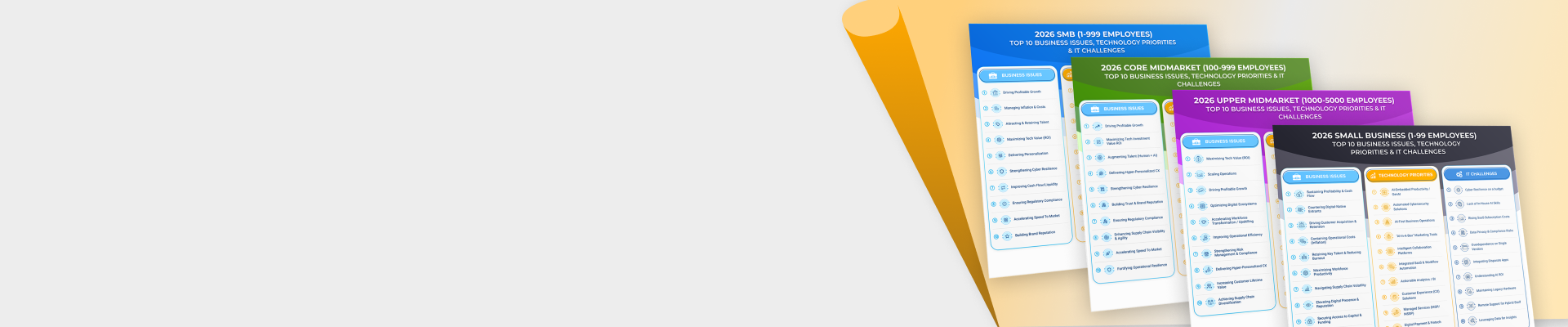
  • 2026 TOP 10 SMB BUSINESS ISSUES, IT PRIORITIES, IT CHALLENGES

    2026 TOP 10 SMB BUSINESS ISSUES, IT PRIORITIES, IT CHALLENGES

  • 2026 TOP 10 SMB PREDICTIONS

    2026 TOP 10 SMB PREDICTIONS

    SMB & Midmarket: Autonomous Business
    READ
  • 2026 TOP 10 PARTNER PREDICTIONS

    2026 TOP 10 PARTNER PREDICTIONS

    Partner & Ecosystem: Next Horizon
    READ
  • ARTIFICIAL INTELLIGENCE

    ARTIFICIAL INTELLIGENCE

    SMB & Midmarket Analytics & Artificial Intelligence Adoption
    LEARN MORE
  • IT SECURITY TRENDS

    IT SECURITY TRENDS

    SMB & Midmarket Security Adoption Trends
    LATEST RESEARCH
  • BUYERS JOURNEY

    BUYERS JOURNEY

    Technology Buyer Persona Research
    LEARN MORE
  • PARTNER ECOSYSTEM

    PARTNER ECOSYSTEM

    Global Channel Partner Trends
    LATEST RESEARCH
  • CLOUD ADOPTION TRENDS

    CLOUD ADOPTION TRENDS

    SMB & Midmarket Cloud Adoption
    LATEST RESEARCH
  • FUTURE OF PARTNER ECOSYSTEM

    FUTURE OF PARTNER ECOSYSTEM

    Networked, Engaged, Extended, Hybrid
    DOWNLOAD NOW
  • MANAGED SERVICES RESEARCH

    MANAGED SERVICES RESEARCH

    SMB & Midmarket Managed Services Adoption
    LEARN MORE

Techaisle Analyst Insights

Trusted research and strategic insight decoding SMBs, the Midmarket, and the Partner Ecosystem.
Anurag Agrawal

80 Percent of SMBs say Cloud Computing helps Grow Their Business

Techaisle’s recently completed US SMB Cloud Computing Adoption Trend research shows that Cloud computing – which IT suppliers often position as a means of reducing cost – is viewed by 80 percent of US SMBs as a solution that contributes to business growth. This is a huge departure from previous years when reducing cost used to be the overarching objective. It implies that cloud vendors and resellers should expand their marketing dialogue beyond the cost and CAPEX vs. OPEX motivations for cloud adoption and focus on ways in which cloud-based solutions enable SMBs to expand their reach to new markets and customers. In fact, over 40 percent of SMBs state that business agility and new capabilities are driving SMB cloud adoption.

This new trend of SMBs adopting cloud for business growth creates a “perfect storm” of opportunity for cloud computing. It satisfies the demand for new technology-enabled business capabilities such as mobility, social media, business intelligence/analytics and collaboration by providing a platform for supporting these initiatives. At the same time, as IT continues to struggle with cost control, cloud provides a clear means of reigning in CAPEX and reducing management costs.

Techaisle’s survey data shows that while there is broad recognition of the importance of business agility as a cloud benefit, a “mid-SMB” niche exists – stretching from 50-250 employees – in which IT productivity is the overarching cloud objective.

The key reasons for using cloud and benefits realized vary by size of business as well as issues that are of critical concern to SMB organizations. For example, small businesses (1-99 employees) focus tightly on business benefits: increased business agility is the most compelling cloud benefit, followed by obtaining capabilities that would have been cost/time prohibitive, reducing business process-related costs, and improving business staff productivity. Mid-market businesses (100-999 employees) also appreciate these outcomes – but the highest-ranked benefit of cloud is IT related, with “make our IT staff more productive” cited as a compelling cloud benefit by nearly 60 percent of mid-market businesses.

Drilling down into the different sizes of businesses the 1-9 micro-business group also places a high value on using cloud to reduce process costs, which makes a great deal of sense, since these tasks are likely not automated in any fashion today. Respondents in the 250-499 employee size segments prioritize use of cloud to increase business user productivity, while the 500-999 employee segments is focused on cloud delivery benefits such as capabilities/agility and IT productivity. Analyzing the data by BDMs and ITDMs, the study finds that these groups have different perspectives on how cloud delivers value to their companies.

Marketers can use this data to establish broad themes for the US SMB market, and then tailor their appeals to specific sub-segments based on demonstrated needs and expectations. For more details or to learn about Techaisle’s SMB Cloud Computing Adoption Trends report please contact This email address is being protected from spambots. You need JavaScript enabled to view it.

Anurag Agrawal

Let us talk Dell’s Commitment to Channels

Dusting off my notebooks (the notepad variety) I came upon some carefully documented notes of my conversations with Dell’s Channel team, in particular with Greg Davis, Vice President and General Manager of Global Commercial Channels.  Just reviewing the notes of the previous two years it hit me squarely in my face that Dell’s channels team has been on a restless pursuit of:

    • Simplicity,


    • Training & enablement,


    • Winning datacenter together with the channel, and


    • Partner profitability


Fall of 2011

Although Dell’s Partner Direct program was formally launched in 2007 with aggressive channel recruitment and courting happening in 2008, we will pick up on our conversations with Dell’s Greg Davis and Paul Shaffer, Executive Director Global Channel Marketing & channel partnerDemand Generation from the fall of 2011. Partner enablement, training, certification and integration of acquisitions had percolated to the top of the team's agenda. For an IT company which is notorious in selling direct, drastic measures were needed to become “one” with the channel. Dell delivered 75,000 training modules to its partners, 30 percent of Dell’s commercial business had started to come from channels and 58,000 registration deals were closed. With the acquisition of Force10 Networks Dell announced enhanced network certification programs and 130 premier partners got their certifications. Emphasizing that the training modules were working, Greg Davis had mentioned that top 10 partners who invested most in training had seen 110 percent growth in revenue. Fall 2011 was also the time when partners started seeing the first glimpse of gentle motivations from Dell to push deeper into healthcare segment and drive revenue from datacenter solutions. Inroads were being made into smaller partners for SMBs as much as national and larger partners.

Cloud Channel

During the same time period while Dell was building out its confidence and trust with the channels, dell-cloud-programenterprises and SMBs were moving to cloud, thus dis-intermediating the channel. Especially the VAR channels (which typically form the largest percent of channel partners of an IT Vendor) had been finding their traditional business models threatened by products and services that could be sold direct by a vendor over the Internet. To continue to adapt to the changing times and never taking its eye off the channel partners’ livelihood Dell launched cloud channel programs in the spring of 2012:

    • Cloud Builder,


    • Cloud Provider, &


    • Cloud Service Enabler


A technical services team was also put into place to help partners sell data center solutions namely, server and storage. Dell now had roughly 250 premium partners and had delivered 135,000 training modules in the year.

Work was far from complete. More acquisitions were taking place; these acquisitions had to be integrated and above all emerging market countries had to be targeted. Both Greg Davis and Amit Midha, President, Asia Pacific and Japan, Chairman, Global Emerging Markets underscored the fact that they were working to ensure a consistent channel engagement across every market covering:

    • Deal registration


    • Compensation neutrality


    • Conflict escalation process, and


    • Executive priority


Asia/Pacific

The channel commitment work in Asia/Pacific countries in our opinion is far from complete. There are still some major strides to be made, specifically in the Asia/Pacific region. By its own acknowledgement, Asia/Pacific is the fastest growing regions for Dell which requires a constant confidence and trust building process with the channels. In many of Techaisle’s analyst interactions with channel partners in 2012 in Asia/Pacific, it was found that channels had warmed up to Dell but some questioned Dell’s sincerity whenever bigger contracts were involved.

In both summer and fall of 2012 we asked Greg Davis and Amit Midha where they thought they were with consistency and confidence. Not only were they bullish but also recognized that they have some hills to climb. They were also candid that services remain a big component of any channel’s revenue mix and while typical services such as warranty, break-fix, and insurance were straightforward re-sale of Dell Services, partnering in consulting was a bit more challenging.

Summer 2012

By the summer of 2012, efforts were paying off, 62,000 deal registrations per quarter were coming through partners with 72 percent approval rate, 35,000 training modules were being delivered per quarter, the number of premier and preferred partners had jumped to 2500, Asia/Pacific channel programs were being strengthened, SonicWALL was integrated and specific courses were introduced on how to talk to a CIO, value of integrated datacenter. Above all social media training programs were launched for the benefit of the channels.

In late summer, in a conversation with Greg Davis and Bob Skelley, Executive Director, Global Certified Partner Program & Channel, they reiterated their commitment to make Dell “easy to work with” and restated their deep & maniacal focus on training and competencies. This focus resulted in 34 percent of global commercial business funneling through Dell channels, up from 30 percent in the fall of 2011. Number of deal registrations had jumped to 71,000 and an enhanced deal registration tool on mobile platforms was rolled-out. 47,000 training courses had been delivered in the quarter and Dell now had 113,000 channel partners. Initial focus on healthcare segment had resulted in a surge in end-user customers. A 40 percent growth in certifications was also achieved when compared with previous quarter. With the integration of Wyse, a desktop virtualization certification program was introduced. Dell channels had truly arrived and there was never a question of ever turning back.

One year later, Fall 2012

One year later, by fall of 2012, Dell had 130,000 channel partners, 35 percent of commercial business revenue was funneling through channels, 142,000 training courses had been delivered in the year, number of deal registrations had shot up to 65,000 and there were now 3600 preferred and premier channel partners. In the words of Greg Davis, “Dell has the most confident and competent channel partners in the world”. One year later, I saw an urgency to deliver with a profound focus on datacenters, systems management and cloud services. Virtualization was also beginning to take center stage. Kathy Schneider, Executive Director, Global Channel Marketing & Programs, drove home the point that she and her team were focused on driving best practices across four strategic pillars:

    1. Easy to do business with One Price and Sales Tools


    1. Win in the Enterprise using a comprehensive sales tool aptly named as Enterprise Master


    1. Training & enablement through expansion of training beyond Dell’s standard solutions to include social media


    1. Partner profitability through a simple, effective and rewarding incentives program


It has been a long way from direct PC selling to indirect solution selling. Real progress has been made. Dell’s channel executives are an end-to-end solutions empowering team for the channels. Not all channels will thrive but those that are equally committed to learn, adapt and practice will certainly succeed.

Anurag Agrawal
With contribution from Gitika Bajaj in Asia/Pacific


Davis Blair

Revisiting the Apple Predicament – What's Next?

This article from the New Yorker brings out several good points about how Apple has lost some of its luster over the past months, but is still in good shape on fundamentals, although it did drop to below $400B market cap a few days ago. As we noted in December, Apple was coming under criticism for not being able to scale to demand for the latest iPhone launch and had several other hiccups to deal with, including questionable worker conditions in China and that its principal manufacturer, Foxconn, was rumored to have begun discussions to pick up the slack by investing in new factories in Brazil.

On the other side, Apple was in a bitter legal fight with Samsung, an important supplier and competitor (frienemy), and could not get an injunction to stick after a lengthy lawsuit. A recent ruling in the case reduced damages awarded to Apple from $1.05B to $600M and the appeals process is ongoing. Another cause for concern in our opinion was that Apple had slipped to 6th place in the China mobile segment (the world’s largest and fastest growing major market), where local manufacturers Lenovo and Huawei were eating up share regardless of how much manufacturing was being done by Apple locally. Samsung leads the handset market in China, underscoring another competitive issue – in Korea, Apple is considered the most prestigious handset and it sells very well in the market, while Samsung is considered a premium brand in China due to early and broad Consumer Electronics investments by the Korean conglomerates; Samsung chief among them. China also has affinity with Korea based on the hope they can emulate the incredible economic growth shown by Korea over the last 25 years.

It was looking a little grim, but as noted at the time, Apple’s considerable war chest of almost half a trillion dollars was adequate to stave off short and medium term threats, however, as the above article notes, competitors are closing the gap and have introduced increasingly sophisticated models, most notably Samsung, with its’ Galaxy S line, which is seen as the strongest challenger to Apple’s technical leadership. Samsung’s newest version, the S IV is expected to be introduced this month, and in an example of raising the bar, is rumored to include “eye scrolling” technology.

Device OS Market Share History


The Big Picture

Apple has always been in a market crowded with well-funded competitors. Keeping the OS and architecture closed had major implications to the development of Apple, as seen above Apple never gained more than a 10-12% share of the OS market during the 1980-2000 boom of the PC market, which eventually forced them to accept both MS Office and Intel into their products to remain viable and while keeping a stubbornly loyal following for computing devices. It was really when Steve Jobs applied his design genius to a series of personal mobile devices starting with the iPod, which displaced the Sony Walkman, that Apple found a large enough consumer base to really explode onto the scene. iPhone followed with several versions and then the iPad was introduced in 2010 and the rest is history as they say…

The point here is that Apple became the largest technology company by using high-quality, high aesthetic design principles that allowed it to survive in the PC segment and applying them to a new category in the market: coveted personal technology devices that displace Phone, PC, Camera, Voice Recorder, Wristwatch, GPS, Media Player, Personal Planner, and other single use devices/apps combined into a single, small footprint high-tech productivity tool.

While Apple survived the PC Wars, many (including myself), gave them little more than niche player status and came close to counting them out altogether. The current situation is similar in a couple ways as Apple looks forward, but instead of Microsoft and Intel the arch rivals are Google and Samsung. The chart shows how WinTel dominated the PC segment from 1985-2005, squeezing Apple to 10% of the market. Currently, the rise of Mobile Computing brings hundreds of millions of new devices into the market, passing the threshold where Smartphones eclipse PCs in both volume and installed base within the next few years, creating an Android camp and an Apple camp. This has many implications for Apple, a few of which include:

Innovation: Apple needs to continue to innovate at a rapid pace. In the first 20 years of the PC market, consumers accepted a very high churn rate in both hardware and software categories because each generation was substantially more efficient and productive than the previous one. To prevent a backlash from consumers, Apple and other players are going to have to make fundamental improvements like very accurate voice recognition and new visual interfaces, not just new form factors.

Price/Performance: demonstrated Price/Performance increases in the bandwidth, applications availability and usability for less money will drive higher adoption. Again, looking back to lessons in the Personal Computer market, there was a long period of time where $2,000 was what the market expected to pay for a quality PC, and new models came out at a regular pace with faster CPU cycles, larger memory and storage subsystems, expanded OS and App capabilities, while keeping within the price range. This worked for a long time, until the market became too crowded and some vendors, led by Dell, overhauled their cost structure by cutting out the channel, using direct sales and a more tightly integrated and automated supply chain, giving back to the consumer in the form of lower prices - then it was a race to the bottom. Remember when the hot new vendor was eMachines?. The de-facto premium price-point that has been set for iPhones and iPads in the market is ~$700 and to maintain it there will be pressure to continue delivering more for the same price or less, as the slew of competitors undercut Apple’s premium.

How Many Form Factors?Cutthroat Competition: All of these segments are characterized by intense competition, and with Google’s ownership of both Android and Motorola brands, things become even more interesting in the handset segment. As Apple goes it alone against the whole market, similar competitive issues will appear as they did with PCs; many companies adding applications and value to a standard operating system (Android), diffusing the R&D costs among a whole ecosystem of suppliers while Apple concentrates on staying ahead of everyone by themselves. Ensuring a steady flow of high quality finished goods coming from China, concentrated among a relatively small group of suppliers, could also become an issue as trade friction, consumer backlash and other uncontrollable variables come into play in the global supply chain and domestic market.

As Apple looks to expand into Televisions there is a potential to tap into another ~$120B market, however, this is not going to be like the introduction of the iPhone; the market is mature and growing slowly, ironically dampened by the move to Tablet computers and Internet content, with a lot of heavyweight competitors led by #1 vendor in the world - Samsung. And Google is also waiting in the wings. Déjà vu all over again. If Apple can pull a rabbit out they may be able to add enough value to demand a premium in flat screen TVs, but that is going to be much easier said than done, the brand only goes so far when displayed next to a similar product priced 20% less on the Walmart showroom - Apple's retail success is based on a much different formula. No 35% margins here without the same kind of fundamental improvements discussed above; interface improvements, simple but deep integration with other devices and something like a super green carbon footprint on top of the demonstrated product superiority. Maybe.

Again, Apple proved very resilient as a survivor in the PC wars and many underestimated their staying power. The Market Cap remains near $400B and they have room to maneuver, it will just get harder over time, as it does for every company that gets to the top.

A Kumar

Software-Defined-Networking (SDN) Promise for SMBs

The Quotes

In a recent Techaisle depth-interview, the CIO of a Network Dependent (Techaisle’s proprietary Segmentation) Mid-Market business with 950 employees, 110 servers, 50 percent of servers virtualized, said, “Yes, I have heard about SDN. It’s a service where the architecture can be dynamically reconfigured or driven by a software personality layer as opposed to being hard-wired. Yes, we are planning to invest in it. Today the trend is towards intelligent networking. Software defined networking is something that can be used to automatically handle the traffic in the network. So, we can expect reduced costs from this type of a service. Brocade and Cisco are the two companies that have good solutions about these services.”

Although the awareness starts to fall rapidly for lower employee sized businesses Software Defined Networking (SDN) holds promise within the SMB and Mid-market business segments.

The IT Manager of a 70 employee size business with 4 servers using cloud, virtualization and managed services belonging to Network Increases Efficiency segment (Techaisle proprietary networking segmentation) said in another depth interview, “Yes, I have heard about SDN. I think it probably has an advantage of being much more flexible because of the different approaches that it has to dynamic network management. It has certain development tools that can be used to operate different network services. We, first of all need to investigate more about this technology and then see how well it fits in our infrastructure and only after we find enough information of it fitting the bill, should we implement it.”

The Opportunity

Techaisle’s research finds that 3 percent of small businesses and 11 percent of mid-market businesses globally have heard about Software Defined Networks. In the US the awareness jumps to 19 percent among mid-market businesses. SMBs that have some knowledge about SDNs, exhibit enhanced interest to adopt them in next 12-18 months with the objective of reducing their network related CAPEXs and managing their growth in cloud, mobility, big data technology usages.

Techaisle’s market sizing estimates that the SMB market for SDN will be US$204 million in 2016 growing at CAGR of nearly 81 percent. The market could open up more once the awareness and use cases increase.

The Concept

Software-defined networking (SDN) is a new approach to building computer networks that separates and abstracts the underlying networking elements thereby making the network more agile. SDN allows system administrators to quickly provision and program network connections on the fly instead of manually configuring policies. Administrators have programmable central control of network traffic without requiring physical access to the network's hardware devices.  Some even call this 'virtualizing the network', in the sense that each individual hardware switch may be part of multiple Layer 2 and Layer 3 networks and have its configuration and traffic management policies dynamically changed by the master network controller.

The Strides Made

Most of the large IT vendors have made very strong commitments to providing SDN solutions. Prominent among the larger IT vendors are:

    • Avaya with its Application Development Network (ADN)


    • Brocade with its Vyatta acquisition


    • Cisco with its Open Network Environment (ONE) and Cariden acquisition and funding of Insiemi


    • Dell with its Virtual Network Architecture (VNA)


    • HP with its Virtual Application Networks (VAN)


    • IBM with its Distributed Overlay Virtual Ethernet (DOVE)


    • Juniper with its Contrail Systems acquisition


    • VMware with its Nicira acquisition


Then there is OpenFlow, closely associated with SDN, an industry consortium of about 70 members, much like the Wi-Fi Alliance, a non-profit group that oversees development of the OpenFlow protocol. Both Google and Facebook have adopted OpenFlow (ONF) protocol within their data center operations. And most of the new switches from networking vendors like Arista, Brocade, Dell/Force10, Extreme, Huawei, HP, IBM, Juniper, NEC, and Pronto are OpenFlow compatible.

‘OpenDaylight’ Project which includes Big Switch Networks, Brocade, Cisco, Citrix, Ericsson, IBM, Juniper Networks, Microsoft, Red Hat, NEC and VMware, aims to provide an open-source software-defined-networking (SDN) controller, with vendor-agnostic interfaces thereby accelerating innovation around the SDN controller itself.

All of the above points to tremendous jostling for leadership roles and confusion in the market place. In spite of the confusion, SDN will continue to gain acceptance as enterprises will develop proof of concepts and the market itself will shake out the true leaders in the next 3-4 years.

The Promise for SMBs

SDN is ideally suited for the SMB segment with its promise of reducing complexity, costs and management along with easing implementation of cloud, mobility, social and big data connectivity.

Specifically within the mid-market segment, SDN will begin to pop-up in conversations among CIOs and IT Directors when they find their businesses faced with:

    • Increased public and private Cloud adoption


    • Network's inability to provide flexibility required to support virtualization, cloud, and mobility


    • Inefficient network and traffic management with the explosion of devices, worker locations and applications


    • Deployment of ultra-low latency networks to effect real-time transactions especially for the financial services vertical and those working on big data analytics


Announcement from HP

However, it must be said, that SMBs will look for product solutions with embedded SDN. We are already starting to see some solutions for the SMB market segment along the same lines. A new BYOD solution bundle was announced at HP’s recent Global Partner Conference. The solution includes end-to-end management software, switches with integrated wired and wireless capabilities, and is extended with a software-defined security solution. Ever bullish on the SMB market, HP believes this is an easily deployable, complete solution for a small to medium sized-business, very cost-effective and that provides investment protection with free switch software upgrades for OpenFlow support. Not only does it mean lower capex, but also less maintenance and less complexity.

Indeed, there’s a viable play for SDN for SMBs. A perfect use case could include implementation of virtual routed network on hypervisors, a web-based unified management application for provisioning, monitoring and control of the entire distributed network.

Technology complexity is continuing to increase for SMBs. And Techaisle is finding that majority of SMBs are required to re-architect and re-configure their networks to make a move to cloud or virtualization. Most of these SMBs take external assistance either from an IT Consultant or their channel partner. Nevertheless, they all have one refrain that reconfiguration is extremely complex, time-consuming and resource intensive.

Final Remarks

SDN is yet very complex even for the most cutting edge and aggressive technology adopter SMBs. It requires tools and structures that are still evolving. Managed services was introduced into the market several years ago but the RMM, PSA and other tools are still being refined so one should not expect the channels or the SMBs to jump onto SDN immediately.

sdn-smb-techaisle-blog

There will be a lag between the enterprise and the SMB adopters. However, once products are available with SDN capabilities, SMBs will adopt SDN faster than enterprises. The SMBs that have virtualized their servers and storage will be the early adopters. Looking at potential savings SDN will a difficult opportunity to pass up on by the SMBs.

Trusted Research | Strategic Insight

Techaisle - TA