










• TRUSTED RESEARCH

    TRUSTED RESEARCH | STRATEGIC INSIGHT

    SMB. CORE MIDMARKET. UPPER MIDMARKET. ECOSYSTEM
    LEARN MORE
  • COMMS, COLLAB, CONTACT CENTER

    COMMS, COLLAB, CONTACT CENTER

    SMB & Midmarket Buyers Collaboration, Contact Center Study
    LATEST RESEARCH
  • DATACENTER SOLUTIONS

    DATACENTER SOLUTIONS

    SMB & Midmarket Datacenter Solution Adoption Trends
    LATEST RESEARCH
  • PARTNER ECOSYSTEM

    PARTNER ECOSYSTEM

    CHANNEL PARTNER ECOSYSTEM TRENDS STUDY
    LATEST RESEARCH
  • BUYER JOURNEY

    BUYER JOURNEY

    SMB & Midmarket Buyers Journey Research
    LATEST RESEARCH
  • BUYER PERSONAS

    BUYER PERSONAS

    SMB & Midmarket Technology Buyer Persona Research
    LATEST RESEARCH
  • ARTIFICIAL INTELLIGENCE

    ARTIFICIAL INTELLIGENCE

    SMB & Midmarket Analytics & Artificial Intelligence Adoption
    LATEST RESEARCH
  • IT SECURITY TRENDS

    IT SECURITY TRENDS

    SMB & Midmarket Security Solutions Adoption Trends
    LATEST RESEARCH
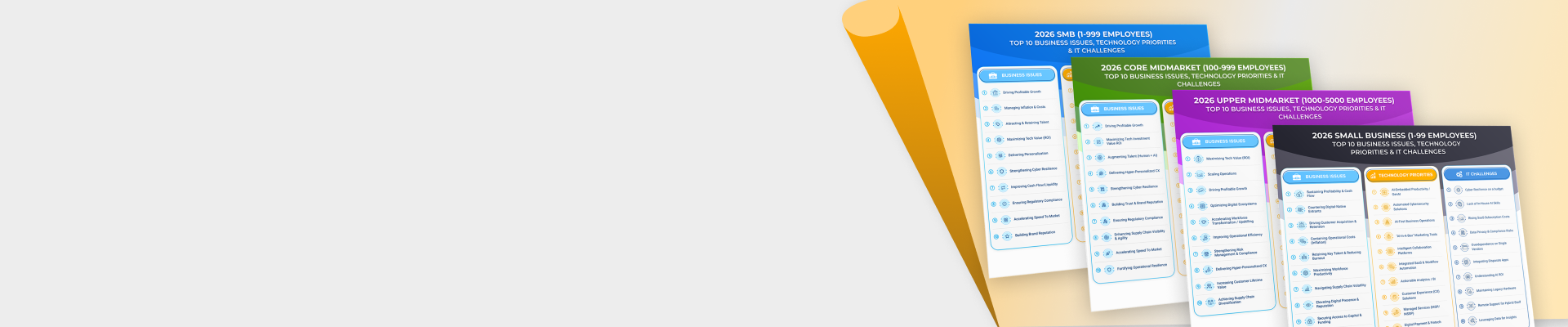
  • 2026 TOP 10 SMB BUSINESS ISSUES, IT PRIORITIES, IT CHALLENGES

    2026 TOP 10 SMB BUSINESS ISSUES, IT PRIORITIES, IT CHALLENGES

  • 2026 TOP 10 SMB PREDICTIONS

    2026 TOP 10 SMB PREDICTIONS

    SMB & Midmarket: Autonomous Business
    READ
  • 2026 TOP 10 PARTNER PREDICTIONS

    2026 TOP 10 PARTNER PREDICTIONS

    Partner & Ecosystem: Next Horizon
    READ

Techaisle Analyst Insights

Trusted research and strategic insight decoding SMBs, the Midmarket, and the Partner Ecosystem.
Anurag Agrawal

HPE ProLiant MicroServer Gen 10 Plus focuses on SMB Digital Transformation

On 11th March 2020, HPE announced its latest Small Business Solutions, leading with its next-generation HPE ProLiant MicroServer Gen10 Plus featuring remote management and security capabilities, with a choice of Intel® Pentium or Intel Xeon E processors. Solutions tailored for small businesses includes Office in a Box, Scalable File and Backup as well as Edge to Cloud for simplified access to cloud services.

Tough economic times bring investment decisions into sharp focus. The result is typically lower investment levels. It also sharpens medium- and longer-term priorities. That leads to smart investments. But also, investments made at this time become longer term drivers of investment for adjacent areas. Techaisle believes that the recent economic implosion acts as a catalyst for such action and change among SMBs. In a digital economy, SMBs are able to expand reach and engagement with customers and prospects, while also locating and integrating with suppliers to improve scale-out options. 79% of SMBs are on the road to digital transformation. The roadmap to successful digital transformation begins with the creation of a sound physical infrastructure - the ‘building blocks’ or ‘foundations’ of business infrastructure. Core infrastructure devices need to be kept in sync with the requirements of digital transformation initiatives; servers, storage, networking and security need to advance with the needs of the organization. The most advanced and transformative SMB firms are looking to improve IT sustainability – their ability to effectively manage IT delivery into the future – customer intimacy, operational excellence and IT’s speed and agility. And they are seeing better business outcomes than those which are not fully committed to the core physical infrastructure modernization.

HPE solutions lay the foundation for effective, agile and secure modernization.

First Impression

HPE ProLiant MicroServer Gen 10 Plus and companion offerings should be no-brainer for small businesses and channel partners. Techaisle data shows that 83% of SMBs consider technology contributing to business success but they also find technology to be kinetic, complex and risky. Regardless, 31% of small businesses want to modernize IT infrastructure and HPE offerings help in overcoming cost of implementation (34%) and security concern (32%) inhibitors of embarking on IT modernization initiative. Techaisle data also shows that a growing percent pf SMBs are using both on-prem and cloud servers, but hybrid is where they are headed. Workloads from public clouds are transitioning to hybrid clouds with 70% of small businesses are either implementing or planning to use basic hybrid cloud with workloads assigned to different cloud/on-prem environments. Techaisle segmentation data reveals that there is a higher demand for on-prem solutions within SMBs that are intermediate and mature cloud adopters as well as those who are in the basic and advanced IT maturity segments. HPE ProLiant MicroServer Gen10 Plus and Office in a box can also be easily adopted and deployed by the Pre-IT maturity segments and passive cloud followers.

HPE ProLiant MicroServer Gen10 Plus

About the size of a typical hardcover book (4.6-inch x 9.65-inch x 9.65-inch) and as quiet as a library (36db) the server packs enough power and storage for a small business prompting HPE to call it “small and Mighty”. The form factor size is volumetrically 3X less than that of Dell PowerEdge R240. As-a-service server pricing starts from at less than US$20 per month. The list price varies from US$$709 to US$899, for Entry to Performance level configurations.

Three key features of HPE ProLiant MicroServer Gen 10 Plus worth calling out are:

  1. HPE-exclusive silicon root of trust that provides 360-degree protection, detection and recovery from malicious cyberattacks. Techaisle SMB security adoption survey data shows that for 53% of SMBs cyberattack security is either the most critical or among the top three critical issues facing their organizations but 78% are not confident that they can recover from a cybersecurity incident. With HPE silicon root of trust they may have one less issue to worry about.
  2. HPE ILO 5 that delivers server health and operations insights with secure remote monitoring and management. With an average of 3.8 IT staff within upper-small businesses, SMBs need help in remote monitoring of IT infrastructure. Manageability is an important solution selection criterion for SMBs which typically have relatively small IT workforce but expansive IT/digital transformation goals. In this environment, it is essential that solutions work seamlessly and without a great deal of hands-on management.
  3. HPE InfoSight for Server that predicts and prevents IT disruptions before business operations are impacted. In the context of growth, cloud is seen as a means of facilitating expanded reach. And SMB cloud adopters are looking for capabilities that contribute to growth: 79% report that cloud enables them to be more agile in their business operations. Cloud built on a strong core technology is not only an essential IT infrastructure but it is also an imperative business infrastructure.

Pre-configured small business solutions on HPE ProLiant MicroServer Gen10 Plus

Office in a box: is a pre-configured solution that includes HPE ProLiant MicroSever Gen10 Plus with built-in security, Aruba Instant On (wireless access point), and HPE RDX removable disk system which can be scaled when required. It is ideal for very small businesses, small offices, small workgroups for up to 10 users. Office in a box also comes with Windows ROK (Reseller Option Kit) and storage controller. Pricing starts at US$125 per month. As per Techaisle’s SMB buyers’ journey and technology research data, nearly 2/3rd of small businesses use existing IT budgets and about 1/5th use CAPEX dollars for IT purchases. For these small businesses, HPE has a list prices for Office in a box. For example, a configuration consisting of MicroServer Gen10+, 4 1TB drives, iLO enablement, Next Business Day support, one Aruba WAP (wireless access point), the list price is approximately US$3,500 before discounts. Only 3% of small businesses have full-time IT staff (Source: Techaisle SMB and Midmarket research) and very small businesses manage workloads with a much smaller staff, typically comprised of IT generalists, and have limited infrastructure resources available for exploration. There is a very short line between acquisition and deployment of new technology and they have fewer chips to place on the table, and need to quickly reap return from their investments. Office in a Box is suitable for both segments of small business – with internally-managed-IT and un-managed-IT.

Scalable file and backup: is a pre-configured solution for centralized access to files for easy and secure collaboration. Scalable up to 16TB the solution enables secure onsite backup and recovery. Businesses are heavily invested in IT, with IT-dependent processes throughout their operations. This ubiquitous dependence on technology means that any systems failure will reverberate throughout all of a company’s daily operations. There is no way to disaster-proof against IT failure with insurance. Appropriate investment in IT backup/DRS, security processes, technologies and management strategies are the only ways to capitalize on the productivity benefits of IT without creating exposure to organizational paralysis in the event of a malware invasion, a hacker attack or an employee’s negligence or malfeasance. Techaisle’s SMB and midmarket security adoption trends research shows that 53% of small business and 48% of midmarket firms prefer less than 1 hour of backup recovery time. Not all SMBs have a backup/DRS strategy because they find it either too expensive or worry about security in the cloud or even find a solution too complex. HPE’s pre-configured solution addresses the needs and objections.

Edge to Cloud: is a pre-configured solution for remote office, branch office (ROBO) deployments. The solution includes optional cloud services for connectivity to the core data center.

Techaisle Take

Techaisle believes that the 34% of SMBs that are prioritizing growth are much more likely to thrive in today’s unpredictable economy than those that focus primarily on cost reduction or other ‘business as usual’ objectives. In the digital world, growth is more than simply increasing the top line. Today, growth is important to both expansion and to maintaining viability. Techaisle’s SMB research has found that the need to be more efficient in operations is the single most compelling reason for SMBs to embrace digital transformation. But there have to be points in the system where the capabilities of core infrastructure connect to the promised benefits of digital transformation solutions. The days of using lengthy, detailed cost analyses to justify new IT systems are disappearing in favor of a more agile approach in which businesses are encouraged to try new approaches and to rapidly wind down these initiatives if they do not deliver anticipated benefits. This may sound like a recipe for an out-of-control spending, but there are options that can protect the cost line. HPE ProLiant MicroServer Gen 10 Plus is one such options which is mind-blowing and should be a no-brainer.

Anurag Agrawal

WW Midmarket Hybrid Cloud penetration has reached 37 percent and 17 percent workload

Techaisle’s SMB and Midmarket Cloud adoption survey of 3200 midmarket firms and 3000 small businesses globally shows that hybrid cloud has been gaining momentum in small businesses, and is already entrenched in the mid-market firms. Hybrid accounts for 37 percent of cloud using mid-market businesses today, up 28% from 2018, and is expected to capture a lot higher proportion of new spending in the next one year. Midmarket firms are moving from public clouds to hybrid deployments with current hybrid workload at 17%, up from 12% in 2018. The current penetration is the highest in the US but planned usage is highest in Europe and Asia/Pacific.

There is no clear trend on the types of workloads on hybrid environments which shows that most deployments are very specific to a customer’s needs and application delivery partner’s expertise. Typical hybrid workloads include ERP, HR, CRM, finance, operations, IoT, analytics, AI, Machine Learning, SAP 4/HANA deployments, disaster recovery, critical event management, mass storage, cloud security and cloud database. Both Azure and AWS are being used by over 90% of US midmarket firms. Red Hat OpenStack is the preferred private cloud platform for 74% of US firms and Red Hat Cloudforms is the most used cloud management solution by 80% of US midmarket firms followed by VMware vRealize. Hypergrid, Morpheus, platform9 and Scalr are in low single digits. Ansible is being used by most channel partners for orchestration and automation.

Corresponding Techaisle survey with partners delivering cloud solutions to SMBs and midmarket customers reveals that Azure Stack is the most popular platform because of Microsoft’s proactive engagement, powerful and extensive Microsoft ecosystem as well as deep product portfolio. Google Anthos and AWS Outposts are picking up pace. Interesting trend is being seen from AWS partners who are beginning to use Google Anthos instead of AWS Outposts. These partners are not only working with AWS native solutions, but offering cloud solutions which are based around other cloud platforms like GCP, Oracle or Microsoft. Some of these partners prefer to use Anthos because they find it to be more of an open technology and AWS Outposts and can be easily implemented across other environments. It gives them a wider approach in terms of compatibility. They have to pay a fixed amount when using using Anthos which is variable with Outposts. None of the application delivery partners are using tools and technology from only a single vendor. The use of Open Source is dominant.

Another view of the data collected in the survey provides fascinating insight into the extent that midmarket cloud users are willing to align different delivery methods with internal requirements. Detailed analysis and segmentation of data reveals that there are pockets of demand (and overlap in these pockets) that exist for public, private and hybrid models in each segment.

Mid-market businesses
Looking at the mid-market segmentation, we see that larger firms are likely to employ multiple cloud delivery strategies. Overall, 51 percent rely on a single delivery approach for cloud, for example, 31 percent use only private. 29 percent of mid-market businesses use two different delivery approaches, with the most common being a combination of private and public models (but not in a hybrid setting). Firms in these overlap areas are not, on average, larger than those using a single delivery method, but they do face added complexity in that they tend to have more locations.

Anurag Agrawal

HPE boldly pivoting headlong into post-transactional market

Recently concluded HPE Discover was different than most other analyst events in more ways than one. First, HPE announced that it has strategically dived into the cloud swim-lane with a confident commitment to offer “everything-as-a-service” by 2022. HPE has plans to offer entire portfolio through a range of subscription, pay-per-use and consumption driven offerings. It is a bold strategy and in direct contrast to its key competitors. Second, the phrase “doubling down” on SMB and midmarket segments was not only mentioned in the HPE Global Partner Summit on the mainstage, but also in the keynote address by Antonio Neri as well as by several senior leaders in their respective breakout sessions thereby targeting SMBs as a priority market segment.

Specifically, “everything as a service” or XaaS is a very astute strategy. As we near the end this decade, it is clear that the IT industry as a whole has been transformed by cloud - by the way it alters IT service delivery options, by the way it impacts the economics & resource requirements associated with that delivery, and by the applications and business opportunities that cloud unlocks for user organizations of all sizes and in all industries. We are increasingly immersed in a post-transactional market, where discrete sales of individual products or integrated systems are replaced by agreements to provide IT capacity and business functionality “as-a-Service.”

No segment of the IT market is immune to this trend. Sales of on-premise hardware and software are declining and will continue to decline; at the same time, leading web service providers, including Microsoft (Azure), Amazon Web Services, Facebook, Google and Alibaba, are building 40 percent – 50 percent of all x86 servers for internal use, and then providing access to these servers on a pay-as-you-go basis, and software developers are creating systems on these platforms to automate sales, marketing, finance, HR and other business functions.

Inexorably, the market is shifting from one defined by discrete purchase-and-deploy deals aligned with refresh cycles to one where businesses take a hybrid approach that blends a limited number of on-premise assets with a growing range of on-demand services. Although hybrid IT is inherently a more flexible and efficient way of providing IT services needed by businesses, it still requires effective planning to address important issues within business operations. There are many different types of hybrid IT solutions, but they all belong to one of three basic types: Solutions that respond to IT department needs, and are adopted by IT professionals; Solutions that address business management needs, where demand is driven by non-IT executives or staff members; Solutions that change both business processes and IT systems, and which require IT/business management collaboration for effective delivery. And these are the hybrid market segments that HPE plans to address.

But Antonio Neri’s ambition is far bolder and greater than simply pivoting to an XaaS business model. His promise is for a zero-friction future in a cloud-less world for all segments of the market. A strong foundation has been laid with HPE GreenLake, an outcome of its acquisition of Cloud Cruiser in 2017. At HPE Discover, HPE extended its GreenLake offerings for the midmarket to enable quick deployments of workloads with right sized and ready to go storage, compute and virtualization. For midmarket firms which do not own and manage their own data centers, HPE has partnered with Equinix and CyrusOne to offer co-location solutions. To help its channel partners that serve the midmarket segment, HPE has developed a new quoting tool that reduces quote time from 18 hours to 15 minutes. In addition, HPE also announced the availability of HPE GreenLake Chatbot - an artificial intelligence driven, automated chatbot that quickly answers partners' HPE GreenLake inquiries.

Anurag Agrawal

HPE addressing SMB and channel partner Hybrid IT demands

Change is a constant in IT – and SMBs are struggling to keep up. A recent Techaisle survey of more than 1,500 US SMBs (1-99 employees) found that in 83% of SMBs, technology is more important today than it was 3 years ago. More than half of SMBs find that their technology adoption related pain points have increased in the last year. Cloud is supposed to provide SMBs with worry-free access to cutting-edge technology – but 59% of SMBs find cloud technology difficult to understand. SMBs need defined paths that help them to build business agility on top of a complex infrastructure foundation.

One area where support and guidance are most needed is hybrid IT. As per Techaisle’s SMB & Midmarket Cloud adoption study just over 80 percent of SMBs are either currently connecting or planning to connect their on-premise environments (including private cloud) to external public clouds. These firms are responding to a need to enable digital transformation of their business operations: more than 40 percent of SMBs (as per Techaisle’s SMB & Midmarket Digital transformation trends study) are already embracing an advanced ‘holistic’ digital transformation strategy; almost all have some type of digitization, digitalization or digital transformation initiative underway.

Because SMBs can’t support multiple parallel environments, hybrid IT took root earlier in this segment than within enterprise accounts. SMB progress on hybrid has been halting, though: there has been a serious disconnect between what the channel partners offer in terms of hybrid IT solutions to the SMBs and what the SMBs really are asking for. Techaisle has seen evidence of greater vendor focus on supporting the SMB transition to hybrid infrastructure, however. As an example, HPE with its recent SMB-focused product announcements is addressing SMB concerns by simplifying its SMB hybrid technology, supporting easier adoption, enabling hybrid deployments and paving a path for digital transformation.

HPE has released five hybrid cloud solutions leveraging Microsoft Azure services, and purpose-built ProLiant Gen10 servers featuring HPE Silicon Root of Trust capabilities for enhanced security. For the very small businesses, HPE rolled out a small office deployment solution that provides wireless networking in-a-box and includes secure servers as well as Aruba Wi-Fi access points and switches.

Trusted Research | Strategic Insight

Techaisle - TA