











• TRUSTED RESEARCH

    TRUSTED RESEARCH | STRATEGIC INSIGHT

    SMB. CORE MIDMARKET. UPPER MIDMARKET. ECOSYSTEM
    LEARN MORE
  • INTERWORK 2.0: THE AGENTIC FUTURE OF CONNECTED BUSINESS

    INTERWORK 2.0: THE AGENTIC FUTURE OF CONNECTED BUSINESS

  • 2026 TOP 10 SMB BUSINESS ISSUES, IT PRIORITIES, IT CHALLENGES

    2026 TOP 10 SMB BUSINESS ISSUES, IT PRIORITIES, IT CHALLENGES

  • 2026 TOP 10 SMB PREDICTIONS

    2026 TOP 10 SMB PREDICTIONS

    SMB & Midmarket: Autonomous Business
    READ
  • 2026 TOP 10 PARTNER PREDICTIONS

    2026 TOP 10 PARTNER PREDICTIONS

    Partner & Ecosystem: Next Horizon
    READ
  • ARTIFICIAL INTELLIGENCE

    ARTIFICIAL INTELLIGENCE

    SMB & Midmarket Analytics & Artificial Intelligence Adoption
    LEARN MORE
  • IT SECURITY TRENDS

    IT SECURITY TRENDS

    SMB & Midmarket Security Adoption Trends
    LATEST RESEARCH
  • BUYERS JOURNEY

    BUYERS JOURNEY

    Technology Buyer Persona Research
    LEARN MORE
  • PARTNER ECOSYSTEM

    PARTNER ECOSYSTEM

    Global Channel Partner Trends
    LATEST RESEARCH
  • CLOUD ADOPTION TRENDS

    CLOUD ADOPTION TRENDS

    SMB & Midmarket Cloud Adoption
    LATEST RESEARCH
  • FUTURE OF PARTNER ECOSYSTEM

    FUTURE OF PARTNER ECOSYSTEM

    Networked, Engaged, Extended, Hybrid
    DOWNLOAD NOW
  • MANAGED SERVICES RESEARCH

    MANAGED SERVICES RESEARCH

    SMB & Midmarket Managed Services Adoption
    LEARN MORE

Techaisle Analyst Insights

Trusted research and strategic insight decoding SMBs, the Midmarket, and the Partner Ecosystem.
Anurag Agrawal

Red Hat Architecting the Agentic AI Nervous System

Red Hat is fundamentally rewiring the way enterprise and midmarket organizations deploy Agentic AI. Rather than joining the crowded, highly commoditized race to build the smartest foundation model or the most clever standalone agent, Red Hat is aggressively architecting the underlying "metal-to-agent" infrastructure to deploy and manage agents across a hybrid cloud environment. It is actively building the secure, governed, and predictable execution environment necessary to move AI from experimental sandboxes to production hybrid clouds. By refusing to engage in the volatile framework wars - declaring strict agnosticism about whether a customer builds an agent using OpenAI-compatible APIs or customized open-source models - Red Hat positions itself as the universal enabler. It is providing the fundamental API foundation, the deployment mechanisms, and the non-negotiable operational guardrails required to run any agent in a production environment.
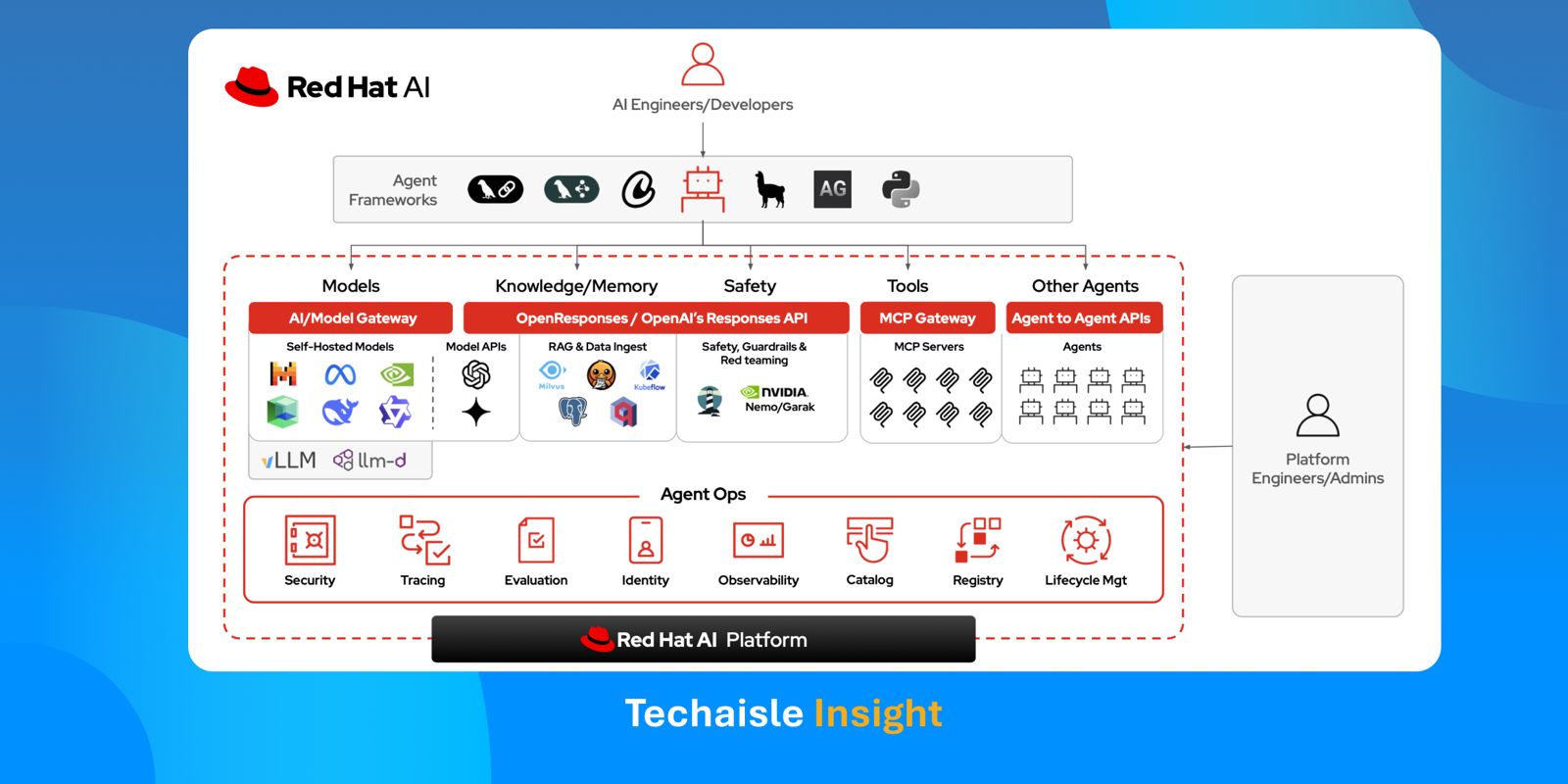
techaisle redhat agentic ai

The Era of Constrained Autonomy

This pragmatic infrastructure play arrives exactly as the business artificial intelligence narrative faces a massive reality check. The market is moving past the conversational parlor tricks of LLMs and rapidly entering the era of Agentic AI. However, as the focus shifts toward systems capable of reasoning, multi-step planning, and independent execution, businesses are slamming into a formidable wall of operational and compliance risk. It is one thing for an AI model to draft an email; it is an entirely different risk paradigm for an autonomous agent to access production databases, negotiate with other microservices, and independently execute infrastructure configuration changes. Unconstrained AI autonomy, lacking accountability and auditability, is not an asset; it is a critical operational liability. The winning narrative for the next 12 to 18 months hinges on what I call "constrained autonomy" - a concept Red Hat completely aligns with, building its strategy around the principles of being "autonomous with responsibility" and "autonomous with safety".
Anurag Agrawal

The Industrialization of AI: Red Hat Moves the Enterprise from Pilot to Production

Last year, we noted that the generative AI market was a chaotic mix of boundless promise and paralyzing complexity. Red Hat’s underlying strategy was a high-stakes bid to become the "Linux of Enterprise AI" by standardizing the inference layer and recasting its legacy motto to "any model, any hardware, any cloud".

Today, the enterprise AI landscape is rapidly shifting away from simple chat interfaces toward high-density, autonomous agentic workflows. Yet, despite massive investments, many organizations remain trapped in pilot purgatory, paralyzed by fragmented tools and highly inconsistent infrastructure. With the launch of Red Hat AI Enterprise, Red Hat AI 3.3, and the Red Hat AI Factory with NVIDIA, Red Hat is aggressively attempting to close this gap. By unifying the "metal-to-agent" stack, the company is moving AI from a series of siloed science projects into governed, repeatable enterprise software operations.

Here is a deeper analytical breakdown of how these new architectural pieces fit together, the economics behind them, and what this actually means for the broader market.

The Architecture of Agents: Open-AI compatible APIs Meet the Python Index

Standardizing agentic development requires more than just an API. Last year, Red Hat positioned Llama Stack and the Model Context Protocol (MCP) as the critical tools for standardizing developer APIs and tool-calling workflows. Now, they are introducing the Red Hat AI Python Index, bringing hardened, enterprise-grade tools like Docling, SDG Hub, and Training Hub into the fold.

Rather than creating a parallel or fragmented workflow, these components are entirely complementary. While Llama Stack serves as the API server for applications and MCP handles external tool calling, the Python Index acts as the centralized packaging mechanism for modularized model customization libraries. This gives developers a unified, predictable path from initial data ingestion through to production pipelines.

The generative AI market is currently a minefield for customers. Competitors typically force IT leaders into a difficult dichotomy: risk massive cost escalation and vendor lock-in with proprietary, API-first hyperscaler models, or brave the wild west of open-source models, fragmented tooling, and complex hardware requirements.

Tags:
Anurag Agrawal

Red Hat’s AI Platform Play: From "Any App" to "Any Model, Any Hardware, Any Cloud"

The generative AI market is currently a chaotic mix of boundless promise and paralyzing complexity. For enterprise customers, the landscape is a minefield. Do they risk cost escalation and vendor lock-in with proprietary, API-first models, or do they brave the "wild west" of open-source models, complex hardware requirements, and fragmented tooling? This dichotomy has created a massive vacuum in the market: the need for a trusted, stable, and open platform to bridge the gap.

Into this vacuum steps Red Hat, and its strategy, crystallized in the Red Hat AI 3.0 launch, is both audacious and familiar. Red Hat is not trying to build the next great large language model. Instead, it is making a strategic, high-stakes play to become the definitive "Linux of Enterprise AI"—the standardized, hardware-agnostic foundation that connects all the disparate pieces.

The company's legacy motto, "any application on any infrastructure in any environment", has been deliberately and intelligently recast for the new era: "any model, any hardware, any cloud". This isn't just clever marketing; it is the entire strategic blueprint, designed to address the three primary enterprise adoption-blockers: cost, complexity, and control.

techaisle redhat ai 650

The Engine: Standardizing Inference with vLLM and LLMD

Anurag Agrawal

Red Hat's Ecosystem Vision: A Collaborative Force Multiplying Innovation in the Hybrid Era

I first met Stefanie Chiras, Senior Vice President, Partner Ecosystem Success, Red Hat, in November 2021. During our conversation, she revealed her ambitious vision: to cultivate an empowering ecosystem that would propel Red Hat's growth and serve as a benchmark for the entire industry. She emphasized her commitment to a sustained, long-term journey. Over the ensuing four years, I witnessed her and her entire partner team's unwavering dedication to this mission, driving both incremental and generational changes that solidified the ecosystem's importance. Fast forward to today, April 2025, her endeavor has materialized; the concept of an ecosystem has become fundamental to Red Hat's strategic direction, and a significant number of leading IT vendors have integrated themselves into this network.

In today's dynamic IT landscape, the notion of a singular vendor providing all solutions has become anachronistic. The complexity of enterprise needs, the rapid pace of technological evolution, and the imperative for agility necessitate a collaborative approach —a vibrant ecosystem where innovation is a shared endeavor. Red Hat, an enterprise software company with an open source development model, has long understood this fundamental truth, and its evolved ecosystem strategy for 2025 underscores its commitment to fostering a robust network of partners that collectively drive customer success in the hybrid cloud and AI-driven future.

Far from being a mere add-on, Red Hat's ecosystem vision is deeply interwoven with its core strategy, serving as a critical engine for growth, adoption, and expansion. It's a testament to the company's open, inclusive, and collaborative culture, where the best ideas are recognized as emanating from within Red Hat and its vibrant communities, customers, and, uniquely, its partners. This foundational belief permeates every facet of Red Hat's ecosystem strategy, setting it apart from vendors who may view partnerships as transactional rather than transformational.

The Strategic Pillars of Red Hat's 2025 Vision: An Ecosystem-Centric Approach

Red Hat's overarching strategy for 2025 rests on three core pillars, each inextricably linked to the power of its ecosystem:

Trusted Research | Strategic Insight

Techaisle - TA