










• TRUSTED RESEARCH

    TRUSTED RESEARCH | STRATEIC INSIGHT

    SMB. CORE MIDMARKET. UPPER MIDMARKET. ECOSYSTEM
    LEARN MORE
  • INTERWORK 2.0: THE AGENTIC FUTURE OF CONNECTED BUSINESS

    INTERWORK 2.0: THE AGENTIC FUTURE OF CONNECTED BUSINESS

  • 2026 TOP 10 SMB BUSINESS ISSUES, IT PRIORITIES, IT CHALLENGES

    2026 TOP 10 SMB BUSINESS ISSUES, IT PRIORITIES, IT CHALLENGES

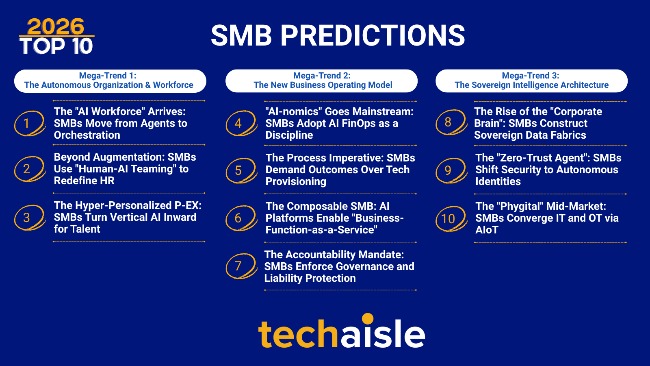
  • 2026 TOP 10 SMB PREDICTIONS

    2026 TOP 10 SMB PREDICTIONS

    SMB & Midmarket: Autonomous Business
    READ
  • 2026 TOP 10 PARTNER PREDICTIONS

    2026 TOP 10 PARTNER PREDICTIONS

    Partner & Ecosystem: Next Horizon
    READ
  • ARTIFICIAL INTELLIGENCE

    ARTIFICIAL INTELLIGENCE

    SMB & Midmarket Analytics & Artificial Intelligence Adoption
    LEARN MORE
  • IT SECURITY TRENDS

    IT SECURITY TRENDS

    SMB & Midmarket Security Adoption Trends
    LATEST RESEARCH
  • BUYERS JOURNEY

    BUYERS JOURNEY

    Technology Buyer Persona Research
    LEARN MORE
  • PARTNER ECOSYSTEM

    PARTNER ECOSYSTEM

    Global Channel Partner Trends
    LATEST RESEARCH
  • CLOUD ADOPTION TRENDS

    CLOUD ADOPTION TRENDS

    SMB & Midmarket Cloud Adoption
    LATEST RESEARCH
  • FUTURE OF PARTNER ECOSYSTEM

    FUTURE OF PARTNER ECOSYSTEM

    Networked, Engaged, Extended, Hybrid
    DOWNLOAD NOW
  • MANAGED SERVICES RESEARCH

    MANAGED SERVICES RESEARCH

    SMB & Midmarket Managed Services Adoption
    LEARN MORE

Techaisle Blog

Insightful research, flexible data, and deep analysis by a global SMB IT Market Research and Industry Analyst organization dedicated to tracking the Future of SMBs and Channels.
Anurag Agrawal

The Pragmatic Platform: How Cisco Webex Can Win the Midmarket with 'Connected Intelligence' and an Open Ecosystem

For years, midmarket businesses have been caught in a difficult position, forced to choose between the chaos of disparate, best-of-breed point solutions and the restrictive "walled gardens" of single-vendor platforms. At WebexOne 2025, Cisco presented a compelling third way: a vision of "Connected Intelligence" that delivers the power of a deeply integrated, cross-portfolio platform without the penalty of a closed ecosystem. This strategy, which Techaisle defines as Pragmatic Platformization, is a masterclass in meeting customers where they are. It is also the realization of a vision Techaisle first articulated in our 2018 white paper, "Interwork: the next step in connected businesses." In that analysis, we identified that the future of business IT would be defined by an 'Interwork platform' built from the interconnection of seven key domains, including "Connected security," "Connected collaboration," and "Connected insights." Cisco's 'Connected Intelligence' strategy is a powerful, real-world execution of this very concept. By combining the unique strengths of its networking, security, and collaboration portfolios while simultaneously forging deep, native integrations with its staunchest competitors, Cisco is building a platform that is uniquely suited to the heterogeneous and investment-conscious nature of the midmarket.

techaisl webex pragmatic platform 650px

The 'One Cisco' Advantage: From Metal to Model

The foundation of the Connected Intelligence vision is the "true platform effect" that comes from leveraging Cisco's entire technology stack. This is not just a marketing concept; it is an organizational and engineering reality that allows Cisco to solve problems that no pure-play collaboration or networking vendor can address alone.

The most powerful new expression of this is the extension of AI Canvas to the collaboration portfolio. Initially announced for networking and security, AI Canvas is a collaborative, AI-powered troubleshooting tool. Integrating collaboration data means an IT admin can now investigate a "poor call quality" complaint and see correlated data from the Webex application, the user's Meraki access point, and the underlying Catalyst switch, all in a single, "multiplayer" interface. AI Canvas can then identify the root cause—such as a misconfigured QoS policy—and suggest a fix that can be applied in minutes, not days.

Tags:
Anurag Agrawal

Architecting the Future-Ready Midmarket: Lenovo's New Playbook for IT Modernization and AI

The global midmarket is a tricky beast. It possesses the ambition and complexity of a large enterprise but often operates with the resource constraints of a small business. For years, Techaisle has maintained that the midmarket is the true battleground for technology growth, urging vendors to address its unique needs. In 2025, it seems that the call has been answered.

These organizations are the engine of economic growth. In fact, Techaisle data reveals this segment is a hotbed of high-growth businesses. Within the upper midmarket (1000-4999 employees), a remarkable 67% of firms are classified as high-growth, projecting an average revenue increase of 7.4% for the coming year. This trend continues in the core midmarket (100-999 employees), where 57% of firms are on a high-growth trajectory, anticipating revenue growth of 6.2%.

Yet, this very growth creates a constant tug-of-war between the need to modernize and the practical limitations of budget, time, and in-house IT expertise. According to Techaisle research, 78% of midmarket firms identify IT complexity as a significant obstacle to digital transformation, and 59% cite a lack of specialized skills as the primary barrier to adopting new technologies like AI. It is precisely this market reality that Lenovo is targeting with its latest suite of flexible solutions for SMBs and midmarket businesses.

Lenovo's announcement is not merely a product refresh; it is a strategic, cohesive, and channel-centric approach designed to de-risk technology adoption and accelerate time-to-value for the midmarket. The strategy is built on three interconnected pillars: simplified, pre-validated Business Solutions in a Box; accessible, outcome-focused AI Solutions; and flexible, intelligent Services & Platforms. This analysis will deconstruct these announcements to explore why they are differentiated and why they matter deeply to midmarket businesses and the channel partners who serve them.

The "In-a-Box" Approach – Building the Foundation for Growth

For SMBs and midmarket firms, unstable IT is like a cracked foundation—nothing innovative or ambitious can be built upon it. Yet, for years, midmarket IT teams have been forced to act as systems integrators, painstakingly assembling servers, storage, networking, and software into functional solutions. This process is time-consuming, fraught with risk, and diverts scarce IT resources from value-added projects. Lenovo’s "in-a-box" concept directly attacks this foundational pain point.

techaisle lenovo midmarket smb 650

Anurag Agrawal

Great Cybersecurity Paradox: Why Skyrocketing SMB Spending Isn't Translating to Readiness

SMBs are caught in a paradoxical cycle. While security solution adoption is poised for explosive growth, fundamental readiness remains dangerously low. The problem is not a lack of tools, but a critical deficit in process, expertise, and operational maturity.

Our latest Techaisle research into the SMB and midmarket security landscape has unearthed a troubling paradox. On one hand, the data forecasts explosive growth in the adoption of security solutions, with categories like Network Detection & Response and Managed Detection & Response (MDR) set to grow by 118% and 107%, respectively. Yet, this rush to acquire technology stands in stark contrast to the segment’s profound lack of foundational preparedness, creating a dangerous gap between investment and actual security posture.

This is not a minor oversight; it is a gaping vulnerability that technology alone cannot patch. A staggering 83% of SMBs conduct no formal security awareness training, and 46% have no established security protocol to follow in the event of an incident. The consequences are severe, with the average financial loss from a security incident for an SMB now standing at $1.6 million. This figure is a clear indictment of a reactive, tool-centric approach.

The issue is not a failure of technology itself, but a failure of operationalization. SMBs are buying the hardware and software but critically lack the frameworks and human capital to wield them effectively. With 51% admitting they have no formal risk frameworks, it is evident they are navigating a complex and hostile threat landscape without a map.

techaisle great cybersecurity paradox 650px

Deconstructing the Readiness Gap

The core of this paradox lies in three interconnected areas where SMB perception and reality diverge sharply:

Anurag Agrawal

A Techaisle Analysis: HP's Threat Insights Report Reveals Why the Old Rules of Cybersecurity No Longer Apply

The cybersecurity perimeter is not just porous; it is an illusion. And the endpoint is no longer the last line of defense; it's the primary battleground. This is the stark reality underscored by the latest HP Threat Insights Report. For years, the industry has been locked in an arms race centered on novelty, but our analysis of HP's data, combined with exclusive follow-up Q&A, reveals a more insidious and challenging truth. The most effective adversaries are no longer focused on reinventing the wheel; they are perfecting it. They are refining age-old techniques with such precision that they systematically dismantle traditional, detection-based security postures.

This evolution marks a critical inflection point for businesses of all sizes. The core tenets of cybersecurity—user training, anomaly detection, and signature-based scanning—are being pushed to their limits. This is not an incremental change, but a paradigm shift that demands a strategic rethinking of endpoint security, moving from reactive detection to proactive isolation.

techaisle hp security insights writeup

The Polishing of Deception: The End of the "Suspicious Link" Era

For over a decade, the cornerstone of user-facing security has been awareness training to identify the proverbial "suspicious link." HP's research confirms this era is drawing to a close as attackers deploy "ultra-realistic" and "highly polished" social engineering lures. These include fake PDF invoice readers that perfectly mimic legitimate applications or malicious cookie banners on spoofed travel websites that exploit the user's conditioned habit of "clicking through" to access content.

Trusted Research | Strategic Insight

Techaisle - TA