










• TRUSTED RESEARCH

    TRUSTED RESEARCH | STRATEGIC INSIGHT

    SMB. CORE MIDMARKET. UPPER MIDMARKET. ECOSYSTEM
    LEARN MORE
  • COMMS, COLLAB, CONTACT CENTER

    COMMS, COLLAB, CONTACT CENTER

    SMB & Midmarket Buyers Collaboration, Contact Center Study
    LATEST RESEARCH
  • DATACENTER SOLUTIONS

    DATACENTER SOLUTIONS

    SMB & Midmarket Datacenter Solution Adoption Trends
    LATEST RESEARCH
  • PARTNER ECOSYSTEM

    PARTNER ECOSYSTEM

    CHANNEL PARTNER ECOSYSTEM TRENDS STUDY
    LATEST RESEARCH
  • BUYER JOURNEY

    BUYER JOURNEY

    SMB & Midmarket Buyers Journey Research
    LATEST RESEARCH
  • BUYER PERSONAS

    BUYER PERSONAS

    SMB & Midmarket Technology Buyer Persona Research
    LATEST RESEARCH
  • ARTIFICIAL INTELLIGENCE

    ARTIFICIAL INTELLIGENCE

    SMB & Midmarket Analytics & Artificial Intelligence Adoption
    LATEST RESEARCH
  • IT SECURITY TRENDS

    IT SECURITY TRENDS

    SMB & Midmarket Security Solutions Adoption Trends
    LATEST RESEARCH
  • 2026 TOP 10 SMB BUSINESS ISSUES, IT PRIORITIES, IT CHALLENGES

    2026 TOP 10 SMB BUSINESS ISSUES, IT PRIORITIES, IT CHALLENGES

  • 2026 TOP 10 SMB PREDICTIONS

    2026 TOP 10 SMB PREDICTIONS

    SMB & Midmarket: Autonomous Business
    READ
  • 2026 TOP 10 PARTNER PREDICTIONS

    2026 TOP 10 PARTNER PREDICTIONS

    Partner & Ecosystem: Next Horizon
    READ

Techaisle Analyst Insights

Trusted research and strategic insight decoding SMBs, the Midmarket, and the Partner Ecosystem.
Anurag Agrawal

SMB and Midmarket Firms Are Buying More Meeting-Room Hardware as They Grow, Not Less

Hardware spend rises as companies scale, which runs against the assumption that software absorbs everything. Techaisle's study of 3,980 organizations shows where the laptop-and-dongle room breaks, what replaces it, and why the equipment is no longer there to show a meeting but to record one.

Almost every company starts the same way. A screen, a dongle, and whoever's laptop is in the room. It costs nothing, and it works well enough, which is why nobody ever decided to do it. Then, somewhere between the fifth room and the fiftieth, companies stop, and in Techaisle's survey of 3,980 organizations, the switch shows up in spending. USB add-ons for the laptop-and-dongle room fall to 18% at the top of the midmarket, the lowest priority on the whole list, while AI cameras, ceiling microphones, and sensors climb fast. The question worth answering is what they buy instead, and what forced the switch.

What the midmarket is actually buying

All-in-one video bars lead at every size, from 42% in the smallest firms to 56% in the largest, because they work the moment you switch them on. That part is expected. The next tier of spending is less so. AI cameras that follow the speaker rise from 21% to 43%. Ceiling microphone arrays climb from 12% to 37%. Sensors that count people and track how a room is used go from 8% to 31%.
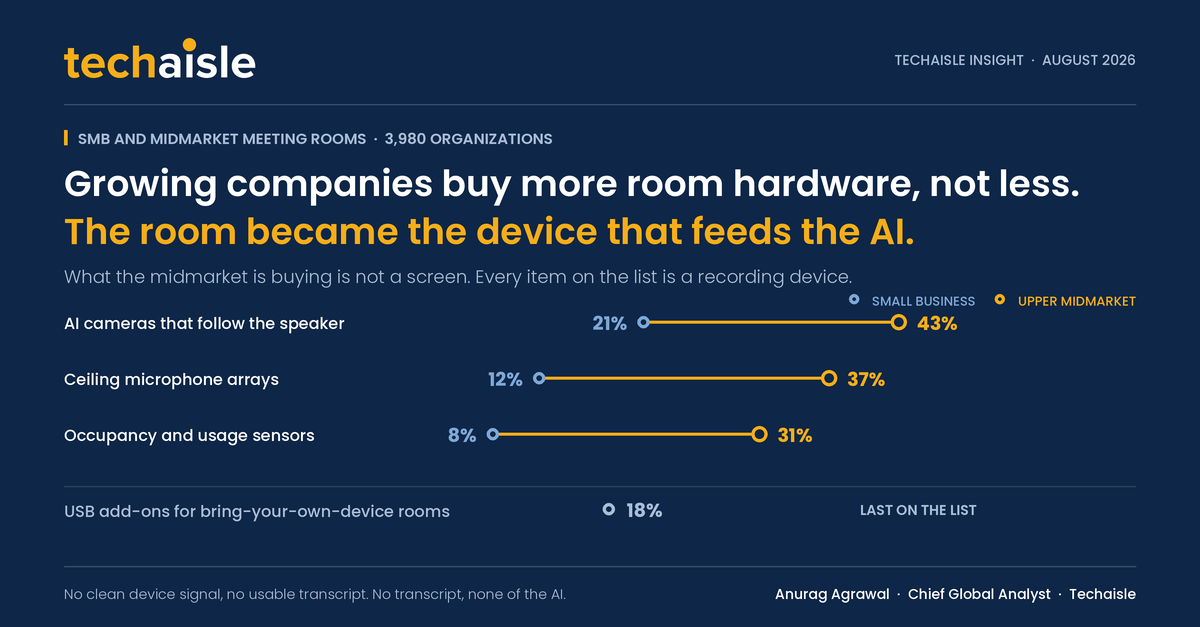
Techaisle chart showing meeting room device priorities rising with company size: AI cameras from 21% to 43%, ceiling microphone arrays from 12% to 37%, and occupancy sensors from 8% to 31%, while USB add-ons for laptop-and-dongle rooms sit last at 18%.

Anurag Agrawal

The Meeting Is the Most Cancelable Thing You Sell: Where SMB and Midmarket Collaboration and Video Stickiness Actually Live

Meetings are the flagship surface and the first line item cut when cash tightens. Techaisle's study of 3,980 SMB and midmarket organizations identifies the real moat in something less glamorous: the phone number, the call history, and the ability to find what was decided.

A standalone meetings subscription is the easiest thing in the software stack to cancel. It is duplicated free inside the productivity bundles most firms already pay for, it carries an obvious monthly price, and nothing breaks when it disappears. In Techaisle's survey of 3,980 small business and midmarket organizations, that fragility is not a small-business quirk. It is the structural weakness sitting at the center of the collaboration category, and most meetings-first roadmaps are aimed in the wrong direction because of it.

Start with what no longer wins. File sharing, messaging, and productivity-suite integration still dominate the list of capabilities buyers rate critical, at 46% to 56%. That is precisely why they no longer close deals. A capability that every competitor ships and every bundle includes is table stakes, not differentiation. The base of the collaboration stack has commoditized, and buyers now assume it the way they assume dial tone.

The instinct, when the base commoditizes, is to pile more features into the flagship. Another AI summary, another whiteboard, another in-meeting widget. The data says that instinct is a treadmill. Voice, video, and chat are universal across every company size. Adding a fourth in-meeting feature to a market that already has three of everything does not move a buyer, because the buyer's pain is no longer inside the meeting. It sits on either side of it.

techaisle meetings

The two unmet needs: find what was said, and meet less

Two problems rise as firms scale, and neither is solved by a better meeting.

Anurag Agrawal

Revolutionizing the Workplace: Cisco Webex’s AI Innovations

My journey with Cisco and its Webex product began when I established Techaisle. At that time, Zoom was not even on the horizon. Initially, GoToMeeting was my go-to platform for presentation collaboration, but we eventually transitioned to Webex. However, we switched as the Techaisle team grew and MS Teams was introduced. In the past two years, I have expanded my toolkit to include Webex, the Webex Desk Pro, Webex Desk Mini, Webex camera, and most recently, the Bang & Olufsen Cisco 950 wireless earbuds. Besides Webex, I have used these devices with various platforms, including Zoom, Teams, and Google Meet. The interoperability has been impressive, and the performance of the Webex devices has been outstanding.

But I am getting ahead of myself.

The recent WebexOne event marked a significant shift and showcased a transformed platform. Webex has shed its old skin and emerged as a rejuvenated entity steered by a team of exceptional executives. 

The digital revolution has reshaped the business landscape, with hybrid work becoming a cornerstone of modern corporate culture. Yet, the transition to hybrid work models is not without its challenges. Many organizations struggle to foster a consistent work culture and build high-performing teams in this new environment. Technological disparities, such as inconsistent internet connectivity, further complicate matters, impacting workforce productivity and inclusivity. This digital divide can lead to a sense of exclusion among employees facing connectivity issues, undermining the inclusivity of hybrid workplaces.

Webex is dedicated to helping organizations overcome these obstacles. By integrating Artificial Intelligence (AI) into its platform, Webex has enhanced its efficiency, user-friendliness, and audio, video, and language processing capabilities. The platform now boasts advanced noise cancellation, speech-to-text conversion, automatic camera framing, facial recognition, and real-time automatic language translation, making meetings more accessible and productive. These AI-driven enhancements were unveiled at the WebexOne 2023 event.

webexone23

Anurag Agrawal

US SMB and Midmarket Video-collaboration adoption may increase by 184 percent

Techaisle data shows that the percent of US SMBs using web-video conferencing solutions is likely to increase from 38% to 89%, a change of 184%. It is common knowledge that cloud is being adopted by SMBs and midmarket businesses for business agility and video-conferencing is playing an increasing role in contributing to SMB agility - decision agility, productivity agility, customer agility and innovation agility - for high-growth and innovative businesses. Businesses without modern collaboration solutions are scrambling to catch up with those that are already capitalizing on the benefits video-conferencing solutions. As new adopters are learning from firms that have already made early investments in the technology, Techaisle is seeing reasons for launching collaboration initiatives rapidly evolve. A comparison of early adopters to firms that are just now embracing advanced collaboration systems finds that the pace set by early adopters is forcing other SMB firms to invest in collaboration solutions to address current and future market issues.

This next generation of SMBs & midmarket business collaboration solution adopters is responding to specific pain points, more than their predecessors and video-conferencing is figuring in their collaboration strategies, specifically because:

• They cannot coordinate meetings involving employees in multiple locations
• Customer satisfaction is declining
• The pace of decision making is too slow
• Email is not an adequate means of connecting staff with each other and with customers
• They are trailing competitors and want to catch up
• They have to keep pace with market uncertainty and want to find new avenues for business viability and growth

Survey data finds that these firms have begun using video-collaboration solutions as a reaction to business problems that are preventing them from achieving their business objectives of growth, productivity, time to market, customer retention and operating cost reduction.

Trusted Research | Strategic Insight

Techaisle - TA