• TRUSTED RESEARCH

    TRUSTED RESEARCH | STRATEGIC INSIGHT

    SMB. CORE MIDMARKET. UPPER MIDMARKET. ECOSYSTEM
    LEARN MORE
  • BUYER JOURNEY

    BUYER JOURNEY

    SMB & Midmarket Buyers Journey Research
    LEARN MORE
  • BUYER PERSONAS

    BUYER PERSONAS

    SMB & Midmarket Technology Buyer Persona Research
    LEARN MORE
  • ARTIFICIAL INTELLIGENCE

    ARTIFICIAL INTELLIGENCE

    SMB & Midmarket Analytics & Artificial Intelligence Adoption
    LEARN MORE
  • DATACENTER SOLUTIONS

    DATACENTER SOLUTIONS

    SMB & Midmarket Datacenter Solution Adoption Trends
    LEARN MORE
  • INTERWORK 2.0: THE AGENTIC FUTURE OF CONNECTED BUSINESS

    INTERWORK 2.0: THE AGENTIC FUTURE OF CONNECTED BUSINESS

  • 2026 TOP 10 SMB BUSINESS ISSUES, IT PRIORITIES, IT CHALLENGES

    2026 TOP 10 SMB BUSINESS ISSUES, IT PRIORITIES, IT CHALLENGES

  • 2026 TOP 10 SMB PREDICTIONS

    2026 TOP 10 SMB PREDICTIONS

    SMB & Midmarket: Autonomous Business
    READ
  • 2026 TOP 10 PARTNER PREDICTIONS

    2026 TOP 10 PARTNER PREDICTIONS

    Partner & Ecosystem: Next Horizon
    READ
  • IT SECURITY TRENDS

    IT SECURITY TRENDS

    SMB & Midmarket Security Adoption Trends
    LATEST RESEARCH
  • PARTNER ECOSYSTEM

    PARTNER ECOSYSTEM

    Global Channel Partner Trends
    LATEST RESEARCH

Techaisle Analyst Insights

Trusted research and strategic insight decoding SMBs, the Midmarket, and the Partner Ecosystem.
Anurag Agrawal

Channel Imperatives for 2020 - accelerating transformation

Inexorably, the market is shifting from one defined by discrete purchase-and-deploy deals aligned with refresh cycles to one where businesses take a ‘hybrid IT’ approach that blends a limited number of on-premise assets with a growing range of on-demand services. Recent work by Techaisle shows that the need for updated understandings of channel management imperatives has expanded beyond the tactical questions of sales or management metrics or marketing activities. This work has identified twelve fundamental areas where conventional wisdom has not kept pace with the business needs of the channel. In each area, policies based on conventional wisdom will lead channel organizations away from the practices needed to compete successfully in the post-transactional cloud market.

The channel transformation accelerator enablers, as laid out in the point-of-view white paper document (free), Channel Imperatives for 2020: The Changing Channel for a Post-transactional IT Market will be gut-wrenching but necessary. [Click on the image below to download the white paper or click on the link]. Within the white paper, Techaisle has developed the “Conventional Wisdom vs. Emerging Imperatives” table to illustrate ways that channel organizations must alter basic attitudes towards the business of the channel in order to be successful in the current and future IT market. 

techaisle pov channel imperatives for 2020 resized 

Anurag Agrawal

SMB Channel and the Cloud - success increasing and coalescing around few factors

In the report “The SMB Channel and the Cloud”, Techaisle uses findings from in-depth surveys with US-based channel firms deriving at least 50% of revenue from sales to SMBs to illuminate conditions within the US SMB cloud channel, and to develop perspectives that suppliers (and the channel itself) can use to construct successful cloud channel strategies.

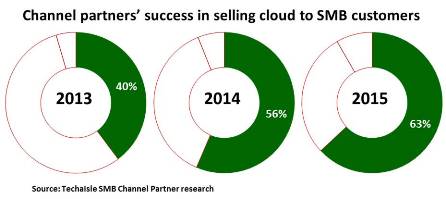
From 2013 to 2015, the percentage of SMB-focused channel partners that have become very successful in selling to SMBs has increased from 40% in 2013 to 63% in 2015. On the flip side, the percent of partners who are unsuccessful has increased by 60%. MSPs are the most successful partner type in cloud, while consultants are struggling to gain traction in the cloud market.

smb channel cloud success trend techaisle

Highlights from the research include:

Anurag Agrawal

Managed services in the SMB channel

What is the current state of managed services in the channel?

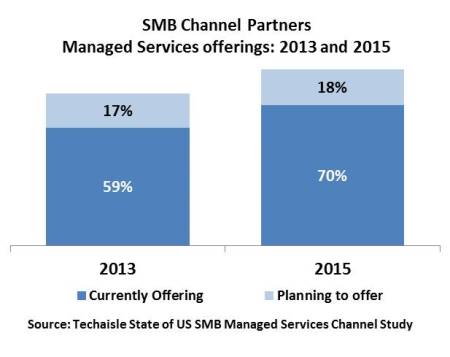
Techaisle’s SMB global channel partner research shows that in the US 71% are currently offering one or more managed services solutions and another 18% are planning to offer managed services within one year. Techaisle believes that the channel is at the beginning of a migration from generalist to specialist firms that will play out over the next few years. With that in mind, it is fair to ask, how widespread is managed services delivery today?

Figure below, taken from Techaisle’s US SMB Managed Services Channel Study illustrates the proportion of channel partners that currently offer managed services to SMBs. Unsurprisingly, 100% of MSPs report that they do so. What might be more surprising is the extent to which channel members with other core business models provide managed services to their SMB clients. Roughly two-thirds of VARs and SPs, and 80% of SIs, offer managed services to SMB customers. IT consultants are less likely to do so, but here, too, one-third of firms are already using managed services delivery to support SMB clients.

techaisle-us-smb-channel-managed-services-current-planned-resized

Above data demonstrates that there has been and continues to be substantial take-up in managed services as a business delivery model outside of MSPs. This will help to build SMB customer awareness of the benefits of the approach and comfort with managed services as a delivery model. It will also have a positive impact on the channel generally, as experience with managed services helps build channel familiarity with recurring revenue models which will be important in other important channel business areas, such as cloud.

Comfort level with – and profitability of – managed services

Clearly, SMB channel members of many types are investing in developing managed services capabilities. This trend begs the question, to what extent are these firms benefitting from these investments?

Anurag Agrawal

SMB top 10 technology predictions: 2016 and beyond

This is a two part blog article. The first part, published earlier, reviewed the predictions we made for 2015 and the second part, below, focuses on outlook for 2016 and for the longer term (2017 - 2020).

Top 10 Predictions for Year 2016

1. 2016 will see even more intense emphasis on “CIA-Plus”
IT Suppliers will begin to align their offerings with Cloud, IoT, and/or Analytics; products that do not address end-user needs in these areas will be positioned as infrastructure and integration services needed to capitalize on these technologies. This trend, like hybrid IT, will continue into 2017. In 2016, Cloud and Analytics will remain among the top five IT priorities of SMBs and midmarket businesses. IoT will inch its way up into the priority list, though adoption will remain limited.

2. Rise of IoT will be constrained by a lack of real-world examples
From a buy-side perspective, the rise of IoT will need to be fueled by real-world examples showing the benefits of automating tasks and processes within IT and in other sectors. Within the SMB community, we expect sporadic implementation and a lack of concerted effort towards creation of IoT strategy, even though IT suppliers will continue to push forward their solutions hoping to remain top-of-mind in order to claim leadership in this emerging space. Each IT supplier will create its own solution set causing decision and adoption inertia, despite the wave of innovation that we expect to see emerge from the smaller & more agile IoT providers that are able to more easily align IT expertise with real life solutions. Experienced consultants and system integrators in particular will hold sway in matching SMB adopters with suppliers.

3. IoT supplier success will be determined by ecosystem management
On the sell side, the rise of IoT will be accompanied by an intense wave of interest in ecosystem management. It is difficult to buy or sell a “box of IoT”, though providers will claim to provide complete solutions. Parenthetically, this constraint is not limited to IoT. While it is possible to sell a “box of cloud” under the right circumstances, only AWS really manages to do so. And while one can sell a “box of analytics”, the boxes themselves come in a lot of different shapes and sizes. To meet SMB and enterprise buy-side demand for IoT, sellers will assemble coalitions that provide the many products and services that comprise an IoT solution. This will make alliance management a key success factor in the marketplace. The last time alliances determined market leadership; SAP became the global standard in ERP. Niche value added reseller may find a new source of success in IoT.

4. Business transformation will continue to elude analytics users
Analytics users will find that they are not achieving the expected benefits, prompting divergent responses. Some SMBs will find that analytics has not been transformative, and will blame the technology; others will look to move past descriptive and diagnostic views, piloting predictive or prescriptive initiatives. One of these responses is clearly more sensible than the other, but that does not mean it will be universal, at least in 2016. Focus on visualization will increase (mine is better than yours), on how the technology can solve business issues and challenges for SMBs and midmarket customers. Simplified implementation of customer and social analytics will be key drivers of adoption.

5. “Hybrid” will be used more often in conjunction with “IT” than “cloud”
User organizations will accept the notion that their focus on cloud needs to evolve into a focus on hybrid IT, as firms realize that their platforms and management scope must encompass on and off-premise systems. Truthfully, there is still a lot of work to do in cloud adoption. But the nature of the discussion has changed from “what and how do we move to the cloud?” to “what do we do to build an integrated, manageable infrastructure?” In 2016, there will likely no longer be an infrastructure debate about use of cloud, but there will be an important emerging discussion around managing hybrid IT.

6. Collaboration will drive “silo” to the realm of four-letter words
Anywhere, anytime also means any type of collaboration. SMB & midmarket businesses will look for unified shared workspaces that allow employees to enter into the workspace from any entry point to work together, collaborate and interact. Collaboration solutions cannot be deployed on stand-alone platforms – they need to be viewed as a framework for integrating multiple capabilities, native to multiple applications.

Trusted Research | Strategic Insight

Techaisle - TA