









• TRUSTED RESEARCH

    TRUSTED RESEARCH | STRATEGIC INSIGHT

    SMB. CORE MIDMARKET. UPPER MIDMARKET. ECOSYSTEM
    LEARN MORE
  • INTERWORK 2.0: THE AGENTIC FUTURE OF CONNECTED BUSINESS

    INTERWORK 2.0: THE AGENTIC FUTURE OF CONNECTED BUSINESS

  • 2026 TOP 10 SMB BUSINESS ISSUES, IT PRIORITIES, IT CHALLENGES

    2026 TOP 10 SMB BUSINESS ISSUES, IT PRIORITIES, IT CHALLENGES

  • 2026 TOP 10 SMB PREDICTIONS

    2026 TOP 10 SMB PREDICTIONS

    SMB & Midmarket: Autonomous Business
    READ
  • 2026 TOP 10 PARTNER PREDICTIONS

    2026 TOP 10 PARTNER PREDICTIONS

    Partner & Ecosystem: Next Horizon
    READ
  • ARTIFICIAL INTELLIGENCE

    ARTIFICIAL INTELLIGENCE

    SMB & Midmarket Analytics & Artificial Intelligence Adoption
    LEARN MORE
  • IT SECURITY TRENDS

    IT SECURITY TRENDS

    SMB & Midmarket Security Adoption Trends
    LATEST RESEARCH
  • BUYERS JOURNEY

    BUYERS JOURNEY

    Technology Buyer Persona Research
    LEARN MORE
  • PARTNER ECOSYSTEM

    PARTNER ECOSYSTEM

    Global Channel Partner Trends
    LATEST RESEARCH
  • CLOUD ADOPTION TRENDS

    CLOUD ADOPTION TRENDS

    SMB & Midmarket Cloud Adoption
    LATEST RESEARCH
  • FUTURE OF PARTNER ECOSYSTEM

    FUTURE OF PARTNER ECOSYSTEM

    Networked, Engaged, Extended, Hybrid
    DOWNLOAD NOW
  • MANAGED SERVICES RESEARCH

    MANAGED SERVICES RESEARCH

    SMB & Midmarket Managed Services Adoption
    LEARN MORE

Techaisle Analyst Insights

Trusted research and strategic insight decoding SMBs, the Midmarket, and the Partner Ecosystem.
Anurag Agrawal

Digital Transformation Challenging the Channel - Five key issues

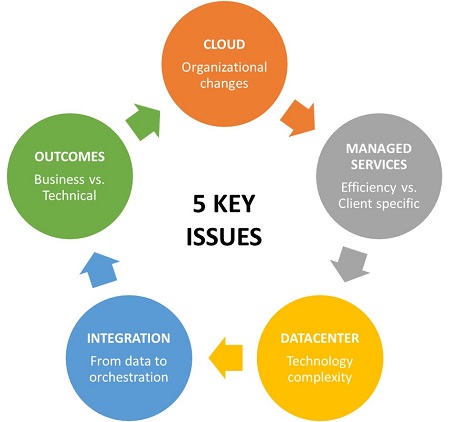
20% of channel partners are offering “digital transformation”, but most common is “digitalization” at 46% and balance 34% are still at the basic “digitization”. MSPs/SPs are the laggards and VARs/SIs the leaders. Among vendors, Dell & Cisco partners are leading the charge. The channel industry examined by Techaisle’s 2018 SMB/Midmarket focused channel research survey is very different from the community that existed a decade ago. Once a staid domain in which technologists provided IT infrastructure support to (mainly) local customers, the channel is being reshaped by five key issues in the face of digital transformation:

  1. Cloud, and its wrenching effect on all aspects of the channel business structure – only 69% of are partners selling cloud, out of which less than 2/3rd are successful
  2. Managed services efficiencies, especially vs. the pending opportunity associated with digital transformation – 77% are selling managed services but 50% are increasing on-site break-fix support
  3. Increasingly-complex data center technologies - there is a skills shortage in the SMB channel
  4. Orchestration & integration demands that are expanding in multiple directions – cloud orchestration expected to be a high-revenue growth area for only 23% of partners
  5. The need to sell on and deliver to business outcomes rather than technical outcomes

The data in the report illustrates the extent to which these factors are affecting channel management decisions today and influencing the future directions. The report covers:

  • What is the state of channel?
  • What does the channel offer?
  • Where does the channel land on digital transformation, orchestration & integration?
  • What does the channel want from vendors & distributors?
  • How does the channel sell?
  • What is channel doing in the cloud?
  • What is channel doing in managed services?
  • What data center solutions is the channel selling?

With digital transformation as the backdrop, let us look at a summary of the five issues highlighted above:

techaisle channel five key issues resized

Cloud

Partners continue to be challenged by the wrenching, organization-wide change that cloud demands at all levels of the organization. Cloud is forcing new metrics and disciplines on management, which has historically worked to maintain sustainable per-deal margins on individual current transactions. It is requiring sales staff to sell differently – stressing recurring-revenue, OPEX-heavy ‘pay as you go’ contracts over larger one-time product transactions – and it is requiring sales management to compensate staff differently. Finance is dealing with a far more complex set of cash management requirements and is also needing to understand the valuation impact of different revenue recognition approaches. In the cloud, marketing’s role is becoming larger, and its tools much more sophisticated; it is almost literally a different (and much higher value) activity in cloud than in conventional channel businesses. Even technical skills requirements are changing, as channel delivery staff is evolving from ‘just in case’ knowledge (often, recognized through certifications) to ‘just in time’ skills acquisition that responds to the rapidly-changing environment.

Clearly, cloud is imposing a daunting challenge on the channel. Techaisle data sees that some partners are working through this transition, but many, especially in markets where cloud has not caused large year-over-year decreases in product sales, are navigating a path that doesn’t include top-to-bottom change. These firms will be under intense pressure as the market increasingly demands that partners support migration to and efficient use of hybrid infrastructure.

Managed Services

Managed services, with its efficient delivery and promise of higher margins and better enterprise values (due to MRR rather than transactional revenue) has become a major factor in channel business strategy. MSPs can increase shareholder returns without needing to meaningfully expand their customer rosters; they can invest in internal efficiencies to boost margins while simultaneously keeping pace with customer expectations, even in areas like managed security, where threat sources advance continuously, driving need for increased response capabilities.

But there are clouds on the managed services horizon. One is digital transformation, “the next big wave” which aligns poorly with managed services. Digital transformation requires a mix of on-site and remotely-managed capabilities, packaged discretely for individual customers – and this isn’t what managed service providers aspire to. At the same time, the push towards everything-as-a-Service is morphing into SMB customer expectation of increasing service levels over time (or decreasing costs), rather than the fixed value for static service level approach used by today’s MSPs (and IaaS suppliers as well). Can traditional MSPs move past the core business notion of one service, one price, delivered with high efficiency from a remote location, to address digital transformation and progressive service delivery expectations? In fact, most are going back to on-site installation & support.

Data center technologies

Data center technologies are another source of challenge for partners. Data center products – especially converged and hyperconverged systems that combine server, storage, networking and virtualization technologies – are much more complex than the client and server technologies that many channel members have focused on in the past.

Typical “one stop shop” VARs are lacking the technical depth needed to work with contemporary data center products. Specializations in current solutions take time, cost money and require skilled staff who is usually not affordable for – or even available to – channel members. But data also shows that VARs have the maximum depth in digital transformation and are involved in orchestration.

Orchestration & Integration

The nature of integration is changing. In an environment where core resources are located in many different physical environments, “systems” integration is becoming less a matter of physical connections and more an issue of automation and orchestration, which call for a distinctly different skill set. Meanwhile, customer interest in a multi-platform world is centering on data rather than systems integration: how can dispersed systems exchange data, securely and with the low latency needed to support workloads that span different environments?

The issue of integration is becoming more complex as businesses embrace IoT to provide a far more detailed view of their markets, and AI to make sense of the vastly-increased base or evidence that is used to support ever-more-rapid decisions. And demands on technology suppliers have already deepened with the need to secure these multiple platforms and sources. Integration offers an enormous opportunity for the channel – but this opportunity is accompanied by a demanding set of requirements.

Business Outcomes

Beyond all of the technology-driven change that the channel is adapting to, there is a shift in how customers are acquiring IT solutions. SaaS has shown buyers that they can acquire IT capabilities that map directly to business needs – they no longer need to take on the risk and uncertain time-to-benefit inherent in the purchase, integration and deployment of building-block technologies. At the same time, IT budget authority continues to migrate from IT gatekeeps to business managers who view technology as a means to achievement of process objectives, rather than as an end in itself. Both trends affect for channel sales and marketing professionals: within client organizations, the key customers are often non-IT professionals who are looking for suppliers to respond to business pain points with approaches that directly address the business requirements, rather than with traditional product-centric ‘some assembly required’ solutions targeted at IT buyers.

The ability to talk credibly to business outcomes vs. technology issues has become the key to selling solutions in today’s market. Most vendors lack business-savvy sales staff – the issue is even more acute in channel firms. Cloud startups often speak to business rather than IT issues (and clients). Can the traditional channel keep pace – at least, enough to prevent services leakage to born-in-the-cloud alternatives?

In the report, Techaisle research demonstrates how channel partners are positioning their firms to navigate this turbulent environment. There may never have been a more stressful time to manage a channel business than 2018 – but channel managers have proven through time that they are adept at finding profitable paths through even the choppiest waters.

The report covers:

  • What is the state of channel? Channel Partner Business Issues, Firmographics
  • What is the global channel landscape? (Only in WW SMB/Midmarket Channel Report)
  • What does the channel offer? Channel & planned offerings including digital workplace
  • Where does the channel land on digital transformation, orchestration & integration?
  • What does the channel want? Channel Expectations from Vendors & Distributors
  • How does the channel sell? Channel sales Strategy
  • What is channel doing in the cloud? Channel Partner Cloud Trends
  • What is channel doing in managed services? Channel Partner Managed Services Trends
  • What data center solutions is the channel selling?
techaisle us channel partner trends report cover resized

techaisle ww channel partner trends report cover resized

Anurag Agrawal

Digital transformation challenging the SMB buyers journey

The first step in influencing the potential of a technology to impact business outcome is identifying the extent to which technology aligns with or supports executive ‘care-abouts’ of the SMB buyers. Technologies that connect directly to C-level objectives are most likely to obtain support. Techaisle survey data shows that digital transformation is very prominent in executive-oriented IT discussions but influencing the SMB & midmarket IT and non-IT buyer is no cakewalk. Consider these statistics from Techaisle surveys:

  • 72% of SMB IT purchases are triggered by an acute business pain point & number of pain points are increasing
  • 52% of SMBs are facing 5+ business challenges
  • SMB IT Purchase Decision Making Unit (DMU) has grown by 250% over the last decade
  • Average of 5.2 decision makers are involved in technology purchase decisions in midmarket firms & 2.1 in small businesses
  • 43% of IT buyers are millennials
  • SMBs have 7 distinct business processes
  • Channel partner is involved at only 50% decision making stage
  • 70% of the buyer’s journey is complete before first meaningful contact with a potential supplier
  • 17% of SMBs use six or more information sources
  • Average channel partner sales cycle is 7.7 weeks

Where, when and who to influence is a key challenge, especially when digital transformation impacts more than one buyer segment and business process.

Anurag Agrawal

Dell, HPE, IBM, Cisco competing for global SMB US$1 trillion IT Spend

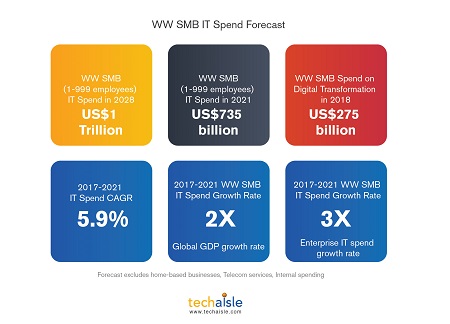
Techaisle forecasts worldwide SMB (1-999 employee segment) IT spend will reach US$735 billion in 2021 and cross US$1 trillion in 2028, growing at 2X the global GDP rate and 3X the enterprise segment. With slightly over 72 million SMBs (excluding home-based businesses), the market segment presents itself as lucrative and yet incredibly difficult to penetrate. Within each employee-size category there exists segments by IT sophistication, cloud maturity, digital transformation strategy, SaaS adoption, cloud first to cloud selective segments. As per Techaisle survey digital transformation is on the minds of most SMBs who are expected to spend US$275 billion on DX in 2018. And 42% of SMBs have become more dependent on technology over the last 12 months for better business outcomes.

techaisle ww smb it spend forecast resized

Anurag Agrawal

Interwork - the next step in connected businesses

Internet and the web are the navigation routes that we have been developing since the 1970s; the always-on, everywhere-connected Interwork platform is the destination that we will be creating in 2018 and for years to come.

As we enter 2018, it seems that online capabilities and activities are entering a new era. There are still advances to be made in the ‘net’ realm: there is constant pressure to expand the speed of the Internet, enabling it to handle the voracious demands of unstructured content like video, and the rise of IoT portends a coming tsunami of data from billions of connected devices. However, the key focus of web-based business investment is now less about the ‘net’ and more about the ‘work’: the ways that an increasingly-connected world supports pursuit of previously-unattainable objectives. The most important IT-related development in 2018 will be this focus on connectedness – connected cloud, connected edge, connected applications, connected security, conected collaboration, connected workspaces and connected insights. (Download your free white paper here)

Techaisle calls it the “Interwork platform” (as described in Techaisle's latest white paper). This refers to Techaisle’s belief that 2018 will mark a transition point at which corporate focus on developing and deploying systems that offer the capacity to connect diverse resources (the Internet platform) will be surpassed by a focus on capitalizing on the benefits of connected information, assets and users and teams – the ‘Interwork platform’ - to deliver on the four pillars of digital transformation: operational efficiency, customer intimacy, employee empowerment and innovation.


In the early 1970s, computer science pioneers Vint Cerf and Robert E. Kahn developed the networking protocol TCP/IP – Transmission Control Protocol/Internet Protocol – which enabled interconnections between networks to form a ‘network of networks’. Fifteen years later, in 1989, Tim Berners-Lee developed the World Wide Web, allowing browsers to follow hypertext links to far-flung resources. The Web was released to the general public in August 1991 – and businesses and individuals around the world have spent more than 25 years developing a vast array of content, process and interactive capabilities that are set within and rely on the network of networks.

Techaisle’s position is that from the perspective of the technology world, 2018 – and quite possibly, several years following 2018 – will be defined by the benefits arising from the interconnection of all types of resources: platforms/environments, information, devices and applications. With the connective fabric now (or rapidly becoming) ubiquitous, businesses of all types and sizes will move beyond a focus on network access, and concentrate instead on using Interwork technologies to drive progress across the four pillars of digital transformation: operational efficiency, customer intimacy, employee empowerment and product innovation.

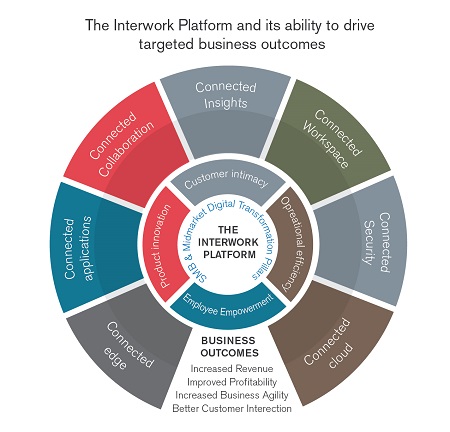
Techaisle’s recent point-of-view on the Interwork platform highlights seven key areas and trends playing out across seven key technology areas:

  1. Connected cloud, which provides the foundation for Interwork, the bedrock on which Interwork platforms are built
  2. Connected edge, which completes that foundation and will work with connected cloud to deliver the ‘yin and yang’ of the Interwork platform’s infrastructure
  3. Connected applications, that represent the best path forward for corporate workloads and processes – and represent a critical component of the Interwork platform
  4. Connected security, is an essential property of the Interwork platform as security strategies no longer resemble a ‘wrapper’ around assets
  5. Connected collaboration, as it becomes part of the fabric of business activity, rather than as a means of enabling connections between discrete tasks
  6. Connected workspaces, which draw together assets and users, delivering increased benefit within each category while simultaneously extending and strengthening the core of the Interwork platform; and
  7. Connected insights, the information gained/accessed through the platform, which enables businesses to address constantly-advancing expectations for speed (of operational decisions) and completeness (of strategic decisions).

techaisle interwork platform description resized

Business and IT executives who are able to grasp the benefits associated with these seven key areas – and who are able to profit from the points at which multiple connected business resources combine to build the broader Interwork platforms – will emerge as leaders in and beyond 2018. Their organizations will participate in shaping rapidly-evolving business and consumer expectations for responsiveness and agility. Businesses that capitalize on Interwork capabilities will capture preferred positions within their markets, and within the millennial labor pool that defines a key area of near-term competition.

There are many powerful rationales for investing in each of the seven components of an Interwork platform, and as Techaisle's white paper demonstrates, each component in turn delivers greater value when it is connected with the other links in the Interwork chain.

Download your free white paper here


Trusted Research | Strategic Insight

Techaisle - TA