










• TRUSTED RESEARCH

    TRUSTED RESEARCH | STRATEGIC INSIGHT

    SMB. CORE MIDMARKET. UPPER MIDMARKET. ECOSYSTEM
    LEARN MORE
  • INTERWORK 2.0: THE AGENTIC FUTURE OF CONNECTED BUSINESS

    INTERWORK 2.0: THE AGENTIC FUTURE OF CONNECTED BUSINESS

  • 2026 TOP 10 SMB BUSINESS ISSUES, IT PRIORITIES, IT CHALLENGES

    2026 TOP 10 SMB BUSINESS ISSUES, IT PRIORITIES, IT CHALLENGES

  • 2026 TOP 10 SMB PREDICTIONS

    2026 TOP 10 SMB PREDICTIONS

    SMB & Midmarket: Autonomous Business
    READ
  • 2026 TOP 10 PARTNER PREDICTIONS

    2026 TOP 10 PARTNER PREDICTIONS

    Partner & Ecosystem: Next Horizon
    READ
  • ARTIFICIAL INTELLIGENCE

    ARTIFICIAL INTELLIGENCE

    SMB & Midmarket Analytics & Artificial Intelligence Adoption
    LEARN MORE
  • IT SECURITY TRENDS

    IT SECURITY TRENDS

    SMB & Midmarket Security Adoption Trends
    LATEST RESEARCH
  • BUYERS JOURNEY

    BUYERS JOURNEY

    Technology Buyer Persona Research
    LEARN MORE
  • PARTNER ECOSYSTEM

    PARTNER ECOSYSTEM

    Global Channel Partner Trends
    LATEST RESEARCH
  • CLOUD ADOPTION TRENDS

    CLOUD ADOPTION TRENDS

    SMB & Midmarket Cloud Adoption
    LATEST RESEARCH
  • FUTURE OF PARTNER ECOSYSTEM

    FUTURE OF PARTNER ECOSYSTEM

    Networked, Engaged, Extended, Hybrid
    DOWNLOAD NOW
  • MANAGED SERVICES RESEARCH

    MANAGED SERVICES RESEARCH

    SMB & Midmarket Managed Services Adoption
    LEARN MORE

Techaisle Analyst Insights

Trusted research and strategic insight decoding SMBs, the Midmarket, and the Partner Ecosystem.
Anurag Agrawal

Causation or correlation - The link between approaches to digital transformation and business success

Techaisle’s 2021 US SMB and Midmarket Digital transformation adoption trends research covering businesses from 1 to 4999 employees (collectively named mainstream businesses by Techaisle) shows a correlation between digital transformation and business growth. Unlike many IT market terms, which tie to specific technologies, digital transformation is most often used to indicate an amorphous state. A state in which firms can seamlessly deploy new digital capabilities that streamline current or next-step processes, eliminating the friction inherent in basing these capabilities on manual tasks and physical documents/inputs. SMBs and midmarket firms view digital transformation as a proxy for business process efficiency. For many years, it has been a management goal, embedded, usually without a consistent set of steps and defined outcomes, in the IT plans of a substantial majority of small businesses (1-99 employees) and more than 90% of midmarket (100-4999 employees) firms. The pandemic brought urgency to these plans. The speed reflected the management’s understanding that highly automated processes are essential in a business environment where physical interactions are awkward or forbidden, adding necessity to efficiency as compelling reasons to invest in digital transformation.

Digital transformation segments

To refine the current and planned digital transformation adoption status perspective, Techaisle segmented the market to one of four phrases to characterize organizations’ attitude or approach towards digitalization of existing processes –

  • Holistic: Digitalization is an essential aspect of overall business strategy
  • Inclusive: Digitalization is a meaningful but non-essential aspect of overall business strategy
  • Siloed: Digitalization strategies are underway in some departments, but there is no overall digitalization strategy for the business
  • In the shadows: Digitalization may be occurring in areas of the company, but it is neither a departmental nor overall business strategy
  • Nonexistent: Business has no digitalization activity or plan; firms have yet to begin digital transformation adoption.

Small business adoption of digital transformation is still at a primary stage. In 27% of small businesses (1-99), digital transformation is either “nonexistent, “in the shadows,” or “siloed.” However, this is vastly lower from 51% in 2020, indicating that small businesses drastically improved their approach to transformation within the last year. Midmarket firms, which have higher overall digital transformation adoption rates, are also much more advanced in their approaches. 90% of midmarket firms take either an “inclusive” or “holistic” approach to digital transformation today. Data shows that there has been an increase of 34% within midmarket firms (100-999) and a corresponding increase of 26% within upper midmarket firms (1000-4999) in their approach to holistic digital transformation from siloed or inclusive approaches.

Digital transformation and business growth
Anurag Agrawal

Quickening pace of SMB and Midmarket digital transformation driving technology spend

Techaisle's latest SMB and Midmarket Digital transformation adoption trends research shows that 37% of small businesses (1-99 employees) and 46% of midmarket firms (100-4999 employees) expedited their digital transformation efforts due to pandemic. On the flip side, 27% of SMBs (1-999 employees) slowed down their digital transformation to prioritize their business's essential aspects, such as revenue generation. 27% of upper midmarket firms (1000-4999 employees) either changed their approach to transformation or kept the same pace as before the pandemic.

Investment in digital transformation has been underway for several years and was poised to be an essential factor in the IT and business market in the early 2020s. The pandemic lent urgency to digital transformation – but having arrived in a hurry, the changes wrought in response to the pandemic do not appear to be leaving as abruptly.

The accelerated pace of transformation will result in US$1,163B worldwide spend on IT (excluding telecom services) by SMB and upper-midmarket firms in 2021.

Unlike many IT market terms, which tie to specific technologies or technology capabilities, digital transformation is most often used to indicate an amorphous state in which an organization can seamlessly deploy new digital capabilities that streamline current or next-step processes, eliminating the business friction.

Organizational restructuring to hasten pace of transformation

Generally, firms consider digital transformation as a proxy for process efficiency. For many years, it has been a management goal, embedded without a consistent set of steps and defined outcomes in the IT plans of a substantial majority of SMBs. The pandemic brought urgency to these plans: there are numerous anecdotal reports of IT leaders being told, "you know that three-year digital transformation plan? Can you deliver it in three months instead?" For the most part, these requests tended to have a minimal additional budget attached to them, generally came without requisitions for new IT staff. These requests reflected management's understanding that highly-automated processes are essential in a business environment where physical interactions are awkward or forbidden, adding necessity to efficiency as compelling reasons to invest in digital transformation.

To change the transformation pace, 17% of SMBs are restructuring their entire organizations, and 24% are creating new functions dedicated to digital transformation. The changes will be more pronounced in the midmarket and upper-midmarket firms, which are quickly putting together dedicated groups and departments to digitize, digitalize and transform their organizations. Nearly one-fifth of SMBs are relying on their employees to guide transformation initiatives.

Changing digital transformation drivers

Anurag Agrawal

Delivering digital transformation benefits to SMB and mid-market customers

79% of US SMBs are either in the planning stage for digital transformation or have a formal strategy but only 19% are actively following through. Small businesses are behind midmarket firms. 29% of small businesses have no ongoing digital transformation strategy as compared to 9% of midmarket firms. As a result, there is a growing digital divide in the SMB segment and most SMBs need guidance in building a vision that involves separating digital transformation components into two nested and complementary ladders, one focused on technology, and second, focused on business outcomes.

The figure below presents a single-image depiction of these twin ladders of digital transformation. The bottom set of steps is labeled “the technology ladder,” and stretches from the deployment of modern, flexible infrastructure to advanced IT-enabled capabilities. The building blocks that are needed to establish an infrastructure that is capable of supporting digital transformation include mobility, virtualization, hyper-converged infrastructure, and other technologies essential to provisioning advanced IT services. These building block technologies are an essential foundation for digital transformation but deliver modest discrete value. The point automation solutions positioned at the base of the business outcomes ladder provide rapid but limited benefit through substitution and augmentation.

Anurag Agrawal

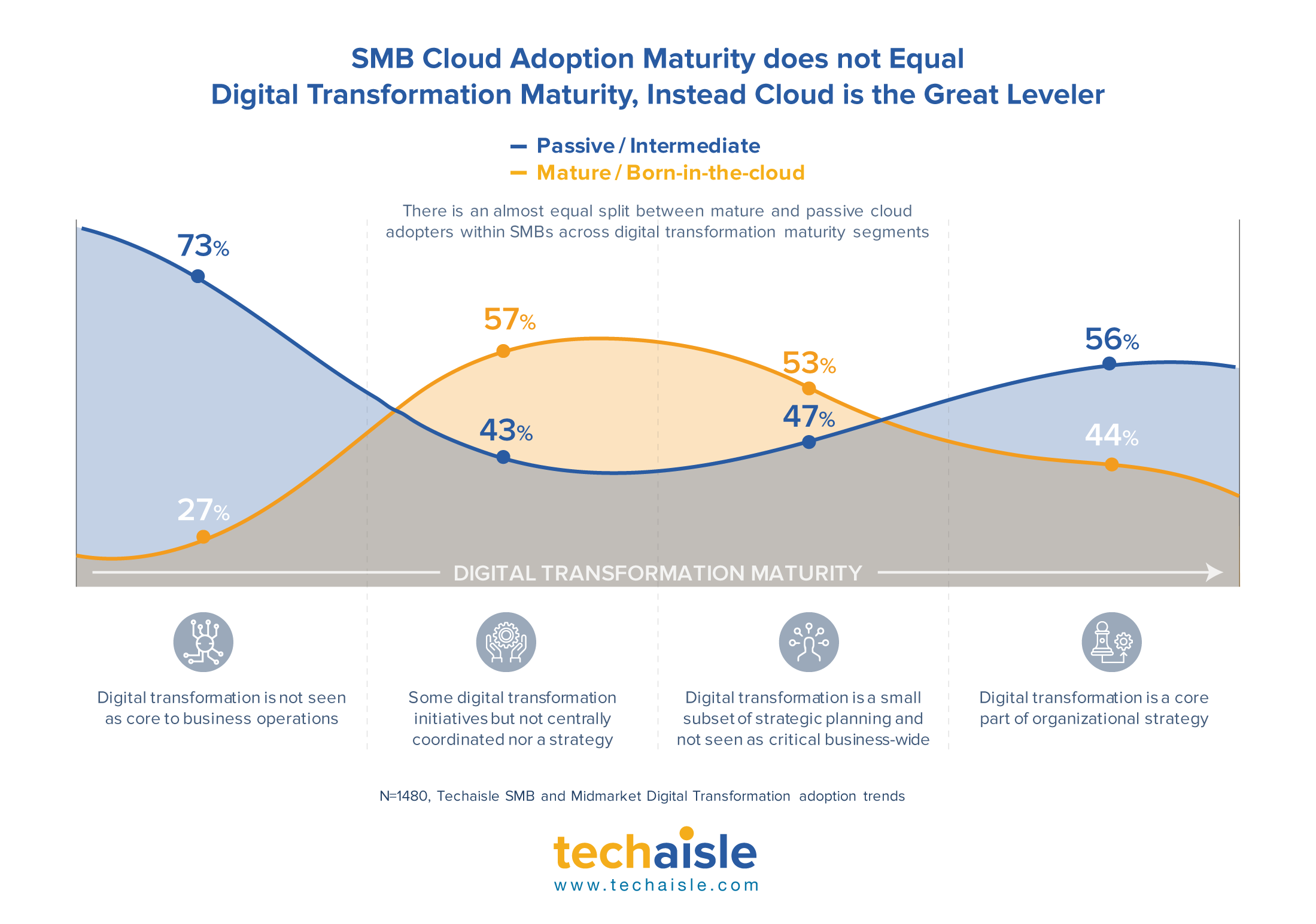
SMB cloud maturity does not equate to digital transformation maturity - IT maturity does

Mature cloud adoption does not equate to high maturity in digital transformation of an SMB business. Data shows that only 44% of SMBs on the digital transformation maturity curve are also mature cloud adopters. It is true that these businesses believe in cloud and its effect on digitization but they also believe that true digital transformation requires advanced adoption of multiple technology solutions. Techaisle survey and segmentation data also shows that SMBs which have a siloed strategy of digital transformation are intermediate adopters of cloud, mostly driven by non-IT business units which need cloud to further their business objectives.

techaisle smb digital tramsformation maturity cloud maturity

Techaisle SMBs digital transformation research revealed that although businesses are investing in cloud solutions, there is a deep-rooted belief and position to continually invest in core modern infrastructure solutions to support emerging technologies that deliver new and previously unimaginable business outcomes.

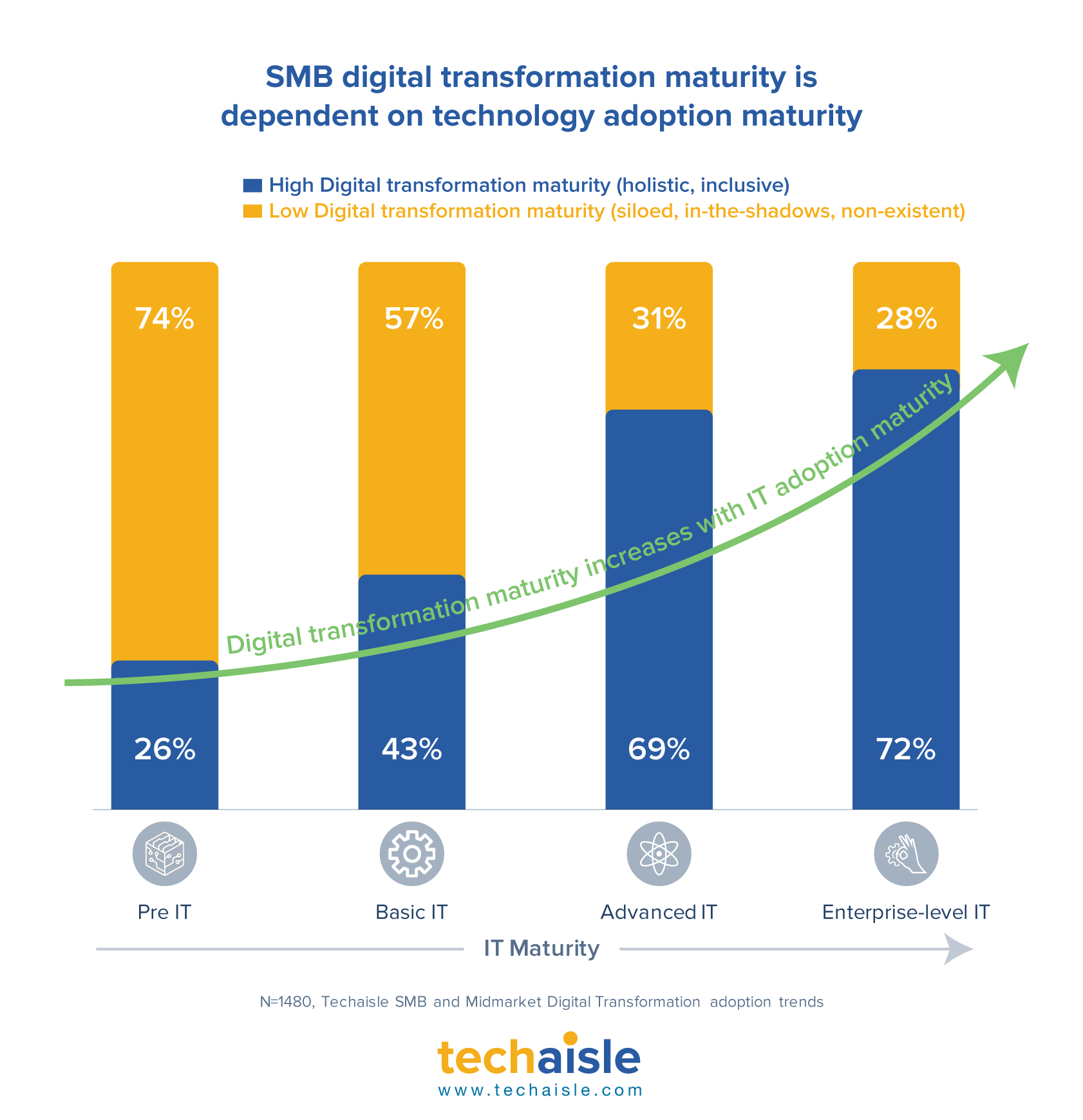
The digital transformation mature SMBs believe that the roadmap to successful digital transformation begins with the creation of a sound physical infrastructure - the ‘building blocks’ or ‘foundations’ of business infrastructure. Digital transformation doesn’t start with a ‘set it and forget it’ approach to the core – it is organic, with evolution happening at all levels of the business infrastructure. They also believe that core infrastructure devices need to be kept in sync with the requirements of digital transformation initiatives; servers and storage and networking and security need to advance with the needs of the organization.

techaisle smb digital transformation depends on it maturity

Research also reveals that there is no simple way of building a comprehensive view of future IT requirements to drive digital transformation. Many of the most powerful and compelling technologies in today’s business world seem almost magical in their abstraction from the physical world that we work in every day. The future requires – at both a business and technology level – a connection between back-end infrastructure, applications and client devices – cloud to core to edge - managed through an effective strategy, to obtain superior returns from interactions with customers and prospects, employees, shareholders and partners, and the market as a whole.

Research Reports

US SMB and Midmarket Digital Adoption trends survey research report
Europe SMB and Midmarket Digital Adoption trends survey research report
Asia/Pacific SMB and Midmarket Digital Adoption trends research
Latin America SMB and Midmarket Digital Adoption trends research

Trusted Research | Strategic Insight

Techaisle - TA