• TRUSTED RESEARCH

    TRUSTED RESEARCH | STRATEGIC INSIGHT

    SMB. CORE MIDMARKET. UPPER MIDMARKET. ECOSYSTEM
    LEARN MORE
  • INTERWORK 2.0: THE AGENTIC FUTURE OF CONNECTED BUSINESS

    INTERWORK 2.0: THE AGENTIC FUTURE OF CONNECTED BUSINESS

  • 2026 TOP 10 SMB BUSINESS ISSUES, IT PRIORITIES, IT CHALLENGES

    2026 TOP 10 SMB BUSINESS ISSUES, IT PRIORITIES, IT CHALLENGES

  • 2026 TOP 10 SMB PREDICTIONS

    2026 TOP 10 SMB PREDICTIONS

    SMB & Midmarket: Autonomous Business
    READ
  • 2026 TOP 10 PARTNER PREDICTIONS

    2026 TOP 10 PARTNER PREDICTIONS

    Partner & Ecosystem: Next Horizon
    READ
  • ARTIFICIAL INTELLIGENCE

    ARTIFICIAL INTELLIGENCE

    SMB & Midmarket Analytics & Artificial Intelligence Adoption
    LEARN MORE
  • IT SECURITY TRENDS

    IT SECURITY TRENDS

    SMB & Midmarket Security Adoption Trends
    LATEST RESEARCH
  • BUYERS JOURNEY

    BUYERS JOURNEY

    Technology Buyer Persona Research
    LEARN MORE
  • PARTNER ECOSYSTEM

    PARTNER ECOSYSTEM

    Global Channel Partner Trends
    LATEST RESEARCH
  • CLOUD ADOPTION TRENDS

    CLOUD ADOPTION TRENDS

    SMB & Midmarket Cloud Adoption
    LATEST RESEARCH
  • FUTURE OF PARTNER ECOSYSTEM

    FUTURE OF PARTNER ECOSYSTEM

    Networked, Engaged, Extended, Hybrid
    DOWNLOAD NOW
  • MANAGED SERVICES RESEARCH

    MANAGED SERVICES RESEARCH

    SMB & Midmarket Managed Services Adoption
    LEARN MORE

Techaisle Analyst Insights

Trusted research and strategic insight decoding SMBs, the Midmarket, and the Partner Ecosystem.
Anurag Agrawal

Approaching the SMB with IoT solutions – internal primary deployment leaders

How should suppliers looking to target SMBs with IoT solutions set their strategies? Techaisle believes that strategy starts with the buyer, which in this case, means understanding who the buyer is, what factors are motivating purchase decisions, and how much is available for spend on IoT. From a deployment perspective, IoT straddles an interesting line: it is technically complex, which would argue for deep IT involvement, but it – at least, in more sophisticated solutions – addresses business process issues that are most important to business managers, which would argue for deep line of business (LOB) involvement. What do we see with today’s SMB IoT adopters?

Data collected from the Techaisle SMB IoT Adoption survey indicates that in these early days, responsibility for IoT deployment in small businesses is divided relatively equally between IT and LOB management, while in midmarket organizations, IoT is most often the responsibility of IT group.

Anurag Agrawal

Role of BDMs in SMB IT solution adoption

Typically, IT suppliers focus on product or service transactions – the point at which a buyer commits to a contract with a specific seller. IT vendor compensation plans are structured around the transaction, and lead funnels captured in CRM and marketing systems coalesce around this event. And because IT professionals are often engaged in signing contracts for IT products and services, vendor sales and marketing initiatives often key on the IT function.

From a buyer’s perspective, though, the solution adoption cycle is much longer, and commitment to a specific product or service is less important than establishing the business context that drives the need for investment, and the processes needed to ensure that the business obtains anticipated value from this investment. Before they commit to a contract, organizations need to identify the need for a new solution, align the need with strategic and operational plans, and identify and evaluate solution options. Once the product/service is acquired, the buyer’s process continues: the business still needs to deploy the new technology, train IT and business users on its features, evaluate the effectiveness of the solution in meeting current requirements, and optimize the solution over time to maximize returns.

Techaisle conducted a unique survey of SMB organizations. To understand the current state and implications of distributed IT influence and authority, Techaisle surveyed roughly equal numbers of business decision makers (BDMs) and IT decision makers (ITDMs) across seven employee size categories, and then analyzed results to create a unified view of the new decision authority realities.

Anurag Agrawal

SMB Cloud CRM adoption journey points to accelerated digital transformation

Techaisle’s detailed SaaS adoption survey tracked the current and planned buying journey of cloud CRM, ERP and other SaaS applications within SMBs and Midmarket firms. Cloud orchestration & digital automation have become essential ingredients for business transformation. Techaisle analyzed the extent to which use/intended use of each of these cloud applications is connected with other applications and whether they are part of a conscious effort for digital transformation. The two sets of figures below show past and planned CRM and its adjacent SaaS applications adoption journey.

The research reveals a very stark difference between the past cloud CRM adoption journey and the intended path after adopting cloud CRM for the first time. The past adoption patterns were seemingly random reacting to a specific point of pain, but planned adoption is deliberate keeping in view the business issues & IT challenges and taking giant steps towards a connected digital business.

Anurag Agrawal

Midmarket technology & business buyers: two peas, two pods

Business decision makers (BDMs) are an intrinsic force in most midmarket organizations and are the primary decision makers in some high-growth technology areas, including collaboration, social media and analytics – meaning that increasingly, BDMs are ‘the boss of IT’. These BDMs view IT as a component of business processes, rather than as a stand-alone silo. Techaisle SMB & Midmarket Decision Authority data shows that twice as many BDMs as ITDMs (IT decision makers) in midmarket businesses say that it is critical for IT to understand how technology contributes to overall organizational success. These BDMs have specific objectives for technology usage, clear perspectives on adoption drivers and impediments, and tend to be influenced by information sources that are different from the inputs used by ITDMs.

This pressure from business managers leaves IT leaders scrambling to stretch limited budgets to meet seemingly limitless requirements, striving to deliver predictable, secure systems that respond to the increasingly varied needs of their business users and competitive environments. The growing divide between IT authority and responsibility, exacerbated by the fact that business perspectives on IT are shaped by information channels that are not part of the IT professional dialogue, has created an environment where businesses are struggling to develop the cohesion needed to promote or embrace new IT capabilities to achieve business objectives within existing IT and business process structures..

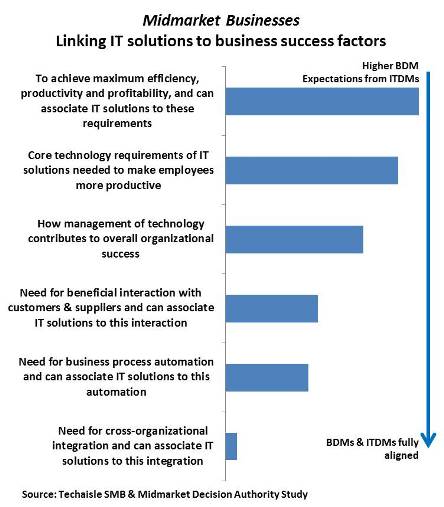
In a unique survey, Techaisle posed the same question, “expectation of associating business success factors to IT solutions” to both BDMs and ITDMs and probed to identify what each expected from the other. Techaisle data shows that BDMs tend to have higher expectations of IT; while business decision makers and technology decision makers are reasonably well aligned in some areas, there is a wide expectation gap in others, which may explain (at least to some extent) the continued proliferation of non-sanctioned, “shadow” IT.
techaisle-midmarket-linking-it-with-business-success-resized

The figure above provides a simplified view of differences between BDMs and ITDMs across several different factors. Although there is a tacit agreement that both business and IT management should understand business related success imperatives and should be able to associate IT solutions to achieving those objectives, closer examination of the data shows some important differences between the two groups:

  • 53 percent of upper midmarket BDMs say that it is very critical for business success that ITDMs are able to identify and associate IT solutions with business efficiency, productivity & profitability. On the on the flip side, only 30% of IT executives in these upper midmarket businesses say that business executives should be able to associate IT solutions with business efficiency, productivity and profitability. Responsibility for delivery clearly rests with IT, and BDMs have very high expectations from ITDMs.
  • Data also clearly shows that BDMs again have high expectations for support in using technology to build customer connections. Over 40 percent of BDMs believe that it is critical that IT has a grasp of solutions that enable beneficial customer & supplier interactions. In contrast, only 1/4th of ITDMs say that BDMs should have a grasp of such solutions.
  • Employee productivity is an important aspect of business and in most cases businesses are expecting IT to understand and deploy core technology solutions to make employees more productive.
  • Business process automation is an area where there is better alignment between IT and business. However, automation is a dominant need within the 100-499 employee size segment; nearly 40 percent of BDMs in the segment say that it is critical that IT can identify requirements for automation and associate IT solutions with these needs.
  • Cross-organizational integration is recognized as being important by both BDMs and ITDMs in mid-size businesses: over 50 percent of both groups agree that it is critical for both business and IT to associate technology solutions with business demands. This is an area where both BDMs and ITDMs are fully aligned.

The trend towards increased BDM involvement in IT decisions is likely to accelerate further. BDMs are already active in shaping demand in core IT markets, and they are the dominant force in high-growth areas like collaboration, social media and business intelligence/analytics. ITDM and BDM divergence will continue and although there is cross-pollination they may as well continue to operate from different pods. Although it may be tempting to try to bring the various parties together, IT suppliers cannot successfully act as intra-corporate matchmakers: they have to come to grasp with the reality of selling to two different constituencies which have different expectations.

Trusted Research | Strategic Insight

Techaisle - TA