• TRUSTED RESEARCH

    TRUSTED RESEARCH | STRATEGIC INSIGHT

    SMB. CORE MIDMARKET. UPPER MIDMARKET. ECOSYSTEM
    LEARN MORE
  • BUYER JOURNEY

    BUYER JOURNEY

    SMB & Midmarket Buyers Journey Research
    LEARN MORE
  • BUYER PERSONAS

    BUYER PERSONAS

    SMB & Midmarket Technology Buyer Persona Research
    LEARN MORE
  • ARTIFICIAL INTELLIGENCE

    ARTIFICIAL INTELLIGENCE

    SMB & Midmarket Analytics & Artificial Intelligence Adoption
    LEARN MORE
  • DATACENTER SOLUTIONS

    DATACENTER SOLUTIONS

    SMB & Midmarket Datacenter Solution Adoption Trends
    LEARN MORE
  • INTERWORK 2.0: THE AGENTIC FUTURE OF CONNECTED BUSINESS

    INTERWORK 2.0: THE AGENTIC FUTURE OF CONNECTED BUSINESS

  • 2026 TOP 10 SMB BUSINESS ISSUES, IT PRIORITIES, IT CHALLENGES

    2026 TOP 10 SMB BUSINESS ISSUES, IT PRIORITIES, IT CHALLENGES

  • 2026 TOP 10 SMB PREDICTIONS

    2026 TOP 10 SMB PREDICTIONS

    SMB & Midmarket: Autonomous Business
    READ
  • 2026 TOP 10 PARTNER PREDICTIONS

    2026 TOP 10 PARTNER PREDICTIONS

    Partner & Ecosystem: Next Horizon
    READ
  • IT SECURITY TRENDS

    IT SECURITY TRENDS

    SMB & Midmarket Security Adoption Trends
    LATEST RESEARCH
  • PARTNER ECOSYSTEM

    PARTNER ECOSYSTEM

    Global Channel Partner Trends
    LATEST RESEARCH

Techaisle Analyst Insights

Trusted research and strategic insight decoding SMBs, the Midmarket, and the Partner Ecosystem.
Anurag Agrawal

Mobile App Adoption exploding within SMBs and Midmarket Businesses

Data drawn from the Techaisle SMB mobility survey shows that SMBs will go from a current average of 7 types of mobility applications in use to 14 in about a year. This 100%-ish growth pattern is demonstrated across most employee size segments.

When we overlay business size with Techaisle’s attitudinally-defined segments of “Pre-IT,” “Basic IT,” “Advanced IT” and “Enterprise IT,” some differences in app adoption emerge. Businesses in the “Pre-IT” segment (found only in the small business group) are currently using only 3 types of mobile apps, versus 7 type of mobile apps in use in each of the “Basic IT: Small Business” and “Advanced IT: Small Business” segments.

This same trend is visible across the three attitudinally-defined midmarket segments. “Basic IT” firms in the midmarket segment are using only 4 types of mobile apps, and planning to add 5 more; both figures are below the adoption rates seen in Basic IT in the small business community.

The more sophisticated segments, though, are adopting mobile applications much more rapidly. The Advanced IT: Midmarket group uses an average of 8 different types of mobile applications today, and is planning to add 6 more in in the next one year, figures that tie very closely to Advanced IT users in the small business community. And the Enterprise IT segment found only within midmarket firms is even more aggressive in mobile app deployment; these firms already use mobile applications in an average of 11 types of apps, and are planning to deploy 9 more.

Mobile applications: scope for growth in core apps and in other categories

The Techaisle SMB mobility adoption survey tracks 20 types of mobile applications. Although there is always overlap between different feature sets and application types, its possible – and useful – to group these into four categories:

Anurag Agrawal

SMB top 10 technology predictions: 2016 and beyond

This is a two part blog article. The first part, published earlier, reviewed the predictions we made for 2015 and the second part, below, focuses on outlook for 2016 and for the longer term (2017 - 2020).

Top 10 Predictions for Year 2016

1. 2016 will see even more intense emphasis on “CIA-Plus”
IT Suppliers will begin to align their offerings with Cloud, IoT, and/or Analytics; products that do not address end-user needs in these areas will be positioned as infrastructure and integration services needed to capitalize on these technologies. This trend, like hybrid IT, will continue into 2017. In 2016, Cloud and Analytics will remain among the top five IT priorities of SMBs and midmarket businesses. IoT will inch its way up into the priority list, though adoption will remain limited.

2. Rise of IoT will be constrained by a lack of real-world examples
From a buy-side perspective, the rise of IoT will need to be fueled by real-world examples showing the benefits of automating tasks and processes within IT and in other sectors. Within the SMB community, we expect sporadic implementation and a lack of concerted effort towards creation of IoT strategy, even though IT suppliers will continue to push forward their solutions hoping to remain top-of-mind in order to claim leadership in this emerging space. Each IT supplier will create its own solution set causing decision and adoption inertia, despite the wave of innovation that we expect to see emerge from the smaller & more agile IoT providers that are able to more easily align IT expertise with real life solutions. Experienced consultants and system integrators in particular will hold sway in matching SMB adopters with suppliers.

3. IoT supplier success will be determined by ecosystem management
On the sell side, the rise of IoT will be accompanied by an intense wave of interest in ecosystem management. It is difficult to buy or sell a “box of IoT”, though providers will claim to provide complete solutions. Parenthetically, this constraint is not limited to IoT. While it is possible to sell a “box of cloud” under the right circumstances, only AWS really manages to do so. And while one can sell a “box of analytics”, the boxes themselves come in a lot of different shapes and sizes. To meet SMB and enterprise buy-side demand for IoT, sellers will assemble coalitions that provide the many products and services that comprise an IoT solution. This will make alliance management a key success factor in the marketplace. The last time alliances determined market leadership; SAP became the global standard in ERP. Niche value added reseller may find a new source of success in IoT.

4. Business transformation will continue to elude analytics users
Analytics users will find that they are not achieving the expected benefits, prompting divergent responses. Some SMBs will find that analytics has not been transformative, and will blame the technology; others will look to move past descriptive and diagnostic views, piloting predictive or prescriptive initiatives. One of these responses is clearly more sensible than the other, but that does not mean it will be universal, at least in 2016. Focus on visualization will increase (mine is better than yours), on how the technology can solve business issues and challenges for SMBs and midmarket customers. Simplified implementation of customer and social analytics will be key drivers of adoption.

5. “Hybrid” will be used more often in conjunction with “IT” than “cloud”
User organizations will accept the notion that their focus on cloud needs to evolve into a focus on hybrid IT, as firms realize that their platforms and management scope must encompass on and off-premise systems. Truthfully, there is still a lot of work to do in cloud adoption. But the nature of the discussion has changed from “what and how do we move to the cloud?” to “what do we do to build an integrated, manageable infrastructure?” In 2016, there will likely no longer be an infrastructure debate about use of cloud, but there will be an important emerging discussion around managing hybrid IT.

6. Collaboration will drive “silo” to the realm of four-letter words
Anywhere, anytime also means any type of collaboration. SMB & midmarket businesses will look for unified shared workspaces that allow employees to enter into the workspace from any entry point to work together, collaborate and interact. Collaboration solutions cannot be deployed on stand-alone platforms – they need to be viewed as a framework for integrating multiple capabilities, native to multiple applications.

Anurag Agrawal

Midmarket technology & business buyers: two peas, two pods

Business decision makers (BDMs) are an intrinsic force in most midmarket organizations and are the primary decision makers in some high-growth technology areas, including collaboration, social media and analytics – meaning that increasingly, BDMs are ‘the boss of IT’. These BDMs view IT as a component of business processes, rather than as a stand-alone silo. Techaisle SMB & Midmarket Decision Authority data shows that twice as many BDMs as ITDMs (IT decision makers) in midmarket businesses say that it is critical for IT to understand how technology contributes to overall organizational success. These BDMs have specific objectives for technology usage, clear perspectives on adoption drivers and impediments, and tend to be influenced by information sources that are different from the inputs used by ITDMs.

This pressure from business managers leaves IT leaders scrambling to stretch limited budgets to meet seemingly limitless requirements, striving to deliver predictable, secure systems that respond to the increasingly varied needs of their business users and competitive environments. The growing divide between IT authority and responsibility, exacerbated by the fact that business perspectives on IT are shaped by information channels that are not part of the IT professional dialogue, has created an environment where businesses are struggling to develop the cohesion needed to promote or embrace new IT capabilities to achieve business objectives within existing IT and business process structures..

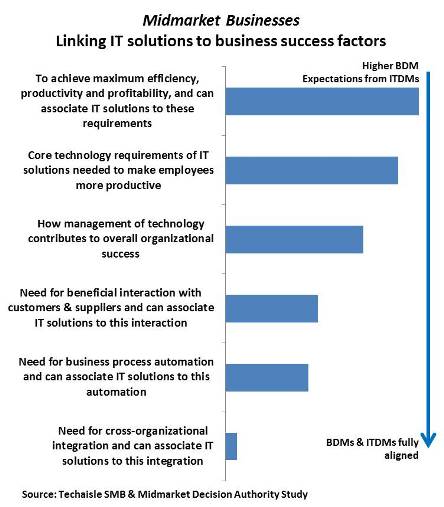
In a unique survey, Techaisle posed the same question, “expectation of associating business success factors to IT solutions” to both BDMs and ITDMs and probed to identify what each expected from the other. Techaisle data shows that BDMs tend to have higher expectations of IT; while business decision makers and technology decision makers are reasonably well aligned in some areas, there is a wide expectation gap in others, which may explain (at least to some extent) the continued proliferation of non-sanctioned, “shadow” IT.

techaisle-midmarket-linking-it-with-business-success-resized

The figure above provides a simplified view of differences between BDMs and ITDMs across several different factors. Although there is a tacit agreement that both business and IT management should understand business related success imperatives and should be able to associate IT solutions to achieving those objectives, closer examination of the data shows some important differences between the two groups:

  • 53 percent of upper midmarket BDMs say that it is very critical for business success that ITDMs are able to identify and associate IT solutions with business efficiency, productivity & profitability. On the on the flip side, only 30% of IT executives in these upper midmarket businesses say that business executives should be able to associate IT solutions with business efficiency, productivity and profitability. Responsibility for delivery clearly rests with IT, and BDMs have very high expectations from ITDMs.
  • Data also clearly shows that BDMs again have high expectations for support in using technology to build customer connections. Over 40 percent of BDMs believe that it is critical that IT has a grasp of solutions that enable beneficial customer & supplier interactions. In contrast, only 1/4th of ITDMs say that BDMs should have a grasp of such solutions.
  • Employee productivity is an important aspect of business and in most cases businesses are expecting IT to understand and deploy core technology solutions to make employees more productive.
  • Business process automation is an area where there is better alignment between IT and business. However, automation is a dominant need within the 100-499 employee size segment; nearly 40 percent of BDMs in the segment say that it is critical that IT can identify requirements for automation and associate IT solutions with these needs.
  • Cross-organizational integration is recognized as being important by both BDMs and ITDMs in mid-size businesses: over 50 percent of both groups agree that it is critical for both business and IT to associate technology solutions with business demands. This is an area where both BDMs and ITDMs are fully aligned.

The trend towards increased BDM involvement in IT decisions is likely to accelerate further. BDMs are already active in shaping demand in core IT markets, and they are the dominant force in high-growth areas like collaboration, social media and business intelligence/analytics. ITDM and BDM divergence will continue and although there is cross-pollination they may as well continue to operate from different pods. Although it may be tempting to try to bring the various parties together, IT suppliers cannot successfully act as intra-corporate matchmakers: they have to come to grasp with the reality of selling to two different constituencies which have different expectations.

Anurag Agrawal

Addressing SMB and Midmarket buyers cloud & mobility journey

In the course of Techaisle’s SMB & Midmarket IT Decision Making Authority: IT vs LoB, BDMs (business decision maker) and ITDMs (technology decision maker) were asked to identify the “greatest benefits” and “key attributes” of both cloud and mobility solutions.

There is an interesting pattern apparent in the survey research findings. When adopting mobility solutions small business BDMs are focused on addressing near-term pain points: attracting new customers, improving accuracy, addressing work/life balance. The ITDMs appear to be taking a longer view, focused on applying automation to bring structure to business processes – improving the quality of interaction through application of mobility solutions, improving the quantity of those interactions, increasing process efficiency.

Midmarket BDMs are looking to mobility to help increase business process efficiency and customer interaction quality. Midmarket ITDMs, on the other hand are focused on increasing the quantity of customer interactions, which would logically impact other core areas (such as business user productivity and process efficiency) as well.

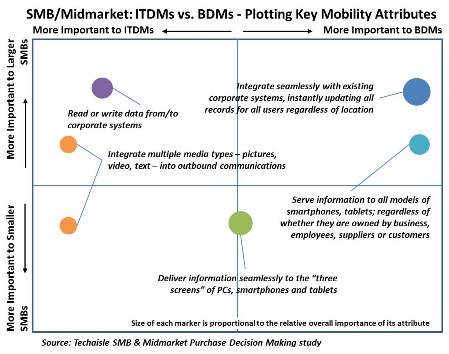
When discussing the mobility solution attributes that BDMs and ITDMs consider important to delivering on mobility benefits BDM and ITDM buyers have similar and common perceptions across all business sizes. “The ability for the mobile solution to be integrated seamlessly with existing corporate systems” – ensuring consistency across devices – is ranked as the most important mobility solution attribute by small business BDMs, and the second-most important attribute by midmarket BDMs. The ability to create and sustain secure connections for remote workers and the ability to deliver seamlessly across the “three screens” of PCs, tablets and smartphones are also priorities for BDMs in both small and midmarket businesses. ITDMs also have some key common areas of focus: the ability to integrate multiple media types into outbound communications and the ability to read or write data from/to corporate systems are the two top-ranked attributes in both employee size categories.

It is clear that each IT and business professional’s perspective on the mobility journey is shaped by their context – by their business objectives, and by the requirements imposed by the size of their organization. In the figure below we have taken the results from the Techaisle survey and plotted them in three dimensions.

techaisle-itdm-bdm-smb-mobility-attributes-resized

A look at the findings from parallel questions on cloud also reveals differences between ITDMs and BDMs, but similarities between small and midmarket firms. Looking at cloud benefits, BDMs, especially in small businesses, view cloud as a means of introducing capabilities that would have been cost or time prohibitive, and of reducing business process costs. ITDMs, on the other hand, view cloud primarily as a means of reducing IT costs. ITDMs in both small and midmarket businesses recognize that cloud can enable their organizations to be more agile, which connects well with a theme expressed by BDMs.

When analyzing the key attributes leading to realization of the above cloud benefits, data shows some differences in emphasis between small and midmarket firms. The most important difference between BDMs and ITDMs is the BDMs’ emphasis on collaboration: BDMs in both small and midmarket businesses are more likely than their ITDM counterparts to view support for collaboration as a key cloud solution attribute. BDMs are also more likely than ITDMs to look to the cloud for detailed reporting and for support of features – disaster recovery, on-demand data access, and mobility support – that may be lacking in their current environments. ITDMs, on the other hand, are focused on technical attributes (scalability, integration, IT management capabilities) that are difficult and/or expensive to develop without third party support.

Understanding the requirements, preferences, success metrics and areas of focus of BDMs and ITDMs within both small and mid-sized businesses is critical to structuring an effective SMB sales and marketing strategy. The findings open the door to an important issue: the requirements in structuring and communicating messages to ITDMs and BDMs within small and midmarket businesses. To effectively engage with and manage the increasingly-diverse decision making unit, IT suppliers will need to structure messages that address the "care-abouts" of BDMs and ITDMs, and deploy those messages through the channels that are most effective at reaching each community.

Trusted Research | Strategic Insight

Techaisle - TA