• TRUSTED RESEARCH

    TRUSTED RESEARCH | STRATEGIC INSIGHT

    SMB. CORE MIDMARKET. UPPER MIDMARKET. ECOSYSTEM
    LEARN MORE
  • COMMS, COLLAB, CONTACT CENTER

    COMMS, COLLAB, CONTACT CENTER

    SMB & Midmarket Buyers Collaboration, Contact Center Study
    LATEST RESEARCH
  • DATACENTER SOLUTIONS

    DATACENTER SOLUTIONS

    SMB & Midmarket Datacenter Solution Adoption Trends
    LATEST RESEARCH
  • PARTNER ECOSYSTEM

    PARTNER ECOSYSTEM

    CHANNEL PARTNER ECOSYSTEM TRENDS STUDY
    LATEST RESEARCH
  • BUYER JOURNEY

    BUYER JOURNEY

    SMB & Midmarket Buyers Journey Research
    LATEST RESEARCH
  • BUYER PERSONAS

    BUYER PERSONAS

    SMB & Midmarket Technology Buyer Persona Research
    LATEST RESEARCH
  • ARTIFICIAL INTELLIGENCE

    ARTIFICIAL INTELLIGENCE

    SMB & Midmarket Analytics & Artificial Intelligence Adoption
    LATEST RESEARCH
  • IT SECURITY TRENDS

    IT SECURITY TRENDS

    SMB & Midmarket Security Solutions Adoption Trends
    LATEST RESEARCH
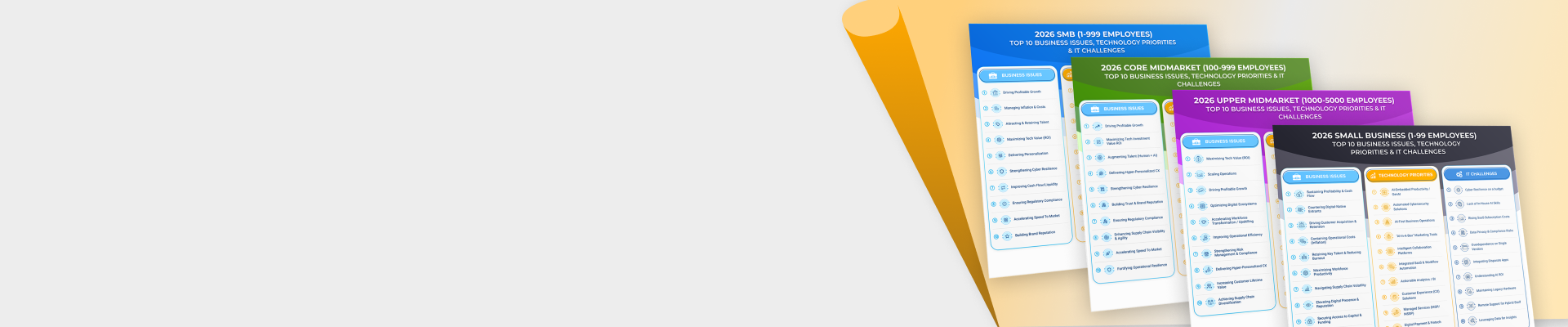
  • 2026 TOP 10 SMB BUSINESS ISSUES, IT PRIORITIES, IT CHALLENGES

    2026 TOP 10 SMB BUSINESS ISSUES, IT PRIORITIES, IT CHALLENGES

  • 2026 TOP 10 SMB PREDICTIONS

    2026 TOP 10 SMB PREDICTIONS

    SMB & Midmarket: Autonomous Business
    READ
  • 2026 TOP 10 PARTNER PREDICTIONS

    2026 TOP 10 PARTNER PREDICTIONS

    Partner & Ecosystem: Next Horizon
    READ

Techaisle Analyst Insights

Trusted research and strategic insight decoding SMBs, the Midmarket, and the Partner Ecosystem.
Anurag Agrawal

Lenovo's Estate Advantage: What the World Cup Proved and the AI PC Debate Keeps Missing

Key Takeaways

  • The advantage is not the AI PC itself. It is the breadth of device categories Lenovo can integrate and manage through a common software and services layer, which is what lets a single agent work across an entire fleet. A vendor focused primarily on PCs has fewer categories to work across.
  • The FIFA World Cup 2026 proved the model at scale. More than 26,000 Lenovo and Motorola devices across three countries, deployed and managed as one fleet, with FIFA highlighting Lenovo’s rapid deployment and managed lifecycle approach as helping accelerate operational readiness in weeks rather than months.
  • The constraint is go-to-market, not portfolio. MSPs influence 61% of SMB PC decisions, yet only 34% of SMBs say their MSP explains the business value of an AI PC. Closing that gap is the highest-return move available to Lenovo today.

For the past two years, almost every conversation I have had about the AI PC has been a conversation about a single device. How many TOPS. Which NPU. How the battery holds up running a model locally. Vendors brief on it, partners repeat it, and buyers listen politely before asking the only question they actually care about: what any of this does for their business on Monday morning.

I have come to think the industry has been measuring the wrong thing, and that the mistake is more basic than any argument about silicon. We keep asking a single device to deliver value that is not created on a single device. Almost nobody does their job on one screen anymore.

Watch how a piece of work moves through a company today. A proposal gets drafted on a laptop, discussed in a message thread on a phone, approved on a tablet in the back of a taxi, and then picked apart the following week on a workstation by someone in finance who was never in the original meeting. No single device holds that story. The work lives across all of them, and so does the context that explains it.

techaisle lenovo estate

That distinction matters enormously once you put an AI agent into the picture, because an agent is only as useful as the context it can actually reach. An agent that lives on the laptop and nowhere else is reasoning about a fraction of what happened. It will summarize the document but miss the decision, because the decision was made on the phone. Techaisle research consistently shows buyers reporting the same frustration in different words, and it is the reason so many AI PC deployments have been underwhelming in practice even when the hardware was perfectly capable.

"We keep asking a single device to deliver value that is not created on a single device," Anurag Agrawal .

Anurag Agrawal

US$1.667 Trillion: WW SMB and Midmarket IT Spend in 2026

Worldwide IT spending by firms with 1 to 4,999 employees will reach US$1.667 trillion in 2026, excluding communication services, and the majority of it will go to IT services rather than to technology products. A market of that size, spread across every economy and every industry, sets the direction for commercial IT rather than following it. These firms are now spending more on the implementation, integration, management, and security of technology than on the technology itself, and the margin between the two is wide and widening.

That composition is the product of two forces working against each other. AI is pulling money up and forward, into software, infrastructure, and services that were not in the budget a year ago. Cost is pulling the other way, as component inflation, tighter budgets, and a higher cost of capital are pushing firms to defer what they can and to rent what they cannot. That second force is the quieter one, and it explains the tilt toward services better than any capability argument does. Buying an outcome instead of an asset moves cost from the balance sheet to the income statement, and it moves operational risk from the firm to the provider. In a year of expensive capital and unforgiving threats, that trade is worth paying for, which is why the money is moving toward services even where the technology itself is cheap.

techaisle smb midmarket it spend 2026

Within services, the mix has shifted. Maintenance, support, and break-fix, the labor of keeping systems alive, once defined the SMB services market. The money is now concentrating in consulting, integration, and putting AI into production. Transformation work has overtaken recurring management, and it is not close.

Anurag Agrawal

The Invisible Enterprise - Why Amazon Quick Dissolves the Application and Why That Favors the Midmarket

For 40 years, enterprise software has run on an assumption nobody priced because nobody could avoid it. The assumption is that a human sits between the systems. Someone reads the email, opens the CRM, checks the ledger, updates the ticket, and carries the context from one application to the next inside their own head. Software grew more capable across those four decades, but the person stayed in the middle as the integration layer. Every organization, large or small, has quietly run on people serving as connective tissue between systems that were never designed to speak to each other.

Amazon Quick is the first credible sign that the integration layer is moving away from the human. My earlier analysis argued that the connective layer is the most defensible position in the agentic stack, which was a claim about where value accrues among vendors. This piece is about the consequences for the buyer. When that connective layer matures into something always on, the application stops being a place you go. It becomes a data source that an intelligence layer reaches into on your behalf. The enterprise, understood as a set of destinations a worker navigates between, begins to disappear. I call the result the Invisible Enterprise. No platform has delivered it yet, but Amazon Quick has assembled the most complete attempt to date.

techaisle amazon quick

The signal is the always-on client

The evidence that this is structural rather than aspirational arrived on April 28, 2026, when Amazon Quick added a desktop application that runs continuously on the machine instead of waiting to be prompted. The desktop client changes the posture from reactive to persistent. It watches the work happen across applications and surfaces what needs attention before anyone asks for it.

Paired with the Knowledge Graph in Quick, the permissions-aware layer that consolidates documents, files, databases, and application data into a single governed foundation, the interface stops being something you operate. It becomes a rendering of intent. You state what you want, Quick assembles the answer or the action from across the estate, and it returns the result with lineage back to the source. Outlook, Teams, Slack, the CRM, and the systems of record recede into the role of data nodes that Quick queries, rather than screens that a worker logs into one at a time.

The shift from prompted to persistent is what earns the word "invisible". A prompted assistant still requires a human to notice that something needs to be done, to switch context, and to ask. An always-on orchestrator can notice the variance, the late shipment, or the stalled approval as it happens, and have the analysis or the draft response prepared before anyone thinks to request it. The work does not move faster so much as it moves out of view. The most valuable work Amazon Quick does is the part the worker never sees, because it runs in the background and is waiting for them when they arrive.

The decoupling of context from the application

Tags:
Anurag Agrawal

Cisco IQ: Repricing the Economics of Infrastructure Support

On Monday morning, 1st June, 2026, a total of 1,500 customers had self-onboarded onto Cisco IQ. By evening, it was 1,600. Tuesday morning, 1,700. By the time I left Cisco Live 2026 in Las Vegas, Tuesday evening, I was told the number had crossed 2,000.

But I am getting ahead of myself.

The Constraint Cisco IQ Removes

Enterprise support has been a reactive business for twenty years, and not for lack of ambition. It was reactive because it was blind. Between audits, no vendor had an accurate, up-to-date picture of what a customer was running, which devices were exposed, and which had drifted out of compliance. Support waited for the failure and billed to fix it. That blindness, not the absence of AI, is the constraint that defined the category.

Cisco IQ removes the constraint. At its simplest, it is an intelligence layer that sits over a customer’s entire Cisco estate. Strip away the module names, and what it does is make that estate continuously legible. It fuses asset telemetry pulled from the live network, contract and entitlement records, and two decades of support history into a single, always-current model of what the customer runs, and it reasons over that model without waiting to be asked. The AI is the visible part, but it sits atop the harder thing: a reconciled, constantly updated model of the estate. That model is what competitors cannot easily reproduce, because it is built from years of data rather than shipped as a feature.

techaisle cisco cx writeup

Tags:

Trusted Research | Strategic Insight

Techaisle - TA