










Techaisle Analyst Insights
Gemini Becomes the Agent: Google Moves the Center of Gravity from Models to Governed Work
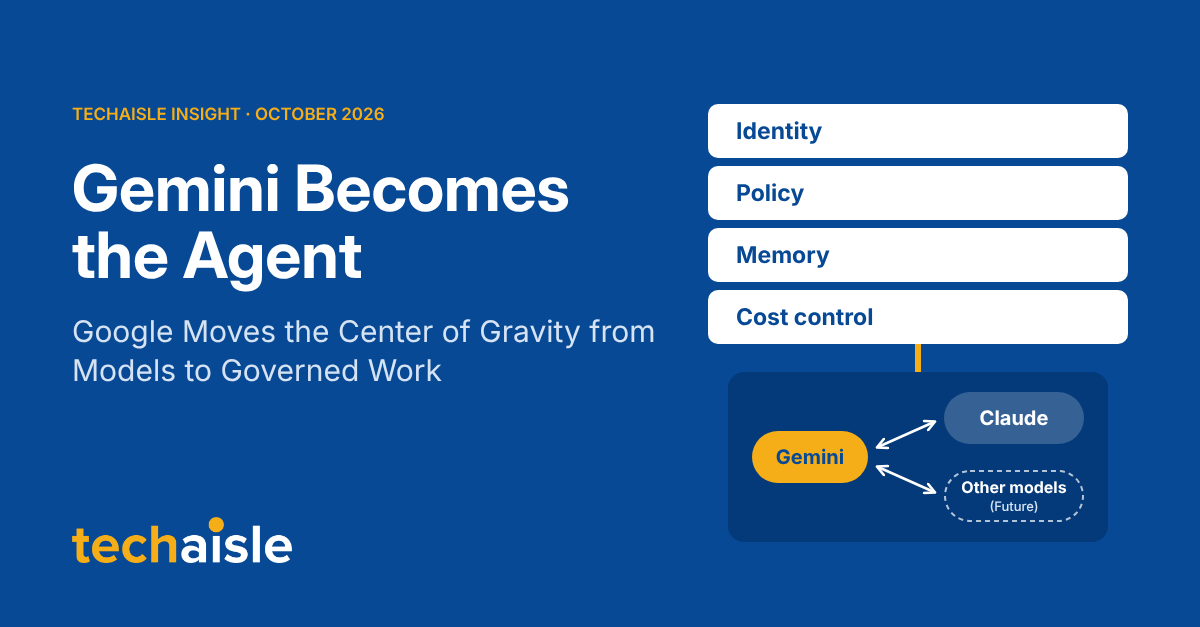
Google's Gemini at Work announcements put one agent, called Gemini, behind every surface a company uses. The agent is meant to be given an outcome rather than instructions, and to return finished work, running across a company's tools and systems for hours or days when the job needs it. Google also separated the agent from the model running underneath, so Gemini can hand a step to Anthropic's Claude when Claude is better suited, with other private and open models to follow. Google is competing on identity, policy, memory, and cost control, and treating the model as a part it is prepared to source from a rival.
For firms with 1 to 10,000 employees, the market Techaisle tracks, model quality is rarely what holds agents back. The harder questions are whether agents stay affordable once usage scales, whether the CISO will let them run, and who will operate them, and Google's launch speaks to those more directly than its enterprise customer stories suggest.
Lock-in moves from the model to the context
Model leadership changes hands several times a year, and few customers want to rebuild their agents each time it does. Gemini's model choice addresses that risk: the agent picks the model for each step, today from Google's own Gemini family or Anthropic's Claude, with other models to follow. Google owns one of the best model families and still built Gemini so customers can choose another. That is a confident bet on the agent, and it works because the switching cost has moved to what the agent knows.
Google is connecting Gemini to its Knowledge Catalog, an existing Google Cloud service, so that every agent works from the company's own business definitions. The catalog holds one agreed definition for each business term and reads metrics from the systems where the company already maintains them. Gemini's memory runs from the task at hand to a record of how the organization does its work, and the agent writes some of its own skills as it goes. After a year of use, that body of definitions, history, and skills is far harder to move than a model is to swap.
Techaisle has long held that you cannot sell AI without data, and agents raise the stakes. If finance and sales define an active customer differently, a fleet of agents will pick one definition and apply it thousands of times before anyone notices. Shared definitions have to be settled before agents act, which makes the Knowledge Catalog one of the more consequential parts of Google's approach.
Gemini also queries data in Amazon S3 and Azure Data Lake without variable egress charges and reads Salesforce, SAP, and Workday data in place. A multi-cloud midmarket firm no longer has to move data before it can start, and moving data first has been the standard objection to consolidating AI on one platform.
The risk for buyers is that context becomes the new lock-in. Google says customers own what they build. It should go further and publish how a customer can inspect, export, and delete what the agent has learned, so procurement teams can verify ownership instead of taking it on trust.
Cost decides adoption below the enterprise tier
Techaisle calls it Token Shock: a pilot succeeds, usage scales, and the consumption bill outruns the budget that approved the pilot. Below the largest enterprises, that is where agent programs stall.
According to Google, there is no incremental seat license for the Gemini agent in Workspace or Gemini Enterprise, and Gemini Enterprise customers can add pay-as-you-go consumption to existing per-user subscriptions. Routing sends routine steps to inexpensive models such as Flash. Administrators can set a hard spending limit per project; the agent stops at the limit until someone restarts it, and per-project tracking lets costs be charged back to departments.
The spending limit is the feature a midmarket CFO will care about, because it converts an open-ended cost into a bounded one. A smaller feature helps almost as much. A report Gemini builds once can be saved and rerun without consuming tokens, so the monthly reporting cycle stops generating consumption charges.
Pricing across the market will keep moving this way. Techaisle forecasts that agentic AI will take 23% of SMB, midmarket, and core enterprise generative AI spending in 2027, and that spending is metered by work completed. Software vendors whose revenue depends on seat counts will have to find another unit.
Routing also creates a new dependency. When the agent chooses the model, Google's routing logic determines a meaningful part of the customer's bill, and regulated buyers will want to inspect it. Google can head off that request by logging each routing and cost decision in the same audit trail it keeps for agent actions.
The CISO decides whether agents ship
The CISO rarely originates an AI purchase and routinely stops one. In our research, the CISO holds veto in 45% of commercial AI decisions, more than any other role, including 50% in the upper midmarket and 44% in the core midmarket. Identity is already the top security need in SMB and midmarket firms, and every agent adds to the identity estate.
Google's governance design meets the CISO's objections head-on. Each agent has its own verifiable identity with only the permissions its job requires, and its actions are logged against that identity and against any sub-agents it creates, never against the employee who started the work. The identity carries into the computing environments the agent starts and into outside systems through OAuth, so the audit trail continues beyond Google's platform. Agent traffic passes through a policy gateway, code runs in isolated environments, and sensitive actions still need a person's approval. A single rule, such as keeping agents out of HR files, applies to every agent in the company.
Techaisle calls this combination Constrained Autonomy. The agent decides how to do the work, and policy sets what it can touch. Partners selling Gemini into security-led accounts should take that design to the CISO at the start of the deal, before the line of business has picked a use case, since security review is where these deals most often stall.
Where Workspace ends and Gemini Enterprise begins
Inside Workspace, Gemini can act for one person, propose tasks it could take on, or join a team as a named colleague with its own account, mailbox, and calendar. Proposing tasks is the more consequential mode. Most employees stall at deciding what to hand off, and a sales manager whose Monday pipeline review is ready before she asks for it will adopt faster than one who has to learn to request it. A named agent colleague also shows up in version history and sees only what people share with it, which makes it easier to audit than an agent working under an employee's login.
Gemini Enterprise lets the same agent act across Slack, Microsoft 365, Salesforce, ServiceNow, Jira, and any MCP server, run code against company data, and govern every agent from one console. The upgrade line is a workflow that crosses a system boundary, which a buyer can recognize without a feature comparison.
Microsoft 365 support is the commercially important part. Many SMB and midmarket firms standardized on Microsoft years ago, and Google had no realistic way into those accounts through Workspace. An agent that works inside an M365 estate gets Google in without displacing anything.
Small business to core enterprise
In our research, 85% of firms below 5,000 employees name talent as a constraint. A company with 2 IT generalists will not build agent identity, monitoring, spending controls, and isolation. It will turn them on in a console if they are there, or go without. That is the Administrative Ceiling, and Google's decision to deliver governance as central settings is what lets its enterprise controls reach these firms.
Techaisle now includes the core enterprise band, firms with 5,000 to 10,000 employees, in its research and forecasts, because it behaves differently from the segments on either side. These firms buy like an enterprise and staff like a midmarket. They answer to enterprise-grade security, compliance, and audit requirements with IT teams a fraction of the size of a Fortune 500 shop, and their AI spending has outgrown a single IT budget. Agent identity across systems, central policy, and departmental chargeback fit their situation closely.
Google's launch references came almost entirely from global enterprises and large public bodies. References from firms of 100 to 10,000 employees, showing completed workflows and bounded costs without a dedicated AI team, would do more to move this market.
What partners sell next
If the agent carries no seat license of its own, the seat stops being the partner's unit of sale. Partners will be paid instead for the work around the agent: deciding which agents a customer needs, writing and maintaining policy, setting routing and spending limits, and connecting the data the agents act on.
Techaisle's Two Economies thesis describes the shift. Advisory work such as prompt training and pilot workshops will shrink as agents remove the need to prompt well. Operational work, running governed agent fleets and being paid for completed work, will grow. Partners are not yet built for it. In the upper midmarket, 42% of partner relationships are project-based, and 5% are managed.
Gemini's skills registry could become a partner product. Customer teams can already publish skills for colleagues to reuse. A partner that has refined how a mid-sized distributor closes its books could package that process once and deploy it across every client, if Google lets partners publish into customer registries. Accenture has formed a dedicated Gemini Enterprise business group. Partners serving firms under 10,000 employees need their own route, including multi-tenant administration of policy, spending, and audit across all their clients. With that in place, a managed service provider becomes a managed agent provider.
Techaisle take
Google's bet is that enterprise AI will be won by whoever governs and meters the work, and that the model will matter less each year. The architecture, pricing, and governance decisions in this launch are consistent with that bet, which is less common in AI launches than it should be.
Google is not alone in this reading of the market. At IBM's Analyst Council this month, IBM made a similar case: as models become cheaper and more interchangeable, value shifts to whoever helps a company run, govern, and pay for AI predictably, and every agent needs its own identity with scoped, revocable access. The two companies start from opposite ends. IBM chose early not to build a frontier model and anchors its control layer in the customer's hybrid infrastructure, while Google delivers control from its own cloud and Workspace. Two companies with such different starting points reaching the same conclusion clearly signals where enterprise AI value is moving.
The test over the next year is a practical one. Can a 2,000-person manufacturer buy Gemini through a partner, set a spending limit, pass its CISO review, and see completed work within a quarter? If Google can show that repeatedly, its position below the Fortune 500 will be stronger than its own launch narrative claims.
When you subscribe to the blog, we will send you an e-mail when there are new updates on the site so you wouldn't miss them.