• TRUSTED RESEARCH

    TRUSTED RESEARCH | STRATEGIC INSIGHT

    SMB. CORE MIDMARKET. UPPER MIDMARKET. ECOSYSTEM
    LEARN MORE
  • INTERWORK 2.0: THE AGENTIC FUTURE OF CONNECTED BUSINESS

    INTERWORK 2.0: THE AGENTIC FUTURE OF CONNECTED BUSINESS

  • 2026 TOP 10 SMB BUSINESS ISSUES, IT PRIORITIES, IT CHALLENGES

    2026 TOP 10 SMB BUSINESS ISSUES, IT PRIORITIES, IT CHALLENGES

  • 2026 TOP 10 SMB PREDICTIONS

    2026 TOP 10 SMB PREDICTIONS

    SMB & Midmarket: Autonomous Business
    READ
  • 2026 TOP 10 PARTNER PREDICTIONS

    2026 TOP 10 PARTNER PREDICTIONS

    Partner & Ecosystem: Next Horizon
    READ
  • ARTIFICIAL INTELLIGENCE

    ARTIFICIAL INTELLIGENCE

    SMB & Midmarket Analytics & Artificial Intelligence Adoption
    LEARN MORE
  • IT SECURITY TRENDS

    IT SECURITY TRENDS

    SMB & Midmarket Security Adoption Trends
    LATEST RESEARCH
  • BUYERS JOURNEY

    BUYERS JOURNEY

    Technology Buyer Persona Research
    LEARN MORE
  • PARTNER ECOSYSTEM

    PARTNER ECOSYSTEM

    Global Channel Partner Trends
    LATEST RESEARCH
  • CLOUD ADOPTION TRENDS

    CLOUD ADOPTION TRENDS

    SMB & Midmarket Cloud Adoption
    LATEST RESEARCH
  • FUTURE OF PARTNER ECOSYSTEM

    FUTURE OF PARTNER ECOSYSTEM

    Networked, Engaged, Extended, Hybrid
    DOWNLOAD NOW
  • MANAGED SERVICES RESEARCH

    MANAGED SERVICES RESEARCH

    SMB & Midmarket Managed Services Adoption
    LEARN MORE

Techaisle Analyst Insights

Trusted research and strategic insight decoding SMBs, the Midmarket, and the Partner Ecosystem.
Anurag Agrawal

Are SMBs the guiding path to Big Data Simplicity?

Various organizations define Big Data differently. Some use “petabytes of data” as a benchmark to isolate big data from other normalized and structured data sets that exist within an organization. However, this measure quickly boxes big data analytics into the large enterprise market segment. Small and mid-market businesses certainly do not have this extent of data but Big Data still relevant for them. In fact Big Data solutions are more relevant for Small and Mid-Market businesses. However, it will take some creativity on the part of solution providers to make Big Data accessible, easy to use and comprehend for segment that constitutes 97 percent of global businesses.

Cloud computing started as an enterprise play, however, it was quickly discovered that SMBs will be the more relevant target segment with a faster path to adoption. Similarly, as Virtualization market started getting fully penetrated within the enterprises, vendors shifted their focus to the SMBs with some very creative solutions. As far as big data is concerned SMBs are starting to show interest and even adoption. However, there is a stark difference in approaches between mid-market businesses and small businesses. While mid-market businesses are experimenting with bespoke solutions, small businesses are gravitating towards a multi-tenant, aggregated and federated big data solution that has a mix of publicly available data and their own internal data.

It is expected that in year 2016, global SMBs would spend US$1.6 Billion on big data solutions exhibiting a growth rate that is faster than what was exhibited by cloud computing solutions. Cumulatively between now and end of 2016, SMBs itself would have shelled out US$3.9 billion on big data solutions. This spending includes hardware, software and services.

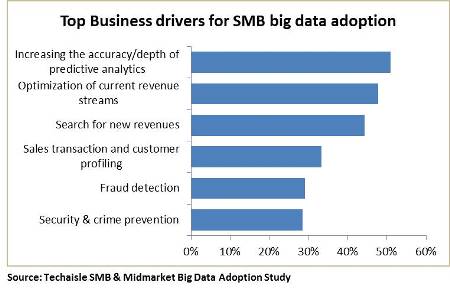
So why are many big data solution providers ignoring SMBs? Simply put, because of perceived complexity and inability to create bite-sized messaging that directly address SMBs pain-points. But they should not forget that business intelligence has now become one of the fastest solutions to be adopted by SMBs. If done right, Big data address three key pain points of SMBs: Increase sales, Efficient operations, Improve Customer service.

Promise of Superior Decision Making

Let us take Techaisle’s recent global mid-market businesses’ Big Data Adoption & Trends study which clearly shows that the promise of superior data-driven decision making is motivating 43 percent of global mid-market businesses to either invest in or investigate Big Data technology. Out of these, 18 percent of mid-market businesses are actively investing in big data related projects. The possibilities of analyzing a variety of data sources, producing action-driven business insights is too big to ignore for these businesses.

Similar to cloud, the attitude towards Big Data is transitioning from “Over-Hype” to “Must-Have” technology with the size of business. Even within the businesses that consider big data to be over-hyped, 29 percent think that it will be an important part of their business decision making process in the future.

Extracting Business Perspectives

Business intelligence by itself has provided enough business insights, however, mid-market businesses are now looking for extracting business perspectives to drive superior decisions and ultimately achieve superior results.  Extracting business perspectives has become important as they rethink their marketing strategies because mobility, social media, and other transactional services have increased the number avenues for connections with their customers and partners.

CRM solutions had first established the analytics for analyzing customer data. However, the data was mostly two-way transactional data. This changed when customers began visiting business websites to explore, browse and perhaps make purchases thus leaving behind a trail of information. IT vendors and mid-market businesses figured out the need to analyze the data and combine it with transactional information.

However, everything changed with the onset of social media, blogs, forums, wikis and opinion platforms where the identification of false positives and negatives became difficult and knowledge about the customer and resulting segmentation became an inaccurate undertaking.

Big data analytics presents the possibilities of connecting together a variety of data sets from disconnected sources to produce business insights whether be for generating sales, improving products or detecting fraud.

It is therefore not surprising that global mid-market businesses are turning towards big data analytics to analyze social media data, web data, customer and sales data along with click-stream machine generated data and even communications data in the form of emails, chat, voicemails.

Leap of Faith or Solution Readiness

Analyzing data from diverse sources leads a mid-market business to naturally consider linking structured and unstructured data. This also drives them to evaluate and select the technology that can be used for simplified implementation. Simplified implementation is important because mid-market businesses do not yet have in-house capabilities to analyze unstructured data and those that have them consider the capabilities at best rudimentary.

Big data therefore is a major leap of faith for mid-market businesses resulting in treating big data analytics projects usually as separate to the existing analytics within the business. More aggressive adopters are planning to use big data analytics along with other analytics in a coordinated manner so that one does not become an inhibitor for the other.

In recent years technology and technology options have evolved extremely rapidly for an average business to understand, evaluate, purchase and implement. The complexity gets further exacerbated with lack of experience, lack of skilled manpower and innate difficulty in identifying external consultants that would be the most right fit for their business objectives and budget availability.

In spite of challenges, the study shows that there have been some successes when business units, IT & data analysts exhibit extraordinary alignment. Our study shows that mid-market businesses typically started their big data journey in one of four ways. Highest success rates for project implementation and generating new insights have been achieved when IT and data analysts work with external consultants from project inceptions.

SMBs as the Path to Big Data Simplicity

The global SMB spend on big-data related deployments will cross US$1.0 billion in 2013 which is a 32 percent increase from 2012. SMBs are still experimenting to see if big data analytics can provide newer insights into their operations and better knowledge about their customers. It is still very early days for small and mid-market businesses to fully embrace big data but they are planting the seeds in terms of re-architecting their IT infrastructure to plan for the future. But we believe that SMBs may very well race ahead of enterprises with their deployments as technology becomes simpler and consultants become experienced.

 
Anurag Agrawal

Whiptail: A friend of big data, foe of storage vendors

Whiptail, the first company to successfully commercialize multi-level flash recently announced its second-generation family of NAND Flash storage products, Accela and Invicta. Accela is an enterprise class, single chassis, and standalone flash storage product. On the other hand Invicta is a modular storage array. It has some very impressive specifications:

  • 6-72 TB of NAND Flash capacity

  • Up to 650,000 IPOS

  • Upto 7 GB/Sec bandwidth

  • Asynchronous replication

  • VMWare and Citrix ready


The products are completely scalable. A mid-market customer can begin with Accela and can add Invicta through InfiniBand as the needs grow. Even within the Invicta chassis, a toup to 6 storage nodes with 6 to 12TB and one router can be added as lego blocks as the data needs evolve.

Analyst Speak

Whiptail’s announcement comes at a time when the buzz about big data has reached a crescendo.  And along with big data, vendors and analysts have started to talk about data obesity and therefore need for storage capacity. Granted that storage capacity needs are multiplying but big data poses a bigger challenge – extremely high throughput and read-to-write performance. Traditional storage vendors have tried to make higher-performing storage either by using as many spindles or constricting drives. None of them technically really address the velocity problem – real time streams of high volume information that is both structured and unstructured. Whiptail is taking the conversation away from storage-capacity play to velocity play thereby reducing the cost of transactions.

Even the channel partners wanting to develop or expand their datacenters and offer cloud-based services can use Invicta because of its multi-tennant, multiple addminstrators, and role-based security capabilities.

Invicta is an application acceleration platform that big data purveyors will love to the bane of other other storage vendors.

Anurag Agrawal
Techaisle
Anurag Agrawal

Intuit brings data-driven insights to small businesses with the launch of Intuit Small Business Revenue Index

Rapid fire announcements from Intuit, all directed towards the betterment of small businesses. Today Intuit announced the availability of Intuit Small Business Revenue Index, which is based on aggregated data from QuickBooks Online. By the very meaning of the term “aggregated” it should be understood that the data is anonymous, that is democratized across 200,000 small businesses. This index is the first of its kind in the market that provides current information on monthly small business revenue. It complements Intuit’s monthly Small Business Employment Index to provide a more complete picture of the economic health of US’s small businesses based on revenue, hiring and compensation trends.

With its latest announcement, Intuit has demonstrated that it is bringing data-driven insights to small businesses, sole-proprietors; insights that were previously only available to large enterprises. This information should empower small businesses to compare themselves against benchmarks and thereby effect changes in their organizations.

It certainly places in the hands of Intuit’s small business customers, power of the data. Both the Employment and Revenue Indexes are updated monthly by Intuit which is far more often than government stats and take a snapshot that is more targeted and pertinent to small business owners. They could use it as a signal for whether it’s time to hire, cut back or increase employee salaries.

As Techaisle had mentioned in its own press release on big data on April 26, 2012, data analytics is equally relevant for small businesses. 12 percent of small businesses using business intelligence are interested in big data analytics. However, they are looking for an IT vendor or partner to collect, collate, and analyze big data and present to these small businesses as a resource, in other words, democratization of big data. The collected data is an aggregation of information being created by other small businesses within the same vertical segment or employee size category. Intuit to my mind, just did it.

Timing by Intuit could not be more perfect.

Anurag Agrawal
Techaisle
Anurag Agrawal

Big Data is the Answer - What was the Question?

The Big Data Analytics' promise: enable “data monetization” through timelier, more accurate, more complete, more granular, more frequent decisions. So, what exactly are the types of business problems big data analytics likely to solve? For this one may need a mini-MBA in Big Data Use Cases.

First let’s define what makes data Big.

Big Data, Little Data
We live in a world of data: transactions, feedback and real-time interaction with customers, partners, suppliers, and employees. In addition to brick, click and mobile transactions, the new variable in the mix is Human generated data – explosive growth of blogs/reviews/messages/emails/pictures. Social graphs such as product recommendations based on circle of friends, jobs you may like, products you have looked at, people who are your contacts etc. also create “second order” data that can be mined for sentiment analytics on products or companies or fact discovery.

Another new variable is computer generated data. Computers generate data as byproduct of interacting with people or with other devices. More the interactions, more is the data and this data comes in a variety of formats from semi-structured log files to unstructured binaries. This “exhaust fumes” of data can be extremely valuable. It can be used to understand and track application or service behavior so that one can find patterns, errors or sub-optimal user experience. One can mine it for statistical patterns and correlations to generate insights.

However, if one listen to the hype, companies can harness this information learn faster, make better decisions, and stay one step ahead of their competitors. Unfortunately, harnessing big data (and separating the signal-from-noise) is trickier than it looks. It takes a lot of skill and superb understanding of use cases.

Big Data Use Cases
The key to exploiting Big Data Analytics is focusing on a compelling business opportunity as defined by a use case — What (What exactly are we trying to do?). Use cases are emerging in a variety of industries that illustrate different core competencies around analytics.

E-tailing/E-Commerce – Online Retailing Use Cases

  • Recommendation engines

  • Cross-channel analytics

  • Event analytics

  • Right offer at the right time


Retail/Consumer Use Cases

  • Merchandizing and market basket analysis

  • Campaign management and customer loyalty programs

  • Supply-chain management and analytics

  • Event- and behavior-based targeting

  • Market and consumer segmentations


Financial Services Use Cases

  • Compliance and regulatory reporting

  • Risk analysis and management

  • Fraud detection and security analytics

  • CRM and customer loyalty programs

  • Credit risk, scoring and analysis

  • High speed Arbitrage trading

  • Trade surveillance

  • Abnormal trading pattern analysis


Web & Digital Media Services Use Cases

  • Large-scale clickstream analytics

  • Ad targeting, analysis, forecasting and optimization

  • Abuse and click-fraud prevention

  • Social graph analysis and profile segmentation

  • Campaign management and loyalty programs


New Applications

  • Sentiment Analytics

  • Mashups – Mobile User Location + Precision Targeting

  • Machine-generated data, the exhaust fumes of the Web


Health & Life Sciences Use Cases

  • Health Insurance fraud detection

  • Campaign and sales program optimization

  • Brand management

  • Patient care quality and program analysis

  • Supply-chain management

  • Drug discovery and development analysis


Telecommunications Use Cases

  • Revenue assurance and price optimization

  • Customer churn prevention

  • Campaign management and customer loyalty

  • Call Detail Record (CDR) analysis

  • Network performance and optimization

  • Mobile User Location analysis


So, What’s the Big Deal?

The big deal is that if analytics is done well there is room for margin expansion and additional profit.

Shirish Netke
(Republished with permission)

Trusted Research | Strategic Insight

Techaisle - TA