• TRUSTED RESEARCH

    TRUSTED RESEARCH | STRATEGIC INSIGHT

    SMB. CORE MIDMARKET. UPPER MIDMARKET. ECOSYSTEM
    LEARN MORE
  • COMMS, COLLAB, CONTACT CENTER

    COMMS, COLLAB, CONTACT CENTER

    SMB & Midmarket Buyers Collaboration, Contact Center Study
    LATEST RESEARCH
  • DATACENTER SOLUTIONS

    DATACENTER SOLUTIONS

    SMB & Midmarket Datacenter Solution Adoption Trends
    LATEST RESEARCH
  • PARTNER ECOSYSTEM

    PARTNER ECOSYSTEM

    CHANNEL PARTNER ECOSYSTEM TRENDS STUDY
    LATEST RESEARCH
  • BUYER JOURNEY

    BUYER JOURNEY

    SMB & Midmarket Buyers Journey Research
    LATEST RESEARCH
  • BUYER PERSONAS

    BUYER PERSONAS

    SMB & Midmarket Technology Buyer Persona Research
    LATEST RESEARCH
  • ARTIFICIAL INTELLIGENCE

    ARTIFICIAL INTELLIGENCE

    SMB & Midmarket Analytics & Artificial Intelligence Adoption
    LATEST RESEARCH
  • IT SECURITY TRENDS

    IT SECURITY TRENDS

    SMB & Midmarket Security Solutions Adoption Trends
    LATEST RESEARCH
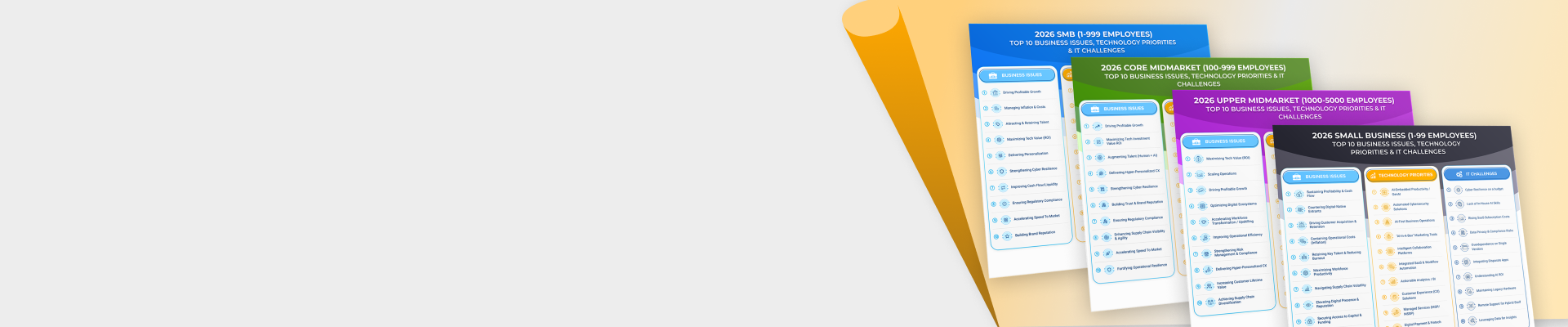
  • 2026 TOP 10 SMB BUSINESS ISSUES, IT PRIORITIES, IT CHALLENGES

    2026 TOP 10 SMB BUSINESS ISSUES, IT PRIORITIES, IT CHALLENGES

  • 2026 TOP 10 SMB PREDICTIONS

    2026 TOP 10 SMB PREDICTIONS

    SMB & Midmarket: Autonomous Business
    READ
  • 2026 TOP 10 PARTNER PREDICTIONS

    2026 TOP 10 PARTNER PREDICTIONS

    Partner & Ecosystem: Next Horizon
    READ

Techaisle Analyst Insights

Trusted research and strategic insight decoding SMBs, the Midmarket, and the Partner Ecosystem.
Anurag Agrawal

Techaisle Take – HPE vs Dell SMB IT solution stack

Comparing Dell and HPE offerings and ecosystems against the Techaisle SMB IT solution stack model

Techaisle’s latest report is designed to help SMB buyers and suppliers identify IT stack requirements, and to compare the offerings and ecosystems of the two current market leaders, Dell and HPE, against Techaisle’s definition of essential SMB & midmarket business technologies. The report is structured in three parts:

  • The IT stack: the report begins by outlining the technologies that SMBs require – and require integration across – in order to support current and emerging business requirements
  • Vendor comparison: an evaluation of Dell and HPE offerings, including core products, non-core products and partner-delivered capabilities, against the stack requirements
  • Evaluating stack suppliers: advice on how to use the stack comparison, and additional Techaisle research findings, to evaluate Dell and HPE strengths
Tags:
Anurag Agrawal

The twin ladder approach to delivering digital transformation for SMB and Midmarket firms

Techaisle's most recent survey of 1600 SMBs & Midmarket firms (defined as 1 employee to 1000 employees), found that only 18% do not have any form of digital transformation initiative. Which means that 82% of SMBs are already on their digital transformation journey. And interestingly, 42% are taking a holistic view of digital transformation. What it means is that these 42% believe the Internet and digital technologies impact every aspect of the business and must become a core part of organizational strategy. What is more encouraging is that SMBs believe that in the next 2 years, 32% of their business activities would be digitized and increase of 30% from 2 years ago. Globally SMBs are expected to spend US$250 billion on digital transformation in 2018.

Techaisle’s extensive research also identified that successful implementation requires a journey through digitization and digitalization, from substitution to augmentation to modification and redefinition, spanning all of the functions in an organization and all of the technology used to support its activities. Based on both quantitative survey and depth-discussions with SMB and midmarket businesses on the transformation journey Techaisle has developed the twin ladder view of digital transformation. Figure below presents a single-image depiction of the ‘twin ladders’ of digital transformation. The bottom set of steps is labelled “the technology ladder,” and stretches from the deployment of modern, flexible infrastructure to advanced IT-enabled capabilities. The technology ladder begins with the building blocks needed to establish infrastructure that is capable of supporting digital transformation. It includes mobility, virtualization, hyperconverged infrastructure & converged infrastructure and other technologies essential to provisioning advanced IT services. Businesses need to deploy and make use of the building blocks and platform technologies before they can launch initiatives that are truly transformative for their businesses and customers.

Anurag Agrawal

Survey shows SMB and Midmarket BDMs control cloud business applications purchase

Techaisle's SMB & midmarket decision making & buyers journey report confirms that business decision makers (BDMs) – who tend to inhabit the ‘carpeted’ realms of their businesses – are more engaged by discussions about business benefits and objectives than by ‘feeds and speeds’. Cloud business application sales reps will need to develop ‘deep carpet’ language and skills. Techaisle survey data shows that:

  • Determining the need for new cloud business applications is the prerogative of business management. The balance of authority within SMBs is nearly 7:1 in favor of business management except in the case of midmarket businesses where it is nearly 2:1
  • Neither business nor IT have a clear authority within 29 percent of small businesses and 22 percent of midmarket businesses to purchase new business applications, yet, cloud applications do get adopted driven by need, experimentation, and rogue adoption
  • At 32 percent, ad-hoc purchases are more popular within upper midmarket businesses than any other employee size business
  • Business management also has authority over determining the needs for enhancements to cloud business applications. The balance of authority within small businesses is 5:1 in favor of business management and 1.2:1 for mid-market businesses
  • Neither business nor IT have a clear authority within 17 percent of Small Businesses and 21 percent of midmarket businesses to enhance already deployed business applications, yet, these applications do go through significant modifications and upgrades to better serve the needs of business management
  • SMB Business management controls the budget and purchase authority by 8:1 as compared to IT management. However, within the midmarket businesses, the control ratio drops to 2:1 indicating that it is easier to sell cloud technology to small businesses than midmarket businesses since the decision-making units are dissimilar
  • In 15 percent of SMBs budget for new business application is usually created at the time of ad hoc decisions for purchase to meet business needs
Anurag Agrawal

Techaisle research shows SMB and midmarket technology purchase process becoming more complex

We are in the midst of a transition from an IT industry shaped by small decision making units (DMUs) comprised of IT professionals to an industry that must respond to the varied needs of BDMs and ITDMs. This makes for a very complex selling environment; many IT suppliers would no doubt like to have ‘the genie hop back into the bottle,’ as many members of their sales and marketing teams lack the skills and understanding needed to sell to BDMs.

Techaisle research on SMB and Midmarket buyers journey and decision-making shows that ITDMs and BDMs have differences in ‘care-abouts, are focused on applying IT to different business objectives, have different perceptions of success measures, and use different information sources. The data is not only helpful in building relevant marketing messages, but also serves to underscore the complexity of working with a diverse DMU. This DMU becomes further complicated with the presence of IT conversant business specialists (embedded IT staff), increasingly residing within line of business units, reporting to business, and away from IT.

  • Business management has seized a much greater role in technology acquisition, deployment & management than IT management – varying from 3.4X in “needs identification” to 2.0X in “solution evaluation & selection”
  • Within small businesses, business management plays a more influential role than IT in five out of nine stages of technology solution adoption
  • Within mid-market businesses, role of business management is predominant in the first three stages of decision making (needs identification to solution options), equal to IT in the next two (solution evaluation & selection) and substantially higher than IT in the last two stages (determining solution effectiveness and optimization)
  • In nearly 1/4th of small businesses and slightly over 1/3rd of medium businesses, technology specialists (embedded IT staff) are employed within Business Units not reporting to IT management. In nearly 50 percent of midmarket firms that have IT specialists, they are the primary decision makers
  • Determining the need for new cloud business applications is the prerogative of business management. The balance of authority within SMBs is nearly 7:1 in favor of business management except in the case of mid-market businesses where it is nearly 2:1
  • Ad-hoc purchase and deployment of new cloud business applications is prevalent within 22 percent of mid-market businesses
  • In 15 percent of SMBs budget for new business application is usually created at the time of ad hoc decisions for purchase to meet business needs

Trusted Research | Strategic Insight

Techaisle - TA