









• TRUSTED RESEARCH

    TRUSTED RESEARCH | STRATEGIC INSIGHT

    SMB. CORE MIDMARKET. UPPER MIDMARKET. ECOSYSTEM
    LEARN MORE
  • INTERWORK 2.0: THE AGENTIC FUTURE OF CONNECTED BUSINESS

    INTERWORK 2.0: THE AGENTIC FUTURE OF CONNECTED BUSINESS

  • 2026 TOP 10 SMB BUSINESS ISSUES, IT PRIORITIES, IT CHALLENGES

    2026 TOP 10 SMB BUSINESS ISSUES, IT PRIORITIES, IT CHALLENGES

  • 2026 TOP 10 SMB PREDICTIONS

    2026 TOP 10 SMB PREDICTIONS

    SMB & Midmarket: Autonomous Business
    READ
  • 2026 TOP 10 PARTNER PREDICTIONS

    2026 TOP 10 PARTNER PREDICTIONS

    Partner & Ecosystem: Next Horizon
    READ
  • ARTIFICIAL INTELLIGENCE

    ARTIFICIAL INTELLIGENCE

    SMB & Midmarket Analytics & Artificial Intelligence Adoption
    LEARN MORE
  • IT SECURITY TRENDS

    IT SECURITY TRENDS

    SMB & Midmarket Security Adoption Trends
    LATEST RESEARCH
  • BUYERS JOURNEY

    BUYERS JOURNEY

    Technology Buyer Persona Research
    LEARN MORE
  • PARTNER ECOSYSTEM

    PARTNER ECOSYSTEM

    Global Channel Partner Trends
    LATEST RESEARCH
  • CLOUD ADOPTION TRENDS

    CLOUD ADOPTION TRENDS

    SMB & Midmarket Cloud Adoption
    LATEST RESEARCH
  • FUTURE OF PARTNER ECOSYSTEM

    FUTURE OF PARTNER ECOSYSTEM

    Networked, Engaged, Extended, Hybrid
    DOWNLOAD NOW
  • MANAGED SERVICES RESEARCH

    MANAGED SERVICES RESEARCH

    SMB & Midmarket Managed Services Adoption
    LEARN MORE

Techaisle Analyst Insights

Trusted research and strategic insight decoding SMBs, the Midmarket, and the Partner Ecosystem.
Anurag Agrawal

2021 Top 10 SMB and Midmarket Business Issues, IT Challenges, IT Priorities

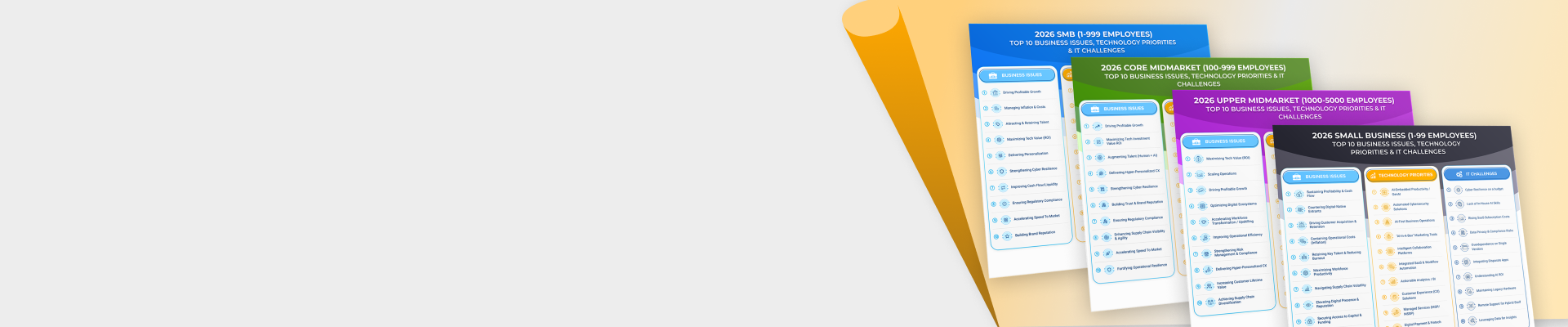
One of Techaisle's SMB surveys' annual highlights is exploring top business challenges and IT priorities for small and midmarket organizations. They are here - Techaisle's annual SMB and Midmarket Top 10 IT Priorities, IT Challenges, and Business Issues infographics, 11th year of Techaisle tracking at a WW level, and is sought after by IT vendors, channels, and media. In all sectors, 2020 was a challenging year – and as a result, 2021 is challenging from a market planning perspective. The disconnect between 2020 and 2019 was so severe that it rendered forecasts effectively useless: IT suppliers reacted to shifting market trends in real-time. As we enter 2021, IT product and service suppliers look to create a context for understanding the range of outcomes that the new year may bring. Techaisle's "2021 in Focus" research series illuminates issues and requirements in the vast SMB market to support that effort.

Techaisle surveyed a total of 5720 SMBs, quota sampled to ensure adequate coverage of four small business (1-9, 10-19, 20-49, and 50-99 employees), three midmarket (100-249, 250-499, and 500-999 employees) and two upper midmarket (1000-2499, 2500-4999) segments. The data represents a robust and reliable sampling of the SMB market for IT products and services.

There is an ongoing trend – in both the buy-side and supplier communities – towards positioning IT initiatives and expenditures in a business context. By providing insight into the most pressing business issues, IT priorities, and IT challenges faced by small, midmarket, and upper midmarket businesses, Techaisle's research helps readers position their go-to-market strategies and offerings with core market drivers.

For 2021, Techaisle investigated 30 technology areas, each with several sub-technology categories, 30 IT challenges, and 30 business issues.

View and download Top 10 SMB Business Issues, IT Priorities, and IT Challenges
View and download Top 10 Midmarket Business Issues, IT Priorities, and IT Challenges
View and download Top 10 Upper Midmarket Business Issues, IT Priorities, and IT Challenges

In 2021, data shows that hybrid/remote work enablement is either the 2nd or 3rd top IT priority depending upon the segment. Collaboration, which Techaisle researched as a discrete category, is the 2nd top priority within SMBs, 3rd in the midmarket, and 6th in the upper-midmarket segments. Collaboration is already an established framework in most midsized businesses, hence a lesser priority in the enterprise-level mid-sized firms. There is a wide-ranging trend towards seeing collaboration as part of the fabric of business activity, rather than merely a means of enabling connections between discrete tasks. It is a core component for midmarket firms' digital transformation. For these firms, VDI and analytics are a greater priority.

The 2021 business challenge findings depict a wide range of objectives: expansion of the customer base, improved top-line, and bottom-line results, cost control (within IT and across the organization), competitiveness, improvement of existing operations and processes, product and process quality, workforce and regulatory issues, and (perhaps as a nod to the pandemic) a need for enhanced ability to manage the unknown.

It is a diverse list. But what is remarkable is that analytics solutions can help address all of these issues – and that, indeed, SMBs are using analytics to manage each today, which gives marketers who sell analytics solutions an enormous advantage. They can position their products as addressing strategic business priorities.

By far, within the SMB segment, the highest adoption growth rates will likely be in 5G, SD-WAN, containers/Kubernetes, UCaaS, VR/AR, AI, HCI, Customer experience tools, and Open-source solutions.

View and download Top 10 SMB Business Issues, IT Priorities, and IT Challenges
View and download Top 10 Midmarket Business Issues, IT Priorities, and IT Challenges
View and download Top 10 Upper Midmarket Business Issues, IT Priorities, and IT Challenges

2021 top10 smb it priorities business issues techaisle infographic blog

2021 top10 midmarket it priorities business issues techaisle infographic blog

2021 top10 upper midmarket it priorities business issues techaisle infographic blog

Anurag Agrawal

US SMB IT spending will grow by 7.6 percent in 2021

US SMB IT spend is forecast to grow by 7.6% in 2021 over 2020. In July 2020, we had written that resiliency, agility, and adaptability would accelerate recovery for SMBs. Techaisle's survey of 1720 US SMBs confirms the prognosis for the US market. Data shows that 45% of US SMBs will be in the high growth segment, with IT budget increases ranging between 7.5% to 15%. However, 12% of SMBs will experience budget decreases of more than 5%. The majority of the declining IT growth segment will be in the 1-49 employee sizes. Regardless, the small businesses will grow their IT spend. There is an apparent dichotomy appearing in how technology is likely to be acquired by SMBs. Nearly two-thirds of micro-businesses prefer acquisitions structured around leases, whereas one-fourth of midmarket firms plan to move to "as-a-service" approaches.

IT services spending will grow by 8.6%, driven by managed services, data/platform integration, cloud orchestration, and business process automation. As cloud applications increase, the demand for hybrid IT is becoming a pressing requirement for SMBs.

2021 will be the year of the midmarket segment, with IT spending forecast to grow by 8%. Data illustrates a fascinating picture showing IT budget increasing in direct proportion with size, from 100-249 to 500-999 employee firms. The upper midmarket (1000-4999 employee size segment) will have an average budget increase of 6.1%, slightly lower than the 500-999 size business.

Anurag Agrawal

Top 10 SMB and Midmarket Predictions for 2021

In all sectors, 2020 was a challenging year – and as a result, 2021 is challenging from a market planning perspective. The disconnect between 2020 and 2019 was so severe that it rendered spend forecasts virtually useless: IT suppliers reacted to shifting market trends in real-time. As we enter 2021, IT product and service suppliers look to create a context for understanding the range of outcomes that the new year may bring. Techaisle's 2021 report series illuminates issues and requirements in the vast SMB market to support that effort. To start 2021, here are our top 10 predictions.

1. Digital inequality will be more important than the digital divide
2. Quest for reinvention, innovation, resiliency will drive bursts of incremental transformation goals
3. The hybrid workplace will require HR focus and drive adoption of workspace, workflow solutions
4. Meaningful customer partners and not trusted advisors will determine supplier success
5. Pragmatism will overtake progressiveness in technology adoption for a future-ready organization
6. Requirements for automation and enhanced IT services will become time-critical
7. Security and risk mitigation will focus on a safe middle ground
8. Systems of insight will move into the analytics mainstream
9. AI will arrive as a capability integrated within other solutions
10. Open source adoption will become an indicator of cloud success

Anurag Agrawal

SMB security and risk management – IT focusing on ensuring integrity of technology infrastructure

Risk mitigation is everyone's business, and SMB IT is uniquely positioning to manage reliability, privacy, and cyber-risk. In most SMBs, IT's role is to provide users with fast and reliable connections to needed systems and data. Increasingly IT is expected to prevent leakage of sensitive information that could harm the business or its customers. A global survey conducted by leading research firm Techaisle found that security solutions (cloud and mobility) are seen as a top IT priority by 75% of SMBs.

There is evidence of the enormous requirement for the defense of an ever-expanding perimeter – but if anything, it understates SMB's focus on cybersecurity. SMBs have deployed, and continue to deploy, increasingly-sophisticated shields to protect against the relentless advance of threat sources attacking businesses of all sizes through their cloud instances, mobile devices and connected users, and new technologies (such as IoT) and core networks and systems. SMBs (and the managed services suppliers they work with) are responding by developing better internal processes and deploying IT security solutions that are frequently enhanced by advanced features rooted in analytics and AI.
Defense against cyber-threats requires a comprehensive approach that spans people, process, and technology: appropriate systems need to be deployed, configured, integrated and continuously upgraded, processes – particularly related to the management of sensitive data – need to be established and embedded in work routines, and staff (all users, including IT) need regular and relevant training. A gap anywhere in this continuum will leave openings that intruders can exploit.
And as daunting as a defense against cyber-risk may be, the reality is that IT's role in ensuring information and infrastructure integrity is extending into other vital areas as well. With businesses now reliant on technology for most tasks' performance, IT must deliver continuous access to systems and safeguard data against loss. And in most environments, it is expected that IT will play a meaningful role in maintaining the privacy of sensitive data. In today's SMB, the IT leader is responding to multiple risk management demands.

SMBs typically start with basic endpoint/user security technologies – and many stop there as well. Even organizations that deploy additional 'shields' often shy away from taking the next step beyond trying to prevent a breach: assuming that a breach will occur and developing processes and deploying technologies needed to minimize the resulting damage and exposure. Some experts also point out that many firms – SMBs and enterprises – don't fully understand their devices (including back-end infrastructure, user devices and sensors), access points, applications, data, and system users. Building this inventory is an essential step in understanding the scope of potential exposure to breaches or losses.
Deployment of security technology will be an ongoing challenge as SMBs attempt to identify, budget for, deploy, integrate, and operate the security shields that are most important to their businesses' operations. In many cases, access to skilled professionals is the most tricky part of this equation. In this environment, SMBs struggle to attract and retain capable security staff members. Increasingly, this is leading to the use of managed security services: Techaisle's global survey shows that managed security, currently used by 29% of SMBs, is in the plans of an additional 44% of small and medium businesses – which will result in a 152% increase in the use of managed security services. 

Privacy is a component of many different SMB business responsibilities: it is critical to compliance, and as a result, to senior executives and shareholders; it is a crucial issue for legal advisors; included in statements made by marketing; and of course, concerning data, it is assumed to be something that is managed by IT. Privacy is a cross-functional responsibility. Sensitive data needs to be classified as such and prioritized for the highest-level security; the security may be an IT function, but the classification needs to be done by the business leaders closest to the inputs and implications of disclosure. Leaks are very often the work of insiders rather than anonymous external hackers. Here, too, while IT plays a role (through monitoring technologies and systems that look to prevent data exfiltration), HR and business unit managers also need to be proactive in preventing privacy breaches.

Security – both the technology and the skills needed to optimize security systems and keep them current, integrated, and complete – is one of IT's most complex areas. To address these complex (and related) issues, SMB IT is needing to develop a portfolio of security technologies and skills that is equal to the task of defending against cyber-threats; develop and continuously execute on business continuity plans; deploy network and access technologies that are aligned with user needs; implement training approaches and management processes that reduce the risk that human error (or malfeasance) will bypass the SMB's technology shields.

They cannot do it in isolation. There is no 'silver bullet' that SMB executives can use to deliver a failure-proof, future-proof approach to risk management. However, by connecting security, privacy, and reliability/continuity – by working with the right suppliers who understand business requirements – SMB IT leaders want to make a real difference to their organizations' regulatory compliance, customer trust, and bottom-line success.

Trusted Research | Strategic Insight

Techaisle - TA