










• TRUSTED RESEARCH

    TRUSTED RESEARCH | STRATEGIC INSIGHT

    SMB. CORE MIDMARKET. UPPER MIDMARKET. ECOSYSTEM
    LEARN MORE
  • INTERWORK 2.0: THE AGENTIC FUTURE OF CONNECTED BUSINESS

    INTERWORK 2.0: THE AGENTIC FUTURE OF CONNECTED BUSINESS

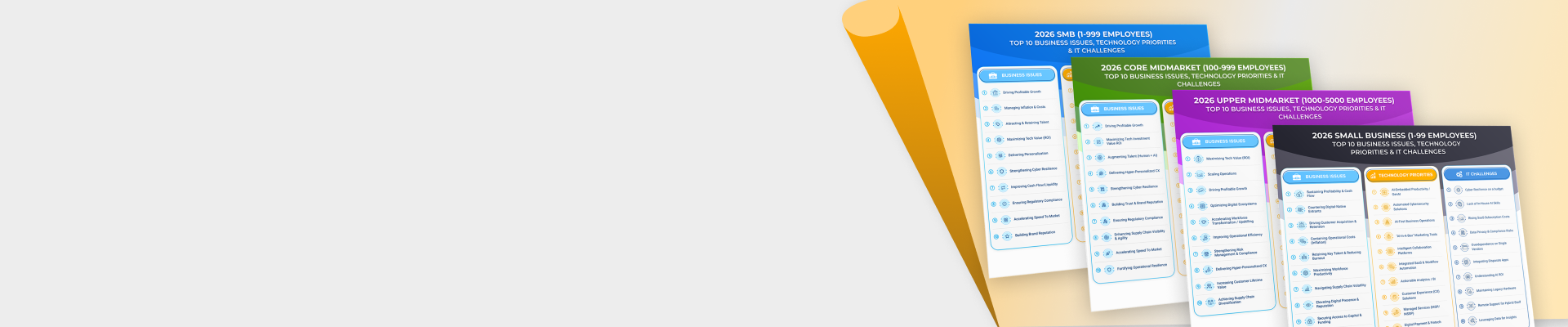
  • 2026 TOP 10 SMB BUSINESS ISSUES, IT PRIORITIES, IT CHALLENGES

    2026 TOP 10 SMB BUSINESS ISSUES, IT PRIORITIES, IT CHALLENGES

  • 2026 TOP 10 SMB PREDICTIONS

    2026 TOP 10 SMB PREDICTIONS

    SMB & Midmarket: Autonomous Business
    READ
  • 2026 TOP 10 PARTNER PREDICTIONS

    2026 TOP 10 PARTNER PREDICTIONS

    Partner & Ecosystem: Next Horizon
    READ
  • ARTIFICIAL INTELLIGENCE

    ARTIFICIAL INTELLIGENCE

    SMB & Midmarket Analytics & Artificial Intelligence Adoption
    LEARN MORE
  • IT SECURITY TRENDS

    IT SECURITY TRENDS

    SMB & Midmarket Security Adoption Trends
    LATEST RESEARCH
  • BUYERS JOURNEY

    BUYERS JOURNEY

    Technology Buyer Persona Research
    LEARN MORE
  • PARTNER ECOSYSTEM

    PARTNER ECOSYSTEM

    Global Channel Partner Trends
    LATEST RESEARCH
  • CLOUD ADOPTION TRENDS

    CLOUD ADOPTION TRENDS

    SMB & Midmarket Cloud Adoption
    LATEST RESEARCH
  • FUTURE OF PARTNER ECOSYSTEM

    FUTURE OF PARTNER ECOSYSTEM

    Networked, Engaged, Extended, Hybrid
    DOWNLOAD NOW
  • MANAGED SERVICES RESEARCH

    MANAGED SERVICES RESEARCH

    SMB & Midmarket Managed Services Adoption
    LEARN MORE

Techaisle Analyst Insights

Trusted research and strategic insight decoding SMBs, the Midmarket, and the Partner Ecosystem.
Dr. Cooram Ramacharlu Sridhar

What is Cisco’s Brand Equity Score among its SMB Channel Partners?

SMBs are being deluged with IT solutions that aim to address their pain points of reducing costs, improving sales and marketing, penetrating new markets, improving employee and group productivity as well as managing more IT with less. The channel comprising of SIs, VARs, SPs, MSPs and IT Consultants form the essential cogs of an IT vendor’s eco-system that puts products and solutions in the hands of the SMBs.

Today’s SMB channel has numerous vendors to partner with to build and grow its business especially if they are targeting the SMB segment. Each channel partner has usually has multiple vendor partnerships. It is therefore essential to have a positive mindshare of the channel which would potentially translate to wallet share.

Techaisle’s SMB Channel BES-360 provides an actionable path for IT vendors to manage their channels. Techaisle’s BES-360 Model looks at the equity of the brand on six overall independent dimensions:

    1. Emotional,


    1. Likeability,


    1. Rational,


    1. Dispositional,


    1. Visibility, and


    1. Human Connect


The data is collected by conducting a primary research and thereafter using ANN (Artificial Neural Networks) we model the responses on several variables with action variable using a non-linear model. Action variables are crucial to measuring brand equity, since having a brand equity which does not lead to action is useless. Techaisle’s BES 360 uses ANN for computing the dimensional weights as opposed to assigning arbitrary weights or no weights at all.

Cisco’s Brand Equity Score with SMB Channel Partners = 41

The model reveals that the BES of Cisco is 41 on a scale of 1-100. The question is, is this good or bad? Since the highest BES is 56, 41/56 is “Good”. Two other IT vendors including IBM have a higher BES than Cisco.

techaisle-cisco-bes-channel-partners


Breaking down the data for Cisco we find that almost 25 percent of Cisco’s channel partners have a BES of 80+. They form Cisco’s core partners. The customized report can delve deeper into the typical profile of these SMB channel partners of Cisco. The data also shows that almost 35 percent of Cisco’s SMB channel partners have equity of less than 40. These are the partners that Cisco needs to work with to try and raise the brand equity. Further research could also be conducted to check and see what these partners contribute to Cisco’s business and their relative importance.

If we look at Cisco’s equity among its own channel partners and non-partners, the difference in equity is substantial. The BES of Cisco among its partners is 55 and among non-partners the BES is 29. A polarised equity pushes a brand in to a niche status, which may not be desirable for all brands Cisco’s BES is the highest among the channel partners of Avaya and even among the channel partners of SAP too the BES is quite high. These could be potential channel partners for Cisco. techaisle-bes-cisco-3

  techaisle-bes-cisco-score-3


 Techaisle’s BES-360: Why is Brand Equity Score Important?

Companies no longer produce products and services but deliver a brand experience through their products and services. It is widely recognized that the status of a brand in the mental space of the customer is best measured through brand equity. If the brand equity is good then a product or service that is similar to another brand with lower brand equity will sell better. Additionally, a brand with a good product or service but lower brand equity has a lower customer satisfaction compared to a brand with a higher brand equity that offers the same, if not an inferior, product or service. Hence measuring and tracking brand equity score is of critical importance to brand management.

What is the key information that I will get from Techaisle’s BES-360 to manage my brand?

Our customized report answers following nine relevant questions:

    1. What is my BES and my competition in the industry?


    1. What is my BES among my channel partners? Understanding overall equity is fine but this equity should also be good among its own channel partners and the difference between the equity among a vendor’s own channel partners and the non-partners should be significant. Otherwise it indicates a non-exploitation of the market completely.


    1. What is my Brand Equity profile of my channel partners? The data and analysis provides critical information for assessing the potential for expanding the foot print of the brand to the other channel partners. The composition of the BES among the channel partners of a brand indicates the core strength of the brand. A brand needs to know what proportion of their customers are at, say, half the total BES? If a small portion of the channel partners have high brand equity and a large number have low brand equity then the customer base is shaky.


    1. What is my BES among the partners of other channels?


    1. What is the composition of my channel partners at various levels of BES? A brand would like to know the business that their partners generate at different levels of brand equity. For example: what is the number of solutions offered by a channel partner whose equity is twice the average brand equity? Such information can be quite useful to build a complete business strategy by better equity management.


    1. How is the BES affecting my business among my channel partners?


    1. What do I do to improve my brand equity? We measure brand equity on nine variables. We can dive and pick up the dimensions on which the brand needs to score. In fact we can even suggest using an optimization scheme the best values of the dimensions that the brand should achieve.


    1. What business improvement do I expect at 5% increase in my brand equity from my channel partners? We can do a detailed analysis of our data to indicate what will be the impact of an increase of 5, 6, 7 or more points on the business, using the survey data.


    1. Which brands’ partners should I choose to enlarge my foot print?


For SMBs, channel partners are the trusted advisors. Addressing the channel partners directly contributes to raising the brand equity among SMBs (measured separately by Techaisle). We call it BES-360 because it covers all the dimensions as well as competition.

If more information is needed for developing a comprehensive and successful marketing strategy Techaisle has the capability to provide the necessary information. From the current data itself we can get more information by looking at the scores on each of the nine variables. However, we can also do a dedicated BES 360 Survey for a specific brand and get a comprehensive picture of the brand that can identify and answer strategic questions like “Why my score is low on the VISIBILITY dimension and what should I do about it?”

 

Anurag Agrawal

SMBs Mixing and Matching Vendors to Find Best Virtualization Solutions

Techaisle’s SMB technology adoption study shows that 72 percent of SMBs find Virtualization to be one of the most relevant technologies for their business, 2nd only to backup and disaster recovery. The actual adoption gets hindered because 56 percent of SMBs find Virtualization to also be one the most complex technologies to understand and adopt. (See infographic)

SMBs cite several reasons for adopting server virtualization; key among them are reducing operating cost, backup and disaster recovery and reducing cost of IT support. Improving existing server and hardware systems utilization is mentioned by 32 percent of SMBs.

In our survey of SMBs either currently using or planning to use Virtualization technologies we found that SMBs currently using Virtualization tended to have a mixed brand Virtualization environment, not relying on a single vendor for the solution, but mixing and matching as they saw appropriate based on their specific requirements.

techaisle-smb-diverse-virtualization-installations


For example, the above chart shows that within VMware Server Virtualization environments, 66 percent of SMBs also use VMware client Virtualization technology, with both Microsoft and Citrix making up the difference for the client side. Similarly, 78 percent of SMBs that use Microsoft server Virtualization also use Microsoft client Virtualization. Several other findings become apparent from the above chart:

  • VMware and Citrix have the most relatively mixed virtualization environment as compared to Microsoft

  • Citrix and Microsoft may have a slightly deeper partnership that enables SMBs using Citrix server Virtualization to be combined with Microsoft client Virtualization more easily and cost effectively


However, we cannot look at the above chart in isolation. SMBs have been using Virtualization technologies as the market developed.

In the words of one VP of IT for a mid-market business, “We use Citrix, VMware, Microsoft Hyper-V, and emulation from Ericom. There are ‘n’ numbers of products that are being used in the whole gamut of things”.

The Venn diagram below not only exposes the vulnerabilities faced by Virtualization vendors but also demonstrates that the market is big enough for solutions from all vendors to work in a heterogeneous IT environment.

techaisle-smb-virtualization-mixed-brand-adoption


For example, the above Venn diagram shows that only 12 percent of SMBs use only VMware Virtualization solution which is twice that of Citrix and almost one-fourth of Microsoft. And 9 percent of SMBs use Virtualization solutions from VMware, Citrix and Microsoft. Once we start to include solutions from Parallels, NComputing, Oracle and others the overlaps become very complicated to map.


Our research found that SMBs usually go through a round of server consolidation before moving to Virtualization.

“The very first step was actually to go for server consolidation. Once the servers were consolidated, then the desktop virtualization was performed. So, typically for VDI architecture or any other technology, the first thing is the server consolidation and after that the procurement of solution and licenses were done from VMware and Citrix for the VDI and after which the user terminals were changed”, this according to one IT Director, Mid-market business.

Not all Virtualization projects finish smoothly. SMBs have also had different experiences with each of the three major brands for server Virtualization projects as shown in the chart below:

techaisle-smb-virtualization-project-implementation-issues


The factors affecting each of the projects could be dependent upon:

  • SMBs’ readiness

  • Channel partners’ capabilities


However, the top 3 most common areas that need addressing are Compatibility Issues, Cost Overruns and Lack of Experience, which are perennial issues as all SMB users adopt new technologies.

“The major challenge was the cost, because the initial hardware investment was huge. Getting rid of the system and moving to the cloud and installing virtual servers required purchasing of physical storage and upgrading the system. Another challenge that we faced was the initial configuration which was addressed timely and efficiently by our partners”, Vice President, IT (500 employee size company).

But SMBs have gained tremendous advantages from using Virtualization. “It certainly has helped us to avail richer network services without increasing our capital investment and has increased our operational efficiency. Moreover computing and networking are much simplified now”.

For additional information on this and other topics from the blog, please feel free to contact us for a discussion and gratis consultation.

To purchase Techaisle’s SMB Virtualization Trends and Adoption study or engage Techaisle in a deep-dive custom research please send an email to This email address is being protected from spambots. You need JavaScript enabled to view it.


Trusted Research | Strategic Insight

Techaisle - TA