










• TRUSTED RESEARCH

    TRUSTED RESEARCH | STRATEGIC INSIGHT

    SMB. CORE MIDMARKET. UPPER MIDMARKET. ECOSYSTEM
    LEARN MORE
  • INTERWORK 2.0: THE AGENTIC FUTURE OF CONNECTED BUSINESS

    INTERWORK 2.0: THE AGENTIC FUTURE OF CONNECTED BUSINESS

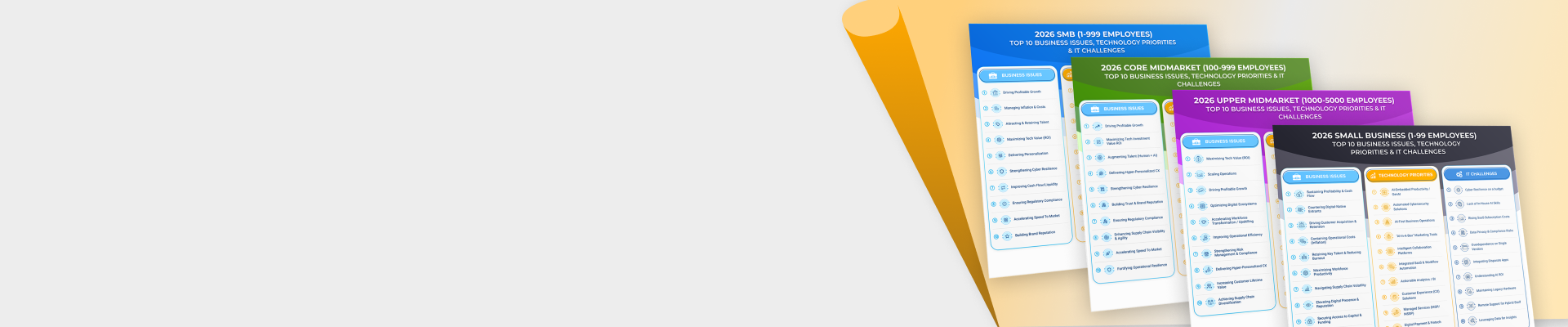
  • 2026 TOP 10 SMB BUSINESS ISSUES, IT PRIORITIES, IT CHALLENGES

    2026 TOP 10 SMB BUSINESS ISSUES, IT PRIORITIES, IT CHALLENGES

  • 2026 TOP 10 SMB PREDICTIONS

    2026 TOP 10 SMB PREDICTIONS

    SMB & Midmarket: Autonomous Business
    READ
  • 2026 TOP 10 PARTNER PREDICTIONS

    2026 TOP 10 PARTNER PREDICTIONS

    Partner & Ecosystem: Next Horizon
    READ
  • ARTIFICIAL INTELLIGENCE

    ARTIFICIAL INTELLIGENCE

    SMB & Midmarket Analytics & Artificial Intelligence Adoption
    LEARN MORE
  • IT SECURITY TRENDS

    IT SECURITY TRENDS

    SMB & Midmarket Security Adoption Trends
    LATEST RESEARCH
  • BUYERS JOURNEY

    BUYERS JOURNEY

    Technology Buyer Persona Research
    LEARN MORE
  • PARTNER ECOSYSTEM

    PARTNER ECOSYSTEM

    Global Channel Partner Trends
    LATEST RESEARCH
  • CLOUD ADOPTION TRENDS

    CLOUD ADOPTION TRENDS

    SMB & Midmarket Cloud Adoption
    LATEST RESEARCH
  • FUTURE OF PARTNER ECOSYSTEM

    FUTURE OF PARTNER ECOSYSTEM

    Networked, Engaged, Extended, Hybrid
    DOWNLOAD NOW
  • MANAGED SERVICES RESEARCH

    MANAGED SERVICES RESEARCH

    SMB & Midmarket Managed Services Adoption
    LEARN MORE

Techaisle Analyst Insights

Trusted research and strategic insight decoding SMBs, the Midmarket, and the Partner Ecosystem.
Anurag Agrawal

Citrix: Delivering Work-Life Harmony through Enabling Technology

Delivering Work-Life Harmony through Enabling Technology

Citrix calls it Life Slicing, a form of work-life harmony. And it is on a relentless pursuit of creating continuities between devices, location, apps, data, events and culture irrespective of place, time and environment. Mark Templeton, CEO says that he and his team are busy designing solutions that create customer experiences that will differentiate Citrix from its competitors and in the process reduce cost and increase simplicity for end-users.

It is not an easy objective to achieve. However it is the right objective. Citrix is either a leader in some categories or second in others and a relatively new entrant in yet other areas. It is confident that a focus on delighting the customer with tools that conform to the way end-users work in a multi-modal collaborative world, pining for utmost simplicity will make Citrix the winner.

To achieve its vision, Citrix has set its eyes on six key areas.

    • Social Collaboration: with carefully selected and integrated product line consisting of – GoToMeeting, GoToTraining, GoToAssist, GoToWebinar, ShareFile and Podio. While GoToMeeting was Citrix’s first foray into collaboration (when collaboration was not yet a must have), recent acquisition Podio extends the collaboration to teams.


    • Data Sharing: ShareFile is Citrix’s answer to enterprise-grade Dropbox that Citrix hopes will win on security, ease of use and customer service. ShareFile enables employees to send, share, sync files with business features such as follow-me data, access from any device, encrypted in transit and at rest, remote wipe and account locking.


    • Enterprise Mobility: a strategy built on Citrix Receiver, a client software app that allows access to data, apps from any device for the unbridled, fast growing BYOD market. Citrix Receiver uses XenApp and XenDesktop to deliver self-service apps and data to over 3 billion devices. Add to it CloudGateway for provisioning that is identity-based, scenario-based and secure serving of data on apps whether the device is windows, mobile, web or HTML5.


    • Windows-as-a-Service: an area which is the bread and butter of Citrix, a leader in the space with maximum number of products – XenDesktop, XenApp, XenClient, VDI-in-a-Box. Citrix is furiously working on delivering Windows apps and desktops as a true cloud service. RingCube and Kaviza acquisitions helped Citrix accelerate its presence in the VDI marketplace and eliminated the trade-offs with VDI to allow both shared and fixed desktops to be managed. In addition its HDX technology aims to deliver high-definition virtualization experience and its FlexCast delivery technology makes possible individual user configuration.


    • Cloud Networking: echoing the thoughts of many others that the future network will be fast and flat Citrix is betting on NetScaler, ByteMobile and CloudBridge solutions to deliver a network fabric that meets or exceeds the demands of a mobile world with ever-growing bandwidth requirements from devices, data and applications that are in constant motion.


    • Cloud Platforms:  staking on its belief that Open platforms will win, Citrix has CloudStack addressing the needs of both traditional and cloud workloads. Specifically, Citrix has also rolled out a Cloud Portal specifically designed for service providers that is a single self-service interface for cloud deployments.


Routes-to-Market for SMBs

The channel comprising of VARs, Systems Integrators (SIs), dealers, resellers and retailers form the essential cogs of an IT vendor’s eco-system that puts products and solutions in the hands of the customers. This is particularly true in the small and medium business market (SMB) where the vast majority of opportunity can only be addressed through the channel. Selling direct is not economical. So it makes complete sense that Citrix is trying to find ways to engage and involve the channel in their cloud efforts. With over 10,000 channel partners globally Citrix is concentrating on three different yet complementary efforts: 1/ Strengthen the VAR and SP channels; 2/ Build strategic alliances; 3/ Reach the SMB channels. The third point is most noticeable as Citrix has launched two new channel programs:

    1. SMB Specialist


    1. Cloud Advisor


SMBs have made the leap to cloud-based infrastructure and will rapidly move to multiple services that leverage their investments. The new solution stack is virtual and relatively standalone at this point; the next stage will require integration of more complex applications. As new Cloud Services are rolled out it will not be possible for most SMBs to maintain the internal expertise to make the most appropriate choices. Helping customers emerge without being overwhelmed and providing relevant knowledge of how to effectively apply the new technology will strengthen the SMB customer-channel-vendor relationship. And Citrix is building that channel handbook to enable its partners to be those trusted advisors.

In addition it has developed and released a Partner 360 Dashboard with real-time analytics. Its channel measurement and incentive metrics are based both on fulfillment and influence. Borrowing a leaf from the SMB transformation phenomenon, Citrix is enabling its partners to shift their focus from just operating to implementing and therefore helping them define their respective roles in the cloud.

Techaisle Take

SMBs are going through a transformation in terms of their work style, behavior and IT usage. Citrix is addressing the transformation. SMBs traditionally started off their journey into IT unknowingly using single building block concepts. The process for an SMB growth and its relative steps to absorb IT were steady and predictable. Some SMBs stacked their blocks faster than the others but the steps to get to the top block were always the same.

Enter flat IT. Cloud, mobility, virtualization, managed services have effectively toppled the blocks down in one fell swoop and have laid everything flat on the table. SMBs have moved from enablement to empowerment. Now it is not a race to the top, but how can an SMB reach its full potential in the shortest period of time. The process of an SMB’s growth and steps to absorb IT are no longer steady and predictable.

The SMBs are looking for value shift, moving from enablement to empowerment. They have moved from individual productivity to group productivity. Work from anywhere, anytime is more prevalent today than ever before. SMBs are no longer clustered in one location. It took 10 years for percentage of SMBs allowing telecommuting to double itself but only 3 years to again double to reach 77% in the US. The average Citrix - Techaisle - Global SMB, Midmarket and Channel Partner Analyst Firm - Techaisle Analyst Insights citrix-apps-blog-300x200 number of locations has gone up from 1.05 to 1.85 in 5 years. Another important number to note – 15% of SMB employees always work from home, that is, 11 million SMB employees.  SMB executives have also accepted work at home culture. And they see it as a benefit for the company as well as employees. 46% agree that it benefits companies, 37% say that tasks can be accomplished from anywhere. And 28% say that the technology used by employees is more advanced than that offered by workplace. It is known as Consumerization of IT but it has implications on how IT is absorbed and how IT vendors offer support and training. SMBs use multiple devices & applications to collaborate when traveling or telecommuting, many of which did not exist 5 years ago. Mobility is at the SMB doorstep.

To address the SMB transformation Citrix has it all: Collaboration, Data sharing, Mobility, Virtualization and even flavors of managed services. In the process, it is introducing simplicity and mobility along with driving down the cost. But what about the routes-to-SMB-customer? This is where Citrix has some work to do. Recognizing the shortcoming, Citrix has launched a somewhat thought out campaign to serve the needs of the channel partners that cater to the SMB community. What it already has in its favor is the tail wind. But any fellow traveler can easily testify that the tail wind can turn into a head wind. Citrix has its work cut out for itself, making sure that the channel partner tail wind is maintained.

Anurag Agrawal
Techaisle

Davis Blair

Mid-Market Businesses Upgrading Network - Voices from the Field

One of the areas we watch most is the evolving needs of the SMB customer, who is being consistently pressured to speed up all core business processes while simultaneously reducing costs, generally  through the introduction of new technologies and specifically by adopting Cloud Computing approaches.

Looking Forward to SDN and SDDC  

Networking Spending Among Mid-Market companies (between 500 and 999 employees) recently interviewed, over 75% described their business being completely “Network Dependent” with a large share planning to move beyond Virtualization to Software-Defined-Networking (SDN) and Software-Defined-Data-Centers (SDDC).  Almost all had implemented Remote Managed Services (RMS), Cloud Computing, and Server Virtualization or VDI.

“Yes, I have heard about it (SDN) and we even tested it on one of our servers. We can get the software easily but we need to get proper hardware implementation as well and that too keeping our costs in control. So, both the things need to be evaluated. Yes, probably we would be investing in it, in the coming future. There are many things that are a concern for us right now, like cost, space and efficiency. So we need things that could help us in these areas.” - 900 Employee SMB IT Decision Maker


Mid-Market Reliance on Outsouced  IT Support

As we have written in the past, the larger SMB customers are more likely to rely on channel partners or vendor direct relationships to free up lean SMB IT departments and allow them to do more with less by supporting the research and selection process, and then testing and implementing the solutions, especially for those solutions involving a high level of configuration and remote management capabilities. The speed that specialists bring to the configuration, testing and implementation tend to outweigh the costs and speed up the decision cycle.

“Yes, the channel partners had a huge role. I sat down with their Cisco engineers and we looked over the changes we were going to make, then we did put together a business case, as to why we needed to upgrade or make changes to the system and what benefit it would result in. They were helpful and they made things look easier for us.” - 750 Employee SMB IT Decision Maker


New Functionality is driving Adoption

Global NetworkAs we move into the Late Majority of SMB Cloud Adopters, there is less perceived risk and enough pressure to move companies toward implementing the architecture, if only to remain competitive.

"Now there are products available with better features and are cost effective. Earlier the cost of moving to the cloud was higher. Now because of the tough competition, the costs have marginally decreased. So, these things are enticing to look at different solutions. When we moved on to the cloud there were various benefits like cost effectiveness, in terms of IT management perspective. Previously it required 10 people, but now it can be done with 2 people. Previously the concept of datacenters was not that…important…, but now people are getting rid of the existing hardware and are moving towards datacenters to host most of their things that are in their offices. The datacenter costs are also competitive. If we look at any datacenter today and what they used to offer 5 years back, there has been a significant drop in prices due to the competition in the market.” - 500 Employee SMB IT Decision Maker


Budgets Continue to be Tight

We also see a significant effort on the part of customers to extend the life of the existing equipment and upgrade only the parts that are needed to achieve specific objectives such as 10GB capacity, which may require more robust firewalls, routers and switches, especially in those moving to VOIP. Typically we saw a reluctance to spend until it was necessary.

“Management here is very price conscious; they did not see the value of doing these things in the first place. The major factors were to increase speed and the reach of the network. So by these upgrades, we were able to demonstrate increased speed and increased network segmentation.” - 750 Employee SMB IT Decision Maker


Brand Importance Increases with Size of Company

While in certain areas such as SaaS, SMB end customers tend to be less likely to consider Brand as the key decision criterion, in the area of Networking among Mid-Market firms, virtually all said Brand was very important in their decision, mostly because of the expected service level associated with larger vendors but also to provide cover in a crowded market:

"There are a thousand solutions available in the market, but we had to ensure that what we chose was the best solution available and were cost effective. The new technology and the need to expand our business base were the main factors that drove the change.” - 900 Employee SMB IT Decision Maker

“Brand perception is very important because the management is not very technology minded, so to have a big name like Cisco was important to them. We depend on our channel partners for networking support or for help with windows server and Citrix products. They are our trusted partners.” - ~1,000 Employee SMB IT Decision Maker


Re-enforcing this tendency to Brand, the majors in the market were cited repeatedly as go-to Vendors. Cisco got the most mentions by far, followed by Citrix, Microsoft, HP, Juniper and Dell. As seen in the quote on outsourced support above, the vendors can also help in creating a business case.

“Well, I guess some of the ones (increase share) would be Cisco, HP, Dell and Microsoft. The major ones I know are trying to get there, if they are not close. It’s very hard to say who is going to lose much (share), but probably Microsoft or Apple are going to lose some. ~800 Employee SMB IT Decision Maker


We believe these attitudes represent some evolution that is becoming more pronounced as the market matures and intelligent networking becomes increasingly important to SMBs in general and Mid-Market companies in particular.

Anurag Agrawal

dinCloud: A Channel focused Desktop-as-a-Service Provider for SMBs

techaisle-VDI-blogThe desktop virtualization juggernaut continues to gather steam as more companies choose to use the technology to reduce costs, improve security, better disaster recovery, easier management and work from anywhere. Numerous Total Cost of Ownership reports have been published and the message from vendors to IT departments is clear – Desktop Virtualization is the way to securing desktops and reducing costs of management.

dinCloud has been making a lot of noise lately in the hosted virtual desktop area with its 100 percent channel-focused cloud-based business provisioning offerings for SMBs. We therefore had to sit down with Ali Din, CMO and Barry Weber, CTO to understand if the noise was pure cacophony in the media or were they really creating music, as their tag line says “Delivering a Heavenly Experience in the Cloud”. What followed was a series of questions and answers. (This Q&A was not sponsored by dinCloud)

What is the unique value proposition that dinCloud brings to the table for SMBs? All providers talk about customer service, understanding SMB requirements, lowering costs, etc. but we want to know what are the 2-3 unique selling points that resonates with SMBs as far as dinCloud is concerned?

dinCloud offers SMBs a fully integrated solution to run their business including backup & recovery, hosted virtual desktops (HVDs), data center security, networking, and servers. Our unique channel centric approach allows SMBs to continue to do business with the local MSP, VAR, and SI they have a relationship with, giving them local hand holding and supplemental services to run their business. Our SMB customers enjoy cost savings of up to 50 percent, enhanced security and compliance, enterprise class IT infrastructure and services, and an OPEX subscription model conserving capital.

How does dinCloud help SMBs assess and design solutions to meet SMB requirements?

We have developed a standard requirements gathering and onboarding process to rapidly migrate our SMBs’ IT infrastructure to their own virtual private Tier 3 data center. In addition, our proprietary cloud orchestration platform, dinManage, automates provisioning and migration tasks including creation and synching of the Active Directory infrastructure. dinManage is often white labeled by our partners.

How much time does dinCloud actually spend with an SMB prior to its becoming a client? What is the typical interaction?

dinCloud approaches the SMB customer through our channel partners. Engagement time varies to almost zero once our VAR/MSP partner has migrated the first of its customers, to several days of discovery for larger more sophisticated engagements.

How much time does dinCloud actually spend with an SMB on an ongoing basis once they become a client?

dinCloud’s channel partners front end most of the customer support activities; typically we will see approximately 1-2 tickets per week per customer.

In your view why does an SMB consider a hosted solution as compared to on-premise?

The SMB customer will enjoy enterprise-class infrastructure, security, and operations possibly for the first time in their history - they will conserve cash only paying for what they need, giving them unparalleled flexibility. They will now have IT compliance as well as backup and DR protecting their business. dinManage offers the remaining IT staff full visibility and control of their virtual private data center. No more HR costs and problems with training and maintaining several IT resources. Hosting in redundant tier 3 data centers not only provides enhanced security and uptime, but environmental factors such as cooling, electricity, and backup power are eliminated. Hardware, software and multiple point solutions no longer need to be purchased, supported, maintained, and managed. The SMB customer will be able to leverage BYOD and anytime, anywhere access. Additionally the SMB customer will immediately realize 30-50% cost savings when compared to a traditional on-premises model.

dinCloud has partnered with many different vendors, with which vendor solution has dinCloud seen more success? Why?

We have had a great deal of success with the purpose built custom high density super-computers by Super-micro giving us extremely competitive pricing and performance on our servers. Additionally, our investment in 100% NetApp has allowed us to leverage their industry leading tools (SnapMirror and SnapVault), as well as very efficient replication of data between our data center and the customer’s primary backup locations.

What are the top challenges you face in implementing virtualization solutions? 

From dinCloud’s perspective, there are a couple of challenges. There are so many great hypervisors to choose from today and dinCloud offers customers the choice of either VMware or KVM. We strive to stay current with hypervisor versions but coordinating the right time to upgrade hypervisor versions with customer schedules is sometimes a challenge.  While an upgrade should not impact to a customer, they are still very cautious about allowing dinCloud to do this.

What should vendors be doing to help you in offering and implementing virtualization solutions for SMBs?

dinCloud requires next to zero support from its vendors outside of normal bug fixes and some assistance in marketing (Netapp and Microsoft). We work very hard to provide a whole solution for the SMB market. This whole solution includes a private cloud environment with a firewall, selectable IP ranges, integration with AD, HVDs and HVSs, an easy to use cloud portal, choices of hypervisors, monitoring and white glove treatment to help the SMB easily and rapidly achieve their infrastructure goals and optimize operations costs and process.   We do not just provide a virtualization solution.

What are your top core challenges with the SMB customer? 

The SMB customer is often caught between a rock and a hard place when it comes to internal IT skills depth and breadth. dinCloud works to make infrastructure and operations easy for the SMB customer by pre-packaging the whole solution, by automating the implementation and by offering services to extend those that exist within the customer. The SMB customer is often faced with enterprise level requirements (PCI, HIPAA, etc.). They are challenged to deliver on these requirements. dinCloud’s challenge and goal is to continuously solve for their future problems. The SMB customer faces not only a budgetary challenge for skilled resources; they may also have small budgets that don’t match the typical costs of achieving the business IT goals. dinCloud works to continuously driving costs down, thereby helping customers protect their budget.

Any final words before we conclude?

dinCloud is gaining rapid momentum through our 100% channel sold model of complete end-to-end “Business Provisioning”. We believe that SMB customers have always relied on local MSPs and VARs and will continue to do so. dinCloud is emerging as the “Cloud Offering of Choice” for these traditional regional MSP/VARs, and more than any other market segment the SMB customer has a perfect use case for cloud-based IAAS, delivered by their local and trusted long time IT resellers.

Techaisle Take

dinCloud, a reseller has become a service provider. As we have written and presented several times that cloud computing is continuing to challenge the channel forcing them to develop and be trained in new competencies. These encompass service provisioning, billing, data center management, customer support and a whole host of related competencies. dinCloud by standard definition is not an IT vendor like VMware or NetApp but it has developed offerings by combining products from established vendors and instead of selling directly to customers is funneling its sales through its own channel partners.

Most SMBs rely on their local channel partners for maintenance & management of their IT infrastructure as well as for advice on new IT purchases. dinCloud is developing a network of channel partners and providing them appropriate training and skills to sell and manage cloud solutions for their local SMB customers. They are - Educating and training channel partners on what cloud actually means and how it impacts the SMBs; Developing solutions and use cases; Providing an effective and efficient pre-sales support to their channel partners to engage with SMBs.

DaaS (Desktop-as-a-Service) is poised for growth and dinCloud has positioned itself extremely well. Techaisle's survey shows that there is a growing SMB intent to use hosted VDI as shown in the chart below. The data compares the current implementation versus planning to implement. The survey shows that there is a 46 percent increase (from current 15 percent to planned 22 percent) in intent to use hosted VDI within mid-market businesses when compared with those that have currently implemented.

techaisle-VDI-blog-implemented-SMB


techaisle-VDI-blog-planning-to-implement-smb


dinCloud is a good example of what Philippe Fossé,  Vice President of Europe, Middle East & Africa (EMEA) Channels, EMC wrote today, “More and more we see service integrators becoming resellers; resellers becoming service providers; and even users becoming service providers. This evolution is unprecedented, but is only the tip of the iceberg”

dinCloud has the right business philosophy, market understanding and product portfolio. They are making noise at the right time. They have had some major wins in the past few months such King Hawaaiin, maker of the number one branded dinner roll in the US which selected dinCloud to implement its hosted virtual desktop, server, and storage services to help IT improve efficiency and better manage operations across all its baking facilities and restaurants.

That noise they are creating could well become an orchestra.


Anurag Agrawal

SMB and Midmarket File Sharing & Collaboration Adoption to Grow by 52 percent

Techaisle’s study on SMB Collaboration Solutions Adoption Trends shows that for 59 percent of US small businesses and 93 percent of US midmarket businesses, collaboration is among the Top 5 IT priorities for investments. In Asia/Pacific, 63 percent of SMBs are turning towards it as a business growth driver and in Western Europe, 68 percent of SMBs are finding that collaboration drives better teamwork and customer responsiveness.

Overall 38 percent of US SMBs are currently using one or more collaboration solutions and another 20 percent are planning to use one within the next year, a growth of 52 percent. Overwhelmingly, SMB customers view online file sharing as the most important aspect of a collaboration solution as 64 percent of SMBs using collaboration are currently using online file sharing (24 percent of all US SMBs) and another 32 percent are planning to use it within the next one year.

The survey data also shows that the next stage in the SMB collaboration adoption is their need for online interaction, that is, simultaneously share and edits files from PCs and mobile devices, mobile video collaboration, integration with social networks, and richer media escalations, such as using chat, text, voice, video at the same time.

As per the study, key business drivers for SMB collaboration adoption are also changing. While currently there is a strong desire to build robust content repositories, the next wave of SMB collaboration adopters are emphasizing speed of innovation, demands for improved productivity, and imperatives for faster time to market.

In terms of brand solution adoption, the SMB market is quite fragmented with Google, Microsoft, and Cisco leading, but there are many other smaller collaboration solution brands that are being used extensively by SMBs. Further analysis of data also underscores the importance and use of collaborative capabilities within SaaS applications such as CRM, ERP, accounting, project management, HR management, business intelligence and content publishing.

With respect to file sharing, Dropbox has had a very strong impact on the SMB collaboration solutions market. By enabling mobile users to share files freely, they at once underscored the central importance of mobility, enabled individual users to be drivers of corporate collaboration activity, and proved the centricity of file-first rather than person-first collaboration models.

Box (another important vendor in the space), on the other hand has gone on record saying that SMBs are not its target market segment. There is a market opportunity for traditional backup and file-sharing IT companies such as Hightail, Carbonite, Egnyte as well as those delivering mobile workspaces such as Citrix and managed services platform providers such as Continuum and security IT vendors such as Trend Micro. However, the reach for each of these will be limited to the reach of their respective SMB focused channel partners.

Techaisle believes that there are additional file-centric developments that will further shape the nature of SMB file sharing solutions in the years to come. Today, most files are intrinsically connected to the applications that created them. If cloud and mobility are the key determinants of IT delivery, then there would be a need for the decoupling of data from applications. Application-independent data wrapped in rich metadata would allow new cloud-based applications (potentially based on BI platforms) to combine existing data to meet new business requirements. In addition, freed of originating applications, it is also likely that data could be optimally formatted for a wide range of displays: large screen PCs, smaller screen smartphones and tablets, and new display types ranging from signage to digital paper to wearable heads-up displays.

For more details on the report, click SMB and Midmarket Collaboration Adoption Trends


Trusted Research | Strategic Insight

Techaisle - TA