










• TRUSTED RESEARCH

    TRUSTED RESEARCH | STRATEGIC INSIGHT

    SMB. CORE MIDMARKET. UPPER MIDMARKET. ECOSYSTEM
    LEARN MORE
  • COMMS, COLLAB, CONTACT CENTER

    COMMS, COLLAB, CONTACT CENTER

    SMB & Midmarket Buyers Collaboration, Contact Center Study
    LATEST RESEARCH
  • DATACENTER SOLUTIONS

    DATACENTER SOLUTIONS

    SMB & Midmarket Datacenter Solution Adoption Trends
    LATEST RESEARCH
  • PARTNER ECOSYSTEM

    PARTNER ECOSYSTEM

    CHANNEL PARTNER ECOSYSTEM TRENDS STUDY
    LATEST RESEARCH
  • BUYER JOURNEY

    BUYER JOURNEY

    SMB & Midmarket Buyers Journey Research
    LATEST RESEARCH
  • BUYER PERSONAS

    BUYER PERSONAS

    SMB & Midmarket Technology Buyer Persona Research
    LATEST RESEARCH
  • ARTIFICIAL INTELLIGENCE

    ARTIFICIAL INTELLIGENCE

    SMB & Midmarket Analytics & Artificial Intelligence Adoption
    LATEST RESEARCH
  • IT SECURITY TRENDS

    IT SECURITY TRENDS

    SMB & Midmarket Security Solutions Adoption Trends
    LATEST RESEARCH
  • 2026 TOP 10 SMB BUSINESS ISSUES, IT PRIORITIES, IT CHALLENGES

    2026 TOP 10 SMB BUSINESS ISSUES, IT PRIORITIES, IT CHALLENGES

  • 2026 TOP 10 SMB PREDICTIONS

    2026 TOP 10 SMB PREDICTIONS

    SMB & Midmarket: Autonomous Business
    READ
  • 2026 TOP 10 PARTNER PREDICTIONS

    2026 TOP 10 PARTNER PREDICTIONS

    Partner & Ecosystem: Next Horizon
    READ

Techaisle Analyst Insights

Trusted research and strategic insight decoding SMBs, the Midmarket, and the Partner Ecosystem.
Anurag Agrawal

AI, Observability, and Security: The Cornerstones of Cisco's Partner Empowerment Strategy

The early years of this decade were a period of significant change and challenge for businesses across all sectors. Traditional market definitions and sales strategies have become obsolete, and the IT channel has faced unique difficulties. Amidst changing business models, declining product margins, and the necessity to establish profitable service practices, channel members have had to devise strategies to adapt to shifts in customer base, buying and selling models, and solution composition.

These changes have put immense pressure on the channel, prompting the exploration of new business models, product mixes, and configurations of marketing, selling, and partner relationships. Despite these challenges, it remains the age of the partner, a theme echoed at Cisco’s Partner Summit. According to Techaisle’s global partner survey, 87% of SMBs and midmarket customers and 69% of enterprise sales involve one or more partners. Cisco leads the way, with 90% of its revenue from partners. This underscores the enduring importance of partnerships in the IT channel.

Techaisle’s end-customer survey reveals that 76% of businesses work with partners who are responsive to business points and provide helpful advice. The partner’s most significant opportunity is meeting buyer needs, which requires IT suppliers to plot a path that is attuned to the partners’ buyers. This is what Cisco is addressing.

Cisco, a pioneer in this transformation, unveiled a suite of products, programs, platforms, and tools at the Cisco Partner Summit 2023. This strategic development of solutions aims to bolster its partners, reinforcing Cisco’s commitment to retain its leadership in AI, observability, and security.

The launch of Cisco Validated Designs (CVDs) for AI, the growth of Cisco’s Full Stack Observability Platform, and the debut of new security suites underscore Cisco’s dedication to technological supremacy. More importantly, these initiatives emphasize Cisco’s commitment to empowering its partners and customers as they navigate the dynamic business landscape.

cisco partner summit 2023 1

Anurag Agrawal

HP's Path to Transformation: Embracing Innovation

In the ever-evolving technological landscape, businesses often stand at a crossroads, compelled to adapt to emerging trends and customer needs. HP, a renowned player in the personal computing arena, remains committed to adapting to changing trends and meeting customer needs. This year alone, the company has unveiled over 150 products. At the inaugural HP Imagine 2023 event, it showcased a range of products and solutions centered around three key trends shaping its offerings: workplace flexibility, the use of AI to enhance productivity and transform PCs into “personal companions,” and the importance of trust—aligning HP’s values with its customers, with a strong focus on sustainability.

HP has demonstrated its adaptability by launching two innovative products: the HP Spectre Foldable PC and the HP Envy Move. It has also introduced Managed Collaboration Services and HP Protect and Trace with Wolf Connect to address users’ productivity and endpoint security needs. Furthermore, it has expanded its collaboration offerings with the launch of the Poly Studio R30+ Bundle. The company also emphasizes enhancing partner growth and customer experiences, as evidenced by its partner ecosystem, including the HP Amplify program.

HP’s Innovative Solutions for Flexible Work Environments: The Spectre Foldable PC and Envy Move

HP’s innovation is significantly driven by what it calls the ‘era of flexibility.’ The swift shift towards hybrid and remote work arrangements in recent years has necessitated organizations to adapt to fluctuating work environments. Consequently, HP is dedicated to offering adaptable solutions, such as devices that effortlessly adjust to diverse work settings, ranging from kitchen counters to executive boardrooms. In alignment with this commitment, it has unveiled two state-of-the-art products – the HP Spectre Foldable PC and the HP Envy Move.

The HP Spectre Foldable PC touted as the world’s thinnest and smallest foldable PC, is a 17-inch, 3-in-1 device that serves as a laptop, tablet, and desktop, ensuring versatility and portability. Its foldable screen enables it to morph into a large tablet compatible with a stylus, a 12.3-inch laptop coupled with a detachable Bluetooth keyboard, and a desktop PC equipped with a built-in kickstand. This device offers flexibility without compromising performance, making it an optimal choice for mobile professionals needing a robust and adaptable computing solution.

The HP Envy Move is another innovative device, a 23.8-inch portable PC hailed as the world’s only movable all-in-one PC. This product caters to the needs of home-based workers, offering flexibility and mobility. It can be effortlessly relocated from one room to another without being bound to a power source. Its built-in handle, lightweight design, and self-deploying kickstand make it perfect for remote workers seeking a large screen without the bulkiness of a traditional laptop.

The Future of AI with HP: Personalized PCs and Collaborative Data Science Platforms

Anurag Agrawal

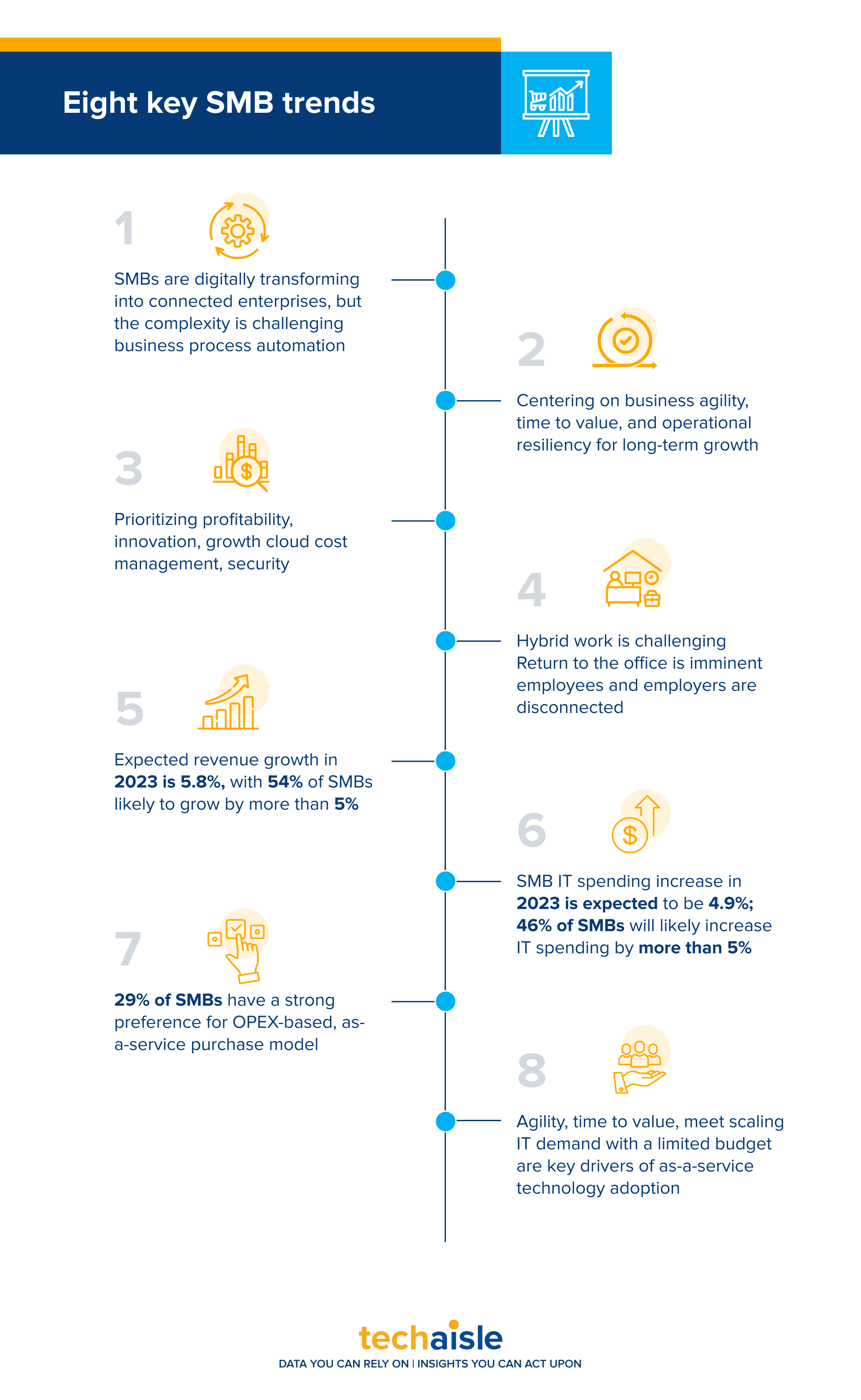
Eight Key SMB and Midmarket Trends

97% of SMBs and midmarket firms consider technology important and integral to business success. As we enter 2023, IT product and service suppliers are looking to create a context for understanding the range of outcomes that the new year may bring. Techaisle has launched its "2023 in Focus" research series to support that effort, which illuminates issues and requirements in the vast SMB, core-midmarket, and upper-midmarket segments. After surveying thousands of SMBs and midmarket firms and having hundreds of depth calls, we see key trends that revolve around:

  • Enabling a connected business and business process automation
  • Converging on long-term growth, profitability, and innovation
  • Prioritizing cloud cost management and security
  • Hybrid work but challenges are overwhelming
  • Sharpening focus on IT spend for time to value, agility
  • As-a-service technology acquisition gaining momentum

techaisle 8 key smb trends

Anurag Agrawal

Zoho – A Great Bet for Mid-Market firms

In October 2022, Zoho reached US$1 billion in revenue. Zoho was founded in 1996 to deliver easy-to-use and deploy CRM solutions to the SOHO market segment (Small Office, Home Office). Even the Zoho name was a spin from SOHO. Zoho has transformed from a fledgling startup to an enterprise serving small, midsized, large, and public sector organizations globally. In recent years, Zoho has successfully moved upmarket from helping small businesses to midmarket firms and enterprise customers. Mid-market firms are measured, thoughtful, agile, and rapidly digitally transforming, focusing on cloud cost optimization and business process automation. These firms are building a longer-term strategy for an integrated, flexible approach to incremental cloud expansion. In direct contrast, small businesses move from point to point, working first on one discrete solution and then on the next. This dichotomous approach is a real challenge for suppliers as they need to differentiate solutions for the small business market and demonstrate that their offerings are essential components of broader strategies for mid-market firms while attracting attention to their products and building brand preference in both segments. While the expectations of mid-market buyers about SaaS providers are similar to large enterprises, the budgetary limitations create challenges in supplier selection, deployment, and management.

Techaisle research shows that midmarket firms invest in their employees and are social responsibility advocates. As a result, they want their vendors to share these characteristics and mindsets. Therefore, serving the mid-market segment necessitates a distinct culture that is not characterized by high prices and lengthy sale cycles.

Midmarket technology DNA and role of Zoho

The positioning of the solutions within the midmarket is essential. It requires in-depth information on business benefits and the process steps needed to capture those benefits targeted at BDMs, and information on how to assemble, deploy, integrate, and support/optimize these solutions targeted at ITDMs – and an understanding of how to position and convey the messages to each audience.

Its extensive portfolio of cloud business applications includes 50+ products, ranging from traditional office suites to analytics, finance, sales and marketing, collaboration, customer service, HR, and many more business processes at competitive pricing. Zoho has a deep engineering culture immersed in R&D, along with maintaining its cultural ethos without having to cope with any interference from either external investors or the public market. Zoho believes that instead of spending heavily on sales and marketing, it would instead invest in software development efforts or let its potential customers access the limited-feature platform for free. This strategy has proved to be very successful for Zoho and its customers.

Simplicity, flexibility, and value for midmarket firms

Zoho One, the flagship product, is designed for mid-market businesses. With Zoho One, customers have access to 45 business, collaboration, and productivity applications, of which over 20 applications (across functions) are used by more than half of Zoho’s customers. The solutions are a part of a unified technology platform with built-in search, messaging, and AI services. It runs on a unified database with a unified data model with data pillars that enable seamless integration to deliver single truth for the business empowering users with a unified experience. The collection of apps running on a single database architecture and purpose-built on Zoho technology stack - services, software, hardware, and network infrastructure - deployed on Zoho’s own global data centers ensures performance, availability, security, and privacy. All these solutions and features come at an affordable price, which makes the package suitable for mid-market firms as it significantly reduces the total cost of ownership, deployment, and integration timeframes.

Raju Vegesna, Chief Evangelist, Zoho, once said, “the market is littered with features masquerading as products.” Zoho One provides single sign-on, single subscription, and a fully integrated platform. It is common knowledge that app-specific experiences drive infrastructure-level optimization steeped in Zero Trust, AI, distributed file structure, and data center expansion driven by market dynamics.

More than 60% of Zoho’s workforce is devoted to engineering, developing new technologies, and keeping these technologies updated. Since the launch of Zoho One in 2017, Zoho has been innovating and updating its applications. With the evolution and maturing of newer technologies, Zoho has been adding AI/ML functionalities and improving user experiences.

In the past five years, Zoho One has grown considerably and has acquired over 50,000 businesses as customers in 160+ countries. Over the past two years, the platform has grown 150%, with 37.5% of new customers from mid-market and enterprise segments. License upgrades have increased by 92%. These figures spotlight the strategic commitment by Zoho to deliver end-to-end solutions that empower organizations to be agile, scalable, and adaptive to changes in their industries. Even the midmarket developers are taking notice as they can access Zoho Tables, RPA, and Test automation tools. Zoho Finance suite has seen tremendous growth. As per Zoho, it is processing 100M invoices per year.

Zoho One is wholly developed in-house on a single technology stack and is a unified, end-to-end platform that offers plenty of integration points across applications. Well-grounded unification enables organizations to link functions such as sales, marketing, customer support, accounting, human resources, and others. Moreover, the platform can be easily integrated with third-party solutions, allowing organizations (especially mid-market enterprises) the flexibility to manage complex systems, large amounts of data, and dispersed teams.

Techaisle’s latest midmarket research shows that 42% of firms are increasing their spending through cloud marketplaces. Over 500K Zoho users use 1500+ apps from the Zoho marketplace (e.g., Twilio for Zoho CRM). Recognizing the need for verticalization, Zoho has purpose-built industry apps such as real estate CRM, travel agencies, IT services, field services, and many others. Most importantly, Zoho enables midmarket firms to develop and deploy custom apps.

zoho unified dashboards widgets

Zoho addresses the need for high-velocity custom apps

It is relatively easy to adopt a single SaaS solution, connecting its inputs and outputs to relevant internal systems and processes. It is possible to adopt a handful of cloud applications, hand-wiring the interconnections between them and adjacent applications. But this craft-built approach to the cloud differs from longer-term visions of scale, flexibility, and agility. It creates IT management overhead and performance and security risks. Even worse, disconnected systems affect relationships between companies and their customers: workflows that lack cohesion create unnecessary gaps in service. Unable to link all inputs to achieve a single view of the business reduces visibility into individual customer preferences and broader market opportunities. Zoho One provides midmarket firms with tools they can use to develop their applications and automate their business processes by creating workflows. For example:

Trusted Research | Strategic Insight

Techaisle - TA