• TRUSTED RESEARCH

    TRUSTED RESEARCH | STRATEGIC INSIGHT

    SMB. CORE MIDMARKET. UPPER MIDMARKET. ECOSYSTEM
    LEARN MORE
  • COMMS, COLLAB, CONTACT CENTER

    COMMS, COLLAB, CONTACT CENTER

    SMB & Midmarket Buyers Collaboration, Contact Center Study
    LATEST RESEARCH
  • DATACENTER SOLUTIONS

    DATACENTER SOLUTIONS

    SMB & Midmarket Datacenter Solution Adoption Trends
    LATEST RESEARCH
  • PARTNER ECOSYSTEM

    PARTNER ECOSYSTEM

    CHANNEL PARTNER ECOSYSTEM TRENDS STUDY
    LATEST RESEARCH
  • BUYER JOURNEY

    BUYER JOURNEY

    SMB & Midmarket Buyers Journey Research
    LATEST RESEARCH
  • BUYER PERSONAS

    BUYER PERSONAS

    SMB & Midmarket Technology Buyer Persona Research
    LATEST RESEARCH
  • ARTIFICIAL INTELLIGENCE

    ARTIFICIAL INTELLIGENCE

    SMB & Midmarket Analytics & Artificial Intelligence Adoption
    LATEST RESEARCH
  • IT SECURITY TRENDS

    IT SECURITY TRENDS

    SMB & Midmarket Security Solutions Adoption Trends
    LATEST RESEARCH
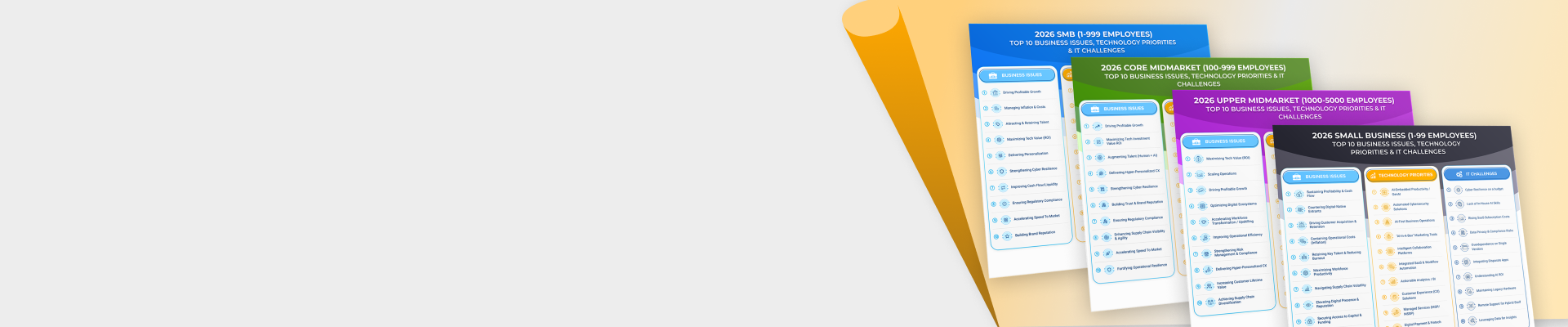
  • 2026 TOP 10 SMB BUSINESS ISSUES, IT PRIORITIES, IT CHALLENGES

    2026 TOP 10 SMB BUSINESS ISSUES, IT PRIORITIES, IT CHALLENGES

  • 2026 TOP 10 SMB PREDICTIONS

    2026 TOP 10 SMB PREDICTIONS

    SMB & Midmarket: Autonomous Business
    READ
  • 2026 TOP 10 PARTNER PREDICTIONS

    2026 TOP 10 PARTNER PREDICTIONS

    Partner & Ecosystem: Next Horizon
    READ

Techaisle Analyst Insights

Trusted research and strategic insight decoding SMBs, the Midmarket, and the Partner Ecosystem.
Anurag Agrawal

Cisco Meraki masterfully enabling digital workplaces for SMBs

New work patterns and the acceleration of distributed workplaces are resulting in a range of productivity benefits for SMBs today. As such, businesses see increased workforce efficiencies and talent recruitment while minimizing cost by reducing intermediaries and integrating contract professionals – and even improved environmental performance through reduced commuting and building footprints.

In the quest to deploy a perfect hybrid workplace technology infrastructure, SMBs often overlook networking – wireless, routers, firewalls, and beyond. Similarly, as small business retailers and other small commercial offices struggle with re-opening uncertainties, they also grapple with the daunting task of enabling secure and safe environments for their employees and customers. Digitization with minimum IT disruption and low manageability is on their minds.

Cash flow constraints, limited access to finances, competitive landscapes, the need for innovation, erratic revenue, uncertainties, the pace of technology change, and many more are drivers for achieving cost efficiencies within SMBs. Digital transformation is no longer the domain of only upper midmarket firms and enterprises. Techaisle's SMB and Midmarket Digital transformation survey research shows that 46% of SMBs are adopting digital transformation to reduce costs, and 38% are planning for innovation in customer engagement and services.

Helping SMBs thrive with robust IT solutions

Unbeknownst to many, the Cisco Meraki platform and the solutions it powers is a critical foundational technology to fast-forward digital transformation for SMBs. Much of this comes from its ease of use, simplicity, and flexibility for lean IT to innovate by doing more with less.

Cisco acquired Meraki in 2012, around the same time (2013), when it divested Linksys to Belkin. Over the years, Cisco has continued to innovate on its highly successful Meraki platform. It is no secret that Cisco Meraki invented cloud-managed networking technology in 2006. It has continued to innovate and expand the networking portfolio to IoT solutions and cover any business need or use case. The Meraki platform consists of switching, security & SD-WAN, wireless access points, mobile device management, and extending to IoT, including smart cameras and AI-equipped sensors to drive business intelligence.

Regarding deep intelligence and analytics, Meraki Health and Meraki Insight allow SMBs to monitor all aspects of their network and applications from the Meraki dashboard or API and easily detect and fix potential issues in minutes. Techaisle's survey shows that only 4% of small businesses have internal full-time IT staff. They spend 79% of their time on support, maintenance, and troubleshooting— creating an IT efficiency deficit and negatively impacting organizational productivity. Meraki Health's objective is to simplify troubleshooting for the lean, almost non-existent, or over-burdened small business owner/manager. Small businesses need to propel growth and enable new business initiatives freeing up time and resources. To ease the digital transformation, Meraki provides many capabilities that protect SMBs of any size, including:

  • Preventing cyber-attacks: Meraki MX Security & SD-WAN appliances protect SMB businesses, users, and devices. Meraki security has the backing of Cisco Talos, one of the largest commercial threat intelligence teams globally.
  • Deploying remote workers: Meraki Z3 teleworker gateways provide connectivity and secure and seamless in-office experiences. Meraki Insight delivers deep visibility into critical business applications and proactive troubleshooting for remote workers.
  • Ensuring safe occupancy: Meraki MV smart cameras let SMBs maintain social distancing guidelines by remotely monitoring and tracking safe occupancy levels in physical environments through intelligent analytics, such as object detection and tracking.
  • Cost savings from simplicity: All Meraki products are deployed and controlled from a single pane of glass. Meraki Health is available for all devices, saving many troubleshooting times by pinpointing specific problematic devices and clients via root cause analysis.

SMBs agree that Meraki solutions can be quickly deployed with zero-touch provisioning and configuration and remotely managed through a cloud-based GUI dashboard (single pane of glass), with all-inclusive licensing. Meraki provides 24/7 technical support (email or phone) and a lifetime warranty on devices (except cameras & outdoor APs) with advanced replacement.

Challenges in small business security

Techaisle's SMB security survey research data shows that security is a top IT priority and challenge for 76% of SMBs, and 65% are planning to increase IT security investments. Within the SMB segment, small businesses often lack the skills required to work with software-based security solutions and are 25%-33% less likely than midmarket firms to work with managed service providers.

Most small businesses are not proactive in addressing security issues, but that may not be the whole problem or perhaps even the greatest obstacle to small businesses’ adoption of security technology. Relative to midmarket firms, small businesses have limited to no internal IT security staff, are not generally working with a managed service provider capable of handling security needs, and are about 50% less likely to embrace external vendors' software-based security solutions.

While small businesses could theoretically pursue some strategies used by larger competitors, they lack the experience and skills to identify, deploy, and manage the products and relationships used to develop shields protecting valuable corporate data, applications, and human assets.

Meraki addresses these issues by providing a secure in-office experience to remote workers—giving access to applications while maintaining visibility and control from anywhere with a cloud-managed dashboard. It also encrypts data with Auto VPN, allowing employees to quickly, securely, and remotely connect to corporate locations.

Meraki smart cameras also address physical security, remote monitoring, and intelligence by including on-device storage and flexibility to access data through the cloud. The cameras allow for many playback features with machine learning and AI to compress the data and provide business intelligence instantly gleaned from long recordings. It is an ideal product for SMBs implementing social distancing guidelines, remotely monitoring physical spaces, reducing in-person exposure on-site, and ensuring comprehensive security.

How SMBs can adapt and digitize

As I said earlier, there is increasing importance for innovation and digitization (not referring strictly to the substitution of digital records for physical documents, but more broadly to the use of digital technologies to meet business goals) in SMB strategy. Dependence on technology as a critical element of business success, burgeoning complexity, and cost constraint has created a perfect storm for small businesses to adapt to changing environments using specifically designed technology.

Over the last few months, we studied use cases and Meraki's usefulness within the SMB segment. Meraki addresses real and compelling issues, and I believe it will continue to expand within the SMB community. Verticals such as healthcare, manufacturing, retail, and financial services have been quick adopters of Meraki, specifically for launching new business models, deploying remote workers, transitioning to hybrid workplaces, cybersecurity, location analysis, contact tracing, social distancing, personal safety, curbside pickup, and more.

SMB owners and executives are concerned with issues that extend beyond technology. Yet, today's business environments are increasingly dependent on IT support, products, and services that improve productivity and efficiency or expand market reach and potential.

Final Techaisle Take

IT initiatives that can be linked meaningfully to broader business objectives can attract SMB executive support – meaning that products and services that address key business priorities have the most significant growth potential. Meraki is well on its way.

Today's economy demands that technology support SMB activities. The future will be defined by them capitalizing on technology-enabled business options. If SMBs are thinking about the path forward, from today's foundation to tomorrow's opportunity, they should include Meraki in their evaluations. Writing this analysis reminds me that I work from home and should probably replace my mesh routers with Meraki devices.

Anurag Agrawal

SMBs Make Cloud Calling and Collaboration a Priority – Webex Gets it

Historically, remote work solutions have been the domain of large enterprises equipped with processes and technology resources needed to support workers in the field. However, driven by short- and longer-term factors, flexible work options are now available to employees in businesses of all sizes. Moreover, as social distance health requirements forced the temporary closure of public office spaces, remote work became a matter of survival for many organizations. The pandemic has also crystalized recognition of the productivity benefits of technology-enabled remote work – measured in output rather than hours – which is sure to have a profound and durable impact on workplace behaviors. Today, working from anywhere is the new normal, enabled by powerful communication and collaboration tools, which draw together workers regardless of physical location and are becoming the catalyst for change in large and smaller businesses. What are the primary enablers of this flexible work trend? Data shows a growing commitment to leveraging the power of the cloud and adjacent technologies of mobility, cloud calling, and collaboration - technologies that allow workers and teams to connect, reflect, and share insights and output. Techaisle SMB and Midmarket Hybrid work and collaboration adoption survey, N=1810, shows that:

  • 93% of SMBs have prioritized remote and hybrid workplace technology solution adoption
  • 58% of employees in the SMB segment are likely to work remotely
  • 79% of SMBs are prioritizing cloud-based communication and collaboration solutions which show evolving recognition of the value of cloud calling and collaboration

The simultaneous commitment to cloud calling and collaboration solutions and future planning around a return to the office suggest that something deeper is at play in the SMB communications solution marketplace. Cloud calling and Collaboration are central components of virtually all SMB business activities. The need to communicate anywhere, anytime also means any type of communication and collaboration – synchronous/asynchronous, serendipitous/scheduled, on-the-go/fixed location, within a virtual workspace/within a specific app, with employees/partners/customers. As the lines of demarcation between tasks have been eroded by the increased pace and changing nature of business activities, SMBs have moved past linking discrete actions through linear, sequential processes. Instead, in today's business environment, SMBs interact at all points in the business cycle: in cross-functional planning and management, within a single co-created document, in the stages and connection points defined by their business processes, in delivering better customer experiences, and enabling improved employee productivity.

There is value in adopting unified cloud calling and collaboration. The use of traditional collaboration tools by SMBs is well-established. However, cloud calling solutions are rapidly gaining attention from SMBs. With nearly a hundred percent cloud priority, shifting from on-prem solutions (acquired through CAPEX budget) to cloud-based as-a-service offerings creates a sort of inflection point. As the name implies, cloud calling is cloud-based and available as a subscription. It supports remote work and mobility, provides cash flow predictability, easily integrates within the employees' workspace, and improves IT manageability and efficiency.

A significant collaboration technology shift is SMB's use of a cloud-based communications platform with integrated telephony (audio/video/web conferencing), IM/chat/presence, unified messaging, and mobility. Techaisle data shows that today, just under a third (27%) of SMBs are using integrated solutions, while over a third (35%) plan to adopt the platform in the coming year, a likely adoption growth of over 100%.

The Webex integrated collaboration platform

Anurag Agrawal

SMB SD-WAN adoption unlocks business potential for MSPs

SMBs are wrestling with many challenges, including unreliable network connections, cybersecurity and privacy concerns, productivity issues, and support. In addition, SMBs are mindful of the need for help composing, deploying, and managing digital business infrastructure. The recent surge in remote work has also significantly increased the requirement for effective networks and network management and the complexity of deploying a holistic digital business infrastructure.

SMB networks and network management resources are not as sophisticated as those in enterprise environments. As a result, SMBs will encounter high incidences of network issues such as delivering robust support for videoconferencing and jittering and extending security across distributed applications, devices, and networks.

Networking, a necessary foundation for digital business infrastructure, is a particularly onerous IT management category. Techaisle survey data shows that managing network hardware or network support consumes 47% of SMB IT staff time.

In response to explosive increases in demand for deployment and support of digital business platforms, resource-constrained SMBs are looking for new solutions. They are looking for MSPs as external service providers – and they are looking at SD-WAN. Techaisle data shows that SD-WAN adoption among SMBs will likely grow by 160% within one year. The adoption growth rate is second only to 5G. There is a firm belief within the SMB community that SD-WAN is a critical technology for enabling digital transformation within the SMB segment.

This data indicates a significant and growing opportunity for MSPs to help SMBs deploy digital business infrastructure and manage the associated networking challenges. So what do MSPs need to do to capture this new business?

Anurag Agrawal

Red Hat cloud services deliver time to value and enhance developer and operator efficiency

In this Techaisle Take analysis, I will discuss which customer challenges Red Hat is addressing with its cloud services, market differentiation, especially VMware, and why its significant value lies in providing a consistent full-stack development and operational experience.

The customer challenges

A successful approach to the cloud needs to be structured around its capacity to evolve, support changing business requirements and customer/partner/employee expectations, respond to competitive pressures, and embrace new opportunities for automation/integration of automated systems. Businesses may be comfortable pursuing a limited number of objectives, but these objectives are no longer static. One of the challenges to providing cloud services is that the cloud spans two significant disciplines. One of the challenges to providing cloud services is that the cloud spans two critical levels. At a strategic level, the cloud is a management issue, and at the execution level, it is an IT issue. In IT, there are two main actors, developers and operators. Both developers and operations teams hold promise to support cloud development and deployment. In response, businesses have turned to an approach to development known as DevOps. In response, businesses have turned to an approach to developing and operating systems known as DevOps. Because of the optionality and complexity of tooling, it can be difficult to source appropriate cloud support for DevOps at a practical level. Techaisle’s Container Adoption Trends survey data shows that 57% of commercial customers seek application modernization services, and 77% are currently engaged in application migration services. Yet, 22% of firms believe there is a lack of IT and business strategy alignment understanding related to DevOps practice. Although modernization is a business priority, determining the right approach, paying off technical debt, internal strife between scrum/agile teams, not well-understood data & application dependencies, and legacy SDLC processes slow down the modernization programs. The competing corporate objectives usually compel an organization to manage and deploy a mix of environments, including on-prem configurations, private cloud, and multiple public cloud services. These diverse environments result in the need for a hybrid approach.

As a result, businesses deal with many inhibitors when planning to add business value at a faster pace and compete in the digital economy. The big challenge is building applications faster, reducing time to value, and deploying on-prem in private or public clouds. Operations teams are specifically under pressure to control costs, reduce operational complexity, improve security, and consistently manage across multiple cloud deployments. Operations teams are managing legacy applications running in virtualized environments in the data center while witnessing explosive adoption of the public cloud and associated services. In addition, businesses are increasing edge deployments, specifically in the industrial and telco verticals.

The solution – Red Hat Cloud Services

Red Hat’s cloud services strategy is built to address the multitude of the above-outlined challenges. Red Hat OpenShift provides consistency across all cloud environments, helping developers in cloud-native application development and rolling out applications in containers faster, giving the operators the ability to have the same operating experience across every deployment footprint for every application in both on-prem and public cloud. In addition to the core OpenShift platform, Red Hat Cloud Services includes several tightly integrated application development and data services intended to help developers build workloads and applications within the OpenShift managed-service environments. These additional managed cloud services include an API management service (Red Hat OpenShift API Management), a Kafka and streaming service (Red Hat OpenShift Streams for Apache Kafka), a service to simplify access control across multiple database vendors (Red Hat OpenShift Database Access), and a data science service (Red Hat OpenShift Data Science) for AI/ML workloads. According to Techaisle’s Container Adoption Trends survey research, the additional services are likely to see an adoption growth of 68% among commercial customers within the year.

Trusted Research | Strategic Insight

Techaisle - TA