










Techaisle Analyst Insights
Vendor Channel Programs Are Simplifying Faster Than They Are Stabilizing
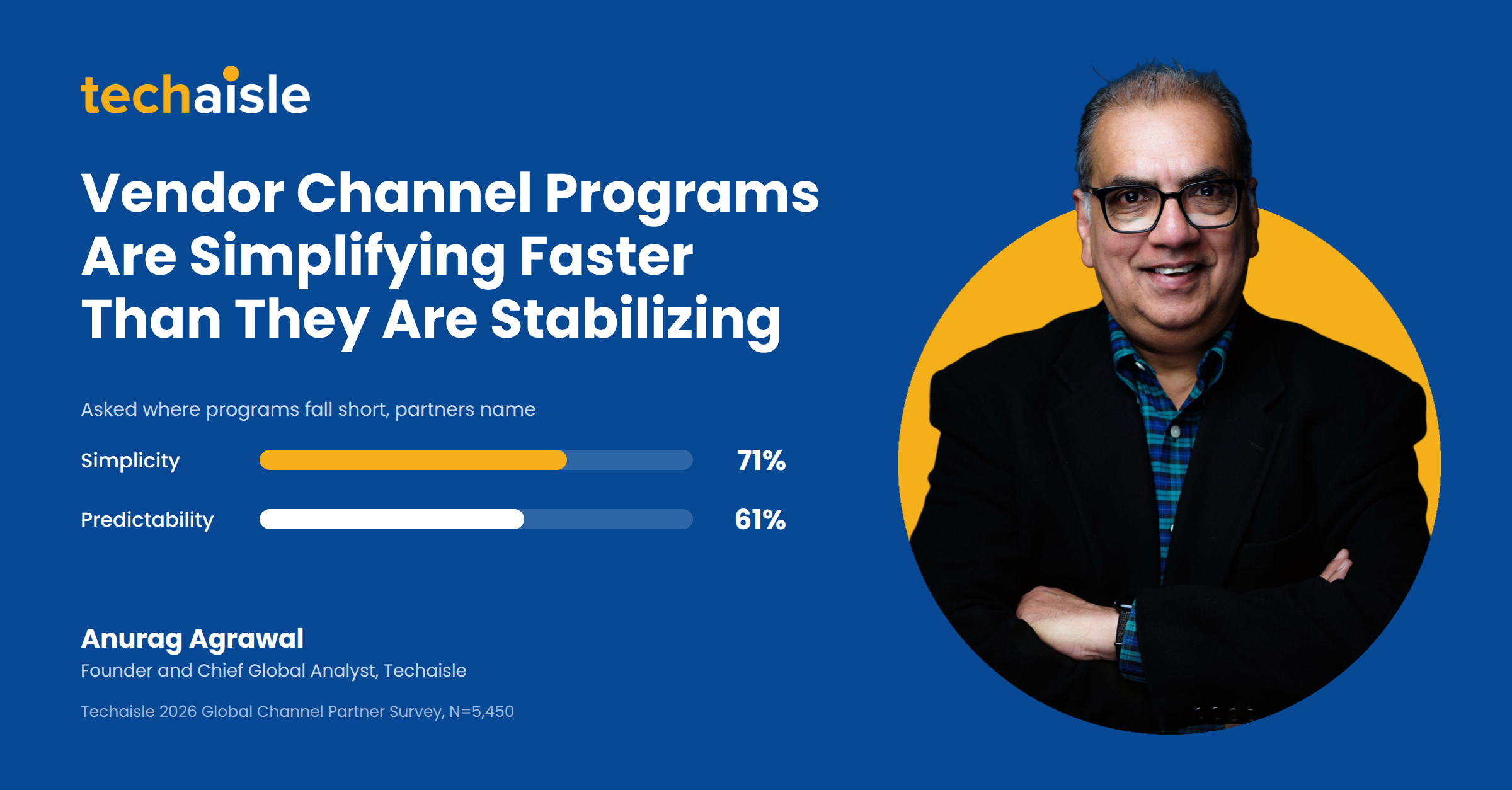
Channel partners were specific when Techaisle asked what a vendor program should deliver. In our 2026 survey of 5,450 channel partner firms, 88% rate profitability as critical or very important, and 78% say the same about predictability. Strategic value ranks last at 69%. Asked where programs fall short, partners name simplicity first (71%) and predictability second (61%). Predictability is one of the attributes partners value most and one of the two where programs fail most often.
Many of the largest vendors have rebuilt their partner programs over the past 2 years. Some of those changes line up with what partners asked for, and a few work against it. Across the 2026 changes from AWS, Cisco, Microsoft, Google Cloud, Dell, HPE, Lenovo, Palo Alto Networks, and Broadcom, one pattern stands out: programs are getting simpler faster than they are getting predictable. Most of the work went into fewer tiers, merged incentives, and automated paperwork, while the changes that cost partners money came from timing.
Techaisle calls this gap the Incentive-Trust Deficit. Partners will accept thinner margins in exchange for rules that hold for a year. For a vendor, that makes predictability a cheaper lever than a richer rebate. For a partner, a vendor's record of program changes matters as much as its margin structure when deciding where to commit staff.
Most 2026 changes went into simplicity
Partners take part in 8.9 vendor programs on average, rising to 18.4 for those above $500M in revenue. Manual and slow administration is the most common partner-experience shortfall, at 67%. Every program a partner joins brings its own portal, claims process, and rulebook, so administrative cost grows with the number of vendors a partner carries.
Several vendors spent 2026 reducing that cost, and AWS started with incentives. It rebuilt the incentive structure of its 2026 Solution Provider and Distribution programs, which it announced in November 2025 and began phasing in on January 1, 2026. One base benefit replaced the earlier base incentive and technical capability discount. One new-customer incentive replaced 3 separate programs: the Partner Originated Discount, the Public Sector Discount, and the Customer Engagement Incentive. AWS then automated the paperwork. AWS Partner Central agents, launched in March 2026, validate funding eligibility, review documentation, and draft fund requests, and in July 2026 AWS extended them to its remaining funding programs. For an AWS partner, this means fewer incentives to track, fewer claims to file, and less staff time spent assembling funding requests, which is the kind of work behind the administration complaint.
Cisco folded VIP, Perform Plus and the Cisco Services Partner Program into a single Cisco Partner Incentive. Google Cloud's Partner Network Hub now automatically applies each customer engagement to a partner's tier and competency progress. Lenovo cut its tiers from 9 to 4 and merged the certification tracks for its device and infrastructure businesses. A Cisco partner now claims incentives in one place, a Google Cloud partner no longer depends on staff to report progress, and a Lenovo partner certifies against one track instead of two.
Acquisitions add a different kind of complexity. When a vendor buys another company, it usually inherits that company's partner program as well, and a partner selling both product lines has to qualify for 2 sets of tiers, claim incentives under 2 sets of rules, and work in 2 portals until the programs merge. HPE and Palo Alto Networks both chose a single program. From November 1, 2026, HPE and Juniper partners move into one HPE Partner Ready Vantage program with one set of tiers, one set of competencies, one compensation model, one portal, and one deal registration process, and HPE is protecting existing partner investments and certifications through the move. Palo Alto Networks kept CyberArk's partner program running as usual until a July 1, 2026 crossover, after which every CyberArk partner works through NextWave. In both cases, a partner knows which rulebook applies and the date it takes over, so it can plan certifications and staffing ahead of the switch.
Simplification only goes so far. Fewer rules make a program easier to run, but they do not tell a partner when the rules will change again, which is the subject of the next section.
Lenovo shows a second shortfall: a vendor can remove complexity in one place and add it in another. The April 2026 update that cut Lenovo's tiers from 9 to 4 also introduced a revamped Lenovo 360 Elevate engagement engine, an upgraded Lenovo 360 Partner Hub, a new Tech Connect technical community, and a new Lenovo 360 for Services pathway. Resellers, the core of Lenovo's channel, resist exactly this kind of addition: 58% of VARs want vendors to stop introducing new portals, tools, and platforms that partners must learn. For a Lenovo partner, the time saved by tracking fewer tiers now goes into learning 4 changed program elements and retraining staff on where to find enablement, incentives, and services content. The net administrative saving in the first year is therefore smaller than the tier cut suggests. Lenovo will realize the full benefit of its shorter tier ladder once those 4 elements work as one experience inside the Partner Hub, so a partner deals with a single program rather than 5 connected ones.
Predictability is where programs still fail
Stopping mid-year program changes is the top item on the list of what partners want vendors to stop doing. 68% ask for it, and among VARs the figure is 78%. Only 4% accept quarterly changes, and 59% of partners under $10M in revenue reject major changes more than once a year. A partner commits hiring, certification, and marketing spend against a program's rules, and a mid-year change rewrites the economics of money it has already spent.
Cisco managed what it called the most significant change to its partner program in nearly 3 decades with a long runway. It announced the Cisco 360 Partner Program in October 2024 with a 15-month transition and launched it in January 2026. Existing partner levels, roles, and lifecycle practice investments remained recognized until the new program was fully in place, giving partners over a year to learn the new measurement model before it could change their status. Cisco also locked each partner's status through August 2027, based on its best Partner Value Index position between August 2025 and January 2026, which gives partners a known standing for 18 months after launch.
Google Cloud followed a similar path. It announced the Google Cloud Partner Network in December 2025, began the rollout in the first quarter of 2026, and gave existing partners a transition window to meet the new tier requirements. Tiers are valid for 12 months and reviewed annually, a cadence partners say they can absorb. The difference from Cisco is protection. Existing Google Cloud partners are not guaranteed their current tier, so partners must requalify within the window rather than carry their status forward.
Palo Alto Networks changes NextWave infrequently. Its February 2026 redesign was the first major update since 2016, giving partners a long, stable base to plan against. The redesign was available to partners at the time of announcement, in the middle of Palo Alto Networks' fiscal year, so partners adjusted to new rebates and discounts mid-year.
Microsoft changed incentives after they were paid. It applied its fiscal 2026 Cloud Solution Provider (CSP) incentive rates back to July 1, 2025, and in February 2026 reversed and reissued the July-to-September earnings partners had already received. 79% of MSPs rate transparency in incentive calculations as critical or very important. For a CSP partner, a retroactive true-up means income booked in one quarter can move to another, making incentive revenue harder to forecast and complicating commissions the partner has already paid its own sellers.
Lenovo switched most of its April 2026 changes on at announcement, on April 2. Every partner above Authorized received a new tier name overnight. For a reseller, a tier is a margin schedule: 78% of VARs name higher front-end discounts and margins as the benefit they value most from a higher tier. A renamed tier sends every Lenovo reseller back to confirm what it now earns, with no transition period to do it in. The quarter added pressure. In a February 2026 letter, Lenovo told North American partners that prices on select PCs and servers would change in March, and that orders not shipped by March 31 would be repriced. Memory costs forced price increases across the industry, and Dell raised prices under the same pressure. The fulfillment rule was Lenovo's own choice, and it put shipping risk on the partner, which controls when it orders and has no control over when Lenovo ships. A Lenovo partner therefore rebuilt customer quotes and replanned its tier position in the same quarter, with no transition window for either.
Broadcom is the extreme case: 4 rounds of VMware partner program changes in 24 months, and 108 days for non-invited cloud service providers to stop selling new business. For a provider without an invitation, a VMware practice built over years had a single quarter to find another route to market. Broadcom's December 2025 points system, which ties discounts to certifications and services skills regardless of partner size, is sound design, and partners will still judge it against those cutoffs.
Platform strategies are pulling tiers toward breadth and size
Only 24% of partners actively manage to the composite index scores vendors now use to set partner tiers. 65% say they cannot see how the score is calculated, rising to 82% among VARs, and 73% of MSPs worry that scores drop without warning. More partners say index models reduced their incentive earnings (39%) than raised them (31%), and the losses fall on the smallest firms. 22% of partners under $10M report a material drop, while 21% of partners above $500M report a material increase. 2.4% of partners under $10M hold the top tier in their primary vendor program, against 41% of those above $500M. Most partners are scored by a system they do not actively manage, and that system is moving incentive money toward the largest firms.
Microsoft's Partner Capability Score shows what a checkable index looks like. Microsoft publishes the metrics, their weights, and their thresholds. A Solutions Partner designation requires 70 of 100 points, with points in every metric. Partners track their score on a Partner Center dashboard, where performance and customer success data refresh monthly, and the dashboard flags when a score is at risk of falling, for example, when certifications are close to expiring. That warning speaks directly to the MSP concern about scores that drop without notice.
Transparency does not settle fairness. From October 2025, a Microsoft partner needs $1M in trailing 12-month CSP revenue to bill customers directly, up from $300K. A partner can see that rule clearly and still cannot meet it through skill. A partner between $300K and $1M must grow into the threshold or give up its direct billing relationship and buy through a distributor.
Vendors building platforms are writing breadth into their tiers. A partner's tier increasingly depends on how many of the vendor's product lines it sells, with less weight on how deeply it sells any one of them.
Lenovo's new tiers run on revenue and competency goals across its entire portfolio, so Lenovo assesses a partner's device, infrastructure, and services business together when it sets a tier. An infrastructure specialist with no device business climbs more slowly, no matter how deep its practice, and Lenovo's real-time Partner Hub will show that partner how far it sits from a tier its business model was not built to reach. Lenovo also lists co-selling opportunities among the benefits partners unlock by moving up tiers. Co-selling puts Lenovo's own sales teams on a deal alongside the partner and brings pipeline the partner could not generate alone, so reserving it for higher tiers gives specialists less of that help. For a Lenovo specialist, the practical choice is to add product lines it may not want or accept a lower tier and fewer co-sell opportunities.
Palo Alto Networks now weights its rebates toward platformization, its strategy of moving customers from separate security products onto its integrated platforms. Under the new design, partners that sell across network security, cloud security and the security operations center earn more. A partner whose practice centers on firewalls earns less than a partner selling across all three, which pushes specialists to broaden their practice or accept lower rebates. Palo Alto Networks offsets some of that effect by varying discounts by specialization and level, so a partner with a recognized specialization keeps some discount advantage even as its rebates fall.
Other vendors separate depth from breadth more directly. Google Cloud's competencies stand apart from its tiers, so a partner can be recognized for depth in one product or industry without meeting a global tier threshold. In January 2026, Cisco announced dedicated indexes for developers and advisors, responding to 76% of SIs and 74% of consultants who say index models weight consumption and ignore services value. Asked to design a tier system from scratch, partners choose 3 simple achievement tiers (35%) or tiers by specialization (30%) over an index (19%). For a specialist, these designs mean depth can earn recognition without selling the full portfolio.
Incentives still concentrate at the point of sale
Techaisle's data shows the channel has split into 2 economies. Consultants, SIs and ISVs invest before the sale in design, architecture and IP. MSPs and VARs earn after it, through deployment, renewal and expansion. Programs fund both poorly. By partners' account, 72% of vendor incentive spend is concentrated at transaction close, yet 40% of partners say renewals and consumption growth are their most profitable motion. MSPs take 41% of their revenue from renewals and rate renewal commissions at 99%, the highest rating in the survey. Vendor money is arriving at the moment of least value to both groups: after the advisor's work is done and before the operator's work begins.
The advisory economy gained new mechanisms in 2026. Dell's program changes, rolling out from August 2026, formally credit advisory and systems integrator partners for deals they influence without transacting. Google Cloud's competency framework counts pre-sales and post-sales contributions to closed opportunities. Palo Alto Networks' new Partner Development Fund puts earned rebates into partner-led demand generation, training, and solution development, and its planned Global Path is designed to reward systems integrators for multi-region influence and consulting. Consultants do not resell, and 71% name help building their own IP as the top sign of a partner-of-choice vendor. For a consultant, credit for influence and funded solution development pay for the work it actually does, which a resale rebate never reaches.
The operational economy is getting partial fixes. Dell's Focus Accounts Incentive rewards expansion inside named and underpenetrated accounts. Palo Alto Networks gives MSSPs tiered pricing built for recurring managed services. Microsoft's fiscal 2027 CSP incentives, from October 1, 2026, pay growth margins for new-to-offer wins, seat expansion, and adoption on selected AI workloads while retiring flat run-rate rebates on Modern Work and Dynamics 365. For an MSP with a stable Microsoft base, customers that renew without growing will earn less from October, and the incentive now depends on selling expansion into that base.
HPE and Lenovo take different views of a partner's services business. HPE is extending partner-branded services beyond its Triple Platinum Plus partners to other medallion partners by November 1, 2026, so more partners can deliver HPE-backed services under their own name. Lenovo 360 for Services is built around attaching services to hardware deals, and the rebates Lenovo added in 2026 pay when a partner sells Lenovo's own Asset Recovery Services, CO2 Offset, TruScale, and Premier Support. Managed services (19%) and project services (15%) make up the largest share of partner revenue, and Lenovo's announcements describe no incentive tied to renewing or expanding services a partner delivers itself. The HPE approach helps a partner build its own services brand on HPE infrastructure. The Lenovo approach makes a partner a better reseller of Lenovo services, with the payment still triggered at the transaction.
Seller pay decides whether co-sell works
The strongest partner-of-choice signal, cited by 67%, is a vendor whose reps are compensated to work with partners. Conflict with vendor direct sellers is the top co-sell obstacle (58%), and 78% of MSPs name seller compensation neutrality as their first co-sell need.
AWS changed the calculation for its own sellers. Since January 2025, a co-sold SaaS deal with any ISV Accelerate partner, transacted through a private offer in AWS Marketplace, counts toward the AWS seller's quota. The benefit had previously been limited to large partners by invitation. Extending it to all ISV Accelerate partners, including startups, gives an AWS account manager a paid reason to bring a smaller ISV into a deal and gives that ISV access to AWS sellers it could not reach before.
Dell designates 99% of customers and prospects as partner-first for storage, so a Dell storage partner knows before the first customer call that the account runs through the channel. HPE removed the conflict outright for 3 products: HPE SimpliVity PC1000, HPE Private Cloud PC3000, and HPE Zerto Software, which have been channel-only for new business since July 1, 2026. A partner selling those products has no direct deal to lose. Each of these moves changes what the vendor's own seller gains from bringing in a partner, and co-sell succeeds or fails on that calculation.
What comes next
Techaisle expects partners to concentrate their best staff on 3 or 4 vendor programs through 2027 and run the rest as transactional relationships. The programs that make that cut will be the ones whose rules held through 2026. Platform vendors face a second test in the same period: whether their tiers leave room for the specialists who carry much of their technical depth.
For program owners planning 2027, 4 commitments matter most. Publish the change calendar and any new tier mapping 90 days before it takes effect, and hold existing status until then. Never recalculate incentives already paid. Score capability by specialization so a deep specialist can reach the top tier without selling the whole portfolio. Move variable money from the close into adoption, renewal, and the services partners deliver under their own name.
Partners should weight their vendor mix toward predictability, since it decides how well they can plan margin. Before committing staff to a vendor, ask 2 questions: how many major program changes did you make in the past 12 months, and can a partner that specializes in our area reach your top tier? Track the answers through the year, and move the best people toward the vendors whose answers hold up.
When you subscribe to the blog, we will send you an e-mail when there are new updates on the site so you wouldn't miss them.