










• TRUSTED RESEARCH

    TRUSTED RESEARCH | STRATEGIC INSIGHT

    SMB. CORE MIDMARKET. UPPER MIDMARKET. ECOSYSTEM
    LEARN MORE
  • COMMS, COLLAB, CONTACT CENTER

    COMMS, COLLAB, CONTACT CENTER

    SMB & Midmarket Buyers Collaboration, Contact Center Study
    LATEST RESEARCH
  • DATACENTER SOLUTIONS

    DATACENTER SOLUTIONS

    SMB & Midmarket Datacenter Solution Adoption Trends
    LATEST RESEARCH
  • PARTNER ECOSYSTEM

    PARTNER ECOSYSTEM

    CHANNEL PARTNER ECOSYSTEM TRENDS STUDY
    LATEST RESEARCH
  • BUYER JOURNEY

    BUYER JOURNEY

    SMB & Midmarket Buyers Journey Research
    LATEST RESEARCH
  • BUYER PERSONAS

    BUYER PERSONAS

    SMB & Midmarket Technology Buyer Persona Research
    LATEST RESEARCH
  • ARTIFICIAL INTELLIGENCE

    ARTIFICIAL INTELLIGENCE

    SMB & Midmarket Analytics & Artificial Intelligence Adoption
    LATEST RESEARCH
  • IT SECURITY TRENDS

    IT SECURITY TRENDS

    SMB & Midmarket Security Solutions Adoption Trends
    LATEST RESEARCH
  • 2026 TOP 10 SMB BUSINESS ISSUES, IT PRIORITIES, IT CHALLENGES

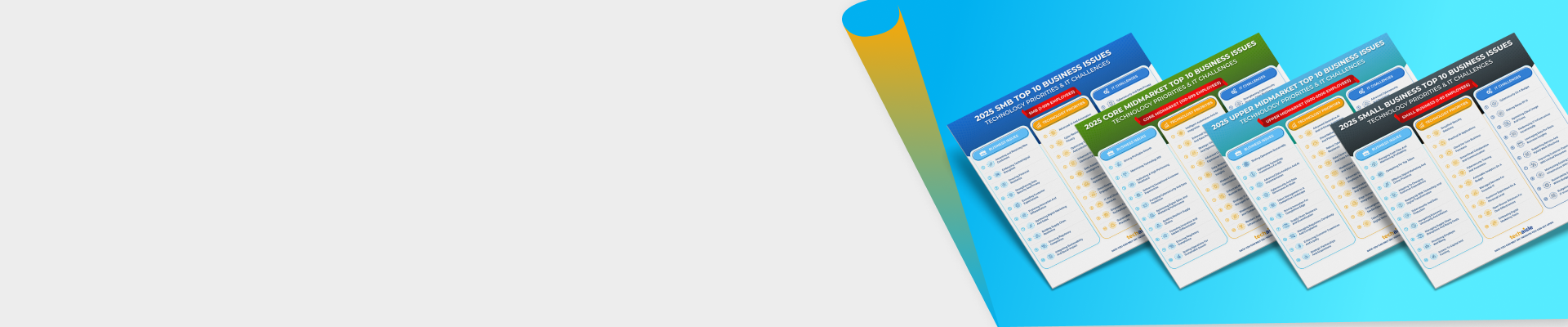
    2026 TOP 10 SMB BUSINESS ISSUES, IT PRIORITIES, IT CHALLENGES

  • 2026 TOP 10 SMB PREDICTIONS

    2026 TOP 10 SMB PREDICTIONS

    SMB & Midmarket: Autonomous Business
    READ
  • 2026 TOP 10 PARTNER PREDICTIONS

    2026 TOP 10 PARTNER PREDICTIONS

    Partner & Ecosystem: Next Horizon
    READ

Techaisle Analyst Insights

Trusted research and strategic insight decoding SMBs, the Midmarket, and the Partner Ecosystem.
Anurag Agrawal

Zero Trust Architecture on the Rise in Midmarket and SMBs

It is the best of places; it is the worst of places. The famous opening line echoed from the Dickens masterpiece “A Tale of Two Cities” describes a period in which opposites – wisdom and foolishness, light and darkness, hope and despair – exist side by side. The events and depths of emotion described in the novel are much more extreme than the scenarios cloud and overall IT adoption presents to businesses. But the notion that there are opposing elements of opportunity and requirement associated with the cloud would ring true to SMB and midmarket executives, who need to balance the new business outcomes that they can achieve via cost-effective cloud/IT solutions with the need to safeguard users, data, and applications from malicious intruders. The upside is competitiveness in a fast-moving economy; the downside is destroying customer relationships and corporate reputations at the core of business success. Where is the safe middle ground – the approach that results in optimal business protection and access to the upside associated with cloud/IT solutions?

The market is buzzing with discussions on zero trust (ZT). A Techaisle survey of 2035 SMBs and Midmarket firms shows that 8% of small businesses, 46% of core-midmarket firms, and 69% of upper midmarket firms know of ZT and that 21% of SMBs and 64% of midmarket firms consider its adoption either very important or important. Critical reasons for adopting zero trust include reducing insider threats, breach prevention, compliance, mitigating endpoint threats, and managing hybrid IT and remote work security issues.

However, most firms need to be made aware that ZT is not a product but a framework that requires a focus on the journey and strategy. Regardless, 14% of “in the know” SMBs and 35% of upper midmarket firms have begun planning their investments in ZT technology, initially focusing on identifying their critical digital assets and security vulnerabilities.

Anurag Agrawal

Zoho Workplace may well be the employee experience platform we have been missing

On February 8th, 2023, Zoho unveiled its unified communications platform, Trident, a Zoho Workplace that offers businesses easier ways to communicate across channels, improve employee experience, enhance organizational productivity, and accelerate business transformation by combining collaboration, productivity, and communication tools. “Distributed,” “remote,” and “hybrid” – these are the realities of today’s workforce. Businesses are increasingly using technology to provide cohesion within the workforce. Businesses that have adopted unified workspace technology believe strongly that it contributes to productivity by providing a single workspace, delivering better access to applications and resources from which employees can accomplish most of their daily work. The Zoho Workplace, five years in development before employee experience became imperative, is one solution that can replace multiple products such as Slack, Trello, Zoom, Monday, DocuSign, Grammarly, and even M365/Google Workspace. Techaisle’s analysis of current and planned cloud workloads underscores the importance of contextual, collaborative capabilities within business applications. Each product mentioned addresses a specific business requirement but is not seamlessly interconnected to provide a cohesive experience without customization and integration overheads.

In the wake of great resignation, robust job market, and paucity of skill sets, businesses are prioritizing employee experience. For example, Techaisle’s latest research shows that deploying employee experience solutions is a priority for 60% of small businesses, 88% of core midmarket, and 96% of upper midmarket firms. These firms are using digitalization initiatives for employee empowerment and are digitally transforming to support employees. Many factors drive productivity, including management approaches, processes and practices, and collaboration/synergy across activities and functions. But technology is a pivotal contributor to productivity – directly and through its ability to positively affect processes and collaboration. This is the target market that Zoho is addressing. Zoho Workplace has more than 16 million users and is growing at 30%+ year-on-year.

Anurag Agrawal

SMBs, core midmarket and upper midmarket firms are adopting RPA and how Xerox is a great match

Current trends show that Robotic Process Automation (RPA) adoption rates have risen significantly, with many businesses wanting to automate processes to increase efficiency. RPA is a non-invasive technology for making daily operations more efficient, allowing for increased productivity. While larger organizations have started early, smaller businesses have also begun to adopt RPA increasingly. While there is still some misconception that RPA is not so relevant for SMBs. The rise in adoption can be attributed to the fact that RPA technology helps boost productivity, enhance customer and employee satisfaction, improve cash flow, support audit and compliance requirements, and gain a competitive advantage. SMBs rely on efficient workflows and effective systems throughout all processes, and in the SMB space, efficiency is often a critical competitive advantage.

Importance of RPA to SMBs and midmarket firms

SMBs have constraints, such as limited resources and budgets, that demand flexibility. However, because SMBs are agile, they can quickly adopt new technologies with less friction. Large enterprises are generally burdened with complexity and red tape, but SMBs can embrace change and gain immensely by implementing RPA.

1. Technological competitive advantage: SMBs can improve productivity to gain a competitive advantage by automating repetitive and time-consuming tasks traditionally associated with back-end office functions.
2. Real-time tracking: RPA systems can track, analyze, and estimate an organization’s data in real time. Based on the estimates, SMBs can focus on improving their shortcomings and building their strengths. In addition, the data can be accessed anytime when required.
3. Cost reduction: SMBs often have limited resources and are highly cautious about direct and indirect costs. Hiring more personnel increases business costs, but by adopting RPA, SMBs can handle daily operations with lesser dependency on the human workforce.

techaisle smb key rpa trends

RPA Use Cases for SMBs

As RPA technology continues to evolve, its applicability across industries, functions, and systems also expands. Here are some of its SMB use cases.

Anurag Agrawal

SMBs and midmarket firms cautiously moving away from Hybrid Work

Poised for liftoff for some time, the remote work revolution was set to shift into overdrive. However, hybrid work is challenging the SMBs. By the end of 2023, 32% of employees within the SMB and midmarket firms expect to have hybrid work arrangements, down from 58% in 2021 and similar to 29% (pre-pandemic levels) in 2019. Over 40% of SMBs and Upper midmarket firms are experiencing significant challenges impacting remote employees’ productivity. In addition, 39% of SMBs and 41% of upper midmarket firms have critical security concerns relative to remote and hybrid work. Furthermore, 43% of businesses cannot adequately support remote employees, and 39% cannot provide consistent technology experience for remote and on-site employees. Finally, 41% of SMBs and upper midmarket firms have not overcome organizational challenges in managing remote employees. Techaisle data shows that senior management is spending 3X more time maintaining company culture through the hybrid organization, 2.5X more time in employee empathy, and 2X more time in supervision and management. 

As a result, 62% of SMBs and 68% of upper midmarket firms plan to return all employees to the office in 2023. However, bringing the employees back to the office is also of concern to the executive management. As a result, 37% of SMBs are prioritizing office space planning, and 32% are identifying wayfinding technologies. In addition, 41% of upper midmarket firms are investigating ID management, and 40% are investing in smart meeting rooms.

techaisle smb midmarket hybrid work

Trusted Research | Strategic Insight

Techaisle - TA