• TRUSTED RESEARCH

    TRUSTED RESEARCH | STRATEGIC INSIGHT

    SMB. CORE MIDMARKET. UPPER MIDMARKET. ECOSYSTEM
    LEARN MORE
  • INTERWORK 2.0: THE AGENTIC FUTURE OF CONNECTED BUSINESS

    INTERWORK 2.0: THE AGENTIC FUTURE OF CONNECTED BUSINESS

  • 2026 TOP 10 SMB BUSINESS ISSUES, IT PRIORITIES, IT CHALLENGES

    2026 TOP 10 SMB BUSINESS ISSUES, IT PRIORITIES, IT CHALLENGES

  • 2026 TOP 10 SMB PREDICTIONS

    2026 TOP 10 SMB PREDICTIONS

    SMB & Midmarket: Autonomous Business
    READ
  • 2026 TOP 10 PARTNER PREDICTIONS

    2026 TOP 10 PARTNER PREDICTIONS

    Partner & Ecosystem: Next Horizon
    READ
  • ARTIFICIAL INTELLIGENCE

    ARTIFICIAL INTELLIGENCE

    SMB & Midmarket Analytics & Artificial Intelligence Adoption
    LEARN MORE
  • IT SECURITY TRENDS

    IT SECURITY TRENDS

    SMB & Midmarket Security Adoption Trends
    LATEST RESEARCH
  • BUYERS JOURNEY

    BUYERS JOURNEY

    Technology Buyer Persona Research
    LEARN MORE
  • PARTNER ECOSYSTEM

    PARTNER ECOSYSTEM

    Global Channel Partner Trends
    LATEST RESEARCH
  • CLOUD ADOPTION TRENDS

    CLOUD ADOPTION TRENDS

    SMB & Midmarket Cloud Adoption
    LATEST RESEARCH
  • FUTURE OF PARTNER ECOSYSTEM

    FUTURE OF PARTNER ECOSYSTEM

    Networked, Engaged, Extended, Hybrid
    DOWNLOAD NOW
  • MANAGED SERVICES RESEARCH

    MANAGED SERVICES RESEARCH

    SMB & Midmarket Managed Services Adoption
    LEARN MORE

Techaisle Analyst Insights

Trusted research and strategic insight decoding SMBs, the Midmarket, and the Partner Ecosystem.
Anurag Agrawal

Salesforce for SMBs – Advantages and Limitations

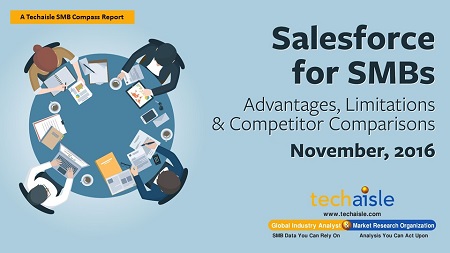
As part of SMB Compass Series, Techaisle has just released a free and detailed report on Salesforce for SMBs – Advantages, Limitations & Competitor comparisons. The report is focused on Salesforce solution portfolio for SMBs and acts as guidance for SMBs deciding to use CRM solutions and planning to use Salesforce solutions as well as competitor solutions. The report has been compiled based on deep discussions with SMBs using Salesforce, partners providing Salesforce implementation for SMBs and Techaisle global cloud surveys. The report covers Salesforce Cloud, SalesforceIQ, Salesforce Analytics Cloud, Salesfroce Pardot and Salesforce Marketing Cloud.

Salesforce has been leading the charge in cloud CRM and has been adding product offerings to its portfolio to provide end-to-end solution attracting, managing & retaining customers. Survey data also shows that within the US, Salesforce appears within top 10 cloud vendors as mentioned by SMBs. 

Click on the report cover image to download the report

techaisle salesforce for smbs cover for blog

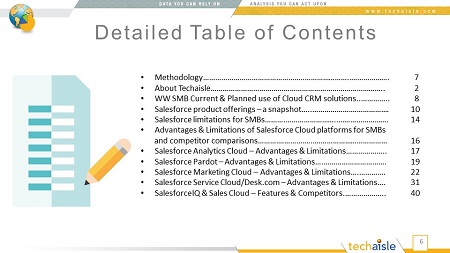
Table of Contents is given below

techaisle salesforce for smbs toc for blog

Techaisle’s worldwide SMB & Midmarket cloud adoption surveys show that 38% of small businesses and 48% of midmarket firms are planning to use cloud CRM in the next 12 months. Data also shows that there is a very strong correlation between top business issues for 2017 and use of CRM. Within midmarket firms, improving effectiveness of sales & marketing is the second top business issue and fourth from the top for overall SMBs. In addition, attracting & retaining new customers /improving customer satisfaction is the 2nd most important business issue for SMBs.

Anurag Agrawal

Salesforce.com for SMBs: The Good, The Bad and The Ugly

Until a few years ago a set of scary questions used to be debated in many business board rooms. “Fire the CEO, CFO or SAP?” Nobody dared to fire SAP. Fast forward today, are we reaching the same set of questions with a difference - replacing SAP with Salesforce.com? Recent Dreamforce 2014, Salesforce.com’s annual gala event firmly established the company’s foothold in the industry and its increasing grip on the enterprise and businesses of all sizes. This year, there was also an increased focus on SMBs, a “back-to-the-roots” story, the backbone on which Salesforce.com launched its “no software” business but somewhere along the way lost sight of SMBs. But then Salesforce.com is no longer a software company, it is a platform company. Is the “no software” logo still valid? Is the company still suitable for SMBs?

The Best

Over the last three years, Salesforce.com has successfully added solutions to its portfolio and has checked off an important spoke in the SMB Wheel of CRM Productivity with business intelligence, one of key elements in the overall CRM productivity suite. Many of the other issues are addressed by the rich Salesforce.com partner ecosystem that connects via Force.com. Combined, these applications provide a 360 degree view of the sales and marketing process. Experience shows that as a software category matures, suite providers eventually win out against point product players. And Salesforce.com is winning.
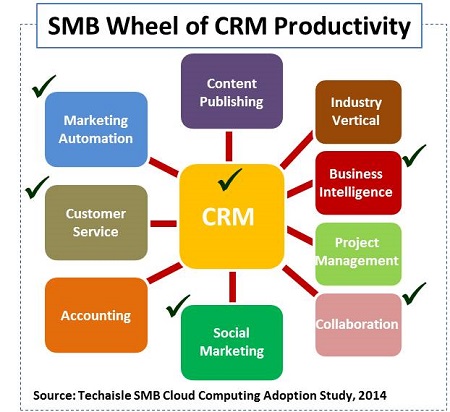
techaisle smb crm wheel blog salesforce resized

 As Salesforce began its foray into the enterprise world, it seemed that it neglected its SMB market, which grew almost in spite of Salesforce’s lack of attention. However, from 2015 onwards, SFDC promises change as it is committing to doubling its investments in SMB education and driving growth. In fact, this year’s Dreamforce had nearly twice as many sessions for SMBs as in 2013.

Techaisle’s SMB segmentation, based on cloud and mobility adoption, finds that there are six major SMB segments:

  1. Smart Investors
  2. Growth Aspirers
  3.  
  4. Dynamic IT
  5.  
  6. Productivity-centric,
  7.  
  8. Innovation-Driven, and
  9.  
  10. Passive Followers


Of these, Dynamic SMBs, followed by Smart Investor SMBs, are most likely to benefit from CRM suites. 

The Good

The new Wave analytics platform, announced and demoed with fanfare at Dreamforce 2014, is one of the most important products to have been introduced by Salesforce.com recently. It gives some credence to Salesforce’s newly christened Analytical Cloud. But is it really that impressive beyond the flashy demo at Dreamforce 2014? Is it really analytics or a series of reports cleverly put together?

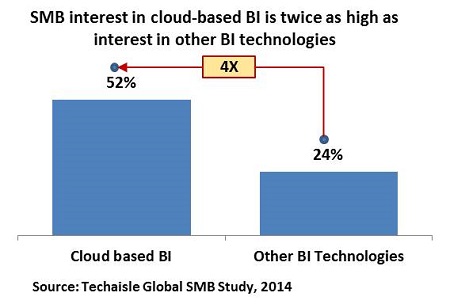
Let us set the context first. Business analytics is fast becoming an integral technology investment for an SMB organization, directly contributing to its revenue growth and reduction in operating costs by enabling informed decision making. Techaisle’s survey of SMBs across numerous countries shows that number of SMBs using one or more type of business intelligence is nearly doubling each year. Business Intelligence tools have matured and become more widely available through cloud-based services.  As a result, enterprise-grade ETL, analytics, reporting, collaboration, dashboards and other functionalities are now within affordable reach of SMBs.
techaisle smb cloud bi salesforce blog resized

We are also in a transformative time for mobility and thereby mobile business Intelligence. The move to mobile BI has largely up until now been accomplished by migrating existing functionality to a mobile environment by using new technologies on top of the old.  Companies such as Oracle, IBM and SAP are doing this through acquisition of smaller companies and integrating them into existing products. On the other hand, in a classic build vs. buy fashion, smaller companies, not hampered by existing architectural constraints are offering SaaS BI services and building new offers from scratch. Smaller BI vendors in many cases have gained a timing advantage, using native technology to bring existing mobile functionality to BI. Instead of simply providing mobile links to server data, these new products offer the rich, interactive capabilities, with the ability to use rich interactive screen manipulation, i.e., pinch and squeeze or geo-location awareness, as part of the data exploration and visualization experience. True mobile business intelligence includes ability to interact with data objects on the screen, such as filters, check-boxes, search, drill-down and drill-through to the record level and other interactive functions. Of course, being able to then use built-in device communications capabilities is also of importance once the information has been identified – SMS, email and Internet forms for dissemination of the information, as well as secure access to collaborative destinations.

Techaisle survey data also shows that the right information for SMBs centers on intelligence that helps them make sound financial decisions. This is reflected in the top three analytics areas reported by SMB respondents:

  1. Financial analysis (47% of SMBs)
  2. Sales tracking (44% of SMBs)
  3. Business activity monitoring (43% of SMBs)

These findings show that SMBs are looking to analyze data that helps to manage DSO (Days Sales Outstanding, the core accounts receivable issue), maximize inventory turns, determine the return on marketing investment for a new route to market, and/or examine the potential lifetime value of a customer through various distribution channels. SMB business intelligence/analytics tools need to deliver across this set of expectations.


What Wave Analytics is not

Wave analytics is mobile business intelligence and not analytics. It can answer one question at a time, but can’t analyze a set of questions based on multi-dimensional data and queries allowing a small business executive to make informed decisions across multiple business factors. Wave analytics cloud offers some but not all of the above functionalities. And Wave’s capabilities are tied to Salesforce.com data unless an SMB is willing to invest in the customization needed to extend analysis across other data sets, thereby increasing TCO. And that is where the bad begins. As one SMB told Techaisle, “Business intelligence and analytics is big need for an SMB, but the platform must provide easy to build reports and dashboards capabilities. If you need to hire a developer for everything, we are back to square one”.

The Bad

To quote Marc Benioff’s tweet, “What skills do you need to find a job today? #5 Salesforce”, quoting an article in Infoworld. Is it SAP redux - was there not a complete industry that had popped up and thrived for SAP developers? In many cases, the level of complexity and cost of deploying Wave solutions, beyond parametric reporting, may be out of reach for many SMBs and may instead be more attractive in the enterprise segment.

Dashboards with ad hoc exploration and structured reports are becoming the ‘new normal’, empowering the SMBs to look at information within the right context depending upon the demands of the business. Right context is not just about driving new user experience, something that Salesforce.com has focused on; it is about driving new business models as well by increasing the value of business intelligence tool to the point where it informs and supports the creation of new SMB revenue models. There are some excellent examples of embedded analysis capabilities that allow very flexible use of KPIs by SMBs across all areas of their business, including creating and analyzing the impact of new KPIs on the fly. Out-of-the-box Wave analytics cloud falls short and does not adequately address SMB BI/analytics needs.

At the outset, the Wave analytics cloud looks like it is targeted towards dashboard-saturated executives who have not been exposed to new technologies. It looks great because it is on Salesforce.com platform and it is mobile. For a CEO, running a company means determining what he/she must track and what he/she can safely de-emphasize. For this, a CEO typically requires multiple dashboards delivering “what-if” analysis capabilities; these CEOs need the ability to generate KPIs quickly and easily, measure them and refine them with time. Keeping true to “no software” rule, there should be either no or very little customization required. It’s clear that Wave needs more IT involvement – and the Wave platform partners announced at Dreamforce were all ‘big names’ such as Accenture and Deloitte, which are not the typical developers for SMBs. The expectation that an SMB has programmers sitting around eager to extract, integrate, and develop dashboards to provide one view of the business is clearly mistaken – and it certainly stretches the limits of “no software” rule.

The Ugly – Have we seen this movie before?

Mark Twain said history does not repeat itself but it does rhyme. The evolution of Salesforce.com represents a remake of a movie and we are not sure it ends well for SMBs. SFDC, which was the SMB champion ten years ago, is starting to look like Napoleon from Orwell’s Animal Farm novel.

Marc Benioff’s Dreamforce keynotes always showcase large enterprise customers, and no SMBs. However, on the 2nd day, in an SMB keynote by Tony Rodoni and Brian Millham there were three case studies of SMBs. However, all three were “born in the cloud” SMBs, not representative of over 90 percent of small businesses. Even Tony Rodoni, SVP of Small Business, Salesforce.com referred to high-growth, scalable small businesses (read startups) in Silicon Valley – again not representative of most of the world. Where have the real-world examples gone? One VP of information technology for an SMB aptly observed that, “SMB for them (SFDC) is always the next Facebook”.

In a Techaisle survey of 2155 SMBs (US, Canada, Germany) to understand cloud adoption, 42 percent mentioned that they are afraid of losing control of their data and another 31 percent said that they are fearful of vendor lock-in. These businesses worry about vendor control of data as they have neither the technical expertise nor the purchasing power to extricate themselves from supplier relationships if they experience difficulties. This concern extends to Salesforce: as the CIO of a financial services SMB said, “SFDC does not play nice when you have to import data from non-cloud solutions, and it is a challenge even with cloud applications.”

With Salesforce.com an SMB could experience both the fear factors – lock-in, loss of control on data - the concerns that are common to enterprise software suites. When software becomes a platform it develops a tendency to move over to the ‘dark side’: It unconsciously forces a lock-in, reduces the pace of innovation, limits price protection and restricts future proofing. SFDC SMB customers are already experiencing this; as one said, “They (SFDC) list per-month prices, but the contracts are executed in years’ terms”. Taken as a whole it flies in the face of everything that is cloud. Is it time for SMBs to find a new champion? And can they, or is the Salesforce grip already too tight? As a platform, Salesforce.com is like a runaway train, very difficult to stop by numerous point solution players. 

Anurag Agrawal

SMB Cloud Computing - Seven Key Trends

It is stunning to see how much corporate IT realities have changed in the last five years. Today, an increasing proportion of infrastructure is rented rather than purchased, sourced with OPEX funds from remote suppliers. Agility has become the watchword for new automation projects, and acceptable timeframes are no longer calibrated in months. End-users can source applications, infrastructure and other needed services from a wide variety of online resources. And workers are tethered to the corporate infrastructure by their smartphones and tablets, not by the cables attached to their desks.

Most of these changes are attributable in part or in whole to cloud computing. Cloud infrastructure provides the basis for OPEX-based, flexible-timeframe infrastructure rentals. SaaS providers are able to deploy new automation in hours rather than months. Mobility is not really a discrete initiative so much as it is a key attribute of ubiquitous infrastructure. And IT now competes for corporate IT influence and budgets – it is no longer the “final word” on IT/business solution strategies.

Spurred by these changes, Techaisle conducted a unique survey of SMBs. To better reflect the reality of distributed IT influence and authority, we surveyed roughly equal numbers of business decision makers (BDMs) and IT decision makers (ITDMs), asking both groups to provide a “360° perspective” on the critical IT/business trends within their organizations. Key findings from the cloud adoption research included:

  1. Why is cloud being used by SMBs: In many organizations, cloud may have first been introduced as a means of reducing CAPEX and/or overall IT costs, but today, it is viewed by SMBs as a means of increasing business agility and of introducing capabilities that would have been cost or time-prohibitive to deploy on traditional technology. Companies in the “middle” of the SMB market – those with 50-250 employees – emphasize the ability of cloud to make IT staff more productive, while smaller and larger organizations are primarily interested in enabling business staff.
  2. Who is driving cloud adoption: Techaisle’s research shows that ITDMs are primarily responsible for cloud’s platform technologies – IaaS, and virtualization and mobile device management – and that they share authority for SaaS with BDMs. However, the capabilities based on these foundational technologies – mobility, Big Data, BI/analytics, collaboration and social media – are largely directed by BDMs. BDMs also have taken a leadership role in the solution process steps  (need identification, strategic and operational planning, even evaluation) that lead to a sale. ITDMs retain responsibility for deployment and training, but optimization is now also primarily the responsibility of BDMs.
  3. What kinds of cloud are in use: Our research shows that SMBs use a mix of public, private and hybrid clouds – and that organizations often use two or three of these approaches simultaneously. The data suggests that the cloud deployment process starts with the business requirement, and moves back to the deployment model – rather than starting with a platform, and expanding across incremental workloads. If cloud selection is not a “religious issue”, then accounts are not won or lost at a single platform decision – they are won or lost on a workload-by-workload basis.
  4. When will cloud usage patterns change and how: Our analysis demonstrates the coming dominance of hybrid as a delivery model – which drives increased demand for both public and private cloud as well – and projects high-growth forecasts for cloud storage, data backup and cloud security at a workload level, and for vertical applications, content publishing, CRM and BI/analytics in SaaS.
  5. Roles and responsibilities through the cloud security process: A troublingly-substantial proportion of small businesses either does not know who is responsible for specific security activities or believe that the requirements do not apply to their businesses, and both small and medium businesses demonstrate an over-reliance on cloud suppliers.
  6. Attributes of successful cloud solutions: Techaisle's survey results clearly demonstrate that small and medium businesses view support for mobility (and information access generally) as a key attribute of cloud success. Small businesses are also focused on the inherent cloud capability to deliver backup, continuity and disaster recovery, while mid-market firms view access to scalable compute and storage resources as a key cloud success attribute.  BDMs view continuity/backup/DR (and security) as key cloud deliverables – likely, as a result of a need to bridge the gap between setting policy and managing security processes while ITDMs demonstrate relatively acute interest in whether their cloud providers can deliver integration with physical systems and support for managed IT environments.
  7. Key inhibitor in using cloud: Security and control over data are two key inhibitors for accelerating the use of cloud, but the data indicates that BDMs can be persuaded that cloud contributes to better security.


Anurag Agrawal

SMB and Midmarket: Cloud Software acquisition and the importance of “deep carpet selling”

Linoleum vs. Deep Carpet Selling

There is an old story about a consultant who was advising a client about changes in his market, and what they would mean to sales strategy. The consultant went through a series of tables demonstrating that, due to increased interconnectivity with other corporate systems, products in the client’s segment were increasingly purchased by senior managers rather than shop floor managers. The consultant stressed the importance of developing new marketing material and directing the sales force to call on the senior managers instead of the shop floor, to which the client replied, “You are talking about deep carpet selling. We don’t do deep carpet selling. We do linoleum selling here.”

Most IT vendors engage in a variation of “linoleum selling”, focused on engaging IT professionals in discussions that focus on the technical attributes of their products. However, BDMs (Business Decision Makers) – who tend to inhabit the “carpeted” realms of their businesses – are more likely to be engaged by discussions about business benefits and objectives than by “feeds and speeds”. In categories where the BDM is central to the needs identification and budget process, sales reps will need to develop “deep carpet” language and skills.

The data from Techaisle’s SMB and Midmarket IT Decision Making Authority survey demonstrates that we have already reached that point in cloud applications and software in both the small and midmarket segments.

Need vs. Enhancements

Survey data shows that in both micro/very small businesses (1-19 employees) and the smaller midmarket businesses (100-499 employees), BDMs are the primary drivers for determining the need for new cloud business applications.

These findings are broadly consistent with the results from the survey question on determining the need for enhancements to existing cloud solutions. While in most cases, IT has more influence in determining the need for enhancements than it does in determining the need for new solutions, BDMs are still generally the most important voice in the discussion. ITDM’s (IT Decision Maker) influence is directly attributable to the extent that enhancements are driven by technological rather than functional requirements.

Conclusively, survey data shows that business requirements are the prime mover for identifying the need for both new solutions and significant enhancements/upgrades in micro and very small businesses, and that technology concerns play a meaningful role in instigating discussions about enhancements to existing solutions in businesses with 20-499 employees.

Interestingly, within the 500-999 segments, there is more BDM influence over identifying the need for meaningful enhancements than for new applications. Following the logic applied to the other segments, this suggests that enhancements within these near-enterprise accounts result primarily from process optimization requirements, rather than from a need to upgrade the underlying technology.

Cloud Software budget authority

“Determining the need for” a new business application or a “meaningful enhancement” to an existing application is not, of course, identical to signing off on the purchase of a new solution. When Techaisle extended its questioning to include “budgetary control and authority,” it resulted in two interesting findings:

    • The proportion of SMBs where budgetary control and purchasing authority for new applications rests entirely with BDMs increases in all employee size segments, relative to the statistics for determining need in these segments. This means that BDM control over the final purchase decision is even higher than the “determining the need for” statistics suggest.


    • The proportion of respondents reporting that responsibility resides entirely with either IT or business – but is not shared between them – increases in five out of seven employee size segments (missing only the 10-19 and 20-49 employees groups). This suggests that needs identification may be more collaborative than final purchase decisions.


Both findings point to the same conclusion: that BDMs are extremely important to suppliers of cloud software. Chart below provides a graphical representation of the determining need vs. final purchase decision authority balance by employee size.

techaisle-blog-smb-midmarket-decision-making

Trusted Research | Strategic Insight

Techaisle - TA