










• TRUSTED RESEARCH

    TRUSTED RESEARCH | STRATEGIC INSIGHT

    SMB. CORE MIDMARKET. UPPER MIDMARKET. ECOSYSTEM
    LEARN MORE
  • INTERWORK 2.0: THE AGENTIC FUTURE OF CONNECTED BUSINESS

    INTERWORK 2.0: THE AGENTIC FUTURE OF CONNECTED BUSINESS

  • 2026 TOP 10 SMB BUSINESS ISSUES, IT PRIORITIES, IT CHALLENGES

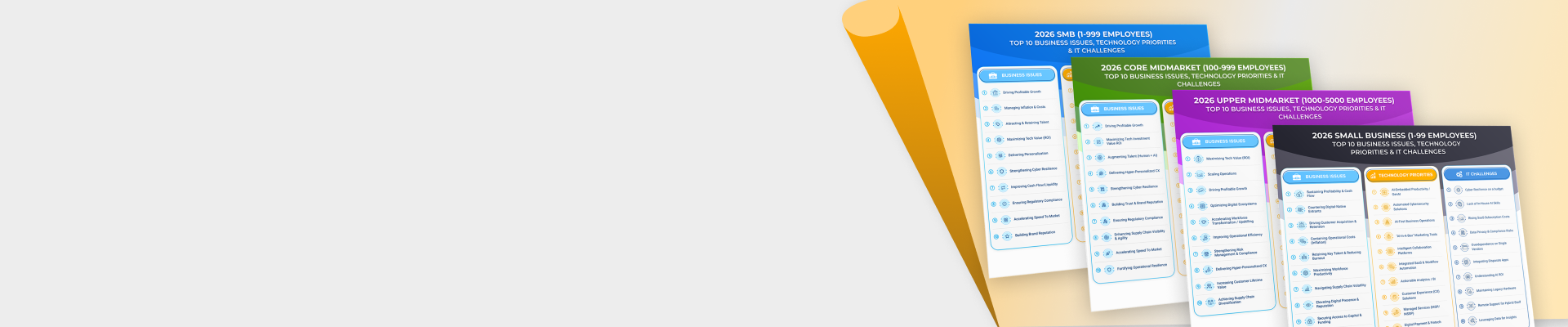
    2026 TOP 10 SMB BUSINESS ISSUES, IT PRIORITIES, IT CHALLENGES

  • 2026 TOP 10 SMB PREDICTIONS

    2026 TOP 10 SMB PREDICTIONS

    SMB & Midmarket: Autonomous Business
    READ
  • 2026 TOP 10 PARTNER PREDICTIONS

    2026 TOP 10 PARTNER PREDICTIONS

    Partner & Ecosystem: Next Horizon
    READ
  • ARTIFICIAL INTELLIGENCE

    ARTIFICIAL INTELLIGENCE

    SMB & Midmarket Analytics & Artificial Intelligence Adoption
    LEARN MORE
  • IT SECURITY TRENDS

    IT SECURITY TRENDS

    SMB & Midmarket Security Adoption Trends
    LATEST RESEARCH
  • BUYERS JOURNEY

    BUYERS JOURNEY

    Technology Buyer Persona Research
    LEARN MORE
  • PARTNER ECOSYSTEM

    PARTNER ECOSYSTEM

    Global Channel Partner Trends
    LATEST RESEARCH
  • CLOUD ADOPTION TRENDS

    CLOUD ADOPTION TRENDS

    SMB & Midmarket Cloud Adoption
    LATEST RESEARCH
  • FUTURE OF PARTNER ECOSYSTEM

    FUTURE OF PARTNER ECOSYSTEM

    Networked, Engaged, Extended, Hybrid
    DOWNLOAD NOW
  • MANAGED SERVICES RESEARCH

    MANAGED SERVICES RESEARCH

    SMB & Midmarket Managed Services Adoption
    LEARN MORE

Techaisle Analyst Insights

Trusted research and strategic insight decoding SMBs, the Midmarket, and the Partner Ecosystem.
Anurag Agrawal

The growing confluence of CRM & ERP within SMBs and the role of NetSuite

Techaisle’s latest Cloud Computing Adoption study, a survey of 2,675 SMBs shows that CRM and ERP are approaching somewhat similar levels of adoption but are facing very different growth trajectories. Further analysis of the data from the survey shows an intriguing connection between the two applications.

Techaisle analyzed the extent to which use/intended use of each of these applications is connected with other applications captured in the survey. We found that SMBs using/planning to use both CRM and ERP have some common characteristics: in each case, buyers are looking to deploy vertical applications, Business Intelligence, project management – and the other solution (i.e., those using/planning use of CRM are also likely to be adopting ERP, and those using/planning use of ERP are also likely adopters of CRM).

techaisle-smb-growing-confluence-of-crm-erp


This helps illustrate the importance of the types of suites that leading vendors like SAP, Oracle, Microsoft and NetSuite have assembled: buyers are consistently looking for a combination of capabilities, and will likely look as well for integration across these applications. The CRM side of this equation shows that marketing automation is an important attached application for CRM, which highlights the importance of recent investments in this area from Salesforce.com, Oracle, Microsoft and IBM, and the probable need for competitors to invest to match this offering.

Techaisle believes that the figure above (from the survey) helps illustrate the go-to-market challenge faced by SaaS suppliers. Buyers will certainly shop for individual applications, but will also look to cluster these applications into broader systems that integrate multiple requirements. We expect to see suppliers address these issues in one of three ways:

    1. Through acquisitions, enabling core solution providers to bolt on needed extensions


    1. Through alliances linking providers of complementary applications


    1. Through adherence to standards allowing for integration between individual applications.


At present, Salesforce.com’s Force.com is a clear leader in the third category (and we are seeing acquisitions within the Force.com community – such as FinancialForce.com’s purchase of Vana Workforce – indicating expansion across functions within the standards-led community). It will be interesting to see if other development platforms emerge to challenge Force.com in this area.

NetSuite Changing the Conversation to management of Customer Relationship

We all know that NetSuite is a clear leader in Cloud ERP solutions category. However, not many (beyond some of the users and customers of NetSuite) know that it also has an integrated CRM solution. Zach Nelson, CEO, NetSuite took the opportunity in his keynote address at SuiteWorld 2014 to emphasize that NetSuite’s solution enables any business to manage the entire customer-lifetime-value-cycle from lead generation to order fulfilment. His keynote certainly succeeded in shifting the conversation in two different but converging directions.

First shift in conversation: introducing NetSuite’s Suite Commerce Advanced for the omni-channel world, Zach Nelson emphasized that NetSuite (with its integrated ERP/CRM) helps a business manage complete customer relationship irrespective of the customer’s point-of-entry: online, in-store and/or catalog/call center. NetSuite is therefore putting equal importance to both being a Cloud ERP and CRM supplier. This is definitely the most vocal shift in conversation yet from yester-years. Granted that there are several important pieces missing such as marketing automation but current popular solutions such as Marketo, SilverPop (now IBM) and Act-On have already built integrations with NetSuite. And in all fairness, marketing automation in its present form will most likely go through a transformation as evidenced in Techaisle’s SMB Marketing Automation Adoption Trends study.

Second shift in conversation: NetSuite raised the question on the traditional definition and usage of CRM as we all know it, making the definition narrower rather than more-encompassing. CRM in NetSuite’s view is akin to SFA (Sales Force Automation). There is nothing wrong with this view except that this is not how most SMBs view their customer facing applications. CRM is the core application for SMBs and we have already seen that Sales Force Automation and Marketing Automation functions have been quickly incorporated along with Business Intelligence. All of these provide a 360 degree view of the sales and marketing process. After the SMB CRM base has been built (or simultaneously), the order of implementation depends on the SMB’s focus but survey data shows that it is usually Financials, HR/Payroll, customer service, ERP, fulfillment (SCM), industry vertical applications such as retail, communication, manufacturing, etc. The SMB buyer for applications is also moving increasingly toward the department that is responsible for delivering business results and Cloud CRM usually gets placed in middle of the SMB cloud application stack as sales revenue becomes the focus rather than tight cost control enabling rapid growth and agility.

NetSuite may have the Last Laugh

Irrespective from where the cycle starts, from CRM to ERP or vice-versa if there is a single unified database (with little requirement for data integration) that powers different application blocks: front-office driven by a single view of the customer (leads, sales, and service), tying these to accounts, billing and fulfillment, along with resource planning, materials and supply-chain management will make for a compelling value proposition for NetSuite. But NetSuite has a long way to go to convince a new customer base to be the Cloud CRM vendor of choice.

Most SMBs that have used CRM, SFA and ERP systems within the past few years are familiar with the dashboards that are available with many of these applications, either embedded or purchased separately. Dashboards continue to evolve and be dynamic in several ways; the way they use data from subsystems like ecommerce and other real time feed sources, the way users can personalize the layout of their dashboards and the ability to build KPIs “on-the-fly”. While several SaaS vendors allow this kind of metric building and start the user at a dashboard, we have yet to see anything targeted to the mid-market or SMBs that connects front office, production, fulfillment and customer service the way that NetSuite does almost out of the box. NetSuite is on the right but a long winding path.

The Fear

With NetSuite’s growing market share its applications have also become complex to support the requirements of multi-country global businesses. NetSuite started from a base of SMB customers but over the years has moved upstream making inroads into enterprises. The implementation timelines, although not in years, is still counted in several months not exactly suitable and palatable to a large majority of SMBs that are planning to adopt cloud ERP and CRM. Even the channel partners that are currently offering and planning to offer ERP/CRM solutions do not have the necessary skill-sets and the manpower to provide support. The SMB ERP market is still open and available. Question is how NetSuite will address this market segment. Fear is if this is even a priority for NetSuite.

Anurag Agrawal

34 percent SMBs want out-of-box Collaboration within SaaS/Cloud applications

Techaisle’s SMB & Midmarket Collaboration adoption research found that apart from traditional collaboration solutions of file sharing and communication, SMBs need SaaS business applications to have collaborative properties. 34 percent of SMBs and 44 percent of midmarket businesses say that SaaS applications should have built-in collaboration properties out-of-the-box. They say that the success of a cloud business application is its ability to provide /support collaboration, including email and/or hosted telephony.

Techaisle survey data shows that there is a strong connection between SaaS applications and collaboration. In some ways, these connections are intuitive: SaaS is a resource that can be accessed simultaneously by multiple individuals located anyplace where there is a network connection and cloud is inherently supportive of collaboration, and many applications are either explicitly focused on collaborative activities (ranging from SharePoint to CRM) or embed these capabilities (as with productivity applications like Office 365 or Google Apps).

Techaisle’s SMB research found quantitative support for these perceptions. When SMB respondents were asked, “what are the key attributes of a successful cloud solution?” As would be expected, security, scalability, and data management (including disaster recovery) were prominent in these responses. However, the most common answer was “the ability to support mobility,” which speaks to the requirement to enable mobile collaboration. And the fifth-most common response was “the ability to provide or support collaboration.” As the figure below shows, this is an important issue across size categories: it was cited as an important cloud success attribute by nearly half of near-enterprise (500-999 employees) firms, and also by companies with just 10-19 employees.

techaisle-saas-collaboration-connection-blog-smb-attributes


Further analysis of current and planned SaaS workloads underscores the importance of collaborative capabilities within SaaS applications. Techaisle asked small business and midmarket respondents who are currently using or planning to use cloud to identify the top SaaS workloads in use today, and those that are in current adoption plans. The results, that collaboration plays a role in most SaaS applications:

Workloads explicitly focused on collaboration

    • Hosted VoIP (used today by 52 percent of midmarket businesses, with 35 percent planning adoption)


    • Content publishing (used today by 53 percent of midmarket businesses; 56 percent of SaaS using small businesses are planning deployment)


    • CRM (in use or planned by 93 percent of midmarket businesses and 71 percent of SaaS using small businesses)


Workloads where collaboration is a key differentiator, attribute or outcome

    • Office suites (both Google Apps and Office 365 emphasize intrinsic collaboration capabilities. Office suites are the most commonly used SaaS application type within small business, and the third most commonly used application type within midmarket business)


    • Project management (most commonly used SaaS application type within midmarket business, and the third most commonly used SaaS application type within small business)


    • Business Intelligence (53 percent of midmarket businesses and 44 percent of small business are planning adoption)


Workloads where better collaboration or reporting within/across departments/functions and/or with external stakeholders is a key outcome

    • Accounting/financial management and ERP (accounting/financial management is the second most widely used SaaS application type within small businesses)


    • HR management (deployed by more than half of midmarket business SaaS users)


    • Marketing automation (highest rate of planned adoption within midmarket business SaaS users)


These findings underscore trends that are apparent in the SMB SaaS and collaboration markets: that increasingly collaboration is important to SMBs (as a means of boosting productivity), and that cloud-based systems – including file sharing systems, and extending to SaaS applications as well – are expected to provide support for many forms of collaborative activities.

Deployment scope further impacts SMB buyer requirements

As Techaisle observes the evolution of collaborative solution capabilities within SaaS, it is important to also consider the scope across which these applications and solutions are expected to operate. Solutions that connect workers within a group or department benefit from a common understanding of context and source applications; those that connect users across groups/departments exist within a single company, and can focus on supporting IT-approved devices with reference to IT-defined security policies. Solutions that extend beyond the organization’s own staff may well offer more business impact than internal-only systems by speeding communications to customers, prospects and/or suppliers – but they come with increased issues in terms of support for seamless connectivity across multiple platforms, and potentially, may raise security concerts as well.

techaisle-saas-collaboration-connection-blog-smb-scope


In the research, Techaisle asked respondents to specify the scope of their collaboration solutions. The results help clarify the strong demand for collaboration within microbusinesses, and provide insight into why businesses view collaboration as an essential solution investment area. More than 40 percent of microbusinesses, and 39 percent of all SMBs, extend their collaboration infrastructure to support for customers. Midmarket businesses are more likely to focus on internal collaboration, but they join smaller peers in having a roughly 20 percent incidence of supporting supply chain relationships (suppliers/vendors) through their collaboration systems.

Looking at the above chart, one sees that there is the potential for missed connections within the emerging panoply of collaboration-enabling systems. Social media, mobility, BI and cloud all have important collaboration extensions. But how can businesses ensure that these technologies will connect internally once they are in place? Techaisle believes that collaboration is evolving in response to this market condition. IT vendors have traditionally tried to position collaboration solutions as a platform on which businesses can create new capabilities and integrated processes. However, data shows that businesses are instead acquiring collaborative capacities as part of other applications: social media, mobility, cloud and BI all provide discrete and important – but potentially disconnected – collaboration capabilities. Moving forward, Techaisle expects that collaborative technology solutions will increasingly be positioned as a framework that integrates and extends the value of these discrete system capabilities, rather than as a “first step” platform.

Related Blogs:

SMB and Midmarket File Sharing & Collaboration Adoption to Grow by 52 percent

SMB Content Management & Collaboration Solutions Adoption: Seven Key Trends

Report details:

360 on SMB & Midmarket File Sharing & Collaboration Solutions Adoption Trends


Anurag Agrawal

SMB Cloud Computing – Looking from Back to the Future

In the early days, the key question wasn’t “when?” but “what?” Looking back at 2011.

Four years ago, Techaisle’s 2011 SMB Cloud Adoption report began with a discussion of cloud awareness within the SMB community. Results showed that while SMBs were reasonably familiar with the terms “private cloud” and “public cloud” (recognized by 84% and 74%, respectively, of SMB respondents), “XaaS” had not yet entered the SMBs’ lexicon: less than 25%  were familiar with the term “hybrid cloud”, and IaaS and PaaS were also not commonly understood.

Discussions of reasons for adoption and barriers to cloud adoption also illustrate how much the cloud market has evolved over the past four years. In 2011, SMBs cited “simplified access through a browser from any location” as the second-most important reason to adopt cloud; in today’s multi-screen, mobile world, requirements have progressed much further, with an application interface layer capable of responding to different displays, a practical necessity for many business systems. Similarly, features like “eliminating the need to upgrade individual users” and “getting new features automatically” have become expected attributes of cloud, as attention progresses to issues like building agility and obtaining new capabilities. The data did highlight one issue that has remained constant from 2011 to 2014 though: as was the case with Techaisle’s most recent 2014 SMB cloud survey, the 2011 results emphasized a desire to increase IT staff’s efficiency as a key reason to embrace cloud.

In 2011, when asked, “What vendor actions would compel you to use cloud services?” 46% of small businesses and 38% of medium businesses replied that they would “never consider using hosted applications.” Today, of course, refusal to consider SaaS is still an option; but increasingly, it is an expensive, non-mainstream option – helping to remind us that “never” is not a good planning horizon for new technology.

Overcoming Cloud Adoption barriers of 2011

In many ways, a review of the list of barriers to cloud adoption cited by our 2011 respondents is even more helpful in illuminating increased SMB focus on cloud. In the 2011 research, respondents not using cloud were asked to specify the conditions that would prompt them to consider use of cloud services. The list of top responses is intriguing. The most frequent answer cited by 2011 respondents was “if the cost of owning the applications is significantly higher than renting them”. It can be argued that this condition has been met – that for many applications, ranging from office suites (where pricing for Office 365 is more compelling than for boxed versions of the software), to niche-specific applications where on-demand fees provide far superior economics than a combination of new hardware and licensed software, to the “fail fast” mantra used to apply cloud to emerging business opportunities (one which relies on the freedom to spin up and spin down applications quickly, without reference to the depreciation cycle associated with the underlying hardware), the economics of cloud are compelling for at least some applications.

Similarly, the second most frequently-cited condition that would prompt 2011 non-users of cloud to consider adoption – “if the application we need meets our needs completely” – is also often frequently met today, thanks to the explosion of niche-specific applications available from an ever-expanding universe of cloud application sources. Viewed in hindsight, we can see that cloud provides an ideal delivery platform (and associated business model) for addressing these conditions, which has in turn helped fuel cloud’s advance in the SMB market.

Where are we heading from here? Tracing the trajectory of SMB cloud usage

Through its relatively brief history, cloud projections have been hampered by the “hockey stick” phenomenon. Cloud is growing in multiple ways simultaneously: the number of firms using cloud is increasing, the number of individuals using cloud within these firms is increasing (e.g., as business users in different areas and IT workers find discrete uses for cloud-based systems), and the number of platforms and applications in use within each organization is increasing. These compounding growth curves drive extreme growth expectations that are difficult to digest.

Based on our most recent 2014 SMB cloud study we have constructed a “current and projected” perspective. The data serves to reinforce the belief that hybrid is emerging as the dominant cloud delivery model. Some of the hybrid growth numbers are extraordinary: use of “hybrid-only” is increasing by 87%, while the proportion of SMBs using a combination of private and hybrid is expected to grow by 122%, and use of all three of public/private/hybrid cloud is expected to increase by 130%.

However, even the figures that are less exceptional still relay an impressive underlying story. Take, for example, the “public only” group. Data shows that businesses using only public cloud will shrink by 20% within US-based SMBs. However, public cloud itself will be a growing part of SMB cloud delivery strategies and is actually poised to increase by 75% through the forecast period.

Using the same survey data based projection methodology we have created workload scenarios across sixteen different applications areas. The “full market adoption” scenario assumes that all SMBs reporting plans to adopt cloud do so whereas the “gradual adoption scenario” takes a different approach: it assumes that current cloud users will adopt each technology according to current plans, while new cloud users will adopt each technology only at current usage rates.

Data clearly shows the coming dominance of hybrid as a delivery model – which drives increased demand for both public and private cloud as well – and provides high-growth forecasts for cloud storage, data backup and cloud security at a workload level, and for vertical applications, content publishing, CRM and BI/analytics in SaaS. It can be difficult to parse through the many, extraordinary growth projections for cloud. By connecting user intentions for growth in overall cloud adoption with adoption patterns for delivery, workloads and applications, Techaisle provides its clients with the data needed to calibrate the growth needed to keep pace with or exceed the overall SMB cloud opportunity.

Related research report: SMB & Mid-Market Cloud Computing Adoption Trends

Anurag Agrawal

SMBs Using Cloud Applications Experiencing Terrific Improvements

Techaisle’s SMB Cloud Adoption survey shows that SMBs that are using Cloud applications are experiencing tremendous improvement in customer acquisition, retention and work satisfaction. In fact, 1 in 4 SMBs say that customer retention has improved, and nearly 1 in 3 says that customer acquisition has improved.

CRM - Techaisle - Global SMB, Midmarket and Channel Partner Analyst Firm - Techaisle Analyst Insights Techaisle-SMB-Cloud-CRM-Blog-and-Press-Release-12-1024x403


In general SMBs have experienced improved customer acquisition and retention after using cloud applications, however, SBs (1-99 employees) and MBs (100-999 employees) differ. Typically, SBs are more hard-pressed to acquire customers, a top business issue for them. With the adoption of cloud, 32 percent SBs say that they have seen improvement. MBs on the other hand, have better direct sales force for customer acquisition, but after equipping the sales force and marketing with cloud applications they have seen marked improvement in customer retention. Additionally, an important point to note is that 29 percent of SBs have reported improved group productivity and 34 percent improved employee satisfaction.

The survey also showed that B2C and B2B SMBs have had different experiences in customer acquisition and retention.  Specifically, B2B SMBs have reported nearly twice as high improved experiences as B2C SMBs. Many B2C SMBs are using social media platforms such as Facebook and twitter and marketing automation solutions to build a set of followers to improve their customer retention and acquisition. On the other hand, comparatively higher percentage of B2B SMBs are using LinkedIn, Twitter and specialized platforms such as Chatter, Yammer and GageIn to track news and conversations with their customersaction.

CRM - Techaisle - Global SMB, Midmarket and Channel Partner Analyst Firm - Techaisle Analyst Insights Techaisle-SMB-Cloud-CRM-Blog-and-Press-Release-21


CRM has become the central application and the core around which other features and functionality are deployed as required by an SMB organization, department within an SMB or an individual user within the SMB. CRM is that core cloud business application. After the SMB CRM base has been built (or simultaneously), the order of implementation depends on the SMB’s focus but is likely to be business intelligence, marketing automation, Financials, HR/Payroll, customer service for service companies, ERP, fulfillment (SCM) and industry vertical applications.

CRM - Techaisle - Global SMB, Midmarket and Channel Partner Analyst Firm - Techaisle Analyst Insights Techaisle-SMB-Cloud-CRM-Blog-and-Press-Release-4


There are four key areas of SMB cloud usage and deployment. Each has got many sub-sets of applications. These four areas are:

  1. Infrastructure and Platforms (US$13.0 Billion SMB Opportunity by 2016)

  2. Communications and Collaboration (US$7.9 Billion SMB Opportunity by 2016)

  3. Business productivity & Applications (US$15.5 Billion SMB Opportunity by 2016)

  4. Industry specific applications ((US$2.7 Billion SMB Opportunity by 2016)


While there are many niche vendors addressing each niche area, the complexity grows manifold as businesses move from one application to another, from one device to multiple devices. As Cloud computing adoption among SMBs grows, the real issue of data integration continues to come into play and it will become imperative for each of the four areas to communicate with the other. And once that “integration enlightenment” happens SMBs will witness even higher improvements in productivity, satisfaction, acquisition and retention.

Anurag Agrawal
Techaisle

Trusted Research | Strategic Insight

Techaisle - TA